This book covers the application of the OCRA (Occupational Repetitive Actions) method. The methods make up a system dedicated to the analysis and management of the risk of biomechanical overload of the upper limbs. The book focuses on the OCRA checklist which presents various models from the most simplified, to the most complex. It describes methods, criteria, procedures and tools on how to perform such an assessment, in line with international standards. The book provides you with the correct methods and tools for prevention of upper limb work related musculoskeletal disorders no matter what the working environment is or what the international standards dictates.

eBook - ePub
Risk Analysis and Management of Repetitive Actions
A Guide for Applying the OCRA System (Occupational Repetitive Actions), Third Edition
- 520 pages
- English
- ePUB (mobile friendly)
- Available on iOS & Android
eBook - ePub
Risk Analysis and Management of Repetitive Actions
A Guide for Applying the OCRA System (Occupational Repetitive Actions), Third Edition
1 Introduction
1.1 THE REFERENCE FRAMEWORK
Musculoskeletal (or osteoarticular) diseases and disorders, especially those affecting the upper limbs, are acquiring growing importance in the field of occupational medicine.
Over the course of time, much evidence has suggested a link between such pathologies and working conditions featuring mechanical overload in a wide range of working communities, which also generate major impacts in terms of economic losses and social costs.
These multifactorial work-related diseases and disorders are caused by the way that manual jobs or tasks are performed.
In the scientific literature, reference is made to overuse syndrome, repetitive strain injuries, repetitive motion injuries, occupational cervico-brachial disorders, and cumulative trauma disorders; while these terms reflect slight conceptual differences, they all fall under the general definition of upper limb work-related musculoskeletal disorders or UL-WMSD.
In Italy, these disorders translate literally as “musculoskeletal disorders due to biomechanical overload.” This is because they are caused by repetitive and/or forceful movements of the upper limbs performed for prolonged periods in the workplace, which put the joints, muscles, tendons, and other soft tissues under significant strain and can also affect the peripheral nerves.
The latter may include disorders or syndromes of the hand and forearm such as tendinitis and tenosynovitis, De Quervain syndrome, carpal tunnel syndrome, Guyon’s canal syndrome, medial and lateral epicondylitis, and rotator cuff syndrome.
Table 1.1 lists the main work-related musculoskeletal diseases of the upper limbs due to biomechanical overload in the 2010 International Labour Office (ILO) list of occupational diseases.
Work-related musculoskeletal diseases are on the rise. According to the latest European data (Eurostat, 2010), they account for more than 55% of all occupational health problems recognized by insurance companies in 15 European Union countries (Figure 1.1). It is worth noting that the Eurostat data refers almost exclusively to diseases and disorders caused by biomechanical overload of the upper limbs, the most common being carpal tunnel syndrome and syndromes caused by overloading tendinous and peritendinous structures.
However, throughout Europe, exposure to these working conditions is widespread.
According to the 5th European Working Condition Survey (EWCS) conducted in 2010 by the European Foundation for the Improvement of Living and Working Conditions (Eurofound, 2012), approximately 63% of European workers (in 27 member countries) perform “repetitive movements of the upper limbs” for at least one-quarter of their working time. Considering virtually the entire working time, 33% of all workers are exposed (the percentage is the same for both sexes). Figure 1.2 summarizes the results of a more analytical EWCS, the fourth of its kind, conducted in 2005 (Eurofound, 2007).
TABLE 1.1
Principal Work-Related Musculoskeletal Diseases and Disorders of the Upper Limbs Due to Biomechanical Overload
Principal Work-Related Musculoskeletal Diseases and Disorders of the Upper Limbs Due to Biomechanical Overload
ILO List of Occupational Diseases (Revised 2010) | |
2.3 MUSCULOSKELETAL DISORDER | |
2.3.1 | Radial styloid tenosynovitis due to repetitive movements, forceful exertions, and extreme postures of the wrist |
2.3.2 | Chronic tenosynovitis of hand and wrist due to repetitive movements, forceful exertions, and extreme postures of the wrist |
2.3.3 | Olecranon bursitis due to prolonged pressure of the elbow region |
2.3.5 | Epicondylitis due to repetitive forceful work |
2.3.7 | Carpal tunnel syndrome due to extended periods of repetitive forceful work, work involving vibration, extreme postures of the wrist, or a combination of the three |
2.3.8 | Other musculoskeletal disorders not mentioned in the preceding items where a direct link is established scientifically, or determined by methods appropriate to national conditions and practice, between the exposure to risk factors arising from work activities and the musculoskeletal disorder(s) contracted by the worker |
Source: ILO, List of Occupational Diseases (revised 2010). Occupational Safety and Health Series, No. 74. International Labour Office, Geneva, Switzerland, 2010. | |
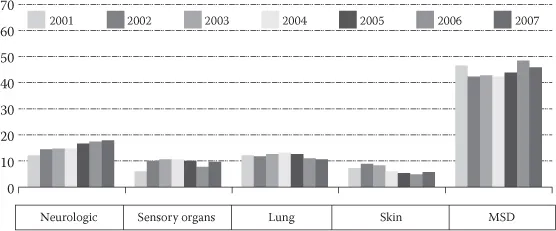
FIGURE 1.1 Main groups of recognized occupational diseases in Europe (in % vs. total) between 2001 and 2007. (From Eurostat, Health and Safety at Work in Europe (1999–2007). A Statistical Portrait. Publications Office of the European Union, Luxembourg, 2010.)
1.2 A GLANCE AT THE REGULATIONS
1.2.1 EUROPEAN DIRECTIVES
Current European legislation does not include specific regulations on the prevention of repetitive movements and forceful exertions of the upper limbs, although over the past 10 years a directive has been proposed (but not yet finalized) for the prevention of all musculoskeletal pathologies.
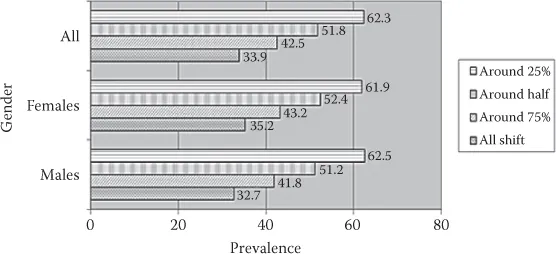
FIGURE 1.2 Prevalence of workers exposed to repetitive movements of the upper limbs, broken down by gender, in Europe (EU-27) in 2005. (From Eurofound, Fourth European Working Conditions Survey. European Foundation for the Improvement of Living and Working Conditions, Dublin, 2007.)
Nonetheless, Framework Directive 89/391/CEE does set forth some general “measures to encourage improvements in the safety and health of workers at work.”
This directive, while not dealing with specific risks, does call for the employer to adopt a series of general measures to safeguard workers, including “adapting the work to the individual, especially as regards the design of workplaces, the choice of work equipment and the choice of working and production methods, with a view, in particular, to alleviating monotonous work and work at a predetermined work rate and to reducing their effect on health.”
Apart from this, the directive stresses that all the risks for the safety and health of workers must be evaluated.
Since it has long been stated in the literature, and found in practice, that activities involving repetitive and forceful movements of the upper limbs may represent a health risk (for upper limb musculoskeletal diseases and disorders), it follows that the employer should also assess this type of risk in the workplace, and that if such specific risks are present and are potentially harmful, a plan should be put in place to reduce them to the lowest technically feasible level.
It is equally obvious that once such an evaluation has been made, a preventive plan should be put in place also aiming to prevent occupational risks and deliver information and training, as well as provide the necessary organization and means.
Also, since the matter concerns risks for human health, a specific health surveillance plan for workers must be put in place where necessary.
It should be stressed that while on the one hand there are no specific regulations, allowing the evaluation in question to be carried out using methods chosen “freely” by the employer (provided they are recognized in the literature), on the other, the national legislations of various European countries make frequent reference to their own technical regulations, when available.
In 2007, the International Standards Organization (ISO) adopted a voluntary technical regulation (standard) that could well represent a starting point for evaluating risk and adopting preventive actions relating to repetitive and forceful movements of the upper limbs (ISO, 2007b).
This regulation, ISO 11228-3; Ergonomics—Manual handling—Handling of low loads at high frequency, is perfectly in line with the spirit of Framework Directive 391/89. It includes several steps: risk identification; simple risk estimation; detailed assessment (in certain limited cases) using selected investigation methods, preferably the Occupational Repetitive Actions (OCRA) method; and lastly, risk reduction.
More recently, ISO has also issued a technical report (TR), ISO/TR 12295, which also better specifies the scope and method of implementation of ISO 11228, part 3 (ISO, 2014).
While the TR provides less expert users with a guide for standardizing “risk identification” and “quick assessments” (c.f. Chapter 3 of this volume), it also gives more skilled professionals guidance on how to make more effective use of the methods and tools identified in ISO 12228-3. More specifically, it stresses the usefulness of the OCRA checklist (latest version) as a means of assessing risk and better defines the methods for analyzing rotating repetitive tasks, preferably using the OCRA system (checklist and index). Brief comments are also provided on the not always successful evolution of the other methods mentioned in ISO 11228-3.
1.2.2 THE MACHINERY DIRECTIVE
The Machinery Directive, issued in accordance with the principle of the free circulation of goods among the member states of the European Union, primarily targets the designers and manufacturers of machinery and equipment and aims to ensure acceptable standards of safety and protection for the health of users.
According to the latest version of the directive, both new machines and existing ones whose design has been revised or that have been as...
Table of contents
- Cover
- Half Title
- Title Page
- Copyright Page
- Dedication
- Table of Contents
- Preface
- Author
- Chapter 1 Introduction
- Chapter 2 Simplified Analysis of Workplace Organization: From a Macro- to a Micro-Analysis of the Workplace and the Basis for Risk Exposure Assessment among Workers (and Homogeneous Worker Groups)
- Chapter 3 Initial Identification and Preliminary Assessment (Pre-Mapping) of Potential Risks
- Chapter 4 Procedures and Criteria for Applying the OCRA Checklist
- Chapter 5 Variants of the OCRA Checklist
- Chapter 6 Assessing Task Rotation
- Chapter 7 Risk Mapping for Repetitive Movements of the Upper Limbs: Criteria, Techniques, and Objectives
- Chapter 8 Analysis of Complex Tasks: Applications
- Chapter 9 The OCRA Index
- Chapter 10 Health Surveillance
- Chapter 11 Guidelines for Redesigning Jobs and Workstations Featuring Repetitive Tasks, and Criteria for Returning Workers with Musculoskeletal Diseases of the Upper Limbs to the Workplace
- References
- Index
Trusted by 375,005 students
Access to over 1.5 million titles for a fair monthly price.
Study more efficiently using our study tools.
Frequently asked questions
Yes, you can cancel anytime from the Subscription tab in your account settings on the Perlego website. Your subscription will stay active until the end of your current billing period. Learn how to cancel your subscription
No, books cannot be downloaded as external files, such as PDFs, for use outside of Perlego. However, you can download books within the Perlego app for offline reading on mobile or tablet. Learn how to download books offline
We are an online textbook subscription service, where you can get access to an entire online library for less than the price of a single book per month. With over 1.5 million books across 990+ topics, we’ve got you covered! Learn about our mission
Look out for the read-aloud symbol on your next book to see if you can listen to it. The read-aloud tool reads text aloud for you, highlighting the text as it is being read. You can pause it, speed it up and slow it down. Learn more about Read Aloud
Yes! You can use the Perlego app on both iOS and Android devices to read anytime, anywhere — even offline. Perfect for commutes or when you’re on the go.
Please note we cannot support devices running on iOS 13 and Android 7 or earlier. Learn more about using the app
Please note we cannot support devices running on iOS 13 and Android 7 or earlier. Learn more about using the app
Yes, you can access Risk Analysis and Management of Repetitive Actions by Daniela Colombini,Enrico Occhipinti in PDF and/or ePUB format, as well as other popular books in Business & Service Industry. We have over 1.5 million books available in our catalogue for you to explore.