- 284 pages
- English
- ePUB (mobile friendly)
- Available on iOS & Android
eBook - ePub
Aberrations of Optical Systems
About this book
Although the subject of optical design as a branch of applied physics is over one hundred years old, the use of aberration theory has changed considerably. Aberrations of Optical Systems covers elementary optics and aberration theory of various optical systems, including the use of nonaxially symmetric systems and diffractive optical elements in complex designs, such as head-up displays and the increasing use of scanning systems with laser illumination. The book provides the complete range of mathematical tools, formulae, and derivations needed for understanding the process of optical design and for planning optical design programs. While the treatment is mainly based on geometrical optics, some excursions into physical optics are made, particularly in connection with the problems of optical tolerances.
Information
1 Optical Systems and Ideal Optical
Images
The symmetrical optical system, i.e. a system with symmetry about an axis of revolution, is the type of system most frequently met as a design problem; this includes systems folded by means of plane mirrors or prisms, since it is trivial to unfold them for optical design purposes. However, non-symmetrical systems are not uncommon, e.g. some kinds of spectacle lens, spectrographic systems, anamorphic projection systems and systems containing holographic optical elements. In this book we shall be mainly concerned with symmetrical systems but some discussion of non-symmetrical systems will be given, chiefly in connection with raytracing.
1.1 Initial assumptions
The treatment will be based mainly on the geometrical optics model but there will be occasional references to physical optics in the form of scalar wave theory; this is needed for dealing with aberration tolerances. In geometrical optics the essential concept is the ray of light; in this chapter we assume this as an intuitive notion, deferring more precise definition to Chapter 2. It is then possible to formulate definitions of ideal image formation using only the concept of rays and the assumption that to one ray entering the system there corresponds one and only one ray emerging. We do not at this stage invoke the laws of reflection and refraction, and we make no assumptions about how the transformation from object to image space is accomplished: i.e. there might be non-spherical surfaces, media of continuously varying refractive index, etc., in the system. However, it is convenient to assume that the entering and emerging rays are straight line segments, or in physical terms that there are clearly defined regions in the object and image spaces in which the respective refractive indices are constant. Ideal image formation for a general system then means that a pencil of rays from a point in object space becomes a pencil also passing through a single point in image space and that this holds for some one-or two-dimensional object surface. This does not get us very far but if we assume a symmetrical system we can obtain many other properties of ideal image formation to which the performance of a real well-corrected system should approximate.
The first notions of ideal image formation through symmetrical systems are due to A. F. Möbius (1855). A few years later James Clerk Maxwell (1856, 1858) formalized the concept of an ideal system without invoking any physical image-forming mechanism. It is essentially Maxwell’s concept which we describe in this chapter.
1.2 Ideal image formation in the symmetrical optical system
Take the z-axis of a right-handed Cartesian coordinate system as the axis of revolution of a symmetrical optical system, as in Fig. 1.1, and the y-axis in the plane of the diagram: the origin O is taken as any convenient point on the axis.
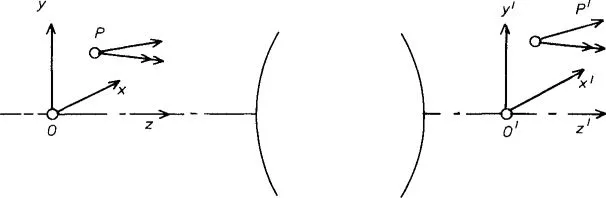
Fig. 1.1 Coordinates for the symmetrical optical system
If, as is customary, the light is supposed to travel from left to right then this coordinate system is in the object space and we take a similar system O′x′y′z′ in the image space, the respective axes being parallel to each other.
All points and rays in object space are referred to Oxyz and those in image space to O′x′y′z′. The rays are shown as straight line segments but we introduce immediately the generalization that they are to be regarded as extending indefinitely in either direction; thus the object space extends right through the optical system and through image space and similarly image space is extended infinitely in both directions. This is an essential convention for dealing with the details of image formation in the intermediate spaces of a system, where the image from one optical element is the object for the next, since this image-cum-object is very frequently virtual.
Ideal image formation from the x−y plane to the x′...
Table of contents
- Cover Page
- Half Title Page
- Title Page
- Copyright
- Table of Contents
- Series Editors’ Preface
- Preface and acknowledgements
- 1 Optical systems and ideal optical images
- 2 Geometrical optics
- 3 Gaussian optics
- 4 Finite raytracing
- 5 Finite raytracing through non-symmetrical systems
- 6 Optical invariants
- 7 Monochromatic aberrations
- 8 Calculation of the Seidel aberrations
- 9 Finite aberration formulae
- 10 Chromatic aberration
- 11 Primary aberrations of unsymmetrical systems and of holographic optical elements
- 12 Thin lens aberrations
- 13 Optical tolerances
- Appendix A Summary of the main formulae
- Appendix B Symbols
- Appendix C Examples
- Appendix D Tracing Gaussian beams from lasers
- Name index
- Subject index
Trusted by 375,005 students
Access to over 1.5 million titles for a fair monthly price.
Study more efficiently using our study tools.
Frequently asked questions
Yes, you can cancel anytime from the Subscription tab in your account settings on the Perlego website. Your subscription will stay active until the end of your current billing period. Learn how to cancel your subscription
No, books cannot be downloaded as external files, such as PDFs, for use outside of Perlego. However, you can download books within the Perlego app for offline reading on mobile or tablet. Learn how to download books offline
Perlego offers two plans: Essential and Complete
- Essential is ideal for learners and professionals who enjoy exploring a wide range of subjects. Access the Essential Library with 800,000+ trusted titles and best-sellers across business, personal growth, and the humanities. Includes unlimited reading time and Standard Read Aloud voice.
- Complete: Perfect for advanced learners and researchers needing full, unrestricted access. Unlock 1.5M+ books across hundreds of subjects, including academic and specialized titles. The Complete Plan also includes advanced features like Premium Read Aloud and Research Assistant.
We are an online textbook subscription service, where you can get access to an entire online library for less than the price of a single book per month. With over 1.5 million books across 990+ topics, we’ve got you covered! Learn about our mission
Look out for the read-aloud symbol on your next book to see if you can listen to it. The read-aloud tool reads text aloud for you, highlighting the text as it is being read. You can pause it, speed it up and slow it down. Learn more about Read Aloud
Yes! You can use the Perlego app on both iOS and Android devices to read anytime, anywhere — even offline. Perfect for commutes or when you’re on the go.
Please note we cannot support devices running on iOS 13 and Android 7 or earlier. Learn more about using the app
Please note we cannot support devices running on iOS 13 and Android 7 or earlier. Learn more about using the app
Yes, you can access Aberrations of Optical Systems by W.T Welford in PDF and/or ePUB format, as well as other popular books in Tecnologia e ingegneria & Ingegneria civile. We have over 1.5 million books available in our catalogue for you to explore.