- 376 pages
- English
- ePUB (mobile friendly)
- Available on iOS & Android
eBook - ePub
Environmental and Architectural Acoustics
About this book
Adopting a multi-disciplinary approach to the practice of achieving a more acceptable acoustic environment, this book draws on the same basic principles to cover both the outdoors and indoor space. It starts with the fundamentals of sound waves and hearing and goes on to the measurement of noise and vibration, room acoustics, sound absorption, airb
Information
1
Fundamentals of sound waves and hearing
Sound can be visualised physically as a wave motion, which is transmitted through a whole range of elastic media. It is called a sound wave. On the other hand, it is also a sensation subjectively perceived by the ear, which is stimulated by the sound wave. This is referred to as auditory sensation, a phenomenon which is the subject of advanced research and comes under the general heading of psychophysiology.
1.1 Sound waves
A sound wave is transmitted through a medium that has both inertia and elasticity. The space in which sound waves travel is called the sound field. In a sound field the medium particles exhibit a repetitive movement backwards and forwards about their original position. Since a particle in the medium causes a neighbouring particle to be displaced by ξ, the repetitive movement produces a wave motion, i.e. vibration that is transmitted from particle to particle successively in the medium. The direction of the particle’s movement is the same as that of the transmission path of the sound wave. Therefore, it is called a longitudinal wave. As shown in Figure 1.1, the medium particles are crowded together at a certain point, producing a high pressure while at a neighbouring point they are dispersed resulting in a reduced pressure. Two such points of condensation and rarefaction exist alternately in the wave motion. Thus, at a fixed point, the dense and rare parts of the wave arrive alternately and the pressure consequently repeatedly rises and falls. This pressure fluctuation is called sound pressure p and the velocity of motion of the particles of the medium is called the particle velocity v.
The number of fluctuations in 1 s is called the frequency generally expressed by f, the unit of which is the hertz (Hz). The distance that a sound travels in 1 s is called the sound speed and generally denoted by c (m s−1). If we let λ represent the wavelength, then
| λ = c/f(m) | (1.1) |
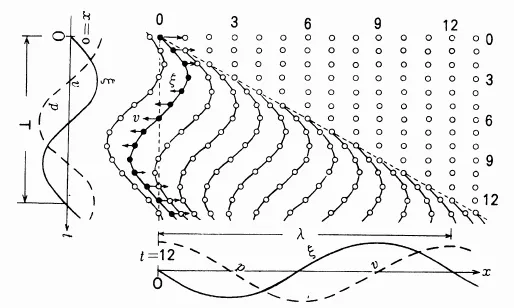
Figure 1.1 Particle movement and wave propagation; ξ: particle displacement, v: particle velocity; p: sound pressure; λ: wavelength; and T: period.
In order to express the wave motion in the form of a mathematical equation, the displacement ξ of a medium particle in the x direction is expressed as follows,
| ξ = AF(t − x/c) | (1.2) |
where F is a function which has two independent variables, time t and distance x; c is a constant and A is the amplitude, which is constant in this case. When a sound source produces simple harmonic motion the equation becomes
| ξ = A cos ω(t − x/c) = A cos (ωt − kx) | (1.3) |
where ω is the angular frequency; ω = 2πf and k = ω/c. The sound pressure and the particle velocity can also be expressed in the same form. In Equation (1.3) when t becomes (t + 1 s) and x becomes (x + c × 1 s),
| ξ = A cos ω[(t + 1) − (x + c)/c] = A cos ω(t − x/c) |
Therefore, the expression does not change. This means the phenomenon shifts through a distance c in 1 s, therefore, c is the sound speed. If we consider a certain position, for instance, where x = 0 in Equation (1.3), then ξ = A cos ωt, which means that it is a sine wave motion. Also at a certain time, for example when t = 0, ξ = A cos (−kx), which shows that the positions of moving particles also follow a sinusoidal pattern. In this case kx = 2π(x/λ), therefore, when (x/λ) is an integer the values of ξ are the same, and it is found that particles separated by λ are in the same phase. Also, k = ω/c...
Table of contents
- Also from Spon Press
- Contents
- Preface
- 1 Fundamentals of sound waves and hearing
- 2 Noise and vibration measurement and rating
- 3 Room acoustics
- 4 Sound absorption
- 5 Outdoor sound propagation
- 6 Airborne sound insulation
- 7 Isolation of structure-borne noise and vibration
- 8 Noise and vibration control in the environment
- 9 Acoustic design of rooms
- 10 Electro-acoustic systems
- 11 Addenda
- Appendices
- Bibliography
- Index
Trusted by 375,005 students
Access to over 1.5 million titles for a fair monthly price.
Study more efficiently using our study tools.
Frequently asked questions
Yes, you can cancel anytime from the Subscription tab in your account settings on the Perlego website. Your subscription will stay active until the end of your current billing period. Learn how to cancel your subscription
No, books cannot be downloaded as external files, such as PDFs, for use outside of Perlego. However, you can download books within the Perlego app for offline reading on mobile or tablet. Learn how to download books offline
Perlego offers two plans: Essential and Complete
- Essential is ideal for learners and professionals who enjoy exploring a wide range of subjects. Access the Essential Library with 800,000+ trusted titles and best-sellers across business, personal growth, and the humanities. Includes unlimited reading time and Standard Read Aloud voice.
- Complete: Perfect for advanced learners and researchers needing full, unrestricted access. Unlock 1.5M+ books across hundreds of subjects, including academic and specialized titles. The Complete Plan also includes advanced features like Premium Read Aloud and Research Assistant.
We are an online textbook subscription service, where you can get access to an entire online library for less than the price of a single book per month. With over 1.5 million books across 990+ topics, we’ve got you covered! Learn about our mission
Look out for the read-aloud symbol on your next book to see if you can listen to it. The read-aloud tool reads text aloud for you, highlighting the text as it is being read. You can pause it, speed it up and slow it down. Learn more about Read Aloud
Yes! You can use the Perlego app on both iOS and Android devices to read anytime, anywhere — even offline. Perfect for commutes or when you’re on the go.
Please note we cannot support devices running on iOS 13 and Android 7 or earlier. Learn more about using the app
Please note we cannot support devices running on iOS 13 and Android 7 or earlier. Learn more about using the app
Yes, you can access Environmental and Architectural Acoustics by Z. Maekawa,Jens Rindel,P. Lord in PDF and/or ePUB format, as well as other popular books in Technology & Engineering & Acoustical Engineering. We have over 1.5 million books available in our catalogue for you to explore.