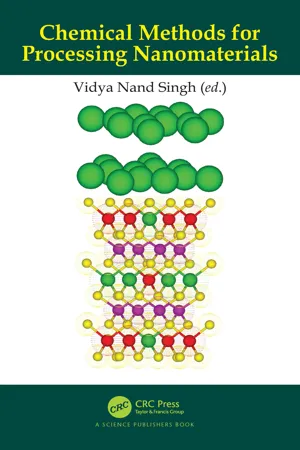
This book discusses the latest advancements in the processing of various types of nanomaterials. The main objective of the book is to provide the reader with a comprehensive review of the latest advances in synthesis as well as processing of almost all kinds of nanomaterials using various physical and chemical methods. The book includes chapters on Chemical Methods such as microemulsions, colloidal route, wet chemical method, chemical vapor deposition technique, sol-gel method, electrodeposition for growing different kinds of nanomaterials including Chalcogenides, Metal Oxide nanostructures, perovskite nanocrystals, nano structures on patterned electrode, Low Dimensional Carbon Nanomaterials and applications at Nanoscale.
- 256 pages
- English
- ePUB (mobile friendly)
- Available on iOS & Android
eBook - ePub
Chemical Methods for Processing Nanomaterials
About this book
Information
1. Introduction
1.1 Carbon Nan omaterials
One of the basic elements which has various allotropes is carbon, and it has the ability to create covalent bonds with other carbon atoms in a range of hybridization states, such as sp, sp2, and sp3. The most well-known natural allotropes of carbon are graphite and diamond. Even though these allotropes mainly consist of carbon atoms, they have different physicochemical properties because of the hybridization of carbon atoms. For example, even though diamond, which consists of sp3 carbon hybridization, is transparent, an electrical insulator, and the hardest known material, graphite, which consists of sp2 carbon hybridization, is opaque, and a soft material with high electrical conductivity.
Fullerene is the first unusual allotrope of carbon that was discovered in 1985 by Robert Curl, Harold Kroto, and Richard Smalley [1]. The discovery of fullerenes opened a new area for carbon allotropes at the nanoscale. The discovery of fullerenes was followed by carbon nanotubes, the straight tubular carbon structure, in 1991 [2]. In 2004, graphene, the one atom thick hexagonal lattice of carbon, was discovered by Andre Geim and Kostya Novoselov at Manchester University (Figure 1.1) [3]. Although various forms of carbon elements have been discovered, there are still many carbon allotropes that need to be experimentally discovered, such as graphyne sheets and graphyne nanotubes [4].
_______________
1 Princeton Institute for the Science and Technology of Materials, Princeton University, Princeton, NJ 08540 USA.
2 Chemical and Biological Engineering, Princeton University, Princeton, NJ 08540 USA.
3 Department of Mechanical and Aerospace Engineering, Princeton University, Princeton, NJ 08540 USA.
Email: [email protected]

Figure 1.1. Timeline for the discovery of carbon nanostructures.
All of these carbon allotropes at nanoscale can be considered as members of the same group because they consist of sp2 hybridization of hexagonal carbon lattice network. As a result of this hybridization, their properties, such as electrical conductivity and mechanical properties are similar, although they have significant differences because of their sizes and shapes.
Different classification methods can be used for carbon nanomaterials. The first classification method is based on the hybridization of the carbon element, such as sp2 and sp3. Fullerene, carbon nanotubes (CNTs), and graphene can be categorized as sp2 hybridization, and nanodiamonds can be counted into sip3 hybridization. The other classification method is based on the structural dimension of carbon element, and in this book we are taking this classification into account. There are zero-dimensional (OD) nanostructures, such as fullerene, one-dimensional (1D) nanostructures, such as nanotubes and nanofibers, graphene-like two-dimensional (2D), and three-dimensional (3D) carbon nanostructures (Figure 1.2).
Carbon nanomaterials can be considered attractive candidates in a broad range of nanotechnology applications, ranging from medicine to aerospace, because of their attractive properties, but these nanomaterials need to be processed and modified during or after their fabrication for the specific application. In this chapter, we will discuss chemical processing and modification of carbon nanomaterials to control their properties for emerging applications.

Figure 1.2. Classification of nanomaterials—zero-dimensional (0D) fullerene, one-dimensional (1D) carbon nanotubes, two-dimensional (2D) graphene, and three-dimensional (3D) carbon nanotubes structures.
2. Carbon Nanotubes
Carbon nanotubes were discovered in 1991 by Iijima, although there are some reports that show tubular structure of CNTs in 1952 and 1976. Ijima et al. and Bethune et al. have reported two separate works about the growth of single-wall carbon nanotubes (SWCNTs). SWCNTs can be described as a rolled-up single-layer graphene. Multi-wall carbon nanotubes (MWCNTs) can be thought as rolling up a multi-layer graphene sheet.
CNTs can be classified based on their wall numbers, such as SWCNTs and MWCNTs, or they can be classified based on their chirality, such as zigzag and armchair. They are semiconductors or metallic based on their chirality. CNTs have extraordinary physical, chemical, and mechanical properties that make them exciting future materials for a broad range of advanced technological applications. For example, their mechanical tensile strength (> 100 GPa) and elastic modulus (~ 1 TPa) are much higher than known materials, such as diamond, with the advantages of low density and flexibility. The thermal conductivity is theoretically reported as 6,600 Wm−1K−1. The electrical conductivity of CNTs is 1000 times higher than copper.
CNTs can be produced using various techniques, as shown in Figure 1.3. CNTs were first produced using high temperature fabrication methods, such as arc-discharge and laser ablation methods, but recently these methods have been replaced by low temperature chemical vapor deposition (CVD) techniques. The CVD method is the most commonly used method for producing CNTs. In this process, nanotubes are obtained by thermal decomposition of a hydrocarbon vapor in the presence of a metal catalyst. The properties of CNTs, such as density, length, and quality can be controlled by CVD technique, etc. Here, we will look into the CVD method in a more detailed manner. These methods mainly require a carbon source, catalyst, temperature, and inert gases.

Figure 1.3. Methods for synthesis of CNTs.
The CVD process involves passing a hydrocarbon vapor using methane, ethylene, acetylene, benzene, xylene, and carbon monoxide as hydrocarbon sources through a reactor with a metal catalyst, such as iron, nickel, and cobalt at a proper temperature (Figure 1.4). The growth of CNTs with CVD method depends on different parameters, such as hydrocarbon source, catalyst, temperature, pressure, gas-flow rate, deposition time, reactor geometry, and the location of substrate inside the reactor. All of these factors not only affect the growth of CNTs, but also their yield, type, and quality.
Although the fundamental mechanism of the growth of CNTs is still not understood well, the widely accepted mechanism is that hydrocarbon sources decompose at high temperature and precipitate on the catalyst. When the decomposed carbon precipitates on the surface of the catalyst, the nucleation of CNT growth starts. If the interactions between metal catalyst and the substrate are weak, the growth continues as tip growth (Figure 1.5a). If the interactions between the metal catalyst and the substrate are strong, decomposed carbon deposits on the catalyst from the lower peripheral surface of metal. In both cases, the growth of CNTs stops when the surface of the catalyst is covered by amorphous carbon. To avoid the catalyst poi...
Table of contents
- Cover
- Title Page
- Copyright Page
- Preface
- Table of Contents
- 1. Chemical Methods for Processing Carbon Nanomaterials
- 2. Synthesis of Nanomaterials and Nanostructures
- 3. Wet Chemical Methods for Nanoparticle Synthesis
- 4. Electrodeposition—A Versatile and Robust Technique for Synthesizing Nanostructured Materials
- 5. Nanostructured Materials Using Microemulsions
- 6. Methods of Manufacturing Composite Materials
- 7. Quantum Dots and Their Synthesis Processes
- 8. Chemical Vapor Deposition (CVD) Technique for Nanomaterials Deposition
- 9. CVD Growth of Transition Metal Dichalcogenides MX2 (M: Mo, W, X: Se, S)
- 10. Metal Oxide/CNT/Graphene Nanostructures for Chemiresistive Gas Sensors
- 11. Chemical Route Synthesis and Properties of CZTS Nanocrystals for Sustainable Photovoltaics
- 12. Surface Modification of Glass Nanofillers and Their Reinforcing Effect in Epoxy-Based Nanocomposites
- 13. Gas Sensor Application of Zinc Oxide
- 14. Titanium Dioxide as A Photo Catalyst Material: A Review
- Index
Trusted by 375,005 students
Access to over 1.5 million titles for a fair monthly price.
Study more efficiently using our study tools.
Frequently asked questions
Yes, you can cancel anytime from the Subscription tab in your account settings on the Perlego website. Your subscription will stay active until the end of your current billing period. Learn how to cancel your subscription
No, books cannot be downloaded as external files, such as PDFs, for use outside of Perlego. However, you can download books within the Perlego app for offline reading on mobile or tablet. Learn how to download books offline
Perlego offers two plans: Essential and Complete
- Essential is ideal for learners and professionals who enjoy exploring a wide range of subjects. Access the Essential Library with 800,000+ trusted titles and best-sellers across business, personal growth, and the humanities. Includes unlimited reading time and Standard Read Aloud voice.
- Complete: Perfect for advanced learners and researchers needing full, unrestricted access. Unlock 1.5M+ books across hundreds of subjects, including academic and specialized titles. The Complete Plan also includes advanced features like Premium Read Aloud and Research Assistant.
We are an online textbook subscription service, where you can get access to an entire online library for less than the price of a single book per month. With over 1.5 million books across 990+ topics, we’ve got you covered! Learn about our mission
Look out for the read-aloud symbol on your next book to see if you can listen to it. The read-aloud tool reads text aloud for you, highlighting the text as it is being read. You can pause it, speed it up and slow it down. Learn more about Read Aloud
Yes! You can use the Perlego app on both iOS and Android devices to read anytime, anywhere — even offline. Perfect for commutes or when you’re on the go.
Please note we cannot support devices running on iOS 13 and Android 7 or earlier. Learn more about using the app
Please note we cannot support devices running on iOS 13 and Android 7 or earlier. Learn more about using the app
Yes, you can access Chemical Methods for Processing Nanomaterials by Vidya Nand Singh in PDF and/or ePUB format, as well as other popular books in Technology & Engineering & Biology. We have over 1.5 million books available in our catalogue for you to explore.