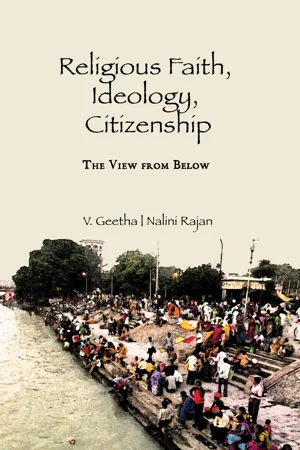
This book looks at the triadic relations between faith, the state and political actors, and the ideas that move them. It comprises a set of essays on diverse histories and ideas, ranging from Gandhian civic action to radical free thought in colonial India, from liberation theologies, that take their cue from specific and lived experiences of oppression and humiliation, to the universalism promised by an expansive Islam. Deploying gender and caste as the central analytical categories, these essays suggest that equality and justice rest on the strength and vitality of the exchanges between the worlds of the civic, the religious and the state, and not on their strict separation.
Going beyond time-honoured dualities — between the secular and the communal (especially in the Indian context), or the secular and the pre-modern — the book joins the lively debates on secularism that have emerged in the 21st century in West, South and South-east Asia.
- 212 pages
- English
- ePUB (mobile friendly)
- Available on iOS & Android
eBook - ePub
About this book
Information
Part I
Gandhi and His Critics
From the early twentieth century, anti-caste radicals in the Tamil country have sought to uphold the importance of modern law, embodied in statutes, policy and legal guarantees and enacted by an impartial state, as the measure of a justice different from what is habitually practised in caste society. The state that these radicals looked up to was the colonial state, which seemed relatively free from the influence of custom and habit — on account of the procedure it had set up, which appeared to them to be based on an exercise of reason, notions of coherence and display of critical judgement. Such a state would necessarily be secular, it went without saying, and not identify its interests with that of any religious group — the Tamil self-respecters, foremost amongst anti-caste radicals, in fact demanded that the state actively work against the power of vested religious interests.
However, this decorous and solemn faith in the state to transact justice was seldom sanguine. On the one hand, anti-caste radicals wished to re-populate the state, with people from communities that were as yet unrepresented in its bureaucracy; and secondly, and more importantly, to retain sustained social pressure on the state, through agitation and argument. These latter were not always addressed to the state and instead were carried out in the civic realm, which in the Indian context comprised social, sacred and cultural spaces.
This double-edged approach to securing justice is interesting, because it makes clear that secularism cannot be a matter of formal separation of powers and interests, but has to be a substantive ideal rooted in alternative social and cultural practices. In other words, both state and civil society are in need of secularisation. Thus it was not enough to insist on fundamental rights, but to also propagandise in their favour, through calling into question social and other privileges and the conflicts they caused. It was also not enough to ask for state neutrality, but for principled intervention on the side of those who dared speak against the hierarchy of faith and caste. In the lexicon of the self-respecters, the secular was not so much an antonym of the theological, but of the national, and it was this opposition which proved germane to the self-respecters’ understanding of the relationship between the secular state and non-secular society.
Their definitions of the secular emerged in their critique of nationalist politics and rhetoric, nationalist practice and prevarication with respect to social change and finally in and through their critical engagement with Gandhi’s nationalist arguments and publicly articulated political and ethical choices. In this sense, they worked their way out of Gandhian nationalism, while retaining its ethical edge and into a peculiarly home-grown philosophy of secularism.
The second chapter in this section is concerned with the tensions between Gandhian and Kantian ethics (as embodied in the ideas of Jurgen Habermas). It is argued that while the Habermasian ethics of communicative rationality works better than the Gandhian vision of satyagraha in the field of political practice, the same is not true in the realm of environmental concerns. Here, Habermasian communicative rationality would require some measure of the Gandhian spirit of collective sacrifice in order to address intergenerational environmental concerns of our planet.
The third chapter studies both Gandhian non-violence and so-called terrorist violence in the context of civil disobedience against a state or states. Curiously, both call for self-sacrifice on the part of the actors, and both are limited in terms of scope, as far as action against the state is concerned, unless such action is a collective quest. A desirable option would be to enforce the left liberal demand for the right to civil disobedience, even when the disobedient are reasonably mistaken in their views.
1
Reconstructing Social Reform as Secularism: The Example of the Tamil Self-respecters
The self-respect movement in Tamil Nadu was self-consciously and resolutely secular — this much is clear from the writings of self-respecters published over two decades and more (1926–49). Like secularists elsewhere, self-respecters insisted that the state remained gloriously free of religious influences. But this did not mean that the state was expected to remain absolutely neutral with respect to religious practices. Rather the state was expected to interfere, on a principled and contextual basis, in religious matters — on the argument that in order to secure dignity, equality and justice for those who are consistently denied them, the state had a right to regulate or annul custom, tradition and social and cultural habit, sanctioned and justified by religious doctrine or belief.
This demand for a principled, interventionist secular state must be distinguished, though, from support for interventionism advanced by groups and parties that call upon the state to regulate minority institutions and social practices. Citing reasons of national necessity, homogeneity and the abridgement of women’s rights in, say Islamic communities, this demand has found its most bigoted expression in the Hindutva demand for a uniform civil code. The self-respecters on the other hand were not enamoured of the claims of the nation: neither the idea of national unity nor the affirmation of a singular, universal citizenship, cutting across faith, caste and class held their imagination. Rather they wished to secure in law and statute their own criticisms of the Hindu social order, and hoped that their sustained work at raising public consciousness might find fit expression in the state’s own position with regard to social inequities. In other words, for them secularism was not merely a principle of nationalist governance, but equally a guarantee of superior civic virtues. These latter, in turn, were not to be secured by state policy merely, though this played a significant role, to be sure, in assuring equality and social justice, but had to be anchored in everyday practices — of defiance, of culture and oppressive custom, on the one hand, and in acts of creation and affirmation, of new social values which upheld mutuality, self-respect and rationality.
The self-respecters may be seen as inheriting and working with the legacy of Hindu social reform such as it was in the mid and late nineteenth century. They did not agree that nationalists had successfully resolved the tricky and difficult question of reform carried out under the aegis of the colonial state — by relegating and displacing questions of tradition, culture and faith to the realm of home and the family. Rather they argued that the incomplete nature of the reform project, particularly with respect to caste and gender inequality, rendered nationalism itself incomplete. For, as they asked in diverse ways, what was the use of a political equality that was also not concomitantly social equality? In fact, it may be said that they reworked the principles and protocols of social reform to represent both a secular critique of Indian nationalism as well as a measure of a new and radical commonweal.
In what follows I describe the circumstances and contexts in which the Tamil self-respecters came to secularism. The second part of my essay offers a brief description of this secularism.
I hope to demonstrate how the secularism of the self-respecters represented and was, fundamentally, an anti-nationalist critique, and that for them the nation represented a focus for civic action and justice, rather than one that guaranteed and embodied national identity.
It could be argued that the self-respecters sought to reconstruct social reform as secularism. This reconstruction did not take place within the ideational realm merely, but emerged in response to a complex historical conjuncture. The late 1920s and the early 1930s were crucial years for the self-respect movement, in this respect, and saw them articulate a fundamental critique of nationalism, even as they advanced a radical philosophy of social equality and reform.
Starting with his famous satyagraha against the infamous Rowlatt Acts of 1919, Gandhi had embarked on a political journey that saw him realise a new practice of politics. Non-cooperation, which required ordinary citizens to withdraw their endorsement of colonial rule and authority, through the relinquishing of posts, titles and presence in government institutions was to be the new form of political activity. Constructive work or an active elaboration of social change was to complement the latter. Abolition of untouchability, abjuring alcohol and practising spinning were upheld as important instances of constructive work, and Gandhi considered each of these indispensable to the nationalist project. He counterposed the practice of these ideals to workaday politics, to petitioning, agitating for greater representation for Indians in local governing councils and legislature. This earned him the unstinting admiration of men like E. V. Ramaswamy (Periyar), who, in spite of being in the Madras ( Tamil) wing of the national Congress, had profound misgivings about that party’s interest in social matters. The fact that during this period, Gandhi viewed untouchability abolition as a necessary condition for the attainment of national freedom endeared him to Periyar.
From the mid-1920s, though, Gandhi appeared equivocal about constructive work. The political crisis that beset non-cooperation in the wake of popular violence (1922) and the tragic fate that greeted the Mahatma’s cherished notion of Hindu–Muslim unity in 1924 caused him to retreat from public life, and he announced that henceforth he would devote himself to constructive work, and called upon fellow Congressmen to assist him in his labours. Yet, he also appeared open to some of his fellow nationalists contesting elections to provincial councils. These men, known to history as the Swarajists, were enemies of reform, at least in the Madras province, and so the credibility granted to them by Gandhi’s acceptance of their programme somewhat dismayed Periyar and his band of followers, and in 1925 Periyar wondered if the Mahatma was aware of how the Swarajists sought to dress up their political ambitions with his moral rhetoric (Geetha and Rajadurai 2008: 273).
The following years, too, Gandhi’s political stance on several issues proved a cause of worry to the self-respecters. Touring the Deccan and the Madras province in the late 1920s, the Mahatma was startled no doubt by the resonant rhetoric of the non-Brahmin parties in these states and realised the salience of the caste question in these parts. His responses, interestingly enough, were defensive, and this was when he produced his tortuous yet affirmative definitions of varnadharma, even as he denounced the essential cruelty and sinfulness of untouchability.
In 1927, when Gandhi was in the Tamil region of Madras province, a group of young self-respecters met him and raised important questions to do with caste, injustice and untouchability. Not entirely satisfied with his responses, and angry with his continuing praise for varnadharma, they decided that they could not, any more, endorse his ideas. It seemed to them, as an editorial in their Tamil weekly Kudi Arasu pointed out, that the Mahatma appeared to interpret his own views on untouchability in such a manner that it was as if he wished this cruel practice to continue: ‘if the body of varnashramadharma did not exist, untouchability which constitutes the very life of this body would not be alive today’ (ibid: 286–87).
The self-respecters’ anguish over Gandhian politics attained a further edge in the following year. The year 1928 saw Gandhi return decisively to the political centre, and at the Calcutta session of the Congress held that year, he showed himself to be firmly in command. The mid and late 1920s had been difficult years for the subcontinent — marked as they were by workers’ unrest in Bombay and Calcutta in key industries, the great railway strike, and articulated rural discontent in the Andhra region of the Madras Presidency and the United Provinces. These years also saw the determined assertion of a radical anti-untouchability politics in the Bombay province under the leadership of Dr B. R. Ambedkar, which directly challenged the Gandhian approach to reform, and threatened to steal nationalism’s moral aura from it. Besides, Congress nationalists had to contend with youthful militancy in Bengal and Punjab. The Young Bengal group and Bhagat Singh’s Hindustan Republican Army (HRA) offered political alternatives that diminished the appeal — at least to the young — of habitual nationalist rhetoric that now appeared wan and discordant.
There were rumblings in the Congress’ own ranks, expressed best in Jawaharlal Nehru’s call for going beyond a politics of seeking autonomy, home rule or dominion status: in the Madras conference of the Indian National Congress, he insisted that nationalists demand ‘Purna Swaraj’. There was discontent of another sort as well, articulated by decidedly ‘Hindu’ Congressmen who were none too happy with attempts to engage the Muslim League’s fears and concerns in the drawing up of a constitutional scheme for Indian governance. These two tendencies had to reckon with a third: the desire expressed by a section of Congressmen to break with Gandhian non-cooperation and enter the legislature. High idealism, a barely-concealed Hindu nationalism, and an articulated desire for political office: to address these disparate interests, Congress had to design a solution that was both ethically credible as well as politically astute.
Gandhi turned out to be the man of the hour. He succeeded in both recognising and restraining the younger Nehru’s political ardour; he endorsed the Motilal Nehru Committee’s proposals for constitutional reform, even though they did not offer nearly enough to the Muslim League; and outlined the conditions in which Congress nationalists could remain opposed to colonial authority, even while being part of the legislature. The Calcutta Congress session of 1928 was the battleground on which this Gandhian consensus was forged: a lofty nationalism was proclaimed, which conceded nothing to the political radicalism of either Young Bengal that was on the nationalist fringe, or the HRA; and which chose to ignore the anti-caste protests in the Madras and Bombay presidencies. Hindu–Muslim unity was loudly and endlessly affirmed, even though Jinnah would denounce Congress’ political reform proposals immediately thereafter; and, importantly, Congressmen were of...
Table of contents
- Cover
- Half Title
- Title Page
- Copyright Page
- Contents
- Introduction
- Part I GANDHI AND HIS CRITICS
- Part II DALIT HISTORY: EXPLORATIONS INTO THE IDEA OF FRATERNITY
- Part III ISLAMIC FEMINISM: MIXED DISCOURSE OF FAITH AND JUSTICE
- Bibliography
- About the Authors
- Index
Trusted by 375,005 students
Access to over 1.5 million titles for a fair monthly price.
Study more efficiently using our study tools.
Frequently asked questions
Yes, you can cancel anytime from the Subscription tab in your account settings on the Perlego website. Your subscription will stay active until the end of your current billing period. Learn how to cancel your subscription
No, books cannot be downloaded as external files, such as PDFs, for use outside of Perlego. However, you can download books within the Perlego app for offline reading on mobile or tablet. Learn how to download books offline
Perlego offers two plans: Essential and Complete
- Essential is ideal for learners and professionals who enjoy exploring a wide range of subjects. Access the Essential Library with 800,000+ trusted titles and best-sellers across business, personal growth, and the humanities. Includes unlimited reading time and Standard Read Aloud voice.
- Complete: Perfect for advanced learners and researchers needing full, unrestricted access. Unlock 1.5M+ books across hundreds of subjects, including academic and specialized titles. The Complete Plan also includes advanced features like Premium Read Aloud and Research Assistant.
We are an online textbook subscription service, where you can get access to an entire online library for less than the price of a single book per month. With over 1.5 million books across 990+ topics, we’ve got you covered! Learn about our mission
Look out for the read-aloud symbol on your next book to see if you can listen to it. The read-aloud tool reads text aloud for you, highlighting the text as it is being read. You can pause it, speed it up and slow it down. Learn more about Read Aloud
Yes! You can use the Perlego app on both iOS and Android devices to read anytime, anywhere — even offline. Perfect for commutes or when you’re on the go.
Please note we cannot support devices running on iOS 13 and Android 7 or earlier. Learn more about using the app
Please note we cannot support devices running on iOS 13 and Android 7 or earlier. Learn more about using the app
Yes, you can access Religious Faith, Ideology, Citizenship by V. Geetha,Nalini Rajan in PDF and/or ePUB format, as well as other popular books in Politics & International Relations & Political Ideologies. We have over 1.5 million books available in our catalogue for you to explore.