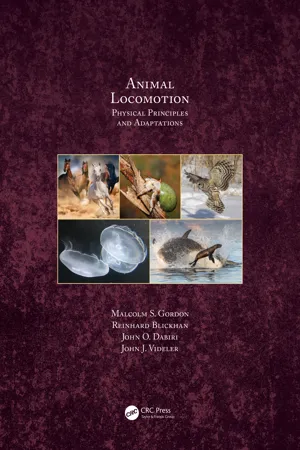
Animal Locomotion: Physical Principles and Adaptations is a professional-level, state of the art review and reference summarizing the current understanding of macroscopic metazoan animal movement. The comparative biophysics, biomechanics and bioengineering of swimming, flying and terrestrial locomotion are placed in contemporary frameworks of biodiversity, evolutionary process, and modern research methods, including mathematical analysis. The intended primary audience is advanced-level students and researchers primarily interested in and trained in mathematics, physical sciences and engineering. Although not encyclopedic in its coverage, anyone interested in organismal biology, functional morphology, organ systems and ecological physiology, physiological ecology, molecular biology, molecular genetics and systems biology should find this book useful.
eBook - ePub
Animal Locomotion
Physical Principles and Adaptations
- 267 pages
- English
- ePUB (mobile friendly)
- Available on iOS & Android
eBook - ePub
Animal Locomotion
Physical Principles and Adaptations
About this book
Information
CHAPTER ONE
Basics
MALCOLM S. GORDON
1.1 INTRODUCTION
This book is about animal locomotion as viewed from the perspectives of comparative animal biophysics, biomechanics, and bioengineering. Animal biophysics may be defined as the study of biological phenomena, structures, and processes in animals, including intact animals, by using the concepts and methods of physics. The field overlaps broadly with and complements comparative animal physiology, much of which emphasizes chemical and biochemical approaches to animal function. Animal biomechanics and bioengineering may be defined as the application of mechanical and other engineering principles to the study of the same animals, phenomena, structures, and processes (Leondes 2007–2009; Chien et al. 2008; Chien 2013).
The word “comparative” here refers to the use in these fields of taxonomic and phylogenetic positions of animals (more broadly their evolutionary lineages) as a major research variable. An array of specific methods for making comparisons has developed in recent years (Felsenstein 1985; Nunn 2011). See Chapter 2 for the evolutionary contexts of this statement. We also interpret comparative to imply emphasizing those features and properties of animals that have the closest relationships to evolutionary, environmental, and ecological conditions and situations in the lives of the forms studied.
The overall organization, structure, content, and approaches to subject matter used in the book are outlined in the Preface. In addition to materials relating directly to the contents of the chapters, the references sections include key references to books, review articles, and research papers that introduce readers to relevant major subject areas not covered by this volume. Relevant, reliable, and useful websites are also listed. More general discussions of animal locomotion include Alexander (2003), Biewener (2003), Vogel (2009, 2013), Hanson and Åkesson (2015), and Irschick and Higham (2016).
Three foundational areas not discussed further here are cosmology, the relationship between physics and biology, and the philosophy of science. Some useful references include Hofstadter (1999), Laughlin and Pines (2000), Nagel and Newman (2001), McCarthy (2004), Berto (2009), Chang (2012), Eigen (2013), Love (2015), Carroll (2016), Otto (2016), and Tyson et al. (2016).
1.2 LIFE ON EARTH
There was no life on Earth for a long time after the origin of the Solar System about 4.5 billion years ago (Gy). Complex processes of both physical and chemical evolution occurred in the prebiotic world. The circumstances under which life first arose, the when, where, and how of the origin(s) of life, remain subjects of active debate. Identifiable living things appeared and biological (organic) evolution began about 3.7 Gy (the age of the oldest known fossils of microorganisms). Multicellular macroscopic animals began to appear about 0.8 Gy, and much of the diversity of major groups appeared during a relatively short time interval that has come to be called the “Cambrian explosion” (0.541–0.515 Gy). Living animals are the current results of ongoing organic evolutionary experiments that nature has been pursuing since then. The most recent best estimates of the numbers of different kinds (species) of extant multicellular organisms (metazoans) included in the kingdom Animalia is 8.7 (±1.0) million (Costello et al. 2013). Evidence from the fossil record indicates that larger numbers of species lived for varying lengths of time in the past.
Prebiotic evolution and the origin(s) of life are large active research areas. References providing entry into the rapidly growing literature include Anderson (1983), Dose (1988), Hogeweg and Takeuchi (2003), Markovitch and Doron (2013), Archibald (2014), Becker et al. (2016), Mesler and Cleaves (2016), and Olson and Straub (2016).
The Cambrian explosion is also an area of active interest (Marshall 2006, Erwin and Valentine 2013, Smith and Harper 2013).
Animals are classified by biologists as belonging to 32 major groups (phyla). Based on evidence from both the fossil record and from molecular phylogenies, many phyla have existed for very long periods (0.8+ Gy). Most of these groups have evolved substantially during these periods. Living representatives of at least some of these groups occur in almost every physical environment on Earth that has conditions compatible with water and carbon-based life forms. These environments range from the aquatic and subaquatic to the terrestrial (including subterranean) and aerial. Individual animals range in size from microscopic to the blue whale (the largest animal that has ever lived). Excellent introductions to this biodiversity are Pechenik (2014) and Pough et al. (2013).
This book is about selected aspects of the science deriving from study of current biodiversity and its evolutionary history. It begins with the recognition that nature is the designer, architect, engineer, builder, and manufacturer of life on Earth. The biological, physical, and chemical aspects of nature have interacted with each other over huge amounts of time and space, using vast amounts of energy and raw materials. During these processes, nature has explored large numbers of possible designs, structures, mechanisms, and modes of production of living organisms. From a utilitarian perspective, we can view nature as an endless store of good, well-tested ideas on how best to achieve many different important goals significant in our lives.
1.3 PERSPECTIVES
This book is about a continuing set of what we regard as mystery stories (many biologists may be viewed as practitioners of evolutionary forensics). The mysteries are both retrospective and prospective. They are retrospective because the molecular, developmental, biological, morphological, and fossil records of the evolutionary past of animal lineages are in many ways fragmentary and incomplete. With respect to the fossil record in particular what we have found is largely the result of both chance and stochastic processes. These features of the fossil record gradually become more and more important the further one goes back in time (Foote and Miller 2006; Benton 2014).
The mysteries are also prospective because the environments of organisms are always changing and varying in unpredictable ways over wide ranges of temporal and spatial scales. Describing and understanding what is happening presently and what may happen even in the near future are both uncertain and speculative.
As scientists, we use two basic approaches to study the parts of the universe of interest to us: analysis and synthesis. Analyses and their results make up the great majority of this book. Syntheses of information are discussed wherever they are justified.
1.4 FRAMEWORKS
Animals differ from nonliving physical–chemical systems in multiple important ways. Most animals are autonomously motile during at least some parts of their life histories, if not throughout their lives. All animals grow and age as individuals. Many, but not all, reproduce, often in complicated ways. As populations and genetically related groups (lineages and clades), they evolve over time, often in complex ways.
1.4.1 Organization and Structure
The bodies of animals are organized and operate as hierarchical systems. Depending upon the definitions used, one can distinguish at least 10 structural and organizational levels of complexity, beginning with the intact animal and going down to the level of atoms.
There are three main levels of concern in this book: intact organisms, organ systems, and organs. Organisms are made up of multiple organ systems (e.g., integumentary system, gastrointestinal system, respiratory system). Each organ system is composed of multiple organs (e.g., stomach, intestine).
A major aspect of the hierarchical framework within which animals live is the fact that, from evolutionary perspectives, multiorganismic groupings of many kinds are often as important as are the properties of individual animals. The hierarchy continues upward to include populations, systematic categories (species and higher taxa), communities, habitats, ecosystems, environments, regions, and the planet as a whole.
1.4.2 Emergent Properties
An important phenomenon becomes apparent if, instead of taking things apart, one tries to synthesize an organism from its component parts. New properties, not predictable from syntheses of the properties of all lower levels, emerge at each successive level of complexity on the way up from atoms. The incompleteness theorem of Gödel is relevant here (Hofstadter 1999; Nagel and Newman 2001; McCarthy 2004; Berto 2009). For present purposes, the best example is that of intact organisms.
1.5 META-ISSUES
Intact animals are not simply organized constructs of their component organ systems. Intact animals do many things that are unpredictable on the basis of as detailed and complete descriptions of the structures and functions of their organ systems as one can produce. The most obvious and important emergent property is that they behav...
Table of contents
- Title Page
- Copyright Page
- Table of Contents
- Preface
- Acknowledgments
- Authors
- 1 • Basics
- 2 • Animal Biodiversity: Origins and Evolution
- 3 • Swimming
- 4 • Natural Flight
- 5 • Terrestrial Locomotion
- Index
Trusted by 375,005 students
Access to over 1.5 million titles for a fair monthly price.
Study more efficiently using our study tools.
Frequently asked questions
Yes, you can cancel anytime from the Subscription tab in your account settings on the Perlego website. Your subscription will stay active until the end of your current billing period. Learn how to cancel your subscription
No, books cannot be downloaded as external files, such as PDFs, for use outside of Perlego. However, you can download books within the Perlego app for offline reading on mobile or tablet. Learn how to download books offline
Perlego offers two plans: Essential and Complete
- Essential is ideal for learners and professionals who enjoy exploring a wide range of subjects. Access the Essential Library with 800,000+ trusted titles and best-sellers across business, personal growth, and the humanities. Includes unlimited reading time and Standard Read Aloud voice.
- Complete: Perfect for advanced learners and researchers needing full, unrestricted access. Unlock 1.5M+ books across hundreds of subjects, including academic and specialized titles. The Complete Plan also includes advanced features like Premium Read Aloud and Research Assistant.
We are an online textbook subscription service, where you can get access to an entire online library for less than the price of a single book per month. With over 1.5 million books across 990+ topics, we’ve got you covered! Learn about our mission
Look out for the read-aloud symbol on your next book to see if you can listen to it. The read-aloud tool reads text aloud for you, highlighting the text as it is being read. You can pause it, speed it up and slow it down. Learn more about Read Aloud
Yes! You can use the Perlego app on both iOS and Android devices to read anytime, anywhere — even offline. Perfect for commutes or when you’re on the go.
Please note we cannot support devices running on iOS 13 and Android 7 or earlier. Learn more about using the app
Please note we cannot support devices running on iOS 13 and Android 7 or earlier. Learn more about using the app
Yes, you can access Animal Locomotion by Malcolm S. Gordon,Reinhard Blickhan,John O. Dabiri,John J. Videler in PDF and/or ePUB format, as well as other popular books in Biological Sciences & Biotechnology in Medicine. We have over 1.5 million books available in our catalogue for you to explore.