Historically treated as an amorphous borderland and marginal to the understanding of democratic politics and governance in South Asia, Southeast Asia and northern Asia, the Himalayan region, in the last 50 years, has become an 'active political laboratory' for experiments in democratic structures and institutions. In turn, it has witnessed the evolution of myriad political ideologies, movements and administrative strategies to accommodate and pacify heterogeneous ethnic-national identities.
Routeing Democracy in the Himalayas highlights how, through an ongoing process of democratisation, the Western liberal ideologies of democracy and decentralisation have interacted with varied indigenous politico-cultural ideas and institutions of an ethnic-nationally diverse population. It also reviews how formal democracy, regular elections, local self-governing structures, protection of the rights of minorities and indigenes, freedom of expression, development of mass media and formation of ethnic homelands — all have furthered participatory democracy, empowered the traditionally marginalised groups and ensured sustainable development to varying degrees. The book provides ethnographic and historical vistas of democracy under formation, at work, being contested and even being undermined, showing how democratisation thematically stitches the independent Himalayan nations and the Indian Himalayan states into a distinctive regional political mosaic.
Combining new perspectives from comparative sociology, political anthropology and development studies, the volume will be useful for policy makers, as well as specialists, researchers and students in sociology, anthropology, area studies, development studies, and Tibet and Himalayan studies.
PART I Identity Politics and Democratic Transition
1 The Adivasi/Janajati Movement in Nepal: Myths and Realities of Indigeneity*
Gérard Toffin
Recent anthropological research on South Asia has stressed the links, past and present, between tribes (or ethnic groups1) and the Hindu mainstream environment. In Nepal, as in India, various tribal groups have been practising hypergamy for a long time with Hindu high-castes. One may mention the cases of marital ties of Kunbis with the Marathas in Maharashtra, of the Kolis with the Rajputs in Gujarat and of the Magars with the Thakuris in Nepal.2 In all these cases, ‘hypergamy enables tribal groups to claim equal status with the castes receiving their women as wives, thus making the boundary between tribe and caste blurred’ (Shah 2007: 113). Many other types of relations—economic, military or religious—between the two group categories have been highlighted as well. Tribesmen, for instance, were often employed as soldiers in the armies of Muslim and Hindu rajas over the centuries. As is well known, tribes had become castes from an early period in Indian history, and conversely, castes had sometimes become tribes. In South India, most tribes share the same Dravidian kinship features as Hindu castes. And the Dravidian kinship system differs from the north Indian one. By and large, the Indian Scheduled Tribes have never lived in isolation. Castes and tribes have often encountered each other in many parts of the subcontinent. Both belong to the same South Asian world. Some decades ago, Louis Dumont (1964: 91) went as far as considering the tribes of India a series of groups which had been disconnected from the Hindu world at some point in their history. Ghurye (1959) was more or less of the same opinion and often called tribal groups ‘backward Hindus’. He observed that caste-like features are found all over the Indian subcontinent, including among tribes. He argued that tribes constituted more often than not a secondary phenomenon, a sort of reaction against the dominant local Hindu society (see Toffin 1979).
Despite these continuities and this interconnectedness, whoever has lived for a long time among tribal groups (which admittedly are very diverse) in these regions, would have been struck by the differences in lifestyle, values, kinship systems and ways of thinking. In many cases, tribal society is organised according to rules different from those of the Hindu caste system. It has a more segmentary structure, less of an internal hierarchy, a more communitarian approach to social life and little occupational specialisation; their unions are mostly isogamous and so on. Instead of hierarchy, territory and kinship units emerge as the two basic principles which govern the tribes. Similarly, deities attached to the clans and the soil are crucial to their religion despite the fact that these elements also exist among castes. Besides, ethnic groups have a strong sense of distinctiveness. They feel their social world to be unlike that of the caste. Nepalese hill ethnic groups have emphatically rejected the values and lifestyle of caste people and market towns in the plains. The western Tamangs of Dhading and Nuwakot districts, among whom I undertook research over a long time, regard the people they call Jartis (Nepali-speaking high-castes living at some distance from them) as a totally different world imbued with non-communitarian values, in stark contrast to the ethos of reciprocity adopted within their villages. The categorisation of Scheduled Tribes in India and the adivasi/janajati3 (‘indigenous nationalities’) movement in Nepal have, therefore, only strengthened an old phenomenon and provided their members with a more acute ethnic consciousness than before. They have, to a certain extent, amplified a lasting division between these two poles of South Asian society. Moreover, it must be recognised that the theory stressing relations between the two groups applies much more to some parts of India (Rajasthan, Gujarat, South India), than, for instance, to the Northeast. In the Northeast, the percentage of tribal people is much higher than elsewhere, and until recently, the ethnic groups lived in a much more isolated manner there than in other regions of India.
Any discussion on South Asian tribes, janajati or adivasi, has to take into account these two complementary and opposing trends. Bearing this in mind, I will ponder in this chapter the present and past situation of ethnic minorities in Nepal—a country which belongs to the South Asian world, except for its northernmost Tibetan fringe—as well as their relations with the Nepalese society at large. This is an important but sensitive topic since indigenous nationalities represent a much higher percentage of the population in Nepal, about 37 per cent (including Newars), than in India (8 per cent). Janajati organisations (a total of 150–250 have been listed) have played a major role in recent political events in the former Hindu kingdom of Nepal. They have contributed to the general ethnicisation of politics and have successfully engendered a change in political consciousness (see Gellner 1997, 2003; Hacchethu 2003; Pfaff-Czarnecka 1997, 1999; Hangen 2007). They are partly responsible for the massive success the Maoists met at the April 2008 elections to the Constituent Assembly. In many ways Maoists have hijacked much of the janajatis’ political agenda to rally support from them (see Hutt 2003; Sales 2003; Thapa 2003).
I am particularly interested in the rise, since the 1990s, of the adivasi/janajati movement, its claims in cultural and political matters, and the essentialist ideology it has developed in relation to autochthony and social grouping. I will emphasise the distance between the representations of these ethnic minorities and the sociocultural realities, as revealed by an anthropologist who has been studying these groups for nearly four decades. I am afraid that in doing so, I will deconstruct some myths which have been built in the contemporary period for political reasons. Until very recently, anthropologists working in Nepal were suspected by the authorities of supporting communalist movements and of sympathising with autonomous ethnic claims. In the near future, they (at least some of them) may be criticised by ethnic leaders for being too negative towards their discourse on the rights of the indigenous and for judging their rhetoric severely.
Rise and Growth of the Janajati Movement
Anthropologically speaking, Nepal is inhabited by five main population groups: (a) Parbatiya Hindu castes which speak Nepali as their mother tongue and live mainly in the hills (ca. 38 per cent of the population in 2001, including hill dalits); (b) ethnic groups (or tribes), a great majority of which speak Tibeto-Burmese languages (about forty have been recognised, but this figure is debatable) and which live in the hills (ca. 23 per cent) and in the Tarai plains in the south (ca. 8.7 per cent); (c) Newars, a hybrid ethnic group which speaks a Tibeto-Burmese language with a script, but is heavily influenced by Indic civilisation (ca. 5.5 per cent) and concentrated in the Kathmandu Valley, though many of them have migrated to all parts of Nepal; (d) Madhesis, people from the south, established in the southern Tarai low-altitude belt, mainly Hindus (ca. 23 per cent of the total population); and (e) Tibetans who live either in the north, or as refugees in different parts of the country, mostly in the Kathmandu Valley (ca. 1 per cent). Muslims in Nepal included among the Parbatiyas or Madhesis, constitute 4.3 per cent of the population.
Until the seventeenth–eighteenth centuries, most Nepalese ethnic groups exercised full authority over their territory. Stretches of land were populated by fairly culturally and linguistically homogenous population groups. They were ruled by autonomous chiefdoms, according to customary regulations and laws which owe very little to the Indic culture. Besides, everything indicated that the boundaries between the various Tibeto-Burmese languages and the ethnic groups were less demarcated than today (Toffin 2007: Ch. 8). The unification of the country from the second half of eighteenth century onwards by Prithivi Narayan Shah, a raja belonging to the small Hindu principality of Gorkha, changed the situation drastically. All former Hindu kingdoms (rajyas) and tribal chiefdoms were conquered militarily by the armies of this Shah (Thakuri) king.
This conquest was accompanied by a vast migration of Hindu Parbatiya people from west to east. The members of these castes settled everywhere in the hills, save the areas at the highest altitude. The tribes’ communal lands were gradually alienated by newcomers through money-lending and other schemes. Tribal territories such as those of the Magars, Gurungs, Tamangs, Rais and Limbus, were incorporated in the new Nepalese state and came to be administrated by those that ethnic groups perceived as foreigners, members of a different culture. Episodic resistance was crushed by the state. During the nineteenth and twentieth centuries, an enduring process of Hinduisation took place in the hills. It can indeed be called a process of Nepalisation since the state-backed Hinduism became the pillar of the Himalayan kingdom. Most ethnic groups adopted elements from the dominant Hindu culture: rites of passage performed by a Brahman priest, marriage prescriptions according to Hindu rules, worship of Hindu gods, etc. Some of them (a minority, in fact) abandoned their language and adopted Nepali.
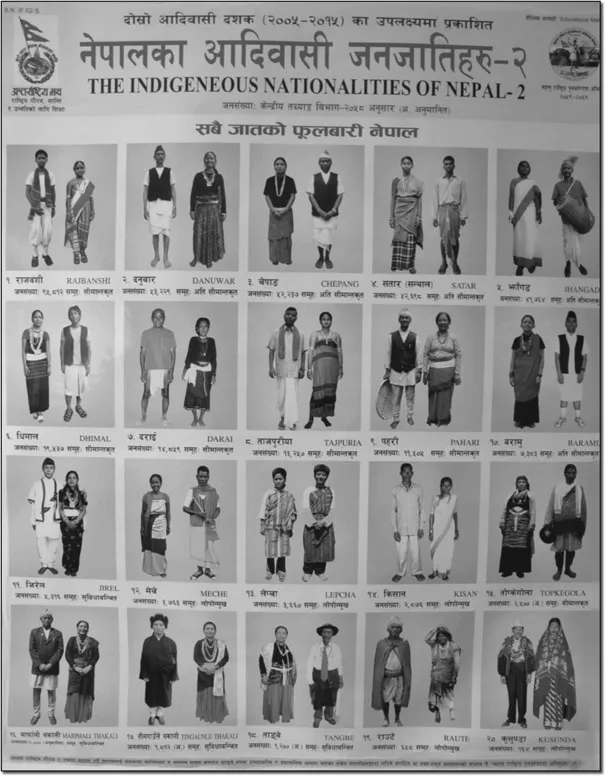
Plate 1.1:Adivasi-janajati Groups of Nepal, published by Nepal Federation of Indigenous Nationalities (NEFIN), 2010.
Source: All photographs in this chapter are by Gérard Toffin.
Ethnic groups were classified as castes (jati) of pure status but relegated to a low rank within the overall hierarchical system (Höfer 1979). Most groups suffered from the new situation. In order to survive, many tribal people were obliged to enrol in the army of East India Company or to migrate to northeastern India. During the post-1951 period, which followed the fall of the Rana rule, most of the higher positions in administration, politics, and economy were still in the hands of Hindu high-castes, namely, Bahun and Chhetri (Gurung 2003, 2006; Lawoti 2005). If we leave aside the Newars who succeeded in maintaining their power by virtue of their brilliant heritage and their location in the Kathmandu Valley, at the heart of the state, and the Thakalis, a small ethnic group commanding an important trade route in the Kali Gandaki zone (western Nepal), most of the groups presently referred to as janajatis were treated as second class citizens. Some were even considered fit to be enslaved, namely, Tharu, Chepang, Hayu, Tamang, etc. Ethnic minorities were underrepresented in the political elite and relegated to subsidiary activities. Today, their disadvantaged position is still deeply resented by janajatis. They consider themselves victims of social and economical discrimination (Bhattachan 1995; Kramer 1995). By and large, one’s vision of Nepal’s history depends on the side one belongs to: the vanquished or the conquerors.
The Janajati Movement may be seen as a response to the country’s strained unification in the nineteenth century and to the complex set of discriminations and inequalities resulting from this situation. It was first launched by individual activists during the late 1980s. Its main national organisation, the Nepal Janajati Mahasang, translated into English as the ‘Nepal Federation of Nationalities’, was founded in 1990, the year the Panchayat party-less system, a disguised form of royal autocracy, collapsed. It serves as a federal umbrella, bringing together several liberation movements (Mukti Morcha) and organisations with various labels (Mongol, Magurali, etc.), each representing one or several ethnic groups. The local translation of janajati as ‘nationality’ most probably came from the Chinese concept of ‘minority nationalities’, shaoshu minzu, used to designate ethnic minorities in the People’s Republic of China. It has indeed very little to do with the sociological term ‘nation’.
Since the 1990s, the Mahasang has been at the forefront of all ethno-political activities. Its adherents intend to promote their respective culture and rectify the discriminations suffered by tribal groups in all spheres of social life. They are demanding a reservation system for seats in the political assemblies and employment in public services (which do not yet exist in Nepal) to ensure better representation at the national level. Similarly, they want their languages to be recognised as national languages, their children to be educated in their mother tongue and all janajati languages recognised for use in state affairs alongside Nepali. More recently, they have also raised issues of human rights, biological diversity, and indigenous knowledge systems (Bennett 2006: 64–66).
In 1996, the Mahasang produced a list of 61 ‘nationalities’ (janajatis) covering all the ethnic minorities of the country, including the Newars. This list, subsequently reduced to 59, was recognised by the government in 2002. It includes ethnic groups from very different economic strata. Some are categorised as ‘backward’ (pichadi) and others as ‘forward’. The Federation tried to reduce this heterogeneity by further proposing a fivefold division of these groups according to their more/less advanced state. In August 2003, the term adivasi (indigenous people, aboriginal) was included in the definition of the movement. The organisation became NEFIN, the ‘Nepal Federation of Indigenous Nationalities’ (Nepal Adivasi Janajati Mahasangh in Nepali) (Onta, 2006: 308–25). The movement was quite successful, even if its representativeness within each ethnic group may be questioned. It has succeeded in mobil-ising members of different groups and enforcing its views. Nepal’s 1990 Constitution explicitly used the term janajati in Article 26, acknowledging their relative social deprivation. The Mahasang can be considered one of the most influential social movements that emerged in the early 1990s. However, no affirmative action has so far been taken in their favour and only modest efforts have been made to use minority languages in newscasts on state-run radio stations.
From an anthropological viewpoint, the ideology of the Janajati Movement relies, however, on obsolete essentialist conceptions. The leaders of these associations contend that everyone belongs to one and only one ethnic or caste group, is born into that group, and cannot change groups during their lifetime. According to these notions, cultures and societies are strictly delineated units, each with its own distinctiveness and sense of belonging. They are viewed as self-contained and unchanging entities, closely associated with a particular tract of land. These ideas nullify the hierarchy and the cultural differences existing within an ethnic group. They are related to an early age of anthropology4 and do not correspond to the newer approaches which highlight the fluidity of ethnic boundaries, their construction over time and the hybridity of various cultures throughout the world. In spite of this, some Nepali anthropologists who were born in one of these ethnic groups such as Om Gurung and K. B. Bhattachan, support these ideas. More specifica...
Table of contents
Cover
Half Title
Title Page
Copyright Page
Dedication Page
Contents
List of Tables
List of Plates and Map
Preface
Introduction: Democracy in the Himalayan Region
Part I. Identity Politics and Democratic Transition
Part II. Development of Democratic Routes
About the Editors
Notes on Contributors
Index
Trusted by 375,005 students
Access to over 1.5 million titles for a fair monthly price.
Study more efficiently using our study tools.
Frequently asked questions
Yes, you can cancel anytime from the Subscription tab in your account settings on the Perlego website. Your subscription will stay active until the end of your current billing period. Learn how to cancel your subscription
No, books cannot be downloaded as external files, such as PDFs, for use outside of Perlego. However, you can download books within the Perlego app for offline reading on mobile or tablet. Learn how to download books offline
Perlego offers two plans: Essential and Complete
Essential is ideal for learners and professionals who enjoy exploring a wide range of subjects. Access the Essential Library with 800,000+ trusted titles and best-sellers across business, personal growth, and the humanities. Includes unlimited reading time and Standard Read Aloud voice.
Complete: Perfect for advanced learners and researchers needing full, unrestricted access. Unlock 1.5M+ books across hundreds of subjects, including academic and specialized titles. The Complete Plan also includes advanced features like Premium Read Aloud and Research Assistant.
Both plans are available with monthly, semester, or annual billing cycles.
We are an online textbook subscription service, where you can get access to an entire online library for less than the price of a single book per month. With over 1.5 million books across 990+ topics, we’ve got you covered! Learn about our mission
Look out for the read-aloud symbol on your next book to see if you can listen to it. The read-aloud tool reads text aloud for you, highlighting the text as it is being read. You can pause it, speed it up and slow it down. Learn more about Read Aloud
Yes! You can use the Perlego app on both iOS and Android devices to read anytime, anywhere — even offline. Perfect for commutes or when you’re on the go. Please note we cannot support devices running on iOS 13 and Android 7 or earlier. Learn more about using the app
Yes, you can access Routeing Democracy in the Himalayas by Vibha Arora,N. Jayaram in PDF and/or ePUB format, as well as other popular books in Politica e relazioni internazionali & Storia dell'India e dell'Asia meridionale. We have over 1.5 million books available in our catalogue for you to explore.