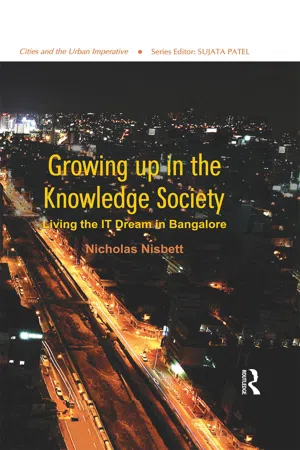
This work is an ethnographic investigation into the everyday lives of young people growing up and living in contemporary Bangalore. Moving beyond the hype of the Indian 'knowledge society', it examines how new forms of technology and outsourced labour become integral to their lives, changing the experience of Indian modernity and globalisation.
- 222 pages
- English
- ePUB (mobile friendly)
- Available on iOS & Android
eBook - ePub
About this book
Information
Chapter 1
Introduction
You can say it’s on top of the world, our IT, Indian IT. So people are just calling, maybe from America, English people, German or Chinese1 people, everyone is coming to India to know how so fast Indian [people have] become so much aware because before 50 years you saw [India was] backward, not yet independent and we didn’t have so much of money, then also. You can say that because of passion, confidence, brain, everything, work hard, you can say the main thing [about] India passion was nobody can touch, because we people like if we want to do something we prove that we can do it. That no one can stop that. That’s what I think.
1 Bill Clinton, Tony Blair, Gerhardt Schroeder and Li Peng had all visited Bangalore between 2000 and 2002 to learn about the software industry.
— Aryan, 22, cybercafé user from Cubbonpet, Central Bangalore
As a young citizen of India,
armed with technology, knowledge and love for my nation,
I realise small aim is a crime.
I will work and sweat for a great vision,
the vision of transforming India into a developed nation,
powered by economic strength with value system.
I am one of the citizens of a billion,
only the vision will ignite the billion souls.
It has entered into me,
the ignited soul compared to any resource,
is the most powerful resource
on the earth, above the earth under the earth.
I will keep the lamp of knowledge burning
to achieve the vision — Developed India.
armed with technology, knowledge and love for my nation,
I realise small aim is a crime.
I will work and sweat for a great vision,
the vision of transforming India into a developed nation,
powered by economic strength with value system.
I am one of the citizens of a billion,
only the vision will ignite the billion souls.
It has entered into me,
the ignited soul compared to any resource,
is the most powerful resource
on the earth, above the earth under the earth.
I will keep the lamp of knowledge burning
to achieve the vision — Developed India.
— President A.P.J. Abdul Kalam (Abdul Kalam 2002: 196)
Aryan’s narrative was offered in response to a question I asked him on the future of the Information Technology (IT) industry in India and the reasons behind its success. I’m not sure if Aryan had ever heard Kalam’s appeal to India’s youth to ‘keep the lamp of knowledge burning’, but the then president of India and a cybercafé user from Bangalore echo each other closely in their exposition of one of the foremost narratives of progress in contemporary urban India. Aryan’s explanation of India’s software success reveals a heady mix of progress (from 50 years ago, backward), pride (it’s on top of the world, everyone is coming to India) and optimism centred on India’s global success in the IT industry. Kalam’s narrative further demonstrates the links of ‘technology, knowledge and love for my nation’ and the ways in which this will help India finally realise that much sought-after goal: to become a developed nation.
Such notions of the information or the knowledge society have become part of the popular lexicon in India — an integral part of popular narratives of progress and of nationalist discourse. For thousands, potentially hundreds of thousands, of Indian middle-class youth who aspire to a place in this privileged new global society, the coupling of knowledge, technology and global economic success, with the promise of individual social mobility, has become something on which to pin their individual hopes and fears regarding a vibrant, yet uncertain, Indian modernity.
Ulf Hannerz has criticised the ‘information society [as] another occidentalist idea’ (Hannerz 1992: 33) and implores theorists to ‘try to give some real attention to the implications of what they are saying to people at the margins of the global ecumene’ (Hannerz 1996: 55). This book, then, is partly an attempt to redress this gap in our knowledge of a city, Bangalore, which although hardly marginal, and rarely out of the media as an instance of the knowledge society in the developing world, has been little investigated from an anthropological perspective. The research is a snapshot of Bangalore in the early twenty-first century, focusing on a group of friends — young, middle-class men, who were aspiring to become part of India’s knowledge society and growing up amidst all the hype and the very real social and economic changes that were occurring in the city. It follows their explorations through the new social spaces of urban consumption and of internet communication, and examines their strategies for social mobility in pursuing jobs in the new software and outsourcing industries.
Those, like my informants, growing up in the milieu of contemporary Bangalore cannot fail to have become aware of IT employment and its associated promises of wealth, modernity, mobility and status. IT has a strongly visible presence in the city, whether in the glass and chrome buildings of foreign multinationals in the centre, or the huge and plush campuses of the Indian multinationals Infosys and Wipro to the south, or in the multitude of companies of all sizes in between, which are spread throughout the city and clustered in and amongst the residential housing of middle-class suburbs such as Jayanagar, Indiranagar and Koramangala. Along the central commercial streets such as MG Road and Brigade Road, rows and rows of brand new Hero Honda and Yamaha motorbikes advertise their owners’ success in acquiring one of the key status markers of the middle-class (male) IT worker. IT companies and their heads, especially public figures such as Naryana Murthy and Azim Premji, have been vocal in their calls to upgrade the city’s infrastructure to meet its global aspirations to ‘make Bangalore’, in the oft-repeated slogan, more ‘like Singapore’. Even outside the clusters of IT companies, residents of Bangalore are witness to the effects of development in the name of IT progress. Existing roads are dug up to lay fibre optic cables, slums are cleared to make way for ever more apartment blocks for IT workers, and peri-urban villages on the outside of the Ring Road now find themselves enveloped by new townships and criss-crossed by new ‘layout’ roads.
Of course, a more objective analysis reveals that the structuring effects of this IT development and its ‘heroic style of architecture’ have been ‘only partial…’ (Nair 2005: 91). The city’s new-found rasion d’etre as an IT hub have led to an underplaying of its significant social problems and urban poverty. IT has been accused of having enclave-like effects within India (D’Costa 2003: 221; Balasubramanyam and Balasubramanyam 1997: 1857) and the distribution of IT-derived wealth in Bangalore has been no less enclave-like. The new roads, flyovers and ‘megaprojects’ that have been constructed as the answer to the city’s numerous planning and infrastructure problems (Benjamin 2000; Heitzman 2004) are notable as much for their seemingly deliberate ignorance of the non-car-driving, non-IT-working public, as for their inability to make a dent in the city’s indomitable traffic. But as Janaki Nair points out, ‘Bangalore…has struck a metropolitan path that is remarkably different from that of older Indian cities such as Calcutta or Bombay’ (Nair 2005). Whilst other metros might well be associated with a diversity of industries and functions, ‘Bangalore’s IT-centricity has imparted a level of visibility to IT professionals and BPO employees that they perhaps do not enjoy in other cities’ (Upadhya and Vasavi 2006: 15) and has thus linked the city’s perceived success or failure to the success of the IT industry and its ability to cope with the belligerent demands that this places on its infrastructure and populace more generally.
Attempting to go beyond the usual journalistic account of shopping malls and beer-drinking IT workers, I sought out sites of access to new technologies which represented the spread of IT-based aspiration beyond the more obvious locations of Bangalore’s IT and outsourcing industries in the IT campuses and offices of the multinationals — and found them in the cybercafés and the IT institutes that have become a ubiquitous presence on Bangalore’s streets. These locales of the acquisition of IT knowledge and of internet access, whilst certainly the preserve of the middle-classes, are not just limited to the elite. I spent close to a year observing and making friends with one group of young men who had colonised a cybercafé in a middle-or lower-middle-class suburb on the edge of the old Cantonment and eight months as a participant in a course at an IT institute in another part of the Cantonment. This work has been augmented with interviews, conversations, observations and friendships with a variety of other people I met during close to 20 months of fieldwork and visits to India between 2001 and 2007. At its core, however, the book remains focused on the cybercafé and the central group of informants I met there.
What has emerged from the fieldwork — much of it spent ‘hanging out’ with the cybercafé friends, is a study covering a range of topics: from internet-based courtship; to the role of social space in the shaping of middle-class identity; to strategies for navigating the IT employment market; to the consumption of alcohol in youth practice and identity. The nexus of capital, labour and technology which form Bangalore’s ‘knowledge industries’ is never far from this examination of everyday practice and narrative; yet this book is not so much an ‘IT ethnography’ as a study of young people rooted in the social space and place of Bangalore, within the historical continuities of middle-class life in the city and the everyday politics of social status and gender.
This introductory chapter begins by examining the global concepts of the knowledge (information/network/post-industrial) society. A fuller explanation of this discourse leads us some way into understanding why it has become such a powerful narrative of progress — not only in India, but globally, as countries vie with each other for recognition of knowledge-society status. Approaches to the topic within India have tended to focus on a science–policy or economic–geography perspective. Here I draw on research developed outside of India to examine what an anthropological approach to the topic — and to a practical strategy of fieldwork — may look like.
These themes are taken up in more detail in Chapter 2 (and indeed throughout the book), which looks at the rise of the specifically Indian version of the knowledge-society discourse. The discourse of the knowledge society and the accompanying excitement over the production and consumption of new media cannot be seen in isolation from the rise of the middle-classes in the popular imagination. In setting the scene for the book’s investigation of middle-class identity in narrative and in practice, this chapter looks also at some of the more recent approaches to the Indian middle classes. Like the IT industry, the middle classes can been seen as both over-representative and yet emblematic of India’s development in the twenty-first century.
Chapter 3 begins by looking at the North Bangalore middleclass background from which my informants were drawn. Many of their English-educated generation have been the beneficiaries of Bangalore’s role in the software and Business Process Outsourcing (BPO) sectors and this chapter looks at the continuities that can be drawn between their selves and their fathers’ generation of industrial factory workers — already something of an industrial elite or ‘labour aristocracy’ (Holmström 1976: 4; Breman 1999: 28) with their own dreams of social mobility via Bangalore’s hi-tech industries of the 1970s. With recruitment slowing or grinding to a halt in these industries, my informants inevitably turned to the city’s burgeoning IT and BPO industries and I briefly describe the growth of these industries in Bangalore as a phenomenon concurrent with my informants’ transition into adulthood.
Some of the key claims of the global knowledge-society discourse, itself a core component of our understandings of globalisation, are the ‘death of distance’ (Cairncross 1997), ‘time–space compression’ (Harvey 1990) and the ‘end of geography’ (Greig 2002). These claims would seem to make the role of physical space and the structuring effects of place redundant. In this introductory chapter and throughout the work I draw on more recent ethnographic approaches to the knowledge society and to the internet in particular, which question this irrelevance of place in the supposedly unconstrained world of ‘cyberspace’. The place-shaping practices in social space and the structuring activity of place (or ‘habitus’) on social practices are indeed core themes of the book and are taken up in Chapters 3 and 4, which examine the social spaces of cybercafés as sites for the performance of middle-class (masculine) identity; and in the extended discussion in Chapter 5 of the ways that courtship is played out in both online and offline social spaces that both erode and yet reinforce the boundaries of geographical and social/gendered space.
The other key claims of the knowledge-society discourse relate to the ability of individuals to transcend their socio-economic background through the accumulation of knowledge and educational capital and through the meritocratic preference of the knowledge industries for candidates who exhibit these competencies. It is hard to properly interrogate these claims without a much wider and intergenerational study. Early works in this field, however, point to the usual suspects — from existing positions of wealth and high social status — finding themselves the most highly coveted and highly paid jobs (Upadhya and Vasavi 2006: 41; Oommen and Meenakshisundararajan 2005; Fuller and Narasimhan 2007a). Lower down the IT hierarchy, however, there is some, albeit limited, room for manoeuvre, and this is where the efforts of most of my informants were concentrated. Chapters 6 and 7 examine the strategies of my informants for social mobility, or more accurately, social reproduction, in detail. I follow their strategies for knowledge and educational capital accumulation (Chapter 6) via the private IT institutes that offer the cultural capital of an IT certificate, and my informants’ attempts to convert this and other capital (Chapter 7) into an IT or BPO job. Whatever their success, the result is a highly tenacious and malleable individual narrative of progress that helps to both shape and to justify individual trajectories within the field.
Overall, this book will disappoint the reader looking for a definitive study of software engineers in Bangalore, the emerging culture of call-centre workers or an exhaustive study of cybercafé users. Several monographs and doctoral theses are emerging to help fill in the picture of new forms of labour and the resultant workplace cultures and practices (Warrier 2003; Upadhya and Vasavi 2006). Those looking for a holistic treatment of Bangalore as a city will be similarly satisfied elsewhere — recent monographs on the city do much to increase our understanding of its social history (Nair 2005) and the physical impact of its IT infrastructure woes (Heitzman 2004; see also Benjamin 2000). Instead, this book’s focus on a limited ethnographic sketch of everyday involvement in IT use and individual trajectories within the IT industry aims, through a fairly detailed account of individual and group narratives, practices and trajectories, to extricate some of the everyday impacts of the knowledge society in contemporary Bangalore, within an overall context of the formation of middle-class, male, youth identity.
Bangalore remains a national exception, but that does not make the experience of my informants examined here irrelevant. This book attempts to argue that the dreams surrounding IT use and employment have become far more widespread than the plush IT campuses, gated communities and gilded shopping malls of Bangalore, Mumbai, Hyderbad or Chennai would suggest. The assumption that the impact of IT in Bangalore, or even India, is limited to a few thousand well-trained, highly-paid individuals from mainly upper-middle-class and forward-caste backgrounds is outdated. IT institutes in the midst of rural Tamil Nadu or Rajasthan (Sood 2002) or on the borders of slums in Bangalore are a demonstration not of the spread of IT-based development, but of the middle-class aspiration to become part of the Indian knowledge society.
The Knowledge Society
The knowledge society is just one of a number of concepts or metaphors (the information age, the network society, the informational economy, cyberspace, the virtual world and so on) that have attempted to explain the changes in human society emerging through the growing use of information, and of information and communication technologies (ICTs), in mediating society, economy and global culture in the last quarter of the twentieth and the beginning of the twenty-first century.
These are not entirely novel concepts. Notions of the information or post-industrial society have been in use since theorists of social mobility in the 1960s and 1970s began to chart the rise of service-sector employment against the declining trends in manufacturing in advanced industrialised societies. A stress on technology and communications as core components of modernity and progress can be traced back further — to the post-enlightenment views of Spencer and the Saint-Simonians (Mattelart 1996: 74).
Frank Webster has carried out one of the most comprehensive surveys of theories relating to the knowledge or information society and divides the main theorists into two camps — those who posit an idea of a new epoch, an information age (Bell, Baudrillard, Poster, Piore, Sable, Hirschhorn, and Castells) and those ‘who place emphasis on continuities’ and believe that the current role of ICTs and information represents a stage of late capitalism and/or modernity (Schiller, Aglietta, Lipietz, Harvey, Giddens, Habermas, and Garnham [Webster 2002: 6]).
The current resurgence of interest in the topic stems from the emergence of the internet in the mid-1990s and the ‘new economy’ boom which accompanied it. One of the key works published at the time, which Webster places in his new epochal camp, was Manuel Castells’ The Information Age trilogy (1997, 2000a, 2000b). Whilst not necessarily representative of the genre, this was one of the most widely read and influential works of the time.
In Castells we see the metaphor of the network writ large upon the world: his thesis is that the network society entails a period of the world’s history in which social, cultural, political and economic processes can be seen as constituting interlinked and interdependent networks. Whilst networks as social organisation pre-existed ICTs, these new technologies have empowered networks as a form of social organisation and decentralised decision-making (Castells 2000b: 5).
According to Castells, the cultural, economic and political implications of the network society are critical and far-reaching. He sees global flows of multimedia, for example, enabled by decentred networks of ICTs, as increasingly shaping a common cultural/symbolic universe. This has its own effects on the political sphere, which becomes m...
Table of contents
- Cover
- Half Title
- Series Page
- Title Page
- Copyright Page
- Dedication Page
- Contents
- List of Figures
- List of Abbreviations
- Acknowledgements
- Chapter 1 Introduction
- Chapter 2 A Genealogy of the Knowledge Society
- Chapter 3 Bangalore and its Cybercafés
- Chapter 4 The Space of Male Friendship
- Chapter 5 Courtship: Online and Off
- Chapter 6 Learning to E-labour
- Chapter 7 Narratives of the Knowledge Society
- Chapter 8 Conclusions
- Bibliography
- About the Author
Trusted by 375,005 students
Access to over 1.5 million titles for a fair monthly price.
Study more efficiently using our study tools.
Frequently asked questions
Yes, you can cancel anytime from the Subscription tab in your account settings on the Perlego website. Your subscription will stay active until the end of your current billing period. Learn how to cancel your subscription
No, books cannot be downloaded as external files, such as PDFs, for use outside of Perlego. However, you can download books within the Perlego app for offline reading on mobile or tablet. Learn how to download books offline
Perlego offers two plans: Essential and Complete
- Essential is ideal for learners and professionals who enjoy exploring a wide range of subjects. Access the Essential Library with 800,000+ trusted titles and best-sellers across business, personal growth, and the humanities. Includes unlimited reading time and Standard Read Aloud voice.
- Complete: Perfect for advanced learners and researchers needing full, unrestricted access. Unlock 1.5M+ books across hundreds of subjects, including academic and specialized titles. The Complete Plan also includes advanced features like Premium Read Aloud and Research Assistant.
We are an online textbook subscription service, where you can get access to an entire online library for less than the price of a single book per month. With over 1.5 million books across 990+ topics, we’ve got you covered! Learn about our mission
Look out for the read-aloud symbol on your next book to see if you can listen to it. The read-aloud tool reads text aloud for you, highlighting the text as it is being read. You can pause it, speed it up and slow it down. Learn more about Read Aloud
Yes! You can use the Perlego app on both iOS and Android devices to read anytime, anywhere — even offline. Perfect for commutes or when you’re on the go.
Please note we cannot support devices running on iOS 13 and Android 7 or earlier. Learn more about using the app
Please note we cannot support devices running on iOS 13 and Android 7 or earlier. Learn more about using the app
Yes, you can access Growing up in the Knowledge Society by Nicholas Nisbett in PDF and/or ePUB format, as well as other popular books in Social Sciences & System Theory. We have over 1.5 million books available in our catalogue for you to explore.