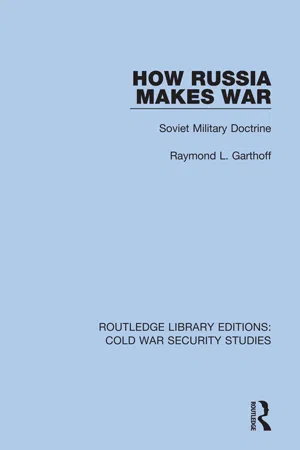
This book, first published in 1954, is a key analysis of the guiding policies, basic assumptions, fundamental principles and methods of the Red Army, in many respects the most powerful force in the Cold War. This analysis examines the strategy and tactics, weapons systems, training, discipline and political doctrine of the Red Army, as well as focusing on the political control of the USSR and its satellite states.
- 604 pages
- English
- ePUB (mobile friendly)
- Available on iOS & Android
eBook - ePub
PART I
BASES OF SOVIET MILITARY DOCTRINE
The military and political strategy and doctrine in the Soviet view are discussed, with detailed consideration of Soviet concepts of military doctrine and a general background survey of the chief influences on its origin and development.
CHAPTER 1
SOVIET STRATEGY, MILITARY DOCTRINE, AND “COLD WAR”
Politics and War
Bolshevism originated as a revolutionary movement with a distinctive image of political relations. In the Bolshevik view of the world, the normal expectation was struggle, a complete struggle to the death between the Bolshevik Party as the vanguard of the oppressed and the capitalist-imperialist oppressors. Originally cast in the Marxian context of class struggle, the Bolshevik seizure of power in Russia in the October (1917) Revolution extended the theater of combat to the “world arena.” Class struggle henceforth acquired a geographic-political dimension, and Bolshevism became an ideology in international relations among states rather than merely the code of a small group of revolutionary Russian exiles.
Soviet military (and political) doctrine is based on a military model of political relations derived from the fundamental Bolshevik conflict-image of the world. The direct application of this “combat frame of reference” to political relations, internal and international, countenancing only perpetual struggle to annihilation, was a revolutionary innovation. Soviet political strategy cannot be understood without acute awareness of this underlying basis.
This “military” conception, oriented on the view of “destroy-or be destroyed,” pervades all Soviet politics, which means all Soviet life. The constant demands to improve the statistical “front,” to build up the moral “reserves” of the “socialist camp,” to increase “vigilance” by the “warriors of the pen,” to increase production by the “shock brigades” of the collective farms and factories—all this military terminology is symptomatic of the thought pattern of militarized politics and the basic combat frame of reference.
Soviet military doctrine shows evidence of certain peculiarities in emphasis probably the result of influences transferred from this Bolshevik political conception, which, of course, preceded the development of military doctrine by one and one-half decades. On some of these points there may be a transfer of nonrational stress, acquired by the Soviet political doctrine as it became sanctified into a secular religion (substituting faith for reason and demanding absolute acceptance). This “religious” compulsion is less strong in military affairs than in perhaps any other walk of life in the USSR. Nonetheless, it affects not only “true believers” in Bolshevism, but pervades all overt thought, indoctrination, and action in the Soviet Union, since disagreement with or modification of Soviet doctrine or policy, as is well known, carries extremely severe sanctions and is hence practically nonexistent. This form of influence may pertain to evaluation of the relative importance of certain types of military behavior (such as a marked stress on flank and rear attacks) and may even affect the military strategy directly; for instance, the selection of “the main blow” of military force may be determined by the Soviet political analysis of “the main link” in the enemy front. For example, the invasion of Finland in 1939 was predicated on an (incorrect) political analysis of internal Finnish political dissension and weakness.
The Soviet world-view accepts completely Clausewitz’ idea that “War is the continuation of politics by other means.” Lenin stressed this many times. Stalin, while repudiating Clausewitz as a military authority,* restated Lenin’s evaluation that Clausewitz had “supported in his works the well known Marxist thesis† of the fact that there exists a direct connection between war and politics, that politics begets war, that war is a continuation of politics by violent means.”1 Soviet doctrine and policy goes far beyond Clausewitz’ idea to a different and supplementary conception of international politics. While fully endorsing and energetically pursuing a policy which takes cognizance of the direct and intimate connection between peacetime and wartime relations, Soviet policy presumes permanent conflict (although not necessarily armed), even in peace.
NOTE: For numbered footnote references, see pp. 447 ff.
* See Chapter 3, pp. 53-56, for these references and for discussion of Clausewitz’ influence on Soviet military doctrine. Marx, Engels, and Lenin all praised him; Stalin says he is now “obsolete.”
† Clausewitz wrote before even Marx was a Marxist.
Thus the Soviet military authority Shaposhnikov declared: “If war is a continuation of politics, only by other means, so also peace is a continuation of struggle only by other means.”2 In this sense, and this is basic to Soviet doctrine and strategy, the distinction between peace and war is obliterated, except for the difference in the degree of armed force used in the perpetual conflict. As Lenin once wrote: “War is the continuation of that same (peacetime) policy with the entry of those changes in the relation of opposed forces which are created by military action.”3 Military action is a planned and controlled segment of the fundamental political strategy. Thus Lenin declared: “War is at the core politics …” and “War is a part of the whole; that whole is politics.”4
War is not the goal of Soviet strategy; the Soviets prefer to gain their objectives by pacific means—by forcing appeasement on the enemy. This consideration holds a significant place in Soviet strategy,* which judges the long-term trends and possibilities in determining what risks are worth taking in the short run. Thus, the Soviet army is generally offensively employed only in situations in which other methods of lesser risk are not considered feasible, but in which a considerable potential for advance is calculated to exist. Although the Soviet armed forces remain the basic instrument for advancing Soviet aims, very wide use is made of supplementary forms of struggle, such as subversion, sabotage, colonial rebellion, and satellite aggression; these are not dependent on a formal state of war or total involvement nor on the risks inherent in total war. (In certain situations, of course, the Politburo has to calculate the possibility of these more limited techniques’ leading to general war.) The Soviet leadership does not consider local armed conflict as necessarily creating total involvement, as the case of the battles with Japan on the Manchurian and Mongolian frontiers in 1934-1939 demonstrates.
* Clausewitz once wrote that “A conqueror is always a peace lover … he would like to make his entry into our state unopposed.” Lenin underscored this line and commented marginally, “Ha, Ha! Pretty smart [ostroumno]!” And Stalin, in his interview with H. G. Wells in 1934, remarked: “Communists do not in the least idealize methods of violence…. They would be very pleased to drop violent methods if the ruling class agreed to give way to the working class.”
The Soviets have always made great efforts in their propaganda to prove their “pacific” intentions. One of the more original of these was an attempt, in 1930, to prove the peacefulness of Soviet policy by comparison with selected nearby capitalist states in terms of soldier power per square kilometer, so that the USSR, with only 27 soldiers per square kilometer, was contrasted with Rumania and Poland having 536 and 806 men per square kilometer, respectively. [See Kadishev, Chto Dolzhen Znat’ Molodoi Krasnoarmeets (“What the Young Red Army Man Should Know”), 13th ed., Moscow-Leningrad, 1930, p. 19.]
The Soviets have always made great efforts in their propaganda to prove their “pacific” intentions. One of the more original of these was an attempt, in 1930, to prove the peacefulness of Soviet policy by comparison with selected nearby capitalist states in terms of soldier power per square kilometer, so that the USSR, with only 27 soldiers per square kilometer, was contrasted with Rumania and Poland having 536 and 806 men per square kilometer, respectively. [See Kadishev, Chto Dolzhen Znat’ Molodoi Krasnoarmeets (“What the Young Red Army Man Should Know”), 13th ed., Moscow-Leningrad, 1930, p. 19.]
Soviet Strategy
Except that they are phases of policy with a differing component of armed force, no distinction between peace and war is meaningful in Soviet doctrine. Similarly, as one Soviet military writer has put it, “Military strategy is part of political strategy. The aims of political strategy are also the aims of military strategy.”5 Military and political strategies are forms of “Soviet strategy” as a whole. Frunze, one of the leading early Soviet military theoreticians, said: “Questions of military strategy, political and economic strategy, are very closely interwoven into a unified whole.”6 Tukhachevsky observed that “The conduct of war has ceased to be an affair of the strategist alone….”7 Another writer, Golubev, declared that “Strategy in the narrow military meaning of the term is a part of political strategy.”8
The most complete understanding of this conception is found in the monumental work Strategy by the early Soviet theorist (and former Imperial major general) A. Svechin.9 Just as war is a continuation of politics, so, he concluded, military strategy is “a continuation, a part of, politics.” Since it is necessary in contemporary affairs that “the highest state power conducts war,” Svechin believed there should be an “integral strategy” (military and political) and an “integral strategist.” Soviet strategy is indeed unified by the identity of the supreme military and political authority (and symbol), Stalin. This is accentuated in Soviet propaganda, which claims: “In Comrade Stalin alone does modern history see for the first time a great leader who combines the genius of a statesman and military leader of a new type.”10
Soviet strategy, in the words of one Soviet general, “is founded on a realistic calculation and analysis of the political, economic, and military factors.”11 In Marxist terms, the dependence of Soviet strategy on such nonmilitary factors is expressed in the following passage: “Strategy … expresses the character and tendency of development of the army and the people, and depends on its economic, political, and cultural development, flowing from the class essence of the state and the level of development of the productive forces.”12 As we shall see in a later discussion of Soviet concepts of military doctrine, the term “military science,” in Marshal Bulganin’s words, “in addition to questions of the military art, concerns questions of the economics and morale capabilities of the country … and the enemy’s country.”13 And according to another writer, “Marxist-Leninist science teaches that politics exerts a decisive influence even on military-strategic plans.”14
The similarity of Soviet military and political doctrines leads to similar or identical considerations in planning and executing military and political strategy. Stalin’s “classical” definitions of strategy and tactics in Marxist-Leninist-Stalinist political ideology are repeated constantly by Soviet military authorities as defining military strategy and tactics, and usually no reference is made to the fact that Stalin’s definitions of these terms were issued in a political context. In this definition, Stalin himself speaks of “the analogy” between political and military strategy and uses military examples to illustrate his political definition. These definitions were formulated by Stalin on several occasions in the 1920’s, most explicitly in his work entitled “On the Strategy and Tactics of the Russian Communists” written in 1923.15 Because of the general unavailability in English and their unique completeness, several passages are reproduced here at some length:
The most important task of strategy is the determination of that basic direction along which the movement of the working class must go, and along which it is most favorable for the proletariat to deliver its main blow to the opponent for the realization of those ends set by the program. The plan of strategy is a plan for the organization of the decisive blow in that direction in which the blow can most quickly give the maximum results.
The basic features of political strategy might easily be sketched without special labor by resorting to analogy with military strategy, for instance, in the period of the Civil War at the time of the fight with Denikin. Everybody remembers the end of 1919, when Denikin stood before Tula. At that time there arose an interesting dispute among the military men over the question of where the decisive attack should be delivered to the armies of Denikin. Certain milit...
Table of contents
- Cover
- Half Title
- Title Page
- Copyright Page
- Original Title Page
- Original Copyright Page
- Preface
- Author’s Note
- Dedication Page
- Contents
- Illustrations
- Acknowledgments
- Introduction
- Part I Bases of Soviet Military Doctrine
- Part II Soviet Principles of War
- Part III Soviet Doctrine on the Operational and Tactical Employment of the Combat Arms
- Appendix I. The Organization of the Soviet Armed Forces
- Appendix II. The Trial by Arms: June to December, 1941
- Glossary of Special Terms
- Footnotes
- Bibliography
- Index
Trusted by 375,005 students
Access to over 1.5 million titles for a fair monthly price.
Study more efficiently using our study tools.
Frequently asked questions
Yes, you can cancel anytime from the Subscription tab in your account settings on the Perlego website. Your subscription will stay active until the end of your current billing period. Learn how to cancel your subscription
No, books cannot be downloaded as external files, such as PDFs, for use outside of Perlego. However, you can download books within the Perlego app for offline reading on mobile or tablet. Learn how to download books offline
Perlego offers two plans: Essential and Complete
- Essential is ideal for learners and professionals who enjoy exploring a wide range of subjects. Access the Essential Library with 800,000+ trusted titles and best-sellers across business, personal growth, and the humanities. Includes unlimited reading time and Standard Read Aloud voice.
- Complete: Perfect for advanced learners and researchers needing full, unrestricted access. Unlock 1.5M+ books across hundreds of subjects, including academic and specialized titles. The Complete Plan also includes advanced features like Premium Read Aloud and Research Assistant.
We are an online textbook subscription service, where you can get access to an entire online library for less than the price of a single book per month. With over 1.5 million books across 990+ topics, we’ve got you covered! Learn about our mission
Look out for the read-aloud symbol on your next book to see if you can listen to it. The read-aloud tool reads text aloud for you, highlighting the text as it is being read. You can pause it, speed it up and slow it down. Learn more about Read Aloud
Yes! You can use the Perlego app on both iOS and Android devices to read anytime, anywhere — even offline. Perfect for commutes or when you’re on the go.
Please note we cannot support devices running on iOS 13 and Android 7 or earlier. Learn more about using the app
Please note we cannot support devices running on iOS 13 and Android 7 or earlier. Learn more about using the app
Yes, you can access How Russia Makes War by Raymond L. Garthoff in PDF and/or ePUB format, as well as other popular books in History & Military & Maritime History. We have over 1.5 million books available in our catalogue for you to explore.