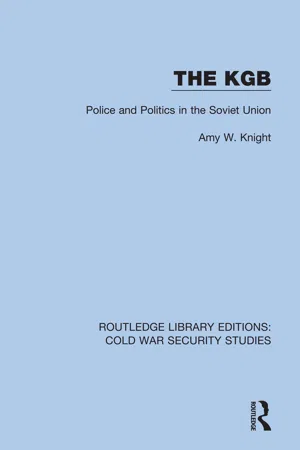
This book, first published in 1990, examines the origins and evolution of the security police, considering the continuities as well as changes in its function as guardian of the regime's security. It analyses the KGB's involvement in Kremlin politics, the structure and organisation of the KGB, its formal tasks and legal prerogatives as set forth by the Party leadership, and the actual functions it performs on behalf of the Soviet regime. Underlying this analysis is an attempt to assess the power and authority of the KGB relative to other political institutions and to explain the crucial dynamics of the Party- KGB relationship.
- 374 pages
- English
- ePUB (mobile friendly)
- Available on iOS & Android
eBook - ePub
I
Origins and Evolution
1
The Origins of the KGB
The Traditional “Police State” of Tsarist Russia
Perhaps the most noticeable feature of Soviet political propaganda is its continual reference to the Bolshevik foundations of the Soviet regime. In stressing their Leninist origins, Soviet leaders attempt to confer legitimacy on themselves, demonstrating that they are carrying on with the goals and purposes of a revolutionary leader who has been revered and sanctified in the minds of the population. Most governments, to be sure, invoke their historical predecessors to arouse feelings of loyalty and patriotism from their citizenry. In the Soviet Union, however, the cult of Lenin and the Bolshevik Revolution is carried much further. In a sense this is appropriate, given how the Soviet regime has evolved since 1917. Political leaders have come and gone; the system has survived the purges and a world war; and great industrial and technological advancements have been made. But the way in which Soviet leaders perform their functions and the institutional foundations upon which the regime rests show strong continuity with the past.
The Soviet political police, known since 1954 as the Committee of State Security (KGB), offers a clear example of this historical continuity. First created in 1917 as the Vecheka, this institution has undergone numerous changes in organization and method, but its underlying purpose—protecting the Soviet state against political subversion—has remained the same. Although Soviet propaganda skirts the period of Stalin’s terror, when the political police exceeded the bounds of party authority and turned against the system itself, the public is constantly, reminded that the KGB is continuing the hallowed traditions of the Vecheka in defending the interests of the state.
In focusing on the historical roots of the KGB, Soviet spokesmen prefer to ignore two important facts. First, when the Vecheka was created in 1917 it was intended only as a temporary institution, to be dissolved when the new regime had defeated its enemies and secured its power. Second, the historical antecedents of the KGB extend back much further than 1917—to the early nineteenth century, when a permanent political police system was first established in Russia.1 Although the tsarist political police was markedly different from its Soviet counterpart, its traditions had a lasting impact. According to one study of Western European police systems, “not only are police systems unique nationally, their distinctive features are relatively impermeable in the face of wars, revolutions and major social and economic transformations. The distinctive characteristics of these police systems have shown remarkable stability over time.”2 This statement is equally applicable to the Soviet Union; its current political police system cannot be properly understood without considering the evolution of the tsarist police, particularly as it related to Russia’s political culture and governmental institutions.
By the middle of the nineteenth century Russia was, by all accounts, a “police state,” not in the modern sense of the term, which connotes all the evils of Nazi Germany and Stalinism, but in the more traditional sense as it applied to certain European states in the eighteenth and early nineteenth centuries. The term “police state” (a translation of the German word polizeistaat) was first used to describe such regimes as Prussia under Frederick II (1712–1786), Austria under Joseph II (1741–1790), and postrevolutionary France (1789–1848). These traditional European police states developed at a time when police functions encompassed not only law and order but a whole range of administrative and welfare tasks. Their rule was by no means arbitrary; it rested upon normalized bureaucratic standards and operated according to well-defined rules and principles. As one scholar expressed it, “the traditional police state was based on a rational division of labour within society and within administration, and its bureaucratic values of order, form and discipline extended from the offices to the citizen in his private as well as his public life.”3 Such states, which incorporated secret political police, spying, and continual encroachments on individual rights in conjunction with both paternalism and enlightenment, were motivated not by evil aims but by a desire to reform and modernize.4
Russia’s monarchical police state was similar in many respects to those that had developed in Western Europe, particularly in the broadly conceived paternalistic role of the police in society. What was different about the Russian model was that it lagged far behind Western Europe in terms of its political evolution and it was also much less efficient. By the middle of the nineteenth century the institutional and theoretical bases of the traditional police state in Western Europe were giving way to democratic influences, and the vast powers of the police were being dispersed. In Russia at this time the foundations of the tsarist police state had only recently been established.
In 1826, following the Decembrist uprising (a conspiracy involving members of Russia’s nobility) Nicholas i formed the so-called Third Section (or Third Department) of the Imperial Chancellery, a political police whose purpose was to protect the state from internal subversion.5 Although the staff of the Third Section was small, numbering from thirty to forty full-time employees, it had a wide net of informers and also controlled a Corps of Gendarmes, or military personnel. This institution was subsequently buttressed by a new criminal code, which appeared in 1845 and dealt extensively with crimes against the state. The codes established for the first time a legal basis through which the government could combat political dissent.
Like its earlier counterparts in Western Europe, the tsarist police state distinguished between the ordinary or “lower” police, whose responsibility, along with numerous administrative and economic tasks, was the enforcement of public order, and the political or “higher” police.6 Despite its greater importance in the eyes of the monarchy, the political police was also burdened with information-gathering and welfare functions that extended well beyond the realm of political surveillance. As a result its role was vague and ill-defined, and its efforts to combat political dissent on the whole were ineffective. As one scholar noted,
Constant interference by the Third Department in all kinds of activities must be considered the chief reason, not only for its unpopularity, but also for its inefficiency. Its officials were overworked, not because political subversion was rife throughout the empire, but because by Nicholas’ wish so many non-political cases engaged their attention.7
The struggle against internal dissent was further constrained by the 1864 reform of the judiciary system, initiated by Alexander ii as part of a broad effort to transform Russia into a Rechtsstaat, or a state based on the rule of law. This reform set up a modern system of courts with judges appointed for life, an independent bar to defend the accused, and public trials by jury for all criminal cases, including those involving political crimes. Taking advantage of the new judiciary system, young radicals and revolutionaries began to use the courtrooms as forums for espousing their political views and often gained enough sympathy from judges and jurors to be treated leniently.8
The last straw for the government was the acquittal of Vera Zasulich, a young female revolutionary who shot (but did not manage to kill) General Trepov, the police chief of St. Petersburg, in March 1878.9 In response to this incident a government committee was set up to deal with the growing threat of revolutionary activities, and special laws were enacted to allow punishment for political crimes without judicial proceedings.10 In August 1880, as part of an effort to improve the effectiveness of the political police, the much discredited Third Section was abolished and replaced by a central Department of State Police under the Ministry of Interior. Its chief responsibility was political crimes, and although its staff consisted of only 161 full-time employees, it had at its disposal the Corps of Gendarmes, numbering several thousand. In addition, the notorious “security sections” (okhrannye otdeleniia) were established in St. Petersburg, Warsaw, and Moscow in 1881, following the assassination of Alexander ii. The Okhrana, as it was known collectively, was to uncover revolutionary groups and to collect evidence against their participants, while formal inquiries were left to the gendarmes. The Okhrana’s operations were largely covert, utilizing nonuniformed agents and informers. The latter penetrated revolutionary organizations under the guise of being radicals while secretly being paid by the police.11
The creation of the Okhrana was accompanied by a government measure that went further than any other to destroy the spirit of the 1864 reform. On 14 August 1881 a decree was issued allowing the minister of interior and governors general to place certain areas of Russia under a state of emergency (called “reinforced safeguard” or “extraordinary safeguard”), giving the police wide latitude in dealing with political dissent by virtually suspending civil rights in the regions under emergency rule.12 The introduction of such extralegal measures, designed not only to persecute those who had broken the law but also to suppress any type of potentially threatening political behavior, was to become common practice in the Soviet period.
However lofty and democratic were the ultimate goals of the revolutionaries, their activities had the effect of strengthening the reactionary tendencies in the government, which rejected the rule of law in favor of stronger political controls. At the same time, government measures to curb the revolutionary movement served only to fuel the fires of radicalism by stimulating the bitterness of those who sought to bring about political change. To be sure, the tsarist political police, particularly in the period after 1905, enjoyed considerable success in using secret agents to penetrate revolutionary parties and groups, where widespread arrests wrought havoc.13 Despite their formidable powers, however, in the end the Russian political police proved incapable of stemming the tide of the revolutionary movement, which by 1905 had reduced the government to a state of paralysis and by 1917 helped to bring it down completely.
The tsarist government took broad steps to strengthen the authority of the political police after the assassination of Alexander n, but this institution was unable to defend the monarchy, for several reasons. First, police operations continued to be inefficient throughout the period up to 1917. As Jacob Walkin points out in his study of political and social institutions under the last three tsars, bureaucratic rivalries and confusion over responsibilities, particularly between the Corps of Gendarmes and the Department of Police, impeded police efforts.14 According to the memoirs of General A. I. Spiridonovich, a former gendarme officer who later (from 1906 to 1916) served in the Okhrana:
The dual subordination of the Corps [of Gendarmes] was very harmful and had a negative effect on its work. The staff was always at war with the [Police] Department and this affected the officers. … Dependent on both the Department and the Staff, officers had to be diplomatic and manoeuver so that work for one institution was not fouled up by the other.15
Police operations were further hampered by the low quality of personnel and the grave deficiencies in their training. Spiridonovich noted bitterly that although there were numerous institutions for training military personnel, there were no corresponding institutions for training gendarmes despite the crucial role these men played in protecting the regime. “This deficiency was scandalous,” he wrote, “and we [the newly recruited gendarme personnel] were astonished.”16 The consequences of this situation could be foreseen by A. A. Lopukhin, chief of the Department of Police from 1902 to 1905. Citing the gendarmes’ complete lack of understanding of the political movements they were dealing with, Lopukhin noted that any societal phen...
Table of contents
- Cover
- Half Title
- Title Page
- Copyright Page
- Original Title Page
- Original Copyright Page
- Dedication Page
- Contents
- Abbreviations
- Acknowledgments
- Introduction
- Part I: Origins and Evolution
- Part II: The Structure of the KGB
- Part III: The Functions of the KGB
- Appendix A: The Soviet Security Police 1917–1987
- Appendix B: Crimes under the Investigative Purview of the KGB
- Appendix C: KGB Central Apparatus 1954–1987
- Appendix D: Leading KGB Cadres: 1958–1962; 1980–1984
- Appendix E: Key KGB Posts in Non-Russian Republics, Moscow, and Leningrad: 1954–1987
- Suggestions for Further Reading
- Index
Trusted by 375,005 students
Access to over 1.5 million titles for a fair monthly price.
Study more efficiently using our study tools.
Frequently asked questions
Yes, you can cancel anytime from the Subscription tab in your account settings on the Perlego website. Your subscription will stay active until the end of your current billing period. Learn how to cancel your subscription
No, books cannot be downloaded as external files, such as PDFs, for use outside of Perlego. However, you can download books within the Perlego app for offline reading on mobile or tablet. Learn how to download books offline
Perlego offers two plans: Essential and Complete
- Essential is ideal for learners and professionals who enjoy exploring a wide range of subjects. Access the Essential Library with 800,000+ trusted titles and best-sellers across business, personal growth, and the humanities. Includes unlimited reading time and Standard Read Aloud voice.
- Complete: Perfect for advanced learners and researchers needing full, unrestricted access. Unlock 1.5M+ books across hundreds of subjects, including academic and specialized titles. The Complete Plan also includes advanced features like Premium Read Aloud and Research Assistant.
We are an online textbook subscription service, where you can get access to an entire online library for less than the price of a single book per month. With over 1.5 million books across 990+ topics, we’ve got you covered! Learn about our mission
Look out for the read-aloud symbol on your next book to see if you can listen to it. The read-aloud tool reads text aloud for you, highlighting the text as it is being read. You can pause it, speed it up and slow it down. Learn more about Read Aloud
Yes! You can use the Perlego app on both iOS and Android devices to read anytime, anywhere — even offline. Perfect for commutes or when you’re on the go.
Please note we cannot support devices running on iOS 13 and Android 7 or earlier. Learn more about using the app
Please note we cannot support devices running on iOS 13 and Android 7 or earlier. Learn more about using the app
Yes, you can access The KGB by Amy W. Knight in PDF and/or ePUB format, as well as other popular books in History & Military & Maritime History. We have over 1.5 million books available in our catalogue for you to explore.