- 256 pages
- English
- ePUB (mobile friendly)
- Available on iOS & Android
eBook - ePub
Floating Island
About this book
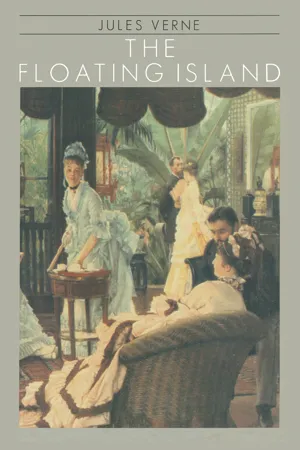
First published in 1990. Although one of Jules Verne's lesser known novels, as part of his 'Extraordinary Voyages' collection, there is still much to enjoy about 'The Floating Island'*. Written in 1895 towards the end of his career this is an adventure novel with elements of sci-fi. A French string quartet traveling from San Francisco to their next engagement in San Diego, is diverted to Standard Island. Standard Island is an immense man-made island designed to travel the waters of the Pacific Ocean. The wealth of residents of the island can only be measured in millions. The quartet is hired to play a number of concerts for the residents during their tour of the islands (Sandwich, Cook, Society, etc.) of the South Pacific. The island seems an idyllic paradise; however, it is an island divided in two. The left half's population is led by Jem Tankerdon and is known as the Larboardites. The right half's population is led by Nat Coverley and is known as the Starboardites. Despite the obstacles encountered on their journey, the two parties have a disagreement that threatens the future of the island itself.
Information
WHEN a journey begins badly it rarely ends well. At least that ought to have been the opinion of the four instrumentalists whose instruments lay on the ground, the carriage in which they were riding having suddenly upset against a mound by the side of the road.
“Anybody hurt?” asked the first, actively springing to his feet.
“I have got off with a scratch,” replied the second, wiping his cheek, striped by a piece of glass.
“And I with a graze,” replied the third, whose calf was bleeding.
There was nothing serious as yet.
“And my violoncello?” said the fourth. “It is to be hoped nothing has happened to my violoncello.”
Fortunately the cases were untouched.
Neither the violoncello, nor the two violins, nor the alto had suffered from the shock, and it was hardly necessary to put them in tune. They were high-class instruments, of course.
“Confound that railway which left us in distress when we had only gone half-way,” said one.
“Confound that carriage which has thrown us out in the open country,” retorted another.
“Just at the moment night was beginning,” added a third.
“Fortunately our concert is announced for the day after to-morrow,” observed the fourth.
Then a few ridiculous repartees were exchanged between the artistes who took their adventure so gaily. One of them, according to his inveterate habit, gave his nonsense a musical twist.
“There is our with the mi on the do.”
“Pinchinat!” exclaimed one of his companions.
“And my opinion is,” continued Pinchinat, “that there are rather too many accidents in this key.”
“Will you be quiet?”
“And that we shall have to transpose our pieces in another carriage!” added Pinchinat.
Yes! rather too many accidents, as the reader will not be slow to learn.
The driver had suffered most, having been pitched off his seat as the front axle broke. The damage was restricted to a few contusions more painful than serious; but he could not walk on account of a sprain. Hence the necessity of finding some means of transport to the nearest village.
It was a miracle, indeed, that somebody had not been killed. The road winds across a mountainous country, skirting high precipices, bordered in many places with deep tumultuous torrents and crossed by fords only passable with difficulty. If the axle had broken a moment sooner the vehicle would have rolled deep down the rocks, and no one could have survived the catastrophe.
Anyhow, the carriage was useless. One of the two horses, whose head had struck against a sharp stone, was gasping on the ground. The other was severely wounded on the quarter; so that there were no horses and no carriage.
In short, ill-fortune had not spared these four artistes, in these regions of Lower California. At this period San Francisco, the capital of the State, was in direct railway communication with San Diego, situated almost on the frontier of the old Californian province. The four travellers were on their way to this important town, where on the next day but one they were to give a concert much advertised and long expected. The night before they had left San Francisco, but when they were within fifty miles of San Francisco the first contretemps had occurred. Yes, contretemps, as the most jovial of the troupe remarked, and the expression might be tolerated on the part of an old master of solfeggio.
The train was stopped at Paschal owing to the line having been swept away by a flood for three or four miles. The accident had occurred but a few hours before, and the communication with the other end had not been organized. The passengers must either wait until the road was repaired, or obtain in the nearest village a vehicle of some sort for San Diego.
And this it was that the quartette decided to do. In a neighbouring village they discovered an old landau, rickety, noisy, and moth-eaten, but not uncomfortable. They hired it from the owner, promised the driver a handsome present, and started with their instruments, but without their luggage, about two o’clock in the afternoon; and up to seven o’clock in the evening the journey was accomplished without much difficulty or fatigue. But here a second contretemps occurred, the upsetting of the carriage, and that with such damage that it was impossible for the said carriage to continue the journey.
And the quartette were a good twenty miles from San Diego.
But why had four musicians, French by nationality, and Parisians by birth, ventured across these out-of-the-way regions of Lower California?
Why? We will tell you in twenty lines, with a few explanatory notes regarding the four virtuosos which chance, that fantastic distributor of parts, was about to introduce among the personages of this extraordinary story.
At this same time a feeling for art had developed among the Americans; and if their productions were of limited number in the domain of the beautiful—if their national genius was still somewhat refractory in painting, sculpture, and music—the taste for good work was, at least, widely spread among them. By purchasing, for their weight in gold, the pictures of old and modern masters for public or private galleries; by engaging, at enormous prices, lyrical and dramatic artistes of renown, instrumentalists of the highest talent, they had infused among themselves that sense of beautiful and noble things which they had been in want of so long.
As regards music, it was by listening to Meyerbeer, Halévy, Gounod, Berlioz, Wagner, Verdi, Massé, Saint-Saëns, Reyer, Massenet, Delibes, the famous composers of the second half of the nineteenth century, that the dilettanti of the New Continent first awoke to enthusiasm. Then gradually they advanced to the comprehension of the profounder work of Mozart, Haydn, Beethoven; mounting back to the sources of the sublime art which expanded to full flood in the course of the eighteenth century. After the operas, the lyric dramas; after the lyric dramas, the symphonies, sonatas, and orchestral pieces. And, just at the moment we speak of, the sonata was the rage among the different States of the Union. The people would willingly have paid so much a note—twenty dollars a minim, ten dollars a crotchet, five dollars a quaver.
When this infatuation was at its height, four instrumentalists of ability conceived the idea of tempting success and fortune in the United States of America. Four excellent fellows, old pupils of the Conservatoire, well known in Paris, much appreciated by the audiences of what is known as “chamber music,” which was then little known in North America. With what rare perfection, what marvellous time, what profound feeling, they interpreted the works of Mozart, of Beethoven, of Mendelssohn, of Haydn, of Chopin, written for four-stringed instruments, a first and second violin, alto, and violoncello. Nothing noisy, nothing showy, but what consummate execution, what incomparable virtuosity! The success of the quartette was all the more intelligible, as at the time people were beginning to tire of formidable harmonic and symphonic orchestras. That music is only an artistic combination of sonorous waves may be true, but there is no reason why these waves should be let loose in deafening tempests.
In short, our four instrumentalists had decided to introduce the Americans to the gentle and ineffable delights of chamber music. They set out together for the New World, and for two years the dilettanti Yankees had spared them neither cheers nor dollars. Their matinées and soirées were well attended. The Quartette Party, as they called themselves, were hardly able to accept their invitations from the wealthy. Without them there was no festival, no meeting, no rout, no five o’clock teas, no garden parties worth talking about. This infatuation had put a good deal of money in the pockets of the fortunate four, and if they had placed it in the Bank of New York it must have constituted a fairly large capital. But why should we not confess it? They had spent their money freely, had these Americanized Parisians! They never thought of saving, did these princes of the bow, these kings of the four strings! They enjoyed to the full this life of adventure, sure of meeting everywhere and always with a good welcome and a profitable engagement. They had travelled from New York to San Francisco, from Quebec to New Orleans, from Nova Scotia to Texas, living rather a Bohemian life—that Bohemia of the young which is the most ancient, the most charming, the most enviable, the most loved province of our old France! We are much mistaken if the moment has not come to introduce them individually to those of our readers who never had, and never will have, the pleasure of listening to them.
Yvernès—first violin—thirty-two years old, above the medium height, slight in build, fair, curly hair, smooth face, large black eyes, long hands, made to stretch to any extent over his Guarnerius, of elegant bearing, wearing a flowing cloak of some dark colour, and a high silk hat, somewhat of an attitudinizer perhaps, the most careless of the four, the least troubled about matters of interest, in all respects the artiste, an enthusiastic admirer of beautiful things, a virtuoso of great talent and great promise.
Frascolin—second violin—thirty years old, short, with a tendency to stoutness—which he by no means liked—brown in hair and brown in beard, big in the head, black eyes, and a long nose, marked at the side with red by the pinch of his gold eyeglasses—which he could not do without—a good fellow, good natured in every way, acting as the banker of the quartette, preaching economy, and never listened to, not at all envious of the success of his comrade, having no ambition of being promoted as solo violin, excellent musician nevertheless—and then wearing but a simple dust coat over his travelling suit.
Pinchinat—alto, commonly addressed as “his highness” —twenty-seven years of age, the youngest of the troupe, the most frolicsome too, one of those incorrigibles who are boys all their life, a fine head, intelligent eyes, always wideawake, hair approaching to red, pointed moustache, teeth white and sharp, tongue never still, never tired of puns and nonsense, and alert for repartee, invariably goodhumoured, for ever making light of the discomforts that fell to his comrades, and therefore continually being reprimanded and taken up short by the chief of the Quartette Party.
For it had a chief, the violoncellist, Sebastien Zorn, chief by his talent, chief by his age, for he was fifty, short, rotund, hair abundant, and curled on the temples, moustache bristling, and losing itself in the whiskers which ended in points, complexion brick red, eyes gleaming through the glasses of his spectacles, which he doubled by means of an eyeglass when he read music, hands plump, the right accustomed to the undulatory movements of the bow, ornamented with large rings on the second and little finger.
This slight sketch is probably sufficient description for the man and the artiste, but one cannot with impunity for forty years hold a sonorous box between one’s knees. It affects one’s whole life, and the character is influenced. Most violoncellists are talkative and quick tempered, impetuous and domineering, and such was Sebastien Zorn, to whom Yvernès, Frascolin, and Pinchinat had willingly abandoned the management of their musical tour. They let him say what he liked, and do what he liked, for they understood him. Accustomed to his imperious manners, they laughed when he “outran the measure”—which is regrettable in the case of an executant, as was remarked by the irrepressible Pinchinat. The composition of the programmes, the direction of the routes, the correspondence with the managers, devolved on him, and permitted his aggressive temperament to manifest itself under a thousand circumstances. Where he did not interfere was with regard to the receipts and the management of the purse, which formed the particular duty of the second violin and chief accountant, the exact and careful Frascolin.
The quartette are now introduced as if they were before you on a platform. We know the types, if not very original, at least very distinct, of which it was composed. As the reader allows the incidents of this strange history to unroll themselves he will see to what adventures were destined these four Parisians, who, after receiving so many bravos throughout the States of the American Confederation, were to be transported.
But let us not anticipate, “not hurry the movement,” as “his highness” would exclaim, and let us have patience.
The four Parisians then, at eight o’clock this evening, were on a deserted road in Lower California, near the ruins of their overturned carriage. The chief of the quartette was violently angry. Why not? Yvernès pretended that he was descended from Ajax and Achilles, those two illustrious angry heroes of antiquity.
Let it not be forgotten that though Zorn might be bilious, Yvernès phlegmatic, Frascolin quiet, and Pinchinat of superabundant joviality, all were excellent comrades, and felt for each other like brothers. They were united by a bond which no dispute or self-love could break, by a community of taste originating from the same source. Their hearts, like well-made instruments, always kept in tune.
While Zorn fretted and fumed, and patted the case of his violoncello to make sure that it was safe and sound, Frascolin went to the driver.
“Well, my friend,” he said; “what are we to do now, if you please?”
“What you can do when you have neither a carriage nor a horse, and that is to wait.”
“Wait for what comes,” said Pinchinat.
“And if nothing comes?”
“We must look for it,” said Frascolin, whose practical mind never failed him.
“Where?” roared Zorn, in a great state of agitation.
“Where it is,” the driver.
“Is that the way you ought to answer?” said the ’cellist, in a voice that gradually mounted towards the high notes. “What! A clumsy fellow who pitches us out, smashes his carriage, lames his horses, and then contents himself with saying, ‘ Get out of it as you like!’”
Carried away by his natural loquacity, Zorn began to launch forth into an interminable series of objurgations, all of them of no use, when Frascolin interrupted him,—
“Allow me, old Zorn.”
And then, addressing himself to the driver, he asked,—
“Where are we, my friend?”
“Five miles from Freschal.”
“A railway station?”
“No, a village near the coast.”
“Where can we find a carriage?”
“A carriage, nowhere—perhaps a cart.”
“A bullock cart, as in Merovingian times!” ex...
Table of contents
- Cover
- Half Title
- Title Page
- Copyright Page
- Introduction
- Part I
- Part II
Trusted by 375,005 students
Access to over 1.5 million titles for a fair monthly price.
Study more efficiently using our study tools.
Frequently asked questions
Yes, you can cancel anytime from the Subscription tab in your account settings on the Perlego website. Your subscription will stay active until the end of your current billing period. Learn how to cancel your subscription
No, books cannot be downloaded as external files, such as PDFs, for use outside of Perlego. However, you can download books within the Perlego app for offline reading on mobile or tablet. Learn how to download books offline
Perlego offers two plans: Essential and Complete
- Essential is ideal for learners and professionals who enjoy exploring a wide range of subjects. Access the Essential Library with 800,000+ trusted titles and best-sellers across business, personal growth, and the humanities. Includes unlimited reading time and Standard Read Aloud voice.
- Complete: Perfect for advanced learners and researchers needing full, unrestricted access. Unlock 1.5M+ books across hundreds of subjects, including academic and specialized titles. The Complete Plan also includes advanced features like Premium Read Aloud and Research Assistant.
We are an online textbook subscription service, where you can get access to an entire online library for less than the price of a single book per month. With over 1.5 million books across 990+ topics, we’ve got you covered! Learn about our mission
Look out for the read-aloud symbol on your next book to see if you can listen to it. The read-aloud tool reads text aloud for you, highlighting the text as it is being read. You can pause it, speed it up and slow it down. Learn more about Read Aloud
Yes! You can use the Perlego app on both iOS and Android devices to read anytime, anywhere — even offline. Perfect for commutes or when you’re on the go.
Please note we cannot support devices running on iOS 13 and Android 7 or earlier. Learn more about using the app
Please note we cannot support devices running on iOS 13 and Android 7 or earlier. Learn more about using the app
Yes, you can access Floating Island by Jules Verne in PDF and/or ePUB format, as well as other popular books in Art & Art General. We have over 1.5 million books available in our catalogue for you to explore.