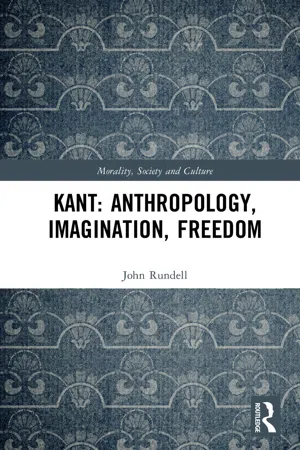
In a new reading of Immanuel Kant's work, this book interrogates his notions of the imagination and anthropology, identifying these – rather than the problem of reason – as the two central pivoting orientations of his work. Such an approach allows a more complex understanding of his critical-philosophical program to emerge, which includes his accounts of reason, politics and freedom as well as subjectivity and intersubjectivity, or sociabilities. Examining Kant's theorisation of the complexity of our phenomenological existence, the author explores his transcendental move that includes reason and understanding whilst emphasising the importance of the faculty of the imagination to undergird both, before moving to consider Kant's pluralised, transcendental notion of freedom. This outstanding book will appeal to scholars with interests in philosophy, politics, anthropology and sociology, working on questions of imagination, reason, subjectivities and human freedom.
- 188 pages
- English
- ePUB (mobile friendly)
- Available on iOS & Android
eBook - ePub
Kant: Anthropology, Imagination, Freedom
About this book
Information
1 Freedom as release from self-incurred tutelage
The unsociable sociability of civilisation
Kant contests and systematically addresses Rousseau’s ambitious and Jacobin notion of freedom, which is conceptually imbedded in the general will. Rousseau wishes to dissolve two of the conditions of modern society: its life of private self-interest which is usually associated with the market and organised at the expense of others, and a public life where opinion about politics is expressed with others in impersonal and dispassionate discussion. In Rousseau’s view, both are open to the permanent play of corrupting and non-virtuous forces. In The Social Contract especially Rousseau asserts that self-love and politics qua empathy and sympathy can only come together through the love of the common good, rather than through discussion and argument.1 Rousseau’s modern goal in The Social Contract at least is to create a new basis of identity beyond corruptibility and thus rescue freedom from egoistic interpretations and place it under a broader umbrella of the ‘common self’ or the ‘general will’. It is here that virtue and harmony come together in a politicised union. The Rousseauian ‘republique’ made real in some of the models of the French revolution symbolises a fusion of virtue, self, politics and nation, which causes the grey areas between each of them to disappear crucially including the ‘grey’ space of the public sphere.
The result, for many commentators including Kant and Schiller, is a deeply problematic and re-sacralisation of politics, which is also equated with a claim to transparency.2 The ‘general will’ is exactly that – both sacred and transparent. There are no hidden corners. It is also demagogic. From Rousseau’s perspective representative democracy is partial, unvirtuous and opaque and cannot represent the general will in its totality. Only unmediated, participatory democracy can be virtuous and transparent, where the political citizen is both performer and spectator, taking his or her place in the public theatres and festivals of the political. Everybody represents themselves and everybody else, where everyone is on display to be judged in a relentless festival of what Foucault would later term in a slightly different context, perpetual surveillant self-governmentality.3 Moreover, in order for these public spectacles and festivals to be coherent and for the members of society to identify and participate in them they must be clearly defined and clearly laid out. They must have a catechism of belief that also indicates those who are corrupt and not yet harmonised. The catechism, rather than constitution, is created by the most virtuous of all, the new politicised intellectuals who are the ones with virtue, with judgement.4
Kant cannot accept Rousseau’s starting point of the distinction between the pre-civilisational, natural and uncorrupted state of human existence and the civilisational corrupted one that results in Rousseau’s almost post-civilisational version of virtuous transparency in the politically unmediated republic. Nor can he accept the mergent and impositional nature of human action that Rousseau posits through his own notion of the general will. Rather, in Kant’s view, we are always and already in civilisation, that is in society, and because of this we are always in and amongst other human beings – not always happily or freely; more often in conditions of unsociable sociability. For Kant, we are social creatures and not ones born of instinct or habit alone, but ones who can also act according to thought and judgement. The question he asks is: how does this thinking and judgement occur?
In answering this question from the vantage point of unsociable sociability another dimension enters in Kant’s work in addition to that of the faculties of the understanding, reason and imagination that ground thinking and judgement – that of history. In order for Kant to theorise the unsociable sociability of our very human condition he must also simultaneously enquire into our political and thus historical condition. The ‘introduction’ of historical questions and themes in Kant’s work that post-dates The Critique of Pure Reason represents, as one commentator has noted, his ‘other Copernican revolution’.5 This other Copernican revolution helps to pinpoint a fundamental distinction within his critical philosophy; one that pertains to the principles of cognition through the faculty of the understanding, and the other that pertains to the problem of practical reason from the standpoint of its historico-cultural contextualisation. Kant’s second Copernican revolution enables him to make conjectures about human history and progress, conjectures which call on the work of the imagination and not only reason to propel them into life.
Let’s turn to Kant’s image of unsociable sociability from the vantage point of his second Copernican revolution before turning to the question of Enlightenment as release from self-incurred tutelage.
In an essay written in 1798 that also follows on from his 1786 ‘Conjectural Beginning of Human History’ Kant asks the question ‘Is the Human Race Constantly Progressing?’ Whilst his answer is, unsurprisingly, affirmative, it is, nevertheless, also critical. As in the earlier 1786 essay Kant disavows both natural and theological histories of humankind. For him, the human world (which he distinguishes, according to first principles, from the natural world) is one of contingent social relations of unsociable sociability. Violence, cruelty and little evils are as much a part of the human condition as perpetual peace.6 The primary issue for Kant, then, is how human beings live together in this permanent condition of unsociable sociability. This is the topic of his ‘Idea for a Universal History from a Cosmopolitan Point of View’.
According to Kant, unsociable sociability constitutes the basic tension that human beings establish between themselves. In other words, human beings are torn between a tendency towards isolation, selfishness and an opposition to others, and a tendency towards social intercourse, which in this context is viewed by Kant initially as a passive absorption in, and identity with, general social life and the opinions of others. For Kant the tension between mutual opposition and society, far from being an unsettling and disordering one, is fundamentally instructive and fecund. Kant transposes contemporary images of individualism into images of creativity. According to him, the knowledge and aggression that mutual opposition generates, and which stems from a desire to both be separate from others and control them, leads to creative activity. At one level, it is irrelevant for Kant whether this activity takes the form of the art of war, the creation of works of art, or creating democratic constitutions. At another level, it is not. Unlike either the Rousseauian image of the noble savage or the Robinsonade image of the isolated human being, this creativity only flourishes when this tension between mutual opposition and society is at its greatest.
There are two lines of thought in this deceptively straightforward image: creativity, which belongs to social subjects, and civilisation, which alludes to the social forms in which creativity may flourish or wither. As we shall see in Chapter 5, these two lines of thought come together, for Kant, in the creation of a republic with an active citizenry.7 This tension, though, for Kant, is the most important, but most difficult part of the story, because it is simultaneously a tension between freedom – the principal end of sociability – and the limitations that are placed on freedoms in the context of unsociability.8
For Kant, the construction of limits, which are then imposed as external forces upon others who are excluded from the political processes of deciding what these limits are, is a form of tyranny. Limits, should, for Kant, be constructed internally. From a political perspective this means that limits should be constructed from within political society itself, and from an anthropological perspective, from within the subject. Each amount to a form of self-mastery – Kant’s image of the Enlightenment. Kant puts forward his own definition of the Enlightenment as ‘[humankind’s] release from its self-incurred immaturity. Immaturity is the inability to use one’s understanding without the guidance of another. It is a state of passivity. This immaturity is self-incurred if its cause is not lack of understanding, but lack of resolution and courage to use it without the guidance of another. The motto of enlightenment is therefore: Sapere aude! Have courage to use your own understanding!’9
In the light of this definition, Kant makes a distinction between cultivation, civilite/civilisation and maturity. Cultivation refers to the activities of higher learning, particularly in the arts and sciences and learning about oneself; civilisation/civilite refers not only to society, but also to courtesy and manners (of which Kant mentions we have an abundance of); maturity refers to the condition of generalised freedom. In this context, it is not a move from savagery to civilisation that Kant has in mind, but one from barbarism to maturity. For Kant, barbarism does not refer to an image of primitivism, but quite specifically to an image of tyranny. From a political perspective this maturity or self-mastery comes about by putting into place a civil constitutional state, where civil society determines the state, and not the other way around. Through this, freedom will be maximised, and violence and tyranny minimised.10
Kant grounds this claim of maturity in a notion of reason that is transcendentally constructed. He wishes to introduce a first principle upon which it can be grounded in order to give it stability, solidity and universality. He establishes this first principle in reason, which he posits as ...
Table of contents
- Cover
- Half Title
- Series Page
- Title Page
- Copyright Page
- Dedication
- Table of Contents
- Acknowledgments
- Introduction: a pragmatic anthropology with imaginative intent
- 1 Freedom as release from self-incurred tutelage
- 2 Anthropological investigations: difficult selves
- 3 The critique of impure reason: the schematic imagination
- 4 The harmony and dissonance of the beautiful and the sublime
- 5 Kant’s political-cosmopolitan notion of freedom: freedom, society and politics in the context of unsociable sociability
- 6 Creating sociable sociability: practical imagining
- 7 Difficult selves, imagination and blurred sketches of freedom
- References
- Index
Trusted by 375,005 students
Access to over 1.5 million titles for a fair monthly price.
Study more efficiently using our study tools.
Frequently asked questions
Yes, you can cancel anytime from the Subscription tab in your account settings on the Perlego website. Your subscription will stay active until the end of your current billing period. Learn how to cancel your subscription
No, books cannot be downloaded as external files, such as PDFs, for use outside of Perlego. However, you can download books within the Perlego app for offline reading on mobile or tablet. Learn how to download books offline
Perlego offers two plans: Essential and Complete
- Essential is ideal for learners and professionals who enjoy exploring a wide range of subjects. Access the Essential Library with 800,000+ trusted titles and best-sellers across business, personal growth, and the humanities. Includes unlimited reading time and Standard Read Aloud voice.
- Complete: Perfect for advanced learners and researchers needing full, unrestricted access. Unlock 1.5M+ books across hundreds of subjects, including academic and specialized titles. The Complete Plan also includes advanced features like Premium Read Aloud and Research Assistant.
We are an online textbook subscription service, where you can get access to an entire online library for less than the price of a single book per month. With over 1.5 million books across 990+ topics, we’ve got you covered! Learn about our mission
Look out for the read-aloud symbol on your next book to see if you can listen to it. The read-aloud tool reads text aloud for you, highlighting the text as it is being read. You can pause it, speed it up and slow it down. Learn more about Read Aloud
Yes! You can use the Perlego app on both iOS and Android devices to read anytime, anywhere — even offline. Perfect for commutes or when you’re on the go.
Please note we cannot support devices running on iOS 13 and Android 7 or earlier. Learn more about using the app
Please note we cannot support devices running on iOS 13 and Android 7 or earlier. Learn more about using the app
Yes, you can access Kant: Anthropology, Imagination, Freedom by John Rundell in PDF and/or ePUB format, as well as other popular books in Social Sciences & Idealism in Philosophy. We have over 1.5 million books available in our catalogue for you to explore.