The sustainability of tourism is increasingly under question given the challenges of overtourism, COVID-19 and the contribution of tourism to climate and environmental change. Degrowth and Tourism provides an original response to the central problem of growth in tourism, an imperative that has been intrinsic within tourism practice, and directs the reader to rethink the impacts of tourism and possible alternatives beyond the sustainable growth discourse.
Using a multi-scaled approach to investigate degrowth's macro effects and micro indications in tourism, this book frames degrowth in tourism in terms of business, destination and policy initiatives. It uses a combination of empirical research, case studies and theory to offer new perspectives and approaches to analyse issues related to overtourism, COVID-19, small-scale tourism operations and entrepreneurship, mobility and climate change in tourism. Interdisciplinary chapters provide studies on animal-based tourism, nature-based tourism, domestic tourism, developing community-centric tourism and many other areas, within the paradigm of degrowth.
This book offers significant insight on both the implications of degrowth paradigm in tourism studies and practices, as well as tourism's potential contributions to the degrowth paradigm, and will be essential reading for all those interested in sustainable tourism and transformations through tourism.
Linda Lundmark, Jundan Jasmine Zhang and C. Michael Hall
Introduction
As an industry and a social practice that is based on people’s ability to move from place to place, tourism requires continual rethinking and reconceptualising. Com-modified cultural souvenirs; local residents displaced from neighbourhoods that have become tourism precincts; overcrowded tourists’ destinations even at remote destinations like the High Arctic and the Antarctic; and not least constant flights, cruise ships and other tourism traffic emitting greenhouse gases into the atmosphere, are all signs of ‘mass tourism’ or, at worse, ‘overtourism’ (Phi, 2019; Adie, Falk, & Savioli, 2020; Sæþórsdóttir, Hall, & Wendt, 2020; Veríssimo, Moraes, Breda, Guizi, & Costa, 2020). This abruptly came to a halt in early 2020 when the novel coronavirus COVID-19 put many mobilities, economies and societies on hold (Gössling, Scott, & Hall, 2020). As a result, a number of researchers have argued that this pandemic provides an opportunity to rethink tourism practices, particularly the more unhealthy and unsustainable aspects of tourism (Cheer, 2020; Hall, Scott, & Gössling, 2020; Everingham & Chassagne, 2020; Renaud, 2020). Importantly, the impacts of COVID-19 on tourism throughout the world and its social, economic and environmental repercussions actually provide even more of a justification to move beyond tourism business as usual to suggest that a radical reform is both necessary and possible to bring to the global tourism agenda. As a result, it is therefore not surprising that a growing number of commentators argue that a degrowth perspective is more relevant than ever today for tourism businesses and destinations, and that tourism can also contribute to a more economically and environmentally equitable society (Hall, 2019; Higgins-Desbiolles, Carnicelli, Krolikowski, Wijesinghe, & Boluk, 2019), especially in the post COVID-19 era (Everingham & Chassagne, 2020).
Although this book was put into production prior to COVID-19 – stirring up the many messy and unsettling discussions on economy, environmental changes and healthcare systems that have been witnessed – the contributors to this book did come together from the common concern for the future of our planet and society. This anthology aims to provide new perspectives on tourism practice and theory from the paradigm of degrowth. Drawing on conceptual and empirical studies, this edited book crosses disciplinary boundaries and attempts to further integrate degrowth paradigms into tourism studies. At the same time, we also hope that the stories and voices coming through the chapters may contribute to the wider discussions among degrowth-interested groups and scholars.
The development of the degrowth concept is situated in a number of discourses of transition and shares similarities with many transition initiatives around the world (Escobar, 2015). Arguably, the contemporary degrowth concept is unique because it criticises the ‘growth imperative’ or growthism which is embedded within the dominant notion of development and modernity, including sustainable development (Demaria, Schneider, Sekulova, & Martinez-Alier, 2013; Hall, 2019). In many ways, degrowth’s promise and proposals speak to UNDP’s Agenda 2030 and the Sustainable Development Goals (SDGs) (see also Chapter 14, this volume). For instance, it advocates for the reduction of working hours, co-housing, voluntary simplicity and downshifting to promote the transition from a materialistic lifestyle towards a more participatory and environmental friendly society, while proposals on enhancing public services and redistributive taxation and including cooperative and circulative economy aim to bring more equity and socio-economic opportunities to more people (Cosme, Santos, & O’Neill, 2017). However, it is important to stress that degrowth is not a single voice, as diverse actors and movements are concerned with subjects ranging from ecological economics, technologies, and political ecology and economy to indigenous knowledge and green theology (Paulson, 2017). This diversity is also noticeable in the various chapters in the present work. Furthermore, degrowth is approached at different scales, for example, at that of individual consumers and entrepreneurs, through to businesses and communities and, in a tourism context, destinations and business networks. These different scales also provide insights into some of the ideological tensions that exist with respect to perspectives on degrowth, especially in a tourism context, and the extent to which the market and proposals for green growth are able to meet degrowth goals.
This introduction is divided into three main sections. The first part provides a broad overview of the degrowth literature via a scoping review of how the notion of degrowth has grown as a research subject in general and in tourism studies in particular. The second section then examines some of the main implications and challenges of employing degrowth in tourism research and the potential link to practice. The final section introduces the reader to the various chapters in this book and how they resonate with some of the identified implications and challenges.
Degrowth in tourism research
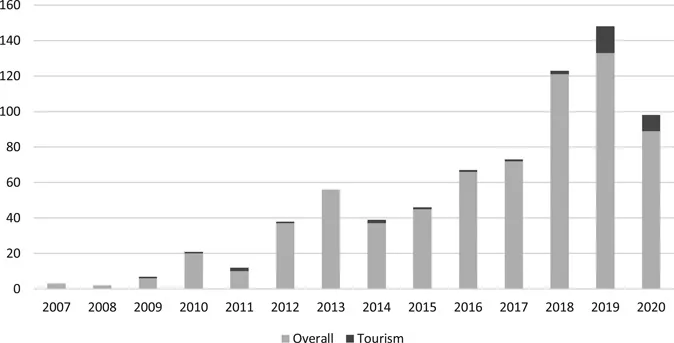
The topic of degrowth has substantially expanded in terms of the number of publications in just over a decade. A comprehensive review of all of those is not within the scope of this introductory chapter, but a brief bibliometric review of degrowth literature can help provide an overview of knowledge production derived from the notion of degrowth, as well as how issues of degrowth within tourism studies relate to the overall development of the degrowth paradigm. Following the PRISMA (Preferred Reporting Items for Systematic Reviews and Meta-Analyses) guidelines and applying search terms such as degrowth, de-growth and décroissance on Scopus and Web of Science (WoS), a list of 671 eligible peer-reviewed records was identified, of which 36 records fall within the field of tourism. Figure 1.1 shows how the peer-reviewed publications including the aforementioned keywords in their titles, abstracts and keywords have grown since 2007. It also clearly shows that the period 2018–2020 witnessed a major growth of degrowth-related publications within tourism studies.
Figure 1.1 Number of degrowth publications overall and in tourism every year in Web of Science and Scopus
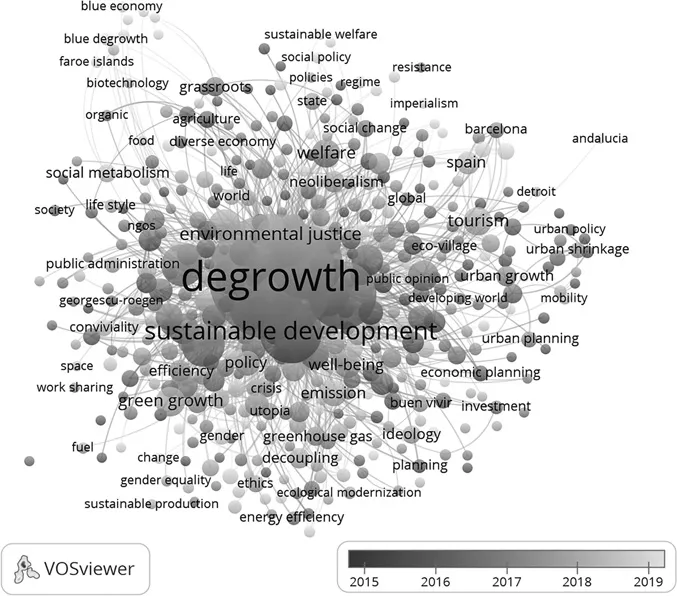
As a term originally used by scholars and activists to critique the ideology and costs of growth-based development (Kallis et al., 2018), degrowth has been increasingly and extensively applied in different domains and with different foci. Using the software VOSviewer 1.6.14 for sourcing and analysing information on important themes, scholarly relationships, and research networks and communities (van Eck & Waltman, 2020), Figure 1.2 illustrates the diversity of keywords used in the degrowth literature and how the focus can change over time.
Figure 1.2 The diversity of keywords used in the degrowth literature and change in focus over time
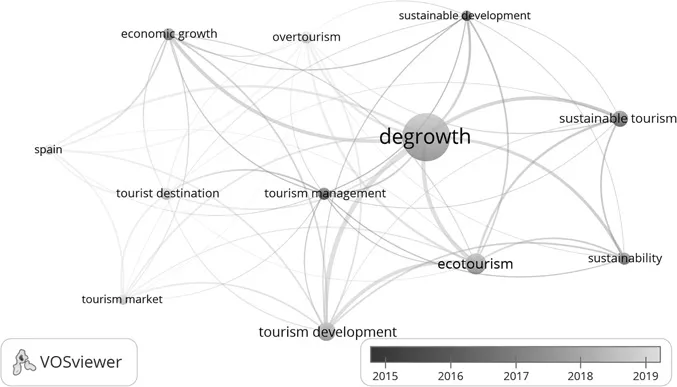
As shown in Table 1.1, the most frequently used keywords in the general degrowth literature (used 28 times or more) are mainly concerned with sustainability and economic (growth) matters. Climate change appears in tenth place. Mirroring the roots of the degrowth paradigm, capitalism occurs 49 times. In the smaller selection of degrowth and tourism literature, one interesting difference is that sustainable development and sustainability did not make it into the ten most frequently used keywords, although sustainable tourism is in ninth place. The issue of overtourism, although appearing rather recently, is in fifth place followed by Spain, showing the focus that has been on problems created by tourism in the Barcelona region (e.g. Ramos & Mundet, 2020).
Table 1.1 The top 12 most frequently occurring keywords used in the identified records in Scopus and Web of Science
Keywords overall
Number of occurrences
Total link strength
Keywords tourism
Number of occurrences
Total link strength
Degrowth
432
534
Degrowth
23
53
Sustainability
150
290
Tourism development
9
36
Economic growth
128
248
Ecotourism
10
35
Sustainable development
106
207
Economic growth
6
24
Economics
52
104
Overtourism
6
24
Growth
48
101
Spain
5
21
Ecological economics
43
100
Tourism management
6
20
Capitalism
49
94
Tourist destination
6
20
Transition
36
87
Sustainable tourism
8
19
Climate change
44
80
Tourism market
5
19
Post-growth
29
75
Sustainability
6
18
Environmental justice
28
61
Sustainable development
5
17
Note: Analysed in VOSviewer 1.6.14
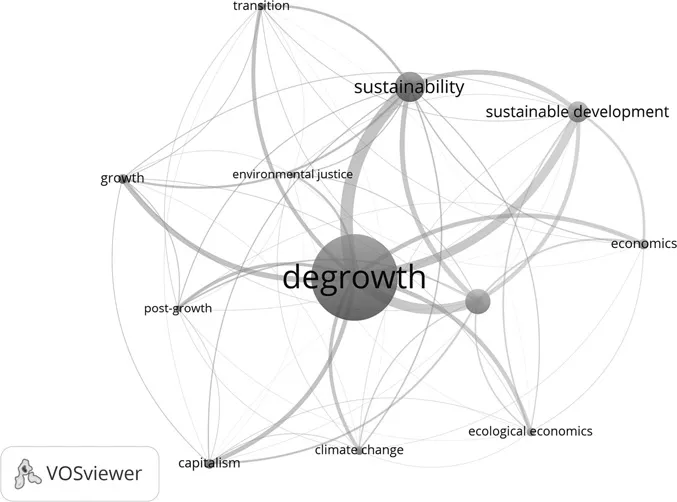
Visualising the most frequently occurring keywords and the links between them illustrates the difference between tourism-specific research and general research on degrowth. The overall research is closely linked to the degrowth key term, and degrowth is in the centre of the network. For tourism research, there is a less obvious core interest in degrowth, and the network is thus more spread out towards one side (see Figures 1.3a and Figure 1.3b, respectively).
Figure 1.3a The 12 overall keywords occurring most frequently and the links between them
Figure 1.3b The 12 tourism keywords occurring most frequently and the links between them
In order to see how the topics in tourism degrowth literature relate to the overall degrowth literature, keywords in each of these two bodies of literature were ordered into three broader clusters in VOSviewer. As shown in Table 1.2, the topics in the overall literature appear to concentrate on a) the ideals and political aspects of degrowth; b) economic issues and sustainable development; and c) climate change and environmental justice. In the tourism literature, two clusters emerge with respect to research on tourism and degrowth: a) economic development, tourism development and issues of overtourism; and b) issues regarding sustainable tourism development and management. Although the second cluster within the tourism literature is more integrated into the core network of overall degrowth literature, indicating an explicit influence of the degrowth concept and research on tourism scholars, the first cluster of tourism literature indicates a rather applied approach to employ the degrowth notion to understand social, economic and environmental issues within tourism contexts.
Table 1.2 Clusters of keywords
Overall keywords clustering
Tourism keywords clustering
First cluster
Second cluster
Third cluster
First cluster
Second cluster
Capitalism
Ecological economics
Climate change
Economic growth
Degrowth
Degrowth
Economic growth
Environmen...
Table of contents
Cover
Half Title
Series Page
Title Page
Copyright Page
Contents
List of figures
List of tables
List of contributors
Preface and acknowledgments
List of acronyms
1 Introduction: degrowth and tourism: implications and challenges
Part 1 Degrowth and tourism entrepreneurship
Part 2 Degrowth and tourism destinations
Part 3 Degrowth and tourism policy
Index
Trusted by 375,005 students
Access to over 1.5 million titles for a fair monthly price.
Study more efficiently using our study tools.
Frequently asked questions
Yes, you can cancel anytime from the Subscription tab in your account settings on the Perlego website. Your subscription will stay active until the end of your current billing period. Learn how to cancel your subscription
No, books cannot be downloaded as external files, such as PDFs, for use outside of Perlego. However, you can download books within the Perlego app for offline reading on mobile or tablet. Learn how to download books offline
Perlego offers two plans: Essential and Complete
Essential is ideal for learners and professionals who enjoy exploring a wide range of subjects. Access the Essential Library with 800,000+ trusted titles and best-sellers across business, personal growth, and the humanities. Includes unlimited reading time and Standard Read Aloud voice.
Complete: Perfect for advanced learners and researchers needing full, unrestricted access. Unlock 1.5M+ books across hundreds of subjects, including academic and specialized titles. The Complete Plan also includes advanced features like Premium Read Aloud and Research Assistant.
Both plans are available with monthly, semester, or annual billing cycles.
We are an online textbook subscription service, where you can get access to an entire online library for less than the price of a single book per month. With over 1.5 million books across 990+ topics, we’ve got you covered! Learn about our mission
Look out for the read-aloud symbol on your next book to see if you can listen to it. The read-aloud tool reads text aloud for you, highlighting the text as it is being read. You can pause it, speed it up and slow it down. Learn more about Read Aloud
Yes! You can use the Perlego app on both iOS and Android devices to read anytime, anywhere — even offline. Perfect for commutes or when you’re on the go. Please note we cannot support devices running on iOS 13 and Android 7 or earlier. Learn more about using the app
Yes, you can access Degrowth and Tourism by C. Michael Hall, Linda Lundmark, Jundan Jasmine Zhang, C. Michael Hall,Linda Lundmark,Jundan Jasmine Zhang in PDF and/or ePUB format, as well as other popular books in Business & Business General. We have over 1.5 million books available in our catalogue for you to explore.