- 336 pages
- English
- ePUB (mobile friendly)
- Available on iOS & Android
eBook - ePub
Water Resources Management
About this book
The world's water resources are being tapped at an ever increasing rate, to the extent that sustainability and water quality are being compromised. This book provides accounts of the technology used for managing water resources to reduce risks. Besides controlling floods, overcoming droughts and reducing pollution, the reader will learn to plan and maintain hydraulic structures, and to appreciate the diverse demands on water, including those of the environment. The topics considered include hydrology and assessment of water resources; drought management and flood management tools; and the interaction between land use and water resources, including surface runoff, groundwater and water quality. The second half of the book focuses on water use, demand management and the infrastructure required to manage water. Consideration is also given to the tools needed for planning, including economics and computer modelling. This book is aimed at a postgraduate level, suitable for students in water engineering and science. It will also serve as a reference for practitioners concerned with water resources and water supply.
Information
CHAPTER 1
Water, a Multi-Dimensional Resource
1.1 INTRODUCTION
In the past, water was regarded as an inexhaustible resource such as air. However, in more recent years we have begun to value water as a limited resource. This may be because of increasing demands but more probably due to the fact that we have realized there are demands on water other than for human consumption. Water, especially clean water, is an integral necessity of the environment, but when people abstract the water from rivers or aquifers the previous regime changes. And over centuries nature has reached a quasi equilibrium with water. For example, rivers become lined with vegetation that can withstand the floods and droughts experienced along the river. There may have been changes in the long term but these are not visible to man. Similarly river bed and bank configuration has changed over long periods. But we are now reaching an acceleration in those changes where the runoff has changed, due to man’s using the water and developing the catchment.
Water forms part of the hydrological cycle and is continuously moving through this cycle. Whether it be as runoff from the surface, flow in rivers, groundwater flow in aquifers or evaporation or transpiration, water is constantly being recycled, and during this recycling process, there are changes in the quantity and quality of the water which are caused by natural and human intervention. It is because we have begun to realize we are changing nature by abstracting water that we have begun to look at water resources in a much broader picture.
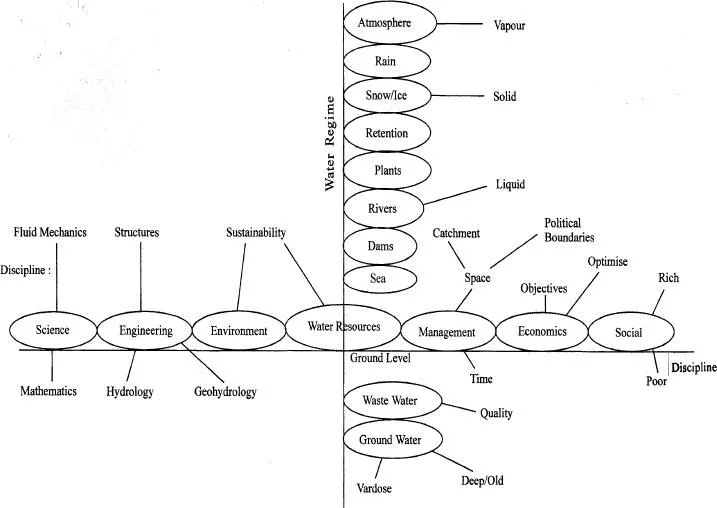
By using water, we manage it in time and space. We store water and we divert it. This interferes with the natural cycle and we should heed other requirements in our management strategy. By incorporating demands other than physical abstraction, we are integrating a number of disciplines and requirements. We put pollutants in the waters and thereby affect the environment and the potability of the water.
Over the last century our efforts in supplying water have swung from philosophic to scientific analysis, then engineering design, construction and now management of facilities and resources. And we can no longer ignore boundaries, be they political, topographic, disciplinary or economic. That is, we have to look at other’s shortages as well as our own. We can manage the water resources or the supply, or both, to meet demands. The following subjects need to be considered:
Water Resources
• Assessment of water resources
• Interaction of various locations of water, i.e. atmospheric, sea, surface and ground
• Drought management
• Flood management
• Impacts of catchment and river development
• Impact on the environment
• Water quality
Water Supply:
• Demand management and loss control
• Hydraulics
• Costs and tariffs
• Economics and development
• Risk and vulnerability
• Asset management
• Administration and public-private partnerships
1.2 WATER RESOURCES PLANNING
The traditional planning approach for water resources projects was for the supplier to identify demands, select the most convenient source, and design the least cost system to meet demands. Due largely to external pressures, the planning process was expanded to facilitate input by users and external groups. Multiple criteria emerged, including conservation and social issues. A long-term strategy was adopted. The process therefore became known as Integrated Resources Planning.
The process became cumbersome and planning became bogged down by major or minor inputs. More recently the process has been streamlined and the term Least Cost Planning originated. A comparison of the methods is made in Table 1.1.
LCP differs from traditional planning by considering long term and lifecycle costs. It costs all factors including demand management and risk. It is a transparent and comprehensive procedure. Integrated resources planning is a broader approach but does not necessarily lead to an engineering solution. It uses economics in decision making in the broader sense by attempting to balance multiple objectives. Integrated Water Resources Management is more focused and may consider a catchment, or a specific problem such as flood control. Nevertheless it is aimed at the end user rather than the utility.
Type of Process | |||
|---|---|---|---|
Dimension | Traditional Planning | LCP | IRP |
Resources options | Supply options (demand is taken as a given) | Demand and supply options (demand can be manipulated) | Demand and supply options (demand can be manipulated) |
Resources diversity | Utility owned and centralised | Diversity of resources, demand-side | Diversity of resources, demand-side management |
Resources ownership | All infrastructure or resources owned by utility | management Most infrastructure or resources owned by utility | Much owned by other utilities, other producers |
Resource selections criteria | Minimise rates and maintain system reliability | Diverse criteria, including risk, technology, environmental, economics | Diverse criteria, including risk, technology, environmental, economics |
Focus of economic cost analysis | Ratepayers | Multiple groups (participants, ratepayers, individuals, etc.) | Multiple groups (participants, ratepayers, individuals, etc.) |
Conduct of planning | Internal to utility, mainly operational, financial planning | Internal to the water industry, planning by professionals | Several departments as well as non-utility experts, staff, public |
Planning horizon | Five to ten years | Minimum of ten years | Minimum of twenty-five years |
Role of public groups | Intervenors | Advisors | Participants |
Judgement | Vague | More defined | Well defined |
Preferences | Vague | Well defined | Well defined |
Objectives | Single | Multiple | Multiple |
Reliability | Constraint | Decision variable | Decision variable |
Environmental quality | Constraint | Constraint | Objective |
Risk | Should be avoided | Should be managed | Should be managed |
Evaluation is over the lifecycle and should include non-targeted objectives, i.e. environment, legal and socio-economic issues. Integration implies the involvement of all stakeholders and disciplines. It also embraces all phases of water in the balance, i.e. precipitation, surface and groundwater as well as water quality and efficiency of use. Long term sustainability and short term requirements are balanced, so a multi objective solution is required.
1.3 MULTI-DIMENSIONAL MANAGEMENT
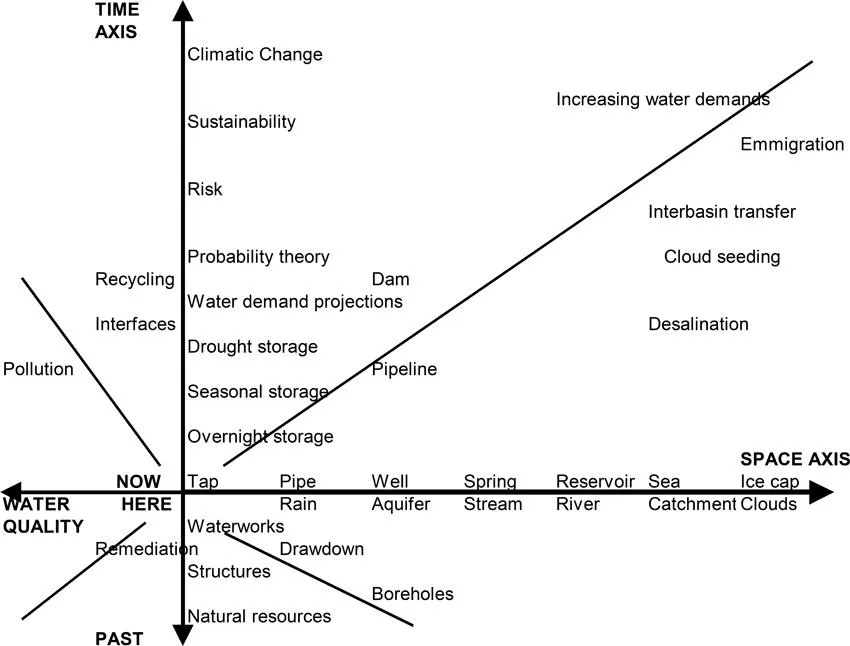
Whereas in the past, we would pump water from the nearest source and, after treating it, distribute it to consumers as part of the engineer’s brief, we now realize this requires both management of the water in time and space.
Storage reservoirs are for management of water in time. That is, they store water in wet periods in order to provide us with water during the dry periods. This is indicated on the time scale vertically in Figure 1.1. On a smaller time scale, we provide balances in reservoir storage for meeting peak demands in consumption. On the larger time scale, we store water for meeting demands during the dry season and on a still larger scale we store water from year to year for overcoming droughts. At this scale we have to consider probability, as the time series of river flow is a variable that we do not understand completely and therefore tend to treat it as a stochastic variable. On a larger time scale we should consider the sustainability of the river flow and on an ever greater time scale, we need to consider cycles in the weather and climatic change due to interference with the atmosphere.
Geographically, we distribute water from watercourses to consumers. On a small scale, we supply water from reservoirs to taps, and on a bigger scale from river basins across catchment boundaries and international boundaries. Similarly the natural water cycle can be inspected on a small scale such as we do when we look at the transport of water or pollution in aquifers, or on a larger scale across catchments in streams and rivers. On an even larger scale, we look at international rivers and the oceans, and on a global scale we need to consider the ice caps and water vapour in the atmosphere.
We could consider water quality on similarly increasing scales. Engineers did not give much attention to the larger scales in the past in order to perform proper bala...
Table of contents
- Cover
- Half Title
- Title Page
- Copyright Page
- Preface
- Table of Contents
- 1 Water, a Multi-Dimensional Resource
- 2 Water Resources Assessment
- 3 Drought Management
- 4 Flood Management
- 5 Effects of Catchment Development on Runoff
- 6 Groundwater
- 7 Water Quality and the Environment
- 8 Water Use
- 9 Demand Management
- 10 Hydraulic Structures
- 11 Economics of Water Resources Development
- 12 Administration of Water Projects
- 13 Computer Modelling and Optimization
- Subject Index
Trusted by 375,005 students
Access to over 1.5 million titles for a fair monthly price.
Study more efficiently using our study tools.
Frequently asked questions
Yes, you can cancel anytime from the Subscription tab in your account settings on the Perlego website. Your subscription will stay active until the end of your current billing period. Learn how to cancel your subscription
No, books cannot be downloaded as external files, such as PDFs, for use outside of Perlego. However, you can download books within the Perlego app for offline reading on mobile or tablet. Learn how to download books offline
Perlego offers two plans: Essential and Complete
- Essential is ideal for learners and professionals who enjoy exploring a wide range of subjects. Access the Essential Library with 800,000+ trusted titles and best-sellers across business, personal growth, and the humanities. Includes unlimited reading time and Standard Read Aloud voice.
- Complete: Perfect for advanced learners and researchers needing full, unrestricted access. Unlock 1.5M+ books across hundreds of subjects, including academic and specialized titles. The Complete Plan also includes advanced features like Premium Read Aloud and Research Assistant.
We are an online textbook subscription service, where you can get access to an entire online library for less than the price of a single book per month. With over 1.5 million books across 990+ topics, we’ve got you covered! Learn about our mission
Look out for the read-aloud symbol on your next book to see if you can listen to it. The read-aloud tool reads text aloud for you, highlighting the text as it is being read. You can pause it, speed it up and slow it down. Learn more about Read Aloud
Yes! You can use the Perlego app on both iOS and Android devices to read anytime, anywhere — even offline. Perfect for commutes or when you’re on the go.
Please note we cannot support devices running on iOS 13 and Android 7 or earlier. Learn more about using the app
Please note we cannot support devices running on iOS 13 and Android 7 or earlier. Learn more about using the app
Yes, you can access Water Resources Management by David Stephenson in PDF and/or ePUB format, as well as other popular books in Physical Sciences & Hydrology. We have over 1.5 million books available in our catalogue for you to explore.