Covering the gamut of technologies and systems used in the generation of electrical power, this reference provides an easy-to understand overview of the production, distribution, control, conversion, and measurement of electrical power. The content is presented in an easy to understand style, so that readers can develop a basic comprehensive understanding of the many parts of complex electrical power systems. The authors describe a broad array of essential characteristics of electrical power systems from power production to its conversion to another form of energy. Each system is broken down into sub systems and equipment that are further explored in the chapters of each unit. Simple mathematical presentations are used with practical applications to provide an easier understanding of basic power system operation. Many illustrations are included to facilitate understanding. This new third edition has been edited throughout to assure its content and illustration clarity, and a new chapter covering control devises for power control has been added.
- 400 pages
- English
- ePUB (mobile friendly)
- Available on iOS & Android
eBook - ePub
Electrical Power Systems Technology, Third Edition
About this book
Information
Publisher
River PublishersYear
2020Print ISBN
9781439800270
9781439800270
Edition
3eBook ISBN
9781000356076
UNIT IV
Electrical Power Conversion Systems
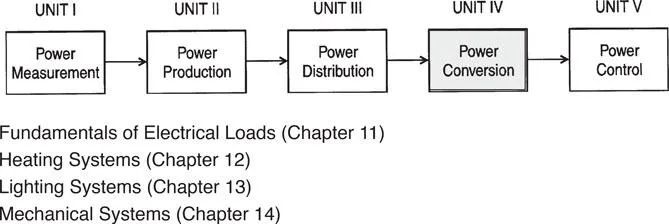
One of the most important aspects of electrical power systems is the conversion of electrical power into some other form of energy. Electrical power is ordinarily converted into light, heat, or mechanical power. The power is converted using either resistive, inductive, or capacitive circuits. The fundamental characteristics of electrical power conversion systems are discussed in Chapter 11.
The basic types of electrical power conversion systems are studied further in the remaining chapters. Heating systems are discussed in Chapter 12. Those systems that convert electrical energy into heat energy use three methods, incorporating resistive, inductive, and capacitive circuits. Basic welding method systems are also included in this chapter, since they are a unique type of electrical load. Chapter 13 deals with the conversion of electrical energy into light energy. Lighting systems include incandescent, fluorescent, and vapor lighting systems. The systems that convert electrical energy into mechanical energy are discussed in Chapter 15. The major mechanical energy conversion takes place in electric motors. Both direct current (DC) and alternating current (AC) motors are studied in that chapter.
Figure IV. shows the electrical power systems model used in this book, and the major topics of Unit IV—Electrical Power Conversion Systems.
UNIT OBJECTIVES
Upon completion of this unit, you should be able to:
1. Define the term “electrical load.”
2. List the types and classifications of electrical loads.
3. Explain the differences between resistive, inductive, and capacitive circuits.
4. Calculate load (demand) factor and power factor.
5. Describe power factor correction, using static capacitors or synchronous capacitors.
6. Define true power, apparent power, and reactive power in AC circuits.
7. Calculate power per phase and total power for balanced or unbalanced three-phase loads.
8. Explain the differences between resistive, inductive, and capacitive electric loads.
9. Describe electric resistive and arc-welding systems as electrical loads.
10. Describe electric heating systems and these associated terms:
BTU
Design Temperature Difference
Degree Days Thermal Resistance (R)
Coefficient of Heat Transfer (U)
Watts of Heat (W)
11. Describe heat pumps and air conditioning systems.
12. Describe the characteristics of light.
13. Define the terms candlepower, lumen, and footcandle as they relate to light.
14. Describe types of street lighting systems.
15. Explain the characteristics of incandescent, fluorescent, and vapor lighting.
16. Describe branch circuits used for controlling electrical lights from one, two, or three locations.
17. Calculate the minimum number of branch circuits and total power requirements for lighting circuits in buildings.
18. Describe the following factors that affect lighting fixture design:
Luminaire
Coefficient of Utilization (CU)
Room Ratio
Depreciation Factor (DF)
19. Calculate light output of a lighting system.
20. Describe the basic principles of electric motor operation.
21. Identify and describe the following types of electric motors:
DC Motors
Single-Phase AC Motors
Three-Phase AC Motors
22. Explain the operation of synchro/servo systems and DC stepping motors.
23. Calculate the following, as each relates to electric motor operation:
Horsepower
Speed Regulation
Starting Current
Synchronous Speed Slip
Rotor Frequency Efficiency
Chapter 11
Fundamentals of Electrical Loads
The electrical load devices that are used in industry, in our homes, and in commercial buildings are very important parts of electrical power systems. The load of any system performs a function that involves power conversion. A load converts one form of energy to another form. An electrical load converts electrical energy to some other form of energy, such as heat, light, or mechanical energy. Electrical loads may be classified according to the function that they perform (lighting, heating, mechanical), or by the electrical characteristics that they exhibit ...
Table of contents
- Cover
- Half Title
- Title Page
- Copyright Page
- Table of Contents
- Preface
- Unit I Power Measurement Systems and Fundamentals
- Unit II Electrical Power Production Systems
- Unit III Electrical Power Distribution Systems
- Unit IV Electrical Power Conversion Systems
- Unit V Electrical Power Control Systems
- Appendix A Trigonometric Functions
- Appendix B The Elements
- Appendix C Metric Conversions
- Index
Trusted by 375,005 students
Access to over 1.5 million titles for a fair monthly price.
Study more efficiently using our study tools.
Frequently asked questions
Yes, you can cancel anytime from the Subscription tab in your account settings on the Perlego website. Your subscription will stay active until the end of your current billing period. Learn how to cancel your subscription
No, books cannot be downloaded as external files, such as PDFs, for use outside of Perlego. However, you can download books within the Perlego app for offline reading on mobile or tablet. Learn how to download books offline
Perlego offers two plans: Essential and Complete
- Essential is ideal for learners and professionals who enjoy exploring a wide range of subjects. Access the Essential Library with 800,000+ trusted titles and best-sellers across business, personal growth, and the humanities. Includes unlimited reading time and Standard Read Aloud voice.
- Complete: Perfect for advanced learners and researchers needing full, unrestricted access. Unlock 1.5M+ books across hundreds of subjects, including academic and specialized titles. The Complete Plan also includes advanced features like Premium Read Aloud and Research Assistant.
We are an online textbook subscription service, where you can get access to an entire online library for less than the price of a single book per month. With over 1.5 million books across 990+ topics, we’ve got you covered! Learn about our mission
Look out for the read-aloud symbol on your next book to see if you can listen to it. The read-aloud tool reads text aloud for you, highlighting the text as it is being read. You can pause it, speed it up and slow it down. Learn more about Read Aloud
Yes! You can use the Perlego app on both iOS and Android devices to read anytime, anywhere — even offline. Perfect for commutes or when you’re on the go.
Please note we cannot support devices running on iOS 13 and Android 7 or earlier. Learn more about using the app
Please note we cannot support devices running on iOS 13 and Android 7 or earlier. Learn more about using the app
Yes, you can access Electrical Power Systems Technology, Third Edition by Dale R. Patrick,Stephen W. Fardo in PDF and/or ePUB format, as well as other popular books in Technology & Engineering & Electrical Engineering & Telecommunications. We have over 1.5 million books available in our catalogue for you to explore.