This is the first book to offer a critical examination of the delivery of before and after-school physical activity programs, from global perspectives. It introduces key theory and best practice in before and after-school physical activity research and programming, and is an essential resource for educators involved in the design and implementation of after-school programs.
With contributions from leading international researchers and practitioners in the field of health and physical education, the book provides an overview of research methods in before and after-school physical activity. It offers insight on theoretical frameworks and the implementation of programs as they relate to policy in schools, as well as an overview of social and emotional learning in after-school programs. The book also explores inclusive before and after-school physical activity programming for underserved communities, covering key topics from Positive Youth Development and urban programming to developing adult leaders and working with LGBTQI populations and children with disabilities.
This book is important reading for researchers in health and physical education, and policy-makers, teachers, youth workers and coaches working with children in physical education, health education, physical activity or sport.
1Implementing before- and after-school physical activity programs within the Whole School, Whole Community, Whole Child framework
Erin E. Centeio, Heather Erwin, Jeanne Barcelona, and Hayley McKown
Participation in physical activity has many benefits for youth. Research has shown that physical activity can elicit numerous physical health benefits such as reduced blood pressure, decreased obesity, increased bone mineral density, as well as many mental health issues such as decreased depression (Janssen & LeBlanc, 2010). Additionally, research has shown that participating in physical activity as youth can decrease the risk of health issues and disease later in life (Warburton et al., 2006). Although the benefits of physical activity are relatively well known, many youth are not meeting the daily recommended guidelines for physical activity (Katzmarzyk et al., 2018). This is partially because of the decreased time spent in physical activity at school (CDC, 2015; IOM, 2013), but is also coupled with issues such as motivation, lack of support, access, etc. (Dumith et al., 2011; Humbert et al., 2006). Given the rise of obesity among youth, especially in countries such as the United States of America (USA), experts have called for schools to take on a larger role in increasing the amount of physical activity provided for youth to help meet the recommended guidelines of 60 minutes per day (IOM, 2013).
Since 1987, a Coordinated School Health (CSH) approach has informed schools and provided guidance for how to include components of health within the school environment specifically advocating for the importance of physical activity within the physical education setting (IOM, 2013; Pate et al., 2006). For years, physical education was a staple in school schedules and seen as a contributing part of the educational system. However, over time, as more emphasis was put on testing as part of the No Child Left Behind Act (2002), which was a somewhat controversial law put into place in 2001 as a means for leveling the playing field for all students who were working from some sort of disadvantage, such as minorities, those with low household income, those receiving special education services, and those who spoke English as a second language. In the U.S., time for physical activity through recess and physical education was rapidly diminished from the traditional school schedule (Anderson et al., 2011). This left advocates without resources or time to provide physical activity prompting creative efforts to promote physical activity during the school day, outside of the physical education classroom.
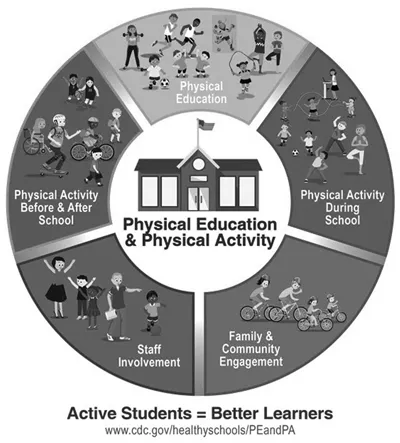
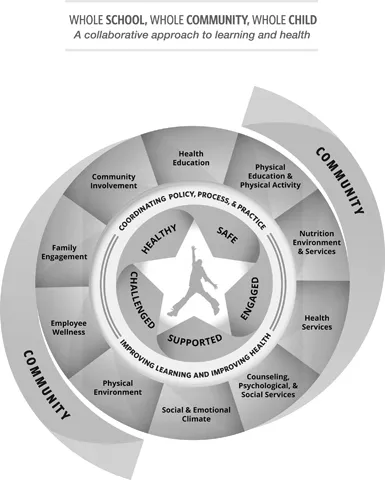
In 2013, in alignment with CSH and the then recent call of the Institutes of Medicine to implement Whole-of-School approaches, the Centers for Disease Control and Prevention (CDC) along with SHAPE America and Let's Move Active Schools launched the Comprehensive School Physical Activity Program (CSPAP) model. The model is specific to the United States and its landscape and consists of five components: 1) physical education, 2) physical activity during school, 3) staff involvement, 4) family and community engagement, and 5) physical activity before and after-school (CDC, 2013; see Figure 1.1). Shortly after, in 2014, as an expansion of the CSH approach, the ASCD (formerly known as the Association for Supervision and Curriculum Development) along with the CDC, launched the Whole School, Whole Community, Whole Child approach (WSCC; ASCD, 2014; Lewallen et al., 2015). The WSCC served as an innovative way to encourage the educational arena to think beyond academic development to consider the holistic aspects that a child needs to develop. WSCC is comprised of 10 components (see Figure 1.2) with one specifically focused on physical activity and physical education (ASCD, 2014). The CSPAP model aligns with one component of the WSCC model and it focuses on mechanisms such as training, support, and resources that provide access and promotion of physical activity before, during, and after-school.
Figure 1.1 Comprehensive School Physical Activity Program
Note* Courtesy of the CDC and ASCD http://www.ascd.org/programs/learning-and-health/wscc-model.aspx
Note* Courtesy of ASCD http://www.ascd.org/programs/learning-and-health/wscc-model.aspx
Both CSPAP and WSCC models are United States centric but there are many models across the world that are similar in nature. These models are linked through their grounding in Bronfenbrenner's ecological systems theory (1979), which posits that there are many different levels of influencers that impact a child's development, starting at the micro level, which consists of one's own individual factors; next, the people directly and closely involved, the community and environments in which they engage as well as remote macro level factors including national and international policies and cultural forces. In a similar framework modified to represent health behaviors, Sallis and colleagues (2008) created the Social Ecological Framework that focuses on multiple influencers, both within a physical and social environment that influence health behavior. The Social Ecological Framework has been utilized to guide work being done towards positive health behavior change, such as increasing physical activity for youth. Collectively, these comprehensive models can be helpful because they help conceptualize all of the factors that influence health behaviors, such as facilitators and barriers to youth participation in physical activity.
Of particular interest in this chapter is the CSPAP framework because unlike the other models it comprehensively focuses on physical activity, therefore including before and after-school time. Understanding best practices in offering physical activity programming before and after-school is often understudied compared to other components such as physical education and during school physical activity (Beighle & Moore, 2012). Connecting before- and after-school programs within a CSPAP and whole child framework will demonstrate the importance of these programs in the model as they can be used to help contribute to increasing physical activity for youth while also reinforcing a culture of health in the school and community (Beets et al., 2009). If we hope to influence and increase physical activity participation among youth, it is imperative, that we provide guidance to practitioners and researchers on best practices to implementing physical activity in both before- and after-school settings. In the United States, this is often tied to the school system, however, around the world often time outside and community agencies facilitate sport and physical activity participation for youth.
Before- and after-school programs that align with Whole School, Whole Community, Whole Child
Before- and after-school programs are not new, nor is the idea that they should include time for children to be physically active. However, with the added emphasis of community involvement as well as a distinguished call for before- and after-school programs through CSPAP programing (ASCD, 2014; CDC, 2013), before- and after-school programs have become more of a priority. Thus, they have been included in more recent publications for whole-of-school programming.
There are many initiatives around the globe that look to increase physical activity through a whole-of-school approach through ever evolving aims and tactics. Some programs focus more on physical activity time during the school day rather than out of school time but all maintain the shared goal of increasing total number of minutes of physical activity… Two specific examples include Active School Flag (ASF; Ireland) and Finnish Schools on the Move (Finland) (McMullen et al., 2015). Finnish Schools on the Move (McMullen et al., 2015) adopted a model where schools were allowed to choose how they were integrating additional physical activity throughout their school day. Therefore, the application looked different across schools, but each one took a whole-of-school approach. One application that schools used was Active Commute to Schools and although it helped with increasing the physical activity of children, schools also noted that they encountered some challenges (Turpeinen et al., 2013). ASF in Ireland has given liberty to schools to choose between three areas to improve their physical activity practices (physical education, physical activity, and community links). Guided by this directive, each school had the autonomy to design their own plan and work toward achieving a set goal. Once they achieved their goal they were instructed to send evidence in to the ASF program to be recognized. Outcomes indicated that the initiative resulted in schools prioritizing promotion of physical activity, as well as recognizing and adopting systematic approaches to increase physical activity (Ní Chróinín et al., 2012).
Many early adopters in the United States who aligned programming to CSH have been seen as leaders and visionaries with whole of school programming and physical activity. Programs such as Coordinated Approach to Child Health (CATCH) and Sports, Play, and Active Recreation for Kids (SPARK) all were grounded in CSH and have incorporated before- and after-school programming in some way. Perhaps it was their positive outcomes on physical activity (Sallis et al., 2003) that spearheaded the evolution of the current WSCC and CSPAP models. Today, the literature base suggests that many United States scholars have continued to align projects and publications within a WSCC or CSPAP framework indicating a continued validation that models in support of comprehensive physical activity for youth are beneficial.
Unlike the governmental acceptance and support among international initiatives to provide youth physical activity in schools, many United States programs rely on private funding mechanisms. The After School Alliance is one of many external funding sources programmers look to for funding to enact programming. In a study conducted by Trost and colleagues (2008), seven after-school programs supported by the After School Alliance were examined to better understand the a...
Table of contents
Cover
Half Title
Series Page
Title Page
Copyright
Dedication Page
Contents
List of figures
List of tables
List of contributors
Introduction
1 Implementing before- and after-school physical activity programs within the Whole School, Whole Community, Whole Child framework
2 Using restorative practices in out-of-school physical activity programs
3 An activist sport approach to before- and after-school programming: Co-creating empowering possibilities with youth from socially vulnerable backgrounds
4 Positive youth development through sport: Enhancing contribution
5 Integrating health and physical activity with social emotional learning in before- and after-school programs
6 Made2Move 3.0: PETE students as design thinkers
7 Ten Years Later: What we learned about after-school programming from the Fitness Improves Thinking in Kids (FITKids) Clinical Trial
8 REACH after-school: Integrating literacy and PA in under-served communities
9 ‘Getting lost,’ being flexible and using innovative methods in an after-school program
10 Care-experienced youth and before- and after-school physical activity
11 Sport for development programming in developing and conflict-affected regions
12 Challenges and opportunities in urban after-school programming
13 Outside the box: LGTBQ-inclusive physical activity programs
14 Before- and after-school programs for students with intellectual and developmental disabilities
15 The role of informal sport in after-school physical activity
16 Preparing adult leaders to work within sport-based youth development settings
17 Funding before- and after-school physical activity programs
18 It’s time to predict the implications of outsourcing health and physical education and extra-curricular physical activity programming
19 Student voice in physical education and before- and after-school physical activity settings
Conclusion
Index
Trusted by 375,005 students
Access to over 1.5 million titles for a fair monthly price.
Study more efficiently using our study tools.
Frequently asked questions
Yes, you can cancel anytime from the Subscription tab in your account settings on the Perlego website. Your subscription will stay active until the end of your current billing period. Learn how to cancel your subscription
No, books cannot be downloaded as external files, such as PDFs, for use outside of Perlego. However, you can download books within the Perlego app for offline reading on mobile or tablet. Learn how to download books offline
Perlego offers two plans: Essential and Complete
Essential is ideal for learners and professionals who enjoy exploring a wide range of subjects. Access the Essential Library with 800,000+ trusted titles and best-sellers across business, personal growth, and the humanities. Includes unlimited reading time and Standard Read Aloud voice.
Complete: Perfect for advanced learners and researchers needing full, unrestricted access. Unlock 1.5M+ books across hundreds of subjects, including academic and specialized titles. The Complete Plan also includes advanced features like Premium Read Aloud and Research Assistant.
Both plans are available with monthly, semester, or annual billing cycles.
We are an online textbook subscription service, where you can get access to an entire online library for less than the price of a single book per month. With over 1.5 million books across 990+ topics, we’ve got you covered! Learn about our mission
Look out for the read-aloud symbol on your next book to see if you can listen to it. The read-aloud tool reads text aloud for you, highlighting the text as it is being read. You can pause it, speed it up and slow it down. Learn more about Read Aloud
Yes! You can use the Perlego app on both iOS and Android devices to read anytime, anywhere — even offline. Perfect for commutes or when you’re on the go. Please note we cannot support devices running on iOS 13 and Android 7 or earlier. Learn more about using the app
Yes, you can access Before and After School Physical Activity Programs by Risto Marttinen, Erin E. Centeio, Thomas Quarmby, Risto Marttinen,Erin E. Centeio,Thomas Quarmby in PDF and/or ePUB format, as well as other popular books in Education & Education General. We have over 1.5 million books available in our catalogue for you to explore.