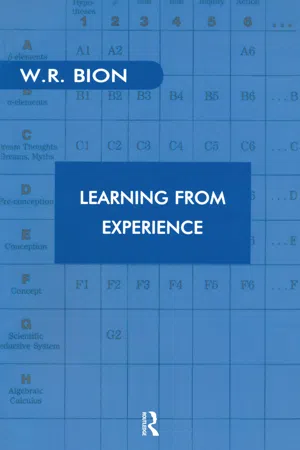
'As the problems raised in this book are fundamental to learning they have a long history of investigation and discussion. In phsycho-analytical practice, particularly with patients displaying symptoms of disorders of thought, it becomes clear that psycho-analysis has added a dimension to problems if not to their solution. 'This book deals with emotional experiences that are directly related both to theories of knowledge and to clinical psycho-analysis, and that in the most practical manner.'- Wilfred R. Bion, from the Introduction. In this book Bion describes his use of the term "alpha-function" to conceptualize how the data of emotional experience is processed and digested. This includes his thinking on "contact barriers" and the bearing of "projective identification" on the genesis of thought.
- 124 pages
- English
- ePUB (mobile friendly)
- Available on iOS & Android
eBook - ePub
Learning from Experience
About this book
Information
CHAPTER ONE
DOI: 10.4324/9780429476631-1
1. TO CALL AN ACTION by the name of the person of whom it is thought to be typical, to talk, for example, of a Spoonerism as if it were a function of the personality of an individual called Spooner, is quite usual in conversation. I take advantage of this usage to derive a theory of functions that will stand up to more rigorous use than that for which the conversational phrase is employed. I shall suppose that there are factors in the personality that combine to produce stable entities which I call functions of the personality. The meaning that I attach to the terms “factors” and “functions” and the use to which I put them will presently appear, but some preliminary explanation may not be amiss.
2. The statement “A factor in X’s personality of which we shall have to take account is his envy of his associates” is one any layman might make and may mean little or much; its value depends on our estimate of the person who makes it and of the weight he attaches to his own words. The force of the statement is affected if I attach to the term “envy” the weight and meaning with which it has been invested by Mrs. Klein.
3. Suppose now another statement: “X’s relationship with his associates is typical of a personality in which envy is a factor.” This statement expresses the observation of a function, the factors in which are transference and envy. What is observed is not the transference or envy, but something that is a function of transference and envy. It is necessary, as a psycho-analysis proceeds, to deduce new factors from the changes observed in the function and to distinguish different functions.
4. “Function” is the name for the mental activity proper to a number of factors operating in consort. “Factor” is the name for a mental activity operating in consort with other mental activities to constitute a function. Factors are deducible from observation of the functions of which they, in consort with each other, are a part. They can be theories or the realities the theories represent. They may appear to be commonplaces of ordinary insight; they are not because the word used to name the factor is employed scientifically and therefore more rigorously than is usual in conversational English. Factors are deduced not directly but by observation of functions.
5. The theory of functions makes it easier to match the realization1 with the deductive system2 that represents it. Moreover, its use gives flexibility to an analytical theory, that may have to be used in a wide variety of analytical situations, without impairing the permanence and stability of the structure of which it is a part. Furthermore, by virtue of the theory of functions deductive systems possessing a high degree of generalization can be seen to represent observations in the analysis of a particular patient. Since psycho-analytic theory has to be applied to the changes occurring in the personality of the patient this is important. If the analyst observes functions and deduces the related factors from them, the gap between theory and observation can be bridged without the elaboration of new and possibly misguided theories.
6. The function I am about to discuss for its intrinsic importance also serves to illustrate the use to which a theory of functions can be put. I call this function an alpha-function so that I may talk about it without being restricted, as I would be if I used a more meaningful term, by an existing penumbra of associations. By contrast, the meaning of theories that appear as factors must be preserved and employed as rigorously as possible. I assume that the meaning has been made sufficiently clear by the authors and others who have discussed the theories with critical sympathy. The freedom implicit in the use of the term alpha-function and the concentration of precision of expression and employment into all that pertains to the factors, confers flexibility without impairing structure. The use I make of an existing theory may seem to distort the author’s meaning; if I think so I have acknowledged it, but otherwise it is to be assumed that I believe I am interpreting the author’s theory correctly.
7. The term alpha-function is, intentionally, devoid of meaning. Before I indicate the area of investigation in which I propose to employ it, I must discuss one of the problems incidental to this investigation. Since the object of this meaningless term is to provide psycho-analytic investigation with a counterpart of the mathematicians variable, an unknown that can be invested with a value when its use has helped to determine what that value is, it is important that it should not be prematurely used to convey meanings, for the premature meanings may be precisely those that it is essential to exclude. Yet the mere fact that the term alpha-function is to be employed in a particular investigation inevitably leads to its reinvestment with meanings derived from the investigations that have already been carried out in that field.1 Constant vigilance must therefore be exerted to prevent this development or the value of the instrument is impaired at the outset. The area of investigation is approximately that covered by the writings described in my next chapter.
CHAPTER TWO
DOI: 10.4324/9780429476631-2
1. DESCRIBING THE INSTITUTION of the reality principle Freud said, “The increased significance of external reality heightened the significance also of the sense-organs directed towards that outer world, and of the consciousness attached to them; the latter now learned to comprehend the qualities of sense in addition to the qualities of pleasure and pain which hitherto had alone been of interest to it.” I emphasize, “the latter now learned to comprehend”; by “the latter” Freud presumably means “the consciousness attached to the sense impressions”.1 The attribution of comprehension to consciousness I discuss later. Of immediate concern is the function of comprehension itself; comprehension of the sense impressions and comprehension of the qualities of pleasure and pain are both investigated in this discussion. I treat sense impressions, pleasure and pain as alike real, thereby discarding the distinction that Freud makes between the “outer-world” and pleasure and pain, as irrelevant to the theme of comprehension. I shall however discuss the bearing of the Pleasure principle and the Reality principle on the choice that a patient can be seen to make between modifying frustration and evading it.
2. The attribution of comprehension to consciousness leads to contradictions which are avoided by accepting, for purposes of the theory I wish to propound, Freud’s later conceptualization, “but what part is there left to be played in our scheme of consciousness, which was once so omnipotent and hid all else from view? Only that of a sense-organ for the perception of psychical qualities”. (Freud’s italics.)
3. Continuing the quotation from Freud’s Two Principles of Mental Functioning “A special function was instituted which had periodically to search the other world in order that its data might be already familiar if an urgent inner need should arise; this function was attention. Its activity meets the sense impressions half-way instead of awaiting their appearance.”1 Freud did not carry his investigation of attention far, but the term, as he uses it, has a meaning I would investigate as a factor in alpha-function.
4. To continue, “At the same time there was probably introduced a system of notation, whose task was to deposit the results of this periodical activity of consciousness—a part of that which we call memory.” Notation and the deposition of the results of attention are also phenomena to be investigated by the aid of the theory of alpha-function.
5. Certain theories of Melanie Klein and her co-workers will be considered; I list them here. They are: Splitting and projective identification1; the transition from the paranoid-schizoid to the depressive position and vice-versa;2 symbol formation and3 some of my previous work on the development of verbal thought.4 I shall not discuss them except as factors modified by combination with each other in a function. So much for previous work; I now give an example of the employment of this Theory of Functions in a psycho-analytic investigation of the field covered by the work referred to in this chapter.
CHAPTER THREE
DOI: 10.4324/9780429476631-3
1. AN EMOTIONAL EXPERIENCE occurring in sleep, which I choose for reasons that will presently appear, does not differ from the emotional experience occurring during waking life in that the perceptions of the emotional experience have in both instances to be worked upon by alpha-function before they can be used for dream thoughts.
2. Alpha-function operates on the sense impressions, whatever they are, and the emotions, whatever they are, of which the patient is aware. In so far as alpha-function is successful alpha elements are produced and these elements are suited to storage and the requirements of dream thoughts. If alpha-function is disturbed, and therefore inoperative, the sense impressions of which the patient is aware and the emotions which he is experiencing remain unchanged. I shall call them beta-elements. In contrast with the alpha-elements the beta-elements are not felt to be phenomena,1 but things in themselves.2 The emotions likewise are objects of sense. We are thus presented with a state of mind precisely contrasting with that of the scientist who knows he is concerned with phenomena but has not the same certitude that the phenomena have a counterpart of things in themselves.
3. Beta-elements are not amenable to use in dream thoughts but are suited for use in projective identification. They are influential in producing acting out. They are objects that can be evacuated or used for a kind of thinking that depends on manipulation of what are felt to be things in themselves as if to substitute such manipulation for words or ideas. For example a man may murder his parents and so feel free to love because the anti-sexual internal parents are supposed by this act to have been evacuated. Such an act is intended “to rid the psyche of accretions of stimuli”. Beta-elements are stored but differ from alpha-elements in that they are not so much memories as undigested facts, whereas the alpha-elements have been digested by alpha-function and thus made available for thought. It is important to distinguish between memories and undigested facts—beta-elements. (The use of the terms “digested” and “undigested” will be investigated later.)
4. If the patient cannot transform his emotional experience into alpha-elements, he cannot dream. Alpha-function transforms sense impressions into alpha-elements which resemble, and may in fact be identical with, the visual images with which we are familiar in dreams, namely, the elements that Freud regards as yielding their latent content when the analyst has interpreted them. Freud showed that one of the functions of a dream is to preserve sleep. Failure of alpha-function means the patient cannot dream and therefore cannot sleep. As alpha-function makes the sense impressions of the emotional experience available for conscious and dream-thought the patient who cannot dream cannot go to sleep and cannot wake up. Hence the peculiar condition seen clinically when the psychotic patient behaves as if he were in precisely this state.
CHAPTER FOUR
DOI: 10.4324/9780429476631-4
1. THE EMOTIONAL EXPERIENCE must now be considered generally and not only as it occurs in sleep. I shall emphasize what I have said so far by re-writing a popular theory of the nightmare. It used once to be said that a man had a nightmare because he had indigestion and that is why he woke up in a panic. My version is: The sleeping patient is panicked; because he cannot have a nightmare he cannot wake up or go to sleep; he has had mental indigestion ever since.
2. The more general statement of the theory is this: To learn from experience alpha-function must operate on the awareness of the emotional experience; alpha-elements are produced from the impressions of the experience; these are thus made storeable and available for dream thoughts and for unconscious waking thinking. A child having the emotional experience called learning to walk is able by virtue of alpha-function to store this experience. Thoughts that had originally to be conscious become unconscious and so the child can do all the thinking needed for walking without any longer being conscious of any of it. Alpha-function is needed for conscious thinking and reasoning and for the relegation of thinking to the unconscious when it is necessary to disencumber consciousness of the burden of thought by learning a skill.
3. If there are only beta-elements, which cannot be made unconscious, there can be no repression, suppression, or learning. This creates the impression that the patient is incapable of discrimination. He cannot be unaware of any single sensory stimulus: yet such hypersensitivity is not contact with reality.
4. Attacks on alpha-function, stimulated by hate or envy, destroy the possibility of the patient’s conscious contact either with himself or another as live objects. Accordingly we hear of inanimate objects, and even of places, when we would normally expect to hear of people. These, though described verbally, are felt by the patient to be present materially and not merely to be represented by their names. This state contrasts with animism in that live objects are endowed with the qualities of death.
CHAPTER FIVE
DOI: 10.4324/9780429476631-5
1. WE MUST NOW EXAMINE enforced splitting associated with a disturbed relationship with the breast or its substitutes. The infant receives milk and other creature comforts from the breast; also love, understanding, solace. Suppose his initiative is obstructed by fear of aggression, his own or another’s. If the emotion is strong enough it inhibits the infant’s impulse to obtain sustenance.
Love in infant or mother or both increases rather than decreases the obstruction partly because love is inseparable from envy1 of the object so loved, partly because it is felt to arouse envy and jealousy in a third object that is excluded. The part played by love may escape notice because envy, rivalry and hate obscure it, although hate would not exist if love were not present. Violence of emotion compels reinforcement of the obstruction because violence is not distinguished from destructiveness and subsequent guilt and depression. Fear of death through starvation of essentials compels resumption of sucking. A split between material and psychical satisfaction develops.
2. Fear, hate and envy are so feared that steps are taken to destroy awareness of all feelings, although that is indistinguishable from taking life itself.1 If a sense of reality, too great to be swamped by emotions, forces the infant to resume feeding, intolerance of envy and hate in a situation which stimulates love and gratitude lea...
Table of contents
- Cover Page
- Title Page
- Copyright Page
- Acknowledgments Page
- Introduction Page
- Chapter One
- Chapter Two
- Chapter Three
- Chapter Four
- Chapter Five
- Chapter Six
- Chapter Seven
- Chapter Eight
- Chapter Nine
- Chapter Ten
- Chapter Eleven
- Chapter Twelve
- Chapter Thirteen
- Chapter Fourteen
- Chapter Fifteen
- Chapter Sixteen
- Chapter Seventeen
- Chapter Eighteen
- Chapter Nineteen
- Chapter Twenty
- Chapter Twenty-One
- Chapter Twenty-Two
- Chapter Twenty-Three
- Chapter Twenty-Four
- Chapter Twenty-Five
- Chapter Twenty-Six
- Chapter Twenty-Seven
- Chapter Twenty-Eight
- Notes
- Index
Trusted by 375,005 students
Access to over 1.5 million titles for a fair monthly price.
Study more efficiently using our study tools.
Frequently asked questions
Yes, you can cancel anytime from the Subscription tab in your account settings on the Perlego website. Your subscription will stay active until the end of your current billing period. Learn how to cancel your subscription
No, books cannot be downloaded as external files, such as PDFs, for use outside of Perlego. However, you can download books within the Perlego app for offline reading on mobile or tablet. Learn how to download books offline
Perlego offers two plans: Essential and Complete
- Essential is ideal for learners and professionals who enjoy exploring a wide range of subjects. Access the Essential Library with 800,000+ trusted titles and best-sellers across business, personal growth, and the humanities. Includes unlimited reading time and Standard Read Aloud voice.
- Complete: Perfect for advanced learners and researchers needing full, unrestricted access. Unlock 1.5M+ books across hundreds of subjects, including academic and specialized titles. The Complete Plan also includes advanced features like Premium Read Aloud and Research Assistant.
We are an online textbook subscription service, where you can get access to an entire online library for less than the price of a single book per month. With over 1.5 million books across 990+ topics, we’ve got you covered! Learn about our mission
Look out for the read-aloud symbol on your next book to see if you can listen to it. The read-aloud tool reads text aloud for you, highlighting the text as it is being read. You can pause it, speed it up and slow it down. Learn more about Read Aloud
Yes! You can use the Perlego app on both iOS and Android devices to read anytime, anywhere — even offline. Perfect for commutes or when you’re on the go.
Please note we cannot support devices running on iOS 13 and Android 7 or earlier. Learn more about using the app
Please note we cannot support devices running on iOS 13 and Android 7 or earlier. Learn more about using the app
Yes, you can access Learning from Experience by Wilfred R. Bion in PDF and/or ePUB format, as well as other popular books in Psychology & History & Theory in Psychology. We have over 1.5 million books available in our catalogue for you to explore.