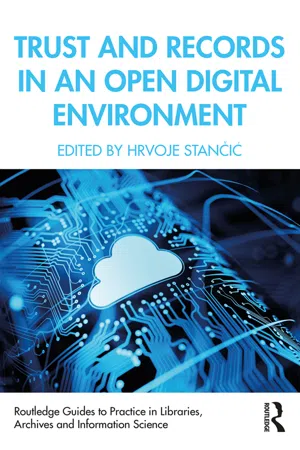
Trust and Records in an Open Digital Environment
eBook - ePub

Trust and Records in an Open Digital Environment

  1. 260 pages
  2. English
  3. ePUB (mobile friendly)
  4. Available on iOS & Android
eBook - ePub

Trust and Records in an Open Digital Environment

About this book

Trust and Records in an Open Digital Environment explores issues that arise when digital records are entrusted to the cloud and will help professionals to make informed choices in the context of a rapidly changing digital economy.

Showing that records need to ensure public trust, especially in the era of alternative truths, this volume argues that reliable resources, which are openly accessible from governmental institutions, e-services, archival institutions, digital repositories, and cloud-based digital archives, are the key to an open digital environment. The book also demonstrates that current established practices need to be reviewed and amended to include the networked nature of the cloud-based records, to investigate the role of new players, like cloud service providers (CSP), and assess the potential for implementing new, disruptive technologies like blockchain. Stan?i? and the contributors address these challenges by taking three themes – state, citizens, and documentary form – and discussing their interaction in the context of open government, open access, recordkeeping, and digital preservation.

Exploring what is needed to enable the establishment of an open digital environment, Trust and Records in an Open Digital Environment should be essential reading for data, information, document, and records management professionals. It will also be a key text for archivists, librarians, professors, and students working in the information sciences and other related fields.

Frequently asked questions

Yes, you can cancel anytime from the Subscription tab in your account settings on the Perlego website. Your subscription will stay active until the end of your current billing period. Learn how to cancel your subscription.
No, books cannot be downloaded as external files, such as PDFs, for use outside of Perlego. However, you can download books within the Perlego app for offline reading on mobile or tablet. Learn more here.
Perlego offers two plans: Essential and Complete
  • Essential is ideal for learners and professionals who enjoy exploring a wide range of subjects. Access the Essential Library with 800,000+ trusted titles and best-sellers across business, personal growth, and the humanities. Includes unlimited reading time and Standard Read Aloud voice.
  • Complete: Perfect for advanced learners and researchers needing full, unrestricted access. Unlock 1.4M+ books across hundreds of subjects, including academic and specialized titles. The Complete Plan also includes advanced features like Premium Read Aloud and Research Assistant.
Both plans are available with monthly, semester, or annual billing cycles.
We are an online textbook subscription service, where you can get access to an entire online library for less than the price of a single book per month. With over 1 million books across 1000+ topics, we’ve got you covered! Learn more here.
Look out for the read-aloud symbol on your next book to see if you can listen to it. The read-aloud tool reads text aloud for you, highlighting the text as it is being read. You can pause it, speed it up and slow it down. Learn more here.
Yes! You can use the Perlego app on both iOS or Android devices to read anytime, anywhere — even offline. Perfect for commutes or when you’re on the go.
Please note we cannot support devices running on iOS 13 and Android 7 or earlier. Learn more about using the app.
Yes, you can access Trust and Records in an Open Digital Environment by Hrvoje Stančić in PDF and/or ePUB format, as well as other popular books in Computer Science & Cloud Computing. We have over one million books available in our catalogue for you to explore.

Information

Part I
State

1
Introduction to Part I

Part I of the book takes the state perspective on the challenges related to entrusting records to the cloud. It starts by examining the relationship between established records management practice and reliable open government data. The key question to ask is what it takes for open data to be considered as verifiable sources of evidence so that citizens can trust the information provided by government. Major barriers to releasing more open government data are identified. The policies and legislation regulating digital preservation in the cloud, specifically the aspects of integrity, location of the data, its portability and ownership, can remove many ambiguities and business insecurity if developed by teaming up records managers and archivists with IT professionals. Assessment of legislation regulating cloud services show that the risks of entrusting records to the cloud are not in focus. Additional insight into this is given through the four case studies on the cloud contracts signed between public administrations and private cloud service providers. However, even if the legal regulations and policies are well formulated and in place, for information governance to manage information as assets this would not be enough – it requires a multidimensional approach additionally involving strategic management, records management, information security, ICT, and ethics. Therefore, this part discusses how information governance is defined and implemented in public administrations and how it could be used efficiently to improve e-services. Governmental e-services come in great variety – for citizens, businesses, and for other public administration e-services. Their development, aligned with the once - only principle, can positively influence efficiency of the developed e-services and communication between public administration, citizens, and businesses. It will be argued that not only should the process of their development take both a cooperative and collaborative approach, but that the mode of inter-organisational collaboration on e-government plays an important part. This is especially important in the context of e-services interconnection, interoperability, development of single sign-on (SSO) systems, trusted exchange of identification and authentication credentials, and transborder data (information, records) flow. If this path is taken, significant benefits can be realized. The financial ones, in the context of using cloud storage services, are neither easy nor straightforward to estimate. Therefore, models for digital storage costs are analyzed and their use among the records professionals is explored. Finally, this part discusses the level of trust that public administration, citizens, and businesses can have in a cloud service provider or, consequently, in the implemented and interconnected cloud-based e-services.
This part brings together research results based on the investigation of the relevant body of literature, policies and legal regulations, interviews, assessments using checklists, and case studies from Croatia, Italy, Russia, Spain, Sweden, Switzerland, and the United Kingdom (UK), portraying the current situation in information governance, records management, storage, and archiving in the cloud from the perspective of public administration, i.e. the state.

2
The role of records managers and archivists in open government

Elizabeth Shepherd with Tove Engvall and Andrew Flinn

Introduction

This chapter builds on work published in the book produced by the international research project ITrust, Trusting Records in the Cloud, in particular Chapter 11, “The Role of the Records Professional” (Anderson et al., 2019). This chapter takes the framework established in that earlier work and populates it with more detail from case studies carried out by several researchers in the ITrust Team Europe. It aims to illustrate the general issues identified in that framework by reference to European-focused research to show how the broad themes come into action in a specifically European context. The cases we draw on are those carried out at University College London for the UK and those conducted at Mid Sweden University over the period 2014–2018, in which we interviewed professionals in records management, archives, information governance, digital services, information security, IT departments, and senior executives, to understand their lived experience of the practical and legislative issues which are brought out in the new open data environment. We hope that by presenting their experiences, we can identify good practice and see areas where further work is needed. Some analysis of critical information issues raised through the case studies were published in Shepherd et al. (2018).
In this chapter, we adopt the ITrust definition of a profession
A field of work that requires advanced education and training, adherence to a code of ethics, and the ability to apply specialized knowledge and judgement in a variety of situations.
(InterPARES Trust, 2018)
And of a records professional
An individual who is trained in all aspects of managing records and information, including their creation, use, retention, disposition, and preservation, and is familiar with the legal, ethical, fiscal, administrative, and governance contexts of recordkeeping.
(InterPARES Trust, 2018)
As Anderson et al. (2019) say
The identity of the records professional has to a large degree been constructed as one of a trusted custodian responsible for ensuring trustworthy records and the trustworthy management of records. The context in which records professionals act has always been complex, operating as they do within evolving legislative (e.g. Freedom of Information, Data Protection) and policy (e.g. Open Access) frameworks which sometimes contradict each other. For example, the good of open access to information and data can sometimes conflict with the good of protecting the privacy of individuals; and records professionals have to be proficient in balancing such conflicting interests and public goods. As the context in which they operate becomes increasingly networked and digital, the complexities faced by records professionals increase in parallel.
The inter-relationships between the key areas of information legislation and the effects this has on records and information professionals is further examined by Shepherd (2015).
Anderson et al.’s chapter (2019) presents an ontology developed by Michetti and Gänser of functions and activities carried out by records professionals from records creation to long term preservation. The ontology recognizes that established roles and labels associated with records professionals are being reshaped and repositioned in broader fields such as information governance, information security, and digital preservation. As records professionals increasingly work in more open information environments and with a much greater focus on digital information and records, issues around trust in records are very significant. Understanding how records professionals operate in an open digital environment in their day-to-day practices and approaches helps to identify good practice and standards which might be more widely adopted. This chapter aims to share the learning from the European case studies by drawing on the practical experience of records managers and archivists in different sectors and showing how those experiences might be adopted or provide the foundation for new and improved services delivered by records professionals.
The ontology outlined in Anderson et al. (2019) comprises an overview map, with nine high-level functions, and 105 submaps representing 105 functions and subfunctions. The nine high-level functions are: records management, archival appraisal, preservation, archival management, information security management, monitoring and auditing, training, governance, and design and implementation of a records system. These nine functions are used as the underlying structure for the rest of this chapter. Since the nine functions are not represented evenly in the existing case studies, some will be addressed in more detail than others here. However, these case studies had virtually nothing to say on some topics and so they are not addressed directly in the rest of the chapter: archival appraisal, archival management, and design and implementation of a records system. Full information about the case studies is available on the ITrust website (https://interparestrust.org/). The case studies drawn on here are: in the United Kingdom, both at national level in the National Health Service (NHS) England (Harrison, Shepherd, & Flinn, 2015) and at a local and more practical NHS hospital trust level (Chorley, Flinn, & Shepherd, 2016; Chorley, 2017), local government (Page, Flinn, and Shepherd, 2014), and higher education (Brimble, Flinn, & Shepherd, 2016); and in Sweden, at the Stockholm City Archives (Engvall, Liang, & Anderson, 2015).

Records management

The hospital trust (Chorley et al., 2016; Chorley, 2017) provided an example of the great opportunities that open data presents to information professionals for increased collaboration and the sharing of ideas and expertise across communities which have not usually or traditionally worked together, such as system designers, data creators, technology experts, data management experts, and information security experts, alongside records and archives management professionals. Records professionals were able to draw on skills in policy and governance, digital and analogue records, data management, and information security when delivering core records management services. Records managers were able to respond more confidently to widespread and complex challenges around open data, such as trying to work out what can be published, but also the processes of how data can best be opened, by whom, and how it is going to be resourced, given organisational pressures. Proactive publication of data is still an exceptional activity and requires new capacity and capabilities before it can become a routine business function, even though the records managers in our study believed that trusted open data led to increased accountability and transparency. In the Stockholm City study, it was emphasized that organisations should know from the beginning when information is created if it can be published as open data. This is also part of strategic and political decisions (Engvall et al., 2015).
Practices of information governance, records management, and access to information in the case study hospital (Chorley et al., 2016) present significant challenges to a trusted data environment, where data might need to be shared between different health providers. The case study highlighted the need for the creation and capture of suitable and sufficient metadata for records to ensure that datasets can be interpreted, retrieved, and used, and to ensure the safeguarding of records and data by all staff to prevent security or sensitivity breaches. The size and complexity of this task is increased with the need to manage a large volume of complex records, including many that contain sensitive and confidential information, and in the absence of standardized metadata processes. Metadata for digital health and corporate records was limited to that captured automatically by computer software programmes, in the absence of a corporate electronic document and records management system (EDRMS), and for paper records, contextual information provided on the transfer forms that accompany records from the creator to the records centre was the main source. Many other organisations also lack reliable systems for capturing metadata: records professionals play a critical role in ensuring that data can be identified and linked, but at present systems to enable this are generally lacking. In the Stockholm City case study (Engvall et al., 2015), the role of metadata was also emphasized to contextualize data when it is published, in order for users to fully understand its meaning and to be useful.
The concern about the lack of reliable metadata was also expressed in the case study with NHS England (Harrison et al., 2015). As Lowry (2014) noted, a lack of metadata can result in data being “unconnected to the context of its creation, left without the esse...

Table of contents

  1. Cover
  2. Half Title
  3. Series Page
  4. Title Page
  5. Copyright Page
  6. Contents
  7. List of figures
  8. List of tables
  9. List of contributors
  10. Acknowledgements
  11. List of acronyms
  12. Introduction
  13. Part I State
  14. Part II Citizens
  15. Part III Documentary form
  16. Conclusion
  17. Appendix 1: Checklist for the assessment of implemented governmental e-services
  18. Appendix 2: Recommendations for planning and designing e-services between public administrations
  19. Appendix 3: Checklist for single sign-on systems
  20. Appendix 4: Checklist for ensuring trust in storage using IaaS
  21. Appendix 5: Metadata elements relevant for retention and disposition of websites
  22. Index