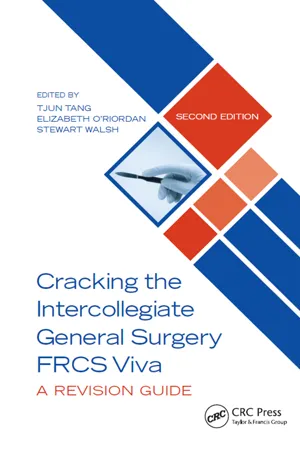
Cracking the Intercollegiate General Surgery FRCS Viva: A Revision Guide 2e provides the framework and knowledge to pass the non-subspecialty sections of the FRCS (General Surgery) viva and clinical examination. This comprehensive and up to date revision text covers all essential topics in critical care, emergency and general surgery as well as research papers, basic statistics and data manipulation for the academic section.This essential revision guide provides you with the vital points for each topic, presented in a concise, structured manner and referenced where appropriate. It is essential reading for anyone preparing for the FRCS General Surgery exam.
eBook - ePub
Cracking the Intercollegiate General Surgery FRCS Viva 2e
A Revision Guide
- 514 pages
- English
- ePUB (mobile friendly)
- Available on iOS & Android
eBook - ePub
Cracking the Intercollegiate General Surgery FRCS Viva 2e
A Revision Guide
About this book
Information
1
Academic Viva
Doireann Joyce and Stewart Walsh
Academic Viva − How to Review a Paper
Abstract
•Does the abstract accurately reflect the content of the paper?
Introduction
•Has the background of the study been given appropriately?
•Is the aim of the study clearly stated?
•What was the hypothesis?
Methodology
•Was there selection bias by the authors?
•What patients were excluded from the study?
•Were the patients included in the study representative of the patients encountered in general surgical practice?
•Are the methods appropriate?
•If it is a randomised study, was a power calculation used?
•What information is required to undertake a power calculation?
•Was the end point valid?
•Was the difference sought in the study of clinical relevance?
Results
•Are the results well set out?
•Was statistical analysis appropriate or needed?
•Are all patients accounted for?
•What is type I or type II error?
•What is sensitivity/specificity?
•Can you explain the forest plots/ROC curves?
•Have the results been presented in a biased way?
•Is follow-up adequate?
•Are significant complications excluded from the analysis?
Discussion
•Are the results discussed fairly and compared to what is known in the literature?
•What are the novel observations?
•Are you aware whether the topic is covered in existing guidelines or published papers?
•Are the conclusions supported by the data presented?
•What are the healthcare issues?
Final summary
•You can give this at the beginning or the end, depending on the examining style.
•Summarise it in five or six sentences.
•Pick out the good and bad points.
•Form an opinion − is it good/average/bad?
•Decide whether it will change your practice.
•How would you have designed the study differently?
•If you were the editor, would you publish it?
Basic Statistic Definitions
Mode
•Most common value in a data set.
Median
•Middle value in a data set.
Mean
•Sum of all values/number of values.
Standard deviation
•Describes degree of data spread about the mean
•square root of the variance (only with parametric data)
•1 SD = 68% observations; 2 SD = 95% observations.
Standard error (SE)
•Standard deviation (SD) of the sample mean.
Confidence interval (CI)
•Measure uncertainty in measurements.
•Width of the CI = precision of estimate.
•95% CI = range in which 95% of population lies.
•CI that includes 0 is not significant.
•The larger the sample is, the smaller the variability, and the more likely the results are true.
•When quoted alongside a ratio (e.g. relative risk, odds ratio), an interval including 1 is not significant.
•When comparing two groups, if the CI of each group does not overlap, this is a significant result.
Prevalence
•Proportion of population with disease at a given time point.
Incidence
•Rate of occurrence of new cases over a period of time.
Odds
•Number of times an event is likely to occur/number of times it is likely not to occur.
•Odds of having a girl = 1/1 = 1
Odds ratio (OR)
•Odds of having the disorder in the experimental group relative to the odds in favour of having the disorder in the control group.
•OR = 1: no effect
•OR >1: higher chance of disease in exposed group
Risk
•Probability of something happening.
•Number of times that an event is likely to occur/total number of events possible.
•Risk of having a girl = 1/2 = 50%
Absolute risk
•Incidence rate of outcome in the group.
Relative risk (RR)
•Experimental absolute risk/control absolu...
Table of contents
- Cover
- Title Page
- Copyright Page
- Dedication
- Contents
- Foreword from the First Edition
- From the Editors
- Editors
- Contributors
- Contributors from the First Edition
- Introduction
- Chapter 1: Academic Viva
- Chapter 2: Breast Surgery
- Chapter 3: Colorectal Surgery
- Chapter 4: Critical Care and Anaesthesia
- Chapter 5: HPB Surgery
- Chapter 6: Applied Surgical Anatomy
- Chapter 7: Vascular Surgery
- Chapter 8: Upper GI Surgery
- Chapter 9: Transplant Surgery
- Chapter 10: Endocrine Surgery
- Chapter 11: Emergency Surgery
- Chapter 12: General Surgery
- Index
Trusted by 375,005 students
Access to over 1.5 million titles for a fair monthly price.
Study more efficiently using our study tools.
Frequently asked questions
Yes, you can cancel anytime from the Subscription tab in your account settings on the Perlego website. Your subscription will stay active until the end of your current billing period. Learn how to cancel your subscription
No, books cannot be downloaded as external files, such as PDFs, for use outside of Perlego. However, you can download books within the Perlego app for offline reading on mobile or tablet. Learn how to download books offline
Perlego offers two plans: Essential and Complete
- Essential is ideal for learners and professionals who enjoy exploring a wide range of subjects. Access the Essential Library with 800,000+ trusted titles and best-sellers across business, personal growth, and the humanities. Includes unlimited reading time and Standard Read Aloud voice.
- Complete: Perfect for advanced learners and researchers needing full, unrestricted access. Unlock 1.5M+ books across hundreds of subjects, including academic and specialized titles. The Complete Plan also includes advanced features like Premium Read Aloud and Research Assistant.
We are an online textbook subscription service, where you can get access to an entire online library for less than the price of a single book per month. With over 1.5 million books across 990+ topics, we’ve got you covered! Learn about our mission
Look out for the read-aloud symbol on your next book to see if you can listen to it. The read-aloud tool reads text aloud for you, highlighting the text as it is being read. You can pause it, speed it up and slow it down. Learn more about Read Aloud
Yes! You can use the Perlego app on both iOS and Android devices to read anytime, anywhere — even offline. Perfect for commutes or when you’re on the go.
Please note we cannot support devices running on iOS 13 and Android 7 or earlier. Learn more about using the app
Please note we cannot support devices running on iOS 13 and Android 7 or earlier. Learn more about using the app
Yes, you can access Cracking the Intercollegiate General Surgery FRCS Viva 2e by Tjun Tang, Elizabeth O'Riordan, Stewart Walsh, Tjun Tang,Elizabeth O'Riordan,Stewart Walsh in PDF and/or ePUB format, as well as other popular books in Medicine & Clinical Medicine. We have over 1.5 million books available in our catalogue for you to explore.