This book covers IoT and Big Data from a technical and business point of view. The book explains the design principles, algorithms, technical knowledge, and marketing for IoT systems.
It emphasizes applications of big data and IoT. It includes scientific algorithms and key techniques for fusion of both areas. Real case applications from different industries are offering to facilitate ease of understanding the approach. The book goes on to address the significance of security algorithms in combing IoT and big data which is currently evolving in communication technologies.
The book is written for researchers, professionals, and academicians from interdisciplinary and transdisciplinary areas. The readers will get an opportunity to know the conceptual ideas with step-by-step pragmatic examples which makes ease of understanding no matter the level of the reader.
1.1Introduction to Big Data and Internet of Things
The healthcare sector is currently experiencing a data overload derived from the digitization revolution. There are multiple streams of data entering healthcare systems through electronic health records. Healthcare data originally was kept in the form of hard copies but following the recent trends, health systems are racing to digitize these large amounts of patient health data. The information includes medical diagnoses, prescriptions, allergy data, demographics, clinical narratives, and the clinical laboratory results [1]. With the change to digitization, we have observed improvements in healthcare systems with data being widely available, resulting in reduced examinations, fewer ambiguities caused by illegible handwriting, and fewer missing or lost patient records. Patient care has immensely improved with healthcare systems becoming more organized [2].
Electronic health records are not the only data that is being recorded; with advancements in healthcare technology, multiple instruments have transformed into digital formats. Like electronic health records, which were originally static, X-ray films, scripts, and so on all went digital. Small electronics, such as heart rate monitors, EKG, and oxygen sensors, and large electronics, such as MRI machines, that are continuously recording data are all now digitized. Keeping all these streams of data organized is a serious challenge, especially with each type of data being different. The challenge of the healthcare sector is how to keep everything, including MRI images, sensory data, and patient health records, organized and interlinked. The historical relational databases that currently exist will struggle in maintaining structured and unstructured data [3].
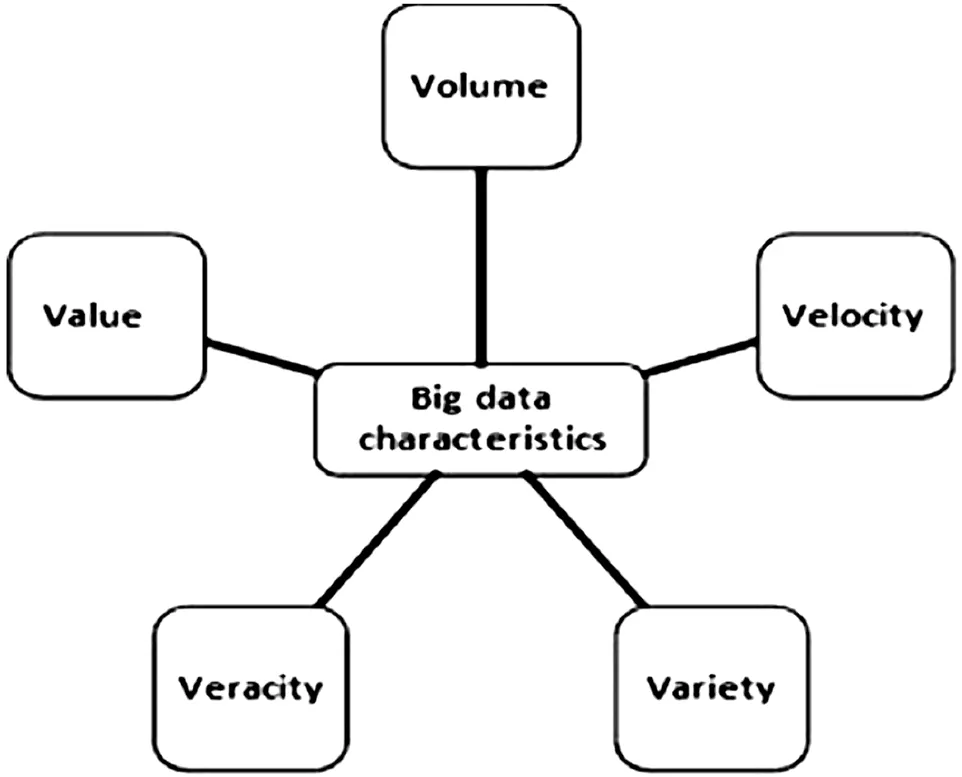
Data analytics revolve around the five Vs of data characteristics. These are volume, velocity, variety, value, and veracity (shown in Figure 1.1), which will be the main challenges healthcare must overcome in order to become dominant in data organization and analytics [4]. Healthcare systems are continuously creating and accumulating data at an exponential rate. These systems need to store this large volume of data and access it at any time with a high rate of velocity. This leads to another data characteristic: the velocity that will be needed to analyse the data in real-time. Real-time monitoring of aspects such as blood pressure, operating room anaesthesia measurements, and heart monitors is crucial, as they can be the difference between life and death. Variety is a big challenge in healthcare, since the data streams come from multiple structured and unstructured sources [5]. Health systems will have to understand and manage these streams of data, such as MRI and X-ray images, sensory data, and genomic data. Healthcare applications need to be efficient in combining and converting various forms of data, including conversion from structured to unstructured data or other creative data storage solutions. Veracity is the final challenge that healthcare systems need to overcome. Is the data reliable and captured correctly? Is the data secured from outside intrusion/attack? In order to ensure these, a methodology and solution need to be constructed to tackle the challenges.
FIGURE 1.1The Five Vs of big data.
There are additional challenges in the healthcare context [6]. These include the high cost of overhauling the whole IT infrastructure that exists currently in the healthcare system. Not many healthcare systems have the money or the resources to dedicate to this kind of technological overhaul. Not only is the cost high, but also resources and a number of inputs are required to pull off a successful project. The healthcare systems will have to organize doctors, scientists, software engineers, and data scientists; all come together and bring a full technological construction, which is a huge challenge in itself.
The end goal of healthcare applications should be to successfully maintain multiple streams of data and grow to include genomic data to provide individualized healthcare treatment for patients and the highest quality of care possible. With the digitization and combining of data in order to use big data, healthcare sectors, ranging from doctors’ offices to large hospital groups, can receive significant advantages. Data would be more readily available, enabling fast disease detection, so starting the right treatment within a short span of time would now be possible. These technical advancements would also lead to improvements in health status, billing fraud would be detected more quickly, and health systems would increase profits and reduce waste and redundant costs. Overall disease patterns and outbreaks would be heavily analysed to improve surveillance and speedy response. Health systems can use this data to deliver faster targeted vaccinations such as the yearly influenza strain. Data collected would turn into actionable information to meet requirements, deliver services, and both forecast and prevent crises for the benefit of mankind. Enhanced data and analytics would benefit patients, most of whom are the largest consumers of health assets and can be provided with factual and accurate information to make informed decisions, proactively handle their own health, select and track healthier practices, and identify treatments in real-time.
Genomics, not to be confused with genetics, is a new science [7]. Genomics is the study of how the entire genome (the unique genetic code that serves as a blueprint for all living things) is expressed in the physical characteristics of an organism. Genetics is an older discipline and tracks how traits are inherited from generation to generation. Genomics is young because genomes could not be sequenced u...
Table of contents
Cover
Half Title
Series Page
Title Page
Copyright Page
Table of Contents
Preface
Acknowledgements
List of Editors
List of Contributors
Chapter 1: Foundation of Big Data and Internet of Things: Applications and Case Study
Chapter 2: Securing IoT with Blockchain: Challenges, Applications, and Techniques
Chapter 3: IoT and Big Data Using Intelligence
Chapter 4: Compulsion for Cyber Intelligence for Rail Analytics in IoRNT
Chapter 5: Big Data and IoT Forensics
Chapter 6: Integration of IoT and Big Data in the Field of Entertainment for Recommendation System
Chapter 7: Secure and Privacy Preserving Data Mining and Aggregation in IoT Applications
Chapter 8: Real-Time Cardiovascular Health Monitoring System Using IoT and Machine Learning Algorithms: Survey
Index
Trusted by 375,005 students
Access to over 1.5 million titles for a fair monthly price.
Study more efficiently using our study tools.
Frequently asked questions
Yes, you can cancel anytime from the Subscription tab in your account settings on the Perlego website. Your subscription will stay active until the end of your current billing period. Learn how to cancel your subscription
No, books cannot be downloaded as external files, such as PDFs, for use outside of Perlego. However, you can download books within the Perlego app for offline reading on mobile or tablet. Learn how to download books offline
Perlego offers two plans: Essential and Complete
Essential is ideal for learners and professionals who enjoy exploring a wide range of subjects. Access the Essential Library with 800,000+ trusted titles and best-sellers across business, personal growth, and the humanities. Includes unlimited reading time and Standard Read Aloud voice.
Complete: Perfect for advanced learners and researchers needing full, unrestricted access. Unlock 1.5M+ books across hundreds of subjects, including academic and specialized titles. The Complete Plan also includes advanced features like Premium Read Aloud and Research Assistant.
Both plans are available with monthly, semester, or annual billing cycles.
We are an online textbook subscription service, where you can get access to an entire online library for less than the price of a single book per month. With over 1.5 million books across 990+ topics, we’ve got you covered! Learn about our mission
Look out for the read-aloud symbol on your next book to see if you can listen to it. The read-aloud tool reads text aloud for you, highlighting the text as it is being read. You can pause it, speed it up and slow it down. Learn more about Read Aloud
Yes! You can use the Perlego app on both iOS and Android devices to read anytime, anywhere — even offline. Perfect for commutes or when you’re on the go. Please note we cannot support devices running on iOS 13 and Android 7 or earlier. Learn more about using the app
Yes, you can access Securing IoT and Big Data by Vijayalakshmi Saravanan, Alagan Anpalagan, T. Poongodi, Firoz Khan, Vijayalakshmi Saravanan,Alagan Anpalagan,T. Poongodi,Firoz Khan in PDF and/or ePUB format, as well as other popular books in Computer Science & Computer Science General. We have over 1.5 million books available in our catalogue for you to explore.