First published in 1991. It was the lyric poetry of Petrarch that popularized the sonnet in European literature, that set the standard for love poetry for centuries to follow. Compared to the large volume of prose, poetry and notes in Latin, the corpus of Petrarch's Italian writings is small: the 366 poems that make up the Canzoniere, the 2000 or so verses of the Trionfi, and an undetermined number of poems, drafts and fragments that comprise what we call the Rime disperse. This collection includes indexes of first lines in both Italian and English.
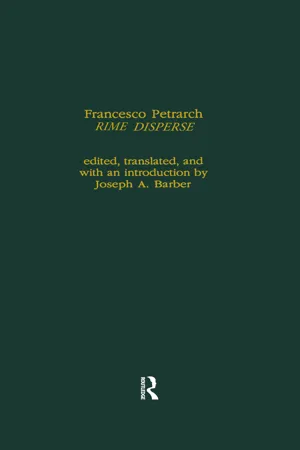
- 216 pages
- English
- ePUB (mobile friendly)
- Available on iOS & Android
eBook - ePub
Francesco Petrarch Rime Disperse
About this book
Information
Rime disperse
Poem 1
Donna mi vene spesso ne la mente;
altra donna v’è sempre:
onde io temo si stempre il core ardente.
Quella ’l notrica in amorosa fiamma
con un dolce martir pien de disire; 5
questa lo strugie oltra misura e ’nfiamma
tanto ch’a doppio è forza che sospire.
Né val perch’io m’adire et armi il core,
ch’i’ non so come Amore,
di che forte mi sdegno, lei consente. 10
The ballata is unique among the Disperse in that it was for many years included in the Canzoniere. It was transcribed in the poet’s final manuscript copy (Vaticano-latino 3195) at position CXXI and replaced by the madrigal, Or vedi Amor, only in the last months of Petrarch’s life. The most widely accepted explanation for the poet’s suppression of this lyric is that it refers to a love for another woman, though some 16th-century commentators interpreted the donna of v. 1 as an allegorical representation of the poet’s desire for glory. 3. Internal rhyme (here and in v.8) is unusual in Petrarch’s baliate. For stempre, Canz. LXXIII, 7-8: ma non in guisa che lo core si stempre/di sorvechia dolcezza.
Poem 1
A lady comes often to my mind; another lady is always there. So I fear that my burning heart will be destroyed.One nourishes it in flames of love with a sweet suffering full of desire; the other destroys it beyond measure and enflames it so much that the force of my sighing is doubled. Nor does it help me to become angry and arm my heart; for I do not know why Love, troubling me so much, permits it.
Poem 2
L’amorose faville e ’l dolce lume
de’ be’ vostri occhi onde la mente ho piena
fanno la vita mia sempre serena.
Donna, l’alto viaggio ond’io m’ingegno
meritar vostra grazia umilemente 5
con sua durezza m’averia già stanco,
se non ch’Amor dal bel viso lucente
si fa mia scorta et infallibil segno
mostrandosi nel bel nero e nel bianco;
onde sospira il disioso fianco 10
e riprende valor che ’n alto il mena,
vincendo ogni contrario che l’affrena.
This ballata is one of a group of three which Petrarch wrote for an acquaintance named Confortino, who was probably a minstrel. 7-8. Canz. LXXIII, 50-51 constitute a variant of these verses: gli occhi lucenti/sono il mio segno e ’l mio conforto solo. 9. The black and white of the lady’s eyes, as in Canz. LXXII, 49-51: quando voi alcuna volta/soavemente tra ’l bel nero e ’l biancho/volgete il lume in cui Amor si trastulla.
Poem 2
The loving sparks and sweet light of your beautiful eyes, which fill my mind, make my life ever serene.Lady, the lofty journey with which I strive to humbly earn your kindness would have already made me tired from its rigor if Love, shining forth from your beautiful face, were not my companion and infallible sign, showing himself in the beautiful black and white; therefore my yearning heart sighs and recovers the strength that leads it aloft, overcoming the obstacles that hold it back.
Poem 3
Amor che ’n cielo e ’n gentil core alberghi
e quanto è di valore al mondo inspiri,
acqueta l’infiammati miei sospiri.
Altera donna con sí dolce sguardo
leva il grave pensier talor da terra 5
che lodarmi conven de gli occhi suoi;
ma dogliomi del nodo ond’io son tardo
a seguire il mio bene, e vivo in guerra
coll’alma rebellante a’ messi tuoi.
Signor che solo intendi e tutto puoi, 10
pur spero che miei passi in parte giri
ove in pace perfetta al fin respiri.
The ballata is contained in Petrarch’s autograph worksheets, where the poet wrote in the margin next to it: “Hic videtur proximior perfectioni.” He also noted the date, Jan. 1, 1350. 1. This verse is probably related to Guinizelli’s doctrinal canzone, Al cor gentil ripara sempre Amore. Petrarch makes use of the same concept in Canz. LXXXIV, 5-6: Già prima ebbe per voi l’entrata Amore,/là onde anchor come in suo albergo vène. 7. Nodo refers to the knot of the body and earthly pursuits in general. Before settling on this term, Petrarch had considered peso. 9. Messi tuoi: literally, “your messengers,” translated less metaphorically as “signs.” 10. Signor: God; though ambiguous, the term may probably be equated with Amore of v. 1. This is the second of the three ballate written for Petrarch’s acquaintance Confortino.
Poem 3
Love, who dwells in heaven and in the noble heart, and who gives life to all that is of value in this world, make quiet my flaming sighs.A noble lady at times raises my grave thoughts from earth with so sweet a look that I should praise her eyes, but I sorrow because of the bind which makes me slow to follow my good, and I live at war with my soul rebellious against your signs. Lord who alone understands and can do all things, I still hope that you will guide my footsteps to a place where I will in the end find repose in perfect peace.
Poem 4
Nova bellezza in abito gentile
volse il mio core a l’amorosa schiera
ove ’l mai si sostene e ’l ben si spera.
Gir mi convene e star, com’altri vole,
poi ch’al vago penser fu posto un freno 5
di dolci sdegni e di pietosi sguardi,
e ’l chiaro nome e ’l suon de le parole
de la mia donna e ’l bel viso sereno
son le faville, Amor, di che ’l cor m’ardi.
I’ pur spero merce, quantunque tardi, 10
ché, ben ella si mostre acerba e fera,
umile amante vince donna altera.
The ballata is the third of the group composed for the minstrel Confortino. The theme, the humility of the poet overcoming the sdegno of the lady, is dear to Petrarch. 6. The antithetical dolci sdegni is one of the poet’s favorite rhetorical figures; it appears also in Canz. CCIV, 13; CCV, 1; and CCLXXXIX, 10. 11. Ben most probably stands for benché.
Poem 4
A new beauty clothed in a noble garment turned my heart to the ranks of lovers, where pain is endured and good is longed for.Now I must come and go as another wishes, since ...
Table of contents
- Cover
- Title Page
- Copyright Page
- Preface of the General Editors
- Preface
- Table of Contents
- Introduction
- Select Bibliography
- Petrarch’s Rime disperse
- Index of Italian First Lines
- Index of English First Lines
Trusted by 375,005 students
Access to over 1.5 million titles for a fair monthly price.
Study more efficiently using our study tools.
Frequently asked questions
Yes, you can cancel anytime from the Subscription tab in your account settings on the Perlego website. Your subscription will stay active until the end of your current billing period. Learn how to cancel your subscription
No, books cannot be downloaded as external files, such as PDFs, for use outside of Perlego. However, you can download books within the Perlego app for offline reading on mobile or tablet. Learn how to download books offline
Perlego offers two plans: Essential and Complete
- Essential is ideal for learners and professionals who enjoy exploring a wide range of subjects. Access the Essential Library with 800,000+ trusted titles and best-sellers across business, personal growth, and the humanities. Includes unlimited reading time and Standard Read Aloud voice.
- Complete: Perfect for advanced learners and researchers needing full, unrestricted access. Unlock 1.5M+ books across hundreds of subjects, including academic and specialized titles. The Complete Plan also includes advanced features like Premium Read Aloud and Research Assistant.
We are an online textbook subscription service, where you can get access to an entire online library for less than the price of a single book per month. With over 1.5 million books across 990+ topics, we’ve got you covered! Learn about our mission
Look out for the read-aloud symbol on your next book to see if you can listen to it. The read-aloud tool reads text aloud for you, highlighting the text as it is being read. You can pause it, speed it up and slow it down. Learn more about Read Aloud
Yes! You can use the Perlego app on both iOS and Android devices to read anytime, anywhere — even offline. Perfect for commutes or when you’re on the go.
Please note we cannot support devices running on iOS 13 and Android 7 or earlier. Learn more about using the app
Please note we cannot support devices running on iOS 13 and Android 7 or earlier. Learn more about using the app
Yes, you can access Francesco Petrarch Rime Disperse by Joseph A. Barber in PDF and/or ePUB format, as well as other popular books in Literature & Italian Literary Criticism. We have over 1.5 million books available in our catalogue for you to explore.