eBook - ePub
Sterile Insect Technique
Principles And Practice In Area-Wide Integrated Pest Management
- 1,200 pages
- English
- ePUB (mobile friendly)
- Available on iOS & Android
eBook - ePub
Sterile Insect Technique
Principles And Practice In Area-Wide Integrated Pest Management
About this book
The sterile insect technique (SIT) is an environment-friendly method of pest control that integrates well into area-wide integrated pest management (AW-IPM) programmes. This book takes a generic, thematic, comprehensive, and global approach in describing the principles and practice of the SIT. The strengths and weaknesses, and successes and failures, of the SIT are evaluated openly and fairly from a scientific perspective. The SIT is applicable to some major pests of plant-, animal-, and human-health importance, and criteria are provided to guide in the selection of pests appropriate for the SIT. In the second edition, all aspects of the SIT have been updated and the content considerably expanded. A great variety of subjects is covered, from the history of the SIT to improved prospects for its future application. The major chapters discuss the principles and technical components of applying sterile insects. The four main strategic options in using the SIT — suppression, containment, prevention, and eradication — with examples of each option are described in detail. Other chapters deal with supportive technologies, economic, environmental, and management considerations, and the socio-economic impact of AW-IPM programmes that integrate the SIT. In addition, this second edition includes six new chapters covering the latest developments in the technology: managing pathogens in insect mass-rearing, using symbionts and modern molecular technologies in support of the SIT, applying post-factory nutritional, hormonal, and semiochemical treatments, applying the SIT to eradicate outbreaks of invasive pests, and using the SIT against mosquito vectors of disease. This book will be useful reading for students in animal-, human-, and plant-health courses. The in-depth reviews of all aspects of the SIT and its integration into AW-IPM programmes, complete with extensive lists of scientific references, will be of great value to researchers, teachers, animal-, human-, and plant-health practitioners, and policy makers.
Information
1. INTRODUCTION
In one of three seminal papers (Baumhover et al. 1955; Knipling 1955; Lindquist 1955) reporting the first success of the sterile insect technique (SIT) to eradicate insect pests, Knipling presented a table showing an example of model simulation for explaining the effect of sterile male releases. The model is

where Ng and Ng+1 are numbers of females at the gth and (g+1)th generation, and R and Q are rates of change in the population size per generation and the proportion of normal females (females which can lay hatchable eggs), respectively. This early model shows that population ecology theory and models have been an integral part of the SIT from the outset (Barclay, this volume; Barclay et al., this volume).
The early success in eradicating the New World screwworm Cochliomyia hominivorax (Coquerel), in the area-wide integrated pest management (AW-IPM) programme in Florida in 1959, was not always replicated in subsequent AW-IPM programmes integrating the SIT (Krafsur 1998; Liebhold et al. 2016). In many cases this was because government officials thought about the SIT as an established technique consisting only of releasing sterile insects, with animal and plant health workers engaged in programmes releasing sterile insects without basic ecological and behavioural studies. Some early programmes did not include first estimating the number of wild females, simulating the process based on a population model incorporating the SIT, and evaluating in the field the mating competitiveness of the released sterile males. Thus, in some of those cases, many sterile males were released but eradication failed, and it was not possible to know the major reason for failure, in spite of overflooding the wild population with sterile males, e.g. ratios of the number of sterile to wild males were 112:1 in a Mediterranean fruit fly Ceratitis capitata (Wiedemann) programme in Nicaragua (Rhode et al. 1971), and 311:1 in another C. capitata programme in Procida Island (Cirio and de Murtas 1974). Without a full understanding of the population and behavioural ecology, the planning, implementation, and evaluation of programmes that release sterile insects become very difficult (FAO/IAEA 2016; Barclay, this volume; Barclay et al., this volume; Vreysen, this volume).
The goal of this chapter is to describe basic theory, models, and some mathematical techniques from population and behavioural ecology that are helpful for planning and executing the SIT component of an AW-SIT programme aimed at the control of pest insects — suppression, containment, prevention or eradication (Hendrichs, Vreysen et al., this volume).
2. THEORETICAL POPULATION DYNAMICS
2.1. Logistic Model
The most basic model of population increase is the Hale-Malthus model:

or, integrating equation 1,
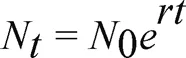
where Nt, N0, r and e are number of individuals at time t, number at the beginning of increase, intrinsic rate of increase, and the base of natural logarithms (= 2.71828), respectively. If population increase with discrete generations, as seen in many insects, is considered, equation 1 can be written as

or
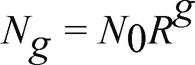
the equation used by Knipling (1955), where lnR = r (Begon and Mortimer 1981).
In equations 1 and 3, the population size increases indefinitely, but the large Nt or Ng may result in a smaller rate of increase, due to density-dependency, and the population may reach an upper limit. The most widely used model of density-dependent population increase is the logistic model,

where h is the suppressive effect of existence of an individual on the intrinsic rate of increase. Here r/h is the upper limit of increase, and writing r/h = K,
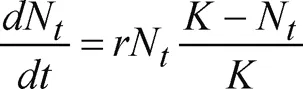
or by integration,
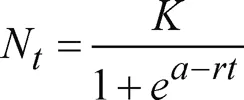
where a is a constant.
To establish a population model of the melon fly Zeugodacus (formerly Bactrocera) cucurbitae (Coquillett) under control by the SIT, Itô (1977) used a discrete expression of equation 7 to calculate generation-based increase of a logistic population (Fujita and Utida 1953). We have the following relation from equation 7 of g generation: ea—rg = (K/N ) — 1. By substituting this relation for equation 7 of (g + 1) generation, we obtain

where B = (er — 1)/K. In place of Itô’s procedure, we can use a logistic difference model, such as
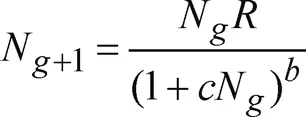
where b and c are constants (Hassell 1975; Begon et al. 1996), in place of equation 4 for constant increase. Fig. 1 shows examples of Hale-Malthusian (dashed) and logistic increase of density (Ng).
2.2. Dynamics of Populations under Control by the SIT
In equations 8 or 9, the population size of the next generation can be expressed as
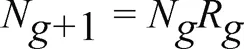
and when the SIT is applied

where Hg is the proportion of fertile (hatchable) eggs, and this value indicates the suppressive effect of sterile males on population increase. Thus, Hg is considered to be a function of the ratio of the number of sterile males, Ns, to fertile (normal) males, Nf in the field, that is,

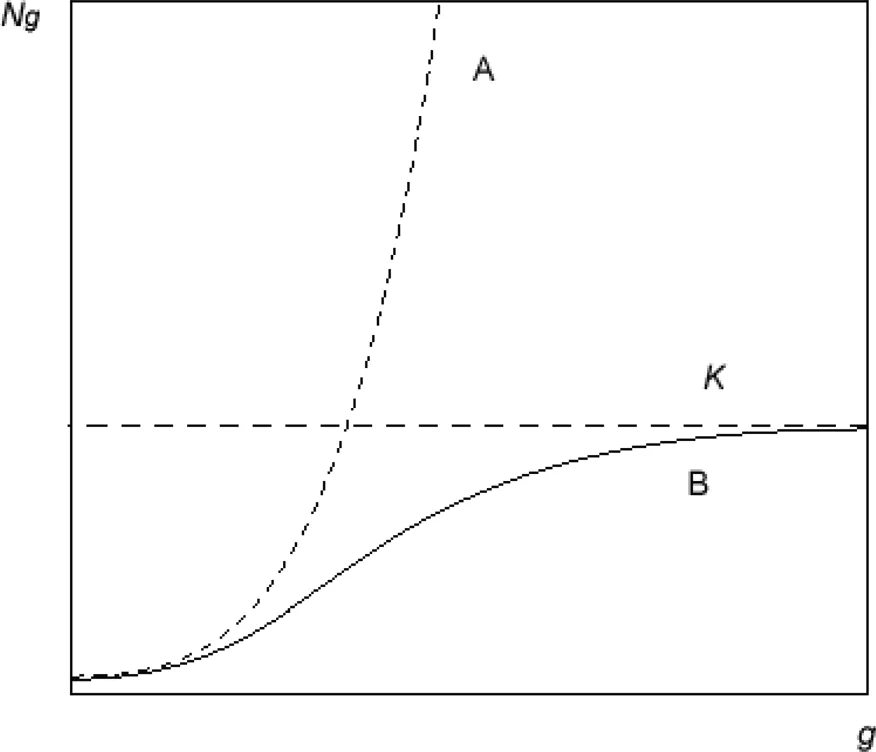
Figure 1. Exponential (A) and sigmoidal (B) increase in the population. The equation giving a sigmoidal increase is the logistic model.
If the number of sterile males released in each generation is the same,

how can f be determined? To establish a model of the SIT process for the melon fly on Kume Island, Okinawa, Itô (1977) adopted a Poisson distribution (mean number of matings = 1.61) for the frequency of matings per wild female. The probability that a female would mate with normal and/or sterile males was approximated by the binomial distribution. Based on this Poisson-binomial model, a curve showing the relationship between the expected hatchability of eggs and the Ns/Nf ratio was obtained (Fig. 2). The Hg values read from this graph are incorporated into equation 11 where Rg is derived from equation 8.
For the melon fly...
Table of contents
- Cover
- Half Title
- Title Page
- Copyright Page
- Preface
- Foreword
- Introductory Remarks
- Table of Contents
- Part II. Principles of the Sterile Insect Technique
- Part III. Technical Components of the Sterile Insect Technique
- Part IV. Supportive Technologies to Improve the Sterile Insect Technique
- Part V. Economic, Environmental, and Management Considerations
- Part VI. Application of the Sterile Insect Technique
- Part VII. Impact of Area-Wide Pest Management Programmes that Integrate the Sterile Insect Technique
- Part VIII. Future Development of the Sterile Insect Technique
- Author Index
- Subject Index
Trusted by 375,005 students
Access to over 1.5 million titles for a fair monthly price.
Study more efficiently using our study tools.
Frequently asked questions
Yes, you can cancel anytime from the Subscription tab in your account settings on the Perlego website. Your subscription will stay active until the end of your current billing period. Learn how to cancel your subscription
No, books cannot be downloaded as external files, such as PDFs, for use outside of Perlego. However, you can download books within the Perlego app for offline reading on mobile or tablet. Learn how to download books offline
Perlego offers two plans: Essential and Complete
- Essential is ideal for learners and professionals who enjoy exploring a wide range of subjects. Access the Essential Library with 800,000+ trusted titles and best-sellers across business, personal growth, and the humanities. Includes unlimited reading time and Standard Read Aloud voice.
- Complete: Perfect for advanced learners and researchers needing full, unrestricted access. Unlock 1.5M+ books across hundreds of subjects, including academic and specialized titles. The Complete Plan also includes advanced features like Premium Read Aloud and Research Assistant.
We are an online textbook subscription service, where you can get access to an entire online library for less than the price of a single book per month. With over 1.5 million books across 990+ topics, we’ve got you covered! Learn about our mission
Look out for the read-aloud symbol on your next book to see if you can listen to it. The read-aloud tool reads text aloud for you, highlighting the text as it is being read. You can pause it, speed it up and slow it down. Learn more about Read Aloud
Yes! You can use the Perlego app on both iOS and Android devices to read anytime, anywhere — even offline. Perfect for commutes or when you’re on the go.
Please note we cannot support devices running on iOS 13 and Android 7 or earlier. Learn more about using the app
Please note we cannot support devices running on iOS 13 and Android 7 or earlier. Learn more about using the app
Yes, you can access Sterile Insect Technique by Victor A. Dyck, Jorge Hendrichs, A.S. Robinson, Victor A. Dyck,Jorge Hendrichs,A.S. Robinson in PDF and/or ePUB format, as well as other popular books in Biological Sciences & Environmental Economics. We have over 1.5 million books available in our catalogue for you to explore.