Creating Sensory Smart Classrooms introduces educators to the foundations of sensory processing and offers tools to meet the wide variety of sensory needs in each classroom. This comprehensive handbook helps readers understand the neurobiology behind sensory processing and regulation issues, recognize when a student is over- or under-stimulated, and integrate different sensory inputs into the school environment. Practical and accessible chapters foster an understanding of how sensory processing influences behaviors in the classroom and how protective relationships, combined with sensory strategies, positively influence students' regulation for improved learning outcomes. Packed with useful examples, this is essential reading for teachers looking to develop the knowledge and skills they need to design sensory smart environments that support ALL learners.
Setting the Stage for Learning with Sensory Processing
Humans are naturally curious and inquisitive—you will see that if you spend even five minutes with a toddler—which facilitates the intrinsic motivation for learning. Sensory information is one of the drivers of this desire to explore, discover, and do. Input from our senses influences how we relate to the environment, how we relate to ourselves, and how we relate to others. It gives meaning to activities and experiences. We cannot engage in the learning process without our senses—they serve as necessary building blocks. Sensory processing impacts every area of learning, attention, and regulation although it is often overlooked or not fully understood. The way in which we take in and utilize sensory input influences how we move our bodies, learn new skills, attend, and participate in everyday activities.
While we all have different ways of learning and doing through the use of sensory input, there are some basic organizational features of the brain that exist in every human. This organization is important in understanding the influence of sensory input on regulation and learning. We will quickly discuss a few brain-based constructs here to provide some background to better understand the concepts throughout the book.
Organization of the Brain and Neuroplasticity
One way that we can look at the organization of the brain is from the bottom of the brain to the top, or from the brainstem up to the cerebral cortex. This is called vertical organization. Lower levels of the brain are responsible for more primitive functions (i.e., breathing, blinking, heart rate, strong emotions) and are more readily accessed than the higher levels of the brain, which are responsible for conscious control and complex thinking (i.e., learning, problem solving, decision making, regulation).1,2 More specifically, from the bottom of the brain to the top:
The brainstem controls involuntary functions such as heart rate, breathing, blood pressure, and motor reflexes
The midbrain is responsible for sensory and motor processing necessary for understanding the body and environment
The limbic system houses the emotional regulation centers that allow for a calm, alert state of functioning
The cerebral cortex is where higher-level thinking, problem solving, engagement, and organization skills occur
Figure 1.1Vertical Organization of the Brain
One way the brain is organized is vertically, from the brainstem to the cerebral cortex—or the bottom to the top. The needs of the lower, more primitive areas of the brain must be established before the higher, more complex areas of the brain can do their job. This demonstrates that sensory processing and regulation are foundations for the academic and social demands at school.
Adapted from Perry, B. D. (1999). Memories of Fear: How the Brain Stores and Retrieves Physiological States, Feeling, Behaviors and Thoughts from Traumatic Events. Splintered reflections: Images of the Body in Trauma. New York: Basic Books.
This organization plays a critical role in a student’s ability to fully participate in the learning process. If, for example, a student is not able to appropriately process certain sensory information then that area of the brain becomes more responsive, making it more difficult for the student to attain emotional regulation and engage in the problem solving necessary to complete a given task such as a math worksheet. The higher levels of the brain, such as the prefrontal cortex, cannot adequately do their job unless the “needs” of the lower brain have been met.1 In other words, the lower levels of the brain need to experience a sense of calm, safety, regulation, and the ability to process sensorimotor input appropriately in order for students to access the upper parts of their brain that allow them to focus, listen, think critically, and engage in the learning process. Ultimately, the integration of all the vertical layers becomes an essential foundation for learning.
Another important concept of learning is neuroplasticity—the brain’s ability to change based on experiences.3 Sensory experiences highly influence the connections made in the brain starting at birth. Relationships, development, emotional responses, and behavior are other examples of constructs that influence neuroplasticity. As you will continue to see throughout this book, sensory input is one very important way in which neuroplasticity of the brain occurs. It is important to realize that neuroplasticity can work in your favor or work against you. A commonly used phrase is, “if you don’t use it, you’ll lose it.” Essentially, this means that the more you do something, learn something, or experience something emotionally, the more solid those connections in your brain will become. Because of something called “pruning” the connections in the brain that we do not use get reduced or eliminated over time.4 Just like learning anything new, such as learning how to tie our shoes, ride a bike, drive a car, or learn a new language, it is hard at first because we don’t have the neural connections in our brain to know how to do it. However, with repeated practice, it becomes easier as the pathways or connections in our brain become solidified and automatic. Because of neuroplasticity we can actually change our brain!3 We have to be mindful, however, of the actions we take, because the repeated behaviors that we engage in make those connections in our brain more solid, and eventually harder to change. For example, if a student learns to use a fisted grasp on a pencil in the first three years of handwriting without any correction, it will become increasingly challenging to change his grasp because those neural connections have become strengthened over the years.
Defining Regulation
While the focus of this book is on sensory processing, the concept of regulation is closely intertwined. A firm understanding of regulation will help to provide context and a foundation to the importance of applying knowledge of sensorimotor integration into the classroom environment. Regulation is a term that you’ve heard before because of its widespread use, but it can have different meanings depending on the context. Thus, it is important that we delineate what we mean when we use the word regulation throughout this book and how we apply it to our work with teachers and students. Regulationis a broad term that describes an “individual’s ability to manage his or her internal emotional and physical state in order to stay calm and engaged.”1 This requires adequate behavioral organization—the ability to achieve an optimal arousal level in order to effectively handle the demands placed on oneself. Regulation often goes hand in hand with our arousal level. When regulation occurs in students, they can access the upper parts of their brain which allows them to communicate, solve problems, learn, connect with others, sit and focus, follow directions, complete school assignments, and make decisions.1 In order for teaching and learning to occur, there must first be a foundation of regulation.
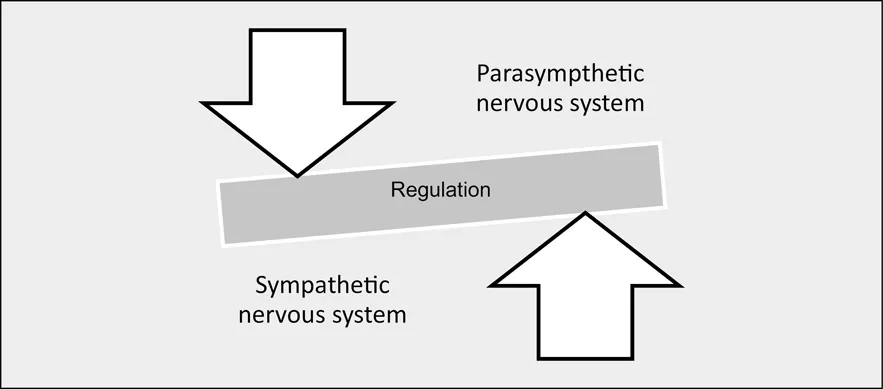
Physiologically, regulation occurs when there is, essentially, a balance between the sympathetic and parasympathetic branches of the nervous system.1
The sympathetic nervous system helps “activate and arouse us into a state of action.”1 Additionally, it helps us attend to novel and relevant sensory information. When the sympathetic nervous system is too engaged a “fight or flight” response is triggered, likely resulting in one becoming overaroused, anxious, hyperactive, or angry.1
The parasympathetic nervous system helps “slow us down and prepares us for rest.”1 This system also helps us to habituate (or “get used to”) sensory information so we don’t get too overwhelmed. If something is perceived as threatening, the parasympathetic nervous system can also be triggered. When the parasympathetic nervous system is too engaged, a “freeze” response is triggered, likely resulting in one becoming underaroused, depressed, sluggish, or passive.1
For many, the brain and body maintain this balance unconsciously to carry out daily activities. This allows us to divert more energy and resources to higher levels of the brain. There are instances throughout the day, however, where we use conscious control to regain a balance in these systems: taking a deep breath when we become frustrated or getting up to walk around when we feel lethargic, for example.
Figure 1.2Regulation as a Balancing Act
Regulation—one’s ability to manage his or her internal emotional and physical state in order to stay calm and engaged—occurs when the parasympathetic (“rest and digest”) and sympathetic (“fight or flight”) nervous systems are in balance. When these systems are in balance we achieve a calm, alert state that is required for attentive cognitive engagement.
A balance between the sympathetic and parasympathetic nervous systems allows students to remain in a calm, alert state that sets the stage for learning. It allows them to feel safe and connected in order to explore and engage with others. When the sympathetic nervous system is activated because a student feels anxious about an upcoming test, the parasympathetic nervous system kicks in to ease that anxiety and bring the nervous system back into equilibrium.1 This can be done through strategies like taking a deep breath or fidgeting with a pen, or it can be done through co-regulating with a friend or teacher. Until a balance is achieved the student will tend to demonstrate behaviors that are either more rigid (being inflexible or controlling) or chaotic (feeling “out of control” or unstable).5 These behaviors are a way of communicating dysregulation—an imbalance between the sympathetic and parasympathetic nervous systems. This is critically important to recognize in the classroom:when a student is dysregulated they are less able to access the higher levels of their brain, which results in a decreased capacity to pay attention, learn, and integrate new information. With the high demands that exist in a school environment—from the academic workload to social engagement to sensory stimulation—achieving a state of regulation is even more important in order to optimize learning.1
Foundations of Sensory Processing in the Classroom
One of the ways in which the sympathetic and parasympathetic nervous systems achieve and maintain balance is through processing of sensory information within the environment and within the body. Sensory processingis defined as “the ability to receive, manage, and interpret messages from each sensory system.”1 Basically, it is how we respond to sensory input. While traditionally we think of the five external sensory systems (sight, sound, touch, taste, smell), there are actually three additional internal sensory systems that influence how we understand our body and environment (proprioception, vestibular, and interoception). All of these sensory systems will be more intricately defined and explored in the upcoming chapters. What is important to know here is that the appropriate integration of all of the sensory systems is a critical foundation for learning. Sensory integrationis our brain’s “ability to orchestrate all of the sensations into meaningful behavioral and motor responses without becoming too overwhelmed, distracted, or disengaged.”1 Simply put, it is how we utilize sensory input in concert in order to navigate the environment. We need all of our sensory systems to work together in order for us to be able to move through our day in a regulated way and perform the tasks required of us. Thus, the sum of all our sensory systems is greater than the individual parts.
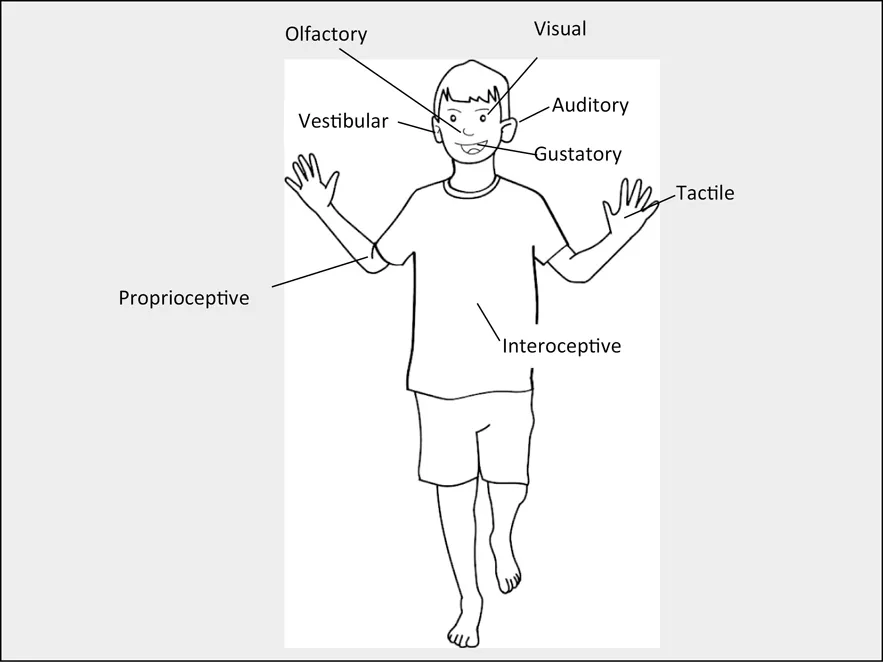
Figure 1.3Sensory Systems
This diagram illustrates the location of the sensory receptors for each of the sensory systems. Visual, auditory, tactile, gustatory (taste), and olfactory (smell) input is all external while vestibular, proprioceptive, and interoceptive input is all internal.
Taken from Chaves, J. & Taylor, A. (2020). The “Why” Behind Classroom Behaviors: Integrative Strategies for Learning, Regulation, and Relationships. Thousand Oaks, CA: Corwin.
Let’s take a minute to look at one way in which sensory processing occurs. When a sensory input is presented to the brain from the environment, the brain is activated in a certain manner to determine if the input is important. Does t...
Table of contents
Cover
Half Title
Series Information
Title Page
Copyright Page
Table of Contents
Meet the Authors
Preface
Acknowledgments
1 Setting the Stage for Learning with Sensory Processing
2 The Connection between Sensory Processing, Regulation, and Relationships
3 Identifying Sensory Processing Disorder in the School Environment
4 The Visual System
5 The Auditory System
6 The Vestibular System
7 The Tactile System
8 The Proprioceptive System
9 The Gustatory, Olfactory, and Interoceptive Systems
10 Postural Stability and Praxis
11 How Sleep, Diet, and Screen Time Can Influence Sensory Processing and Regulation
Concluding Thoughts
Appendix A: Movement Activities for the Classroom
Appendix B: Multisensory Learning Activities
Appendix C: Sensory Preference Checklist
Appendix D: Flexible Seating Options
Appendix E: Quick-Reference Sheets
Trusted by 375,005 students
Access to over 1.5 million titles for a fair monthly price.
Study more efficiently using our study tools.
Frequently asked questions
Yes, you can cancel anytime from the Subscription tab in your account settings on the Perlego website. Your subscription will stay active until the end of your current billing period. Learn how to cancel your subscription
No, books cannot be downloaded as external files, such as PDFs, for use outside of Perlego. However, you can download books within the Perlego app for offline reading on mobile or tablet. Learn how to download books offline
Perlego offers two plans: Essential and Complete
Essential is ideal for learners and professionals who enjoy exploring a wide range of subjects. Access the Essential Library with 800,000+ trusted titles and best-sellers across business, personal growth, and the humanities. Includes unlimited reading time and Standard Read Aloud voice.
Complete: Perfect for advanced learners and researchers needing full, unrestricted access. Unlock 1.5M+ books across hundreds of subjects, including academic and specialized titles. The Complete Plan also includes advanced features like Premium Read Aloud and Research Assistant.
Both plans are available with monthly, semester, or annual billing cycles.
We are an online textbook subscription service, where you can get access to an entire online library for less than the price of a single book per month. With over 1.5 million books across 990+ topics, we’ve got you covered! Learn about our mission
Look out for the read-aloud symbol on your next book to see if you can listen to it. The read-aloud tool reads text aloud for you, highlighting the text as it is being read. You can pause it, speed it up and slow it down. Learn more about Read Aloud
Yes! You can use the Perlego app on both iOS and Android devices to read anytime, anywhere — even offline. Perfect for commutes or when you’re on the go. Please note we cannot support devices running on iOS 13 and Android 7 or earlier. Learn more about using the app
Yes, you can access Creating Sensory Smart Classrooms by Jamie Chaves,Ashley Taylor in PDF and/or ePUB format, as well as other popular books in Education & Education General. We have over 1.5 million books available in our catalogue for you to explore.