John L. Austin was one of the leading philosophers of the twentieth century. The William James Lectures presented Austin's conclusions in the field to which he directed his main efforts on a wide variety of philosophical problems. These talks became the classic How to Do Things with Words.
For this second edition, the editors have returned to Austin's original lecture notes, amending the printed text where it seemed necessary. Students will find the new text clearer, and, at the same time, more faithful to the actual lectures. An appendix contains literal transcriptions of a number of marginal notes made by Austin but not included in the text. Comparison of the text with these annotations provides new dimensions to the study of Austin's work.
eBook - ePub
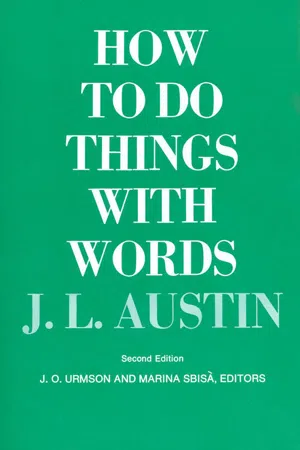
How to Do Things with Words
Second Edition
- 169 pages
- English
- ePUB (mobile friendly)
- Available on iOS & Android
eBook - ePub
How to Do Things with Words
Second Edition
About this book
Information
Topic
PhilosophySubtopic
LinguisticsLECTURE XII
WE have left numerous loose ends, but after a brief résumé we must plough ahead. How did the ‘constatives’-’performatives’ distinction look in the light of our later theory? In general and for all utterances that we have considered (except perhaps for swearing), we have found:
(1) Happiness/unhappiness dimension,
(1 a) An illocutionary force,
(2) Truth/falsehood dimension,
(2 a) A locutionary meaning (sense and reference).
The doctrine of the performative/constative distinction stands to the doctrine of locutionary and illocutionary acts in the total speech act as the special theory to the general theory. And the need for the general theory arises simply because the traditional ‘statement’ is an abstraction, an ideal, and so is its traditional truth or falsity. But on this point I could do no more than explode a few hopeful fireworks. In particular, the following morals are among those I wanted to suggest:
(A) The total speech act in the total speech situation is the only actual phenomenon which, in the last resort, we are engaged in elucidating.
(B) Stating, describing, &c., are just two names among a very great many others for illocutionary acts; they have no unique position.
(C) In particular, they have no unique position over the matter of being related to facts in a unique way called being true or false, because truth and falsity are (except by an artificial abstraction which is always possible and legitimate for certain purposes) not names for relations, qualities, or what not, but for a dimension of assessment—how the words stand in respect of satis-factoriness to the facts, events, situations, &c., to which they refer.
(D) By the same token, the familiar contrast of ‘normative or evaluative’ as opposed to the factual is in need, like so many dichotomies, of elimination.
(E) We may well suspect that the theory of ‘meaning’ as equivalent to ‘sense and reference’ will certainly require some weeding-out and reformulating in terms of the distinction between locutionary and illocutionary acts (if these notions are sound: they are only adumbrated here). I admit that not enough has been done here: I have taken the old ‘sense and reference’ on the strength of current views. But here we should consider again the statement which we have called ‘void’ for breakdown of reference, e.g., the statement ‘John’s children are all bald’ if made when John has no children.
Now we said that there was one further thing obviously requiring to be done, which is a matter of prolonged fieldwork. We said long ago that we needed a list of ‘explicit performative verbs’; but in the light of the more general theory we now see that what we need is a list of illocutionary forces of an utterance. The old distinction, however, between primary and explicit will survive the sea-change from the performative/constative distinction to the theory of speech-acts quite successfully. For we have since seen reason to suppose that the sorts of test suggested for the explicit performative verbs (‘to say . . . is to. . .’, &c.) will do, and in fact do better for sorting out those verbs which make explicit, as we shall now say, the illocutionary force of an utterance, or what illocutionary act it is that we are performing in issuing that utterance. What will not survive the transition, unless perhaps as a marginal limiting case, and hardly surprisingly because it gave trouble from the start, is the notion of the purity of performatives: this was essentially based upon a belief in the dichotomy of performatives and constatives, which we see has to be abandoned in favour of more general families of related and overlapping speech acts, which are just what we have now to attempt to classify.
Using then the simple test (with caution) of the first person singular present indicative active form, and going through the dictionary (a concise one should do) in a liberal spirit, we get a list of verbs of the order of the third power of 10.1 I said I would attempt some general preliminary classification and make some remarks on these proposed classes. Well, here we go. I shall only give you a run around, or rather a flounder around.
I distinguish five very general classes: but I am far from equally happy about all of them. They are, however, quite enough to play Old Harry with two fetishes which I admit to an inclination to play Old Harry with, viz. (1) the true/false fetish, (2) the value/fact fetish. I call then these classes of utterance, classified according to their illocutionary force, by the following more-or-less rébarbative names:
(1) Verdictives.
(2) Exercitives.
(3) Commissives.
(4) Behabitives (a shocker this).
(5) Expositives.
We shall take them in order, but first I will give a rough idea of each.
The first, verdictives, are typified by the giving of a verdict, as the name implies, by a jury, arbitrator, or umpire. But they need not be final; they may be, for example, an estimate, reckoning, or appraisal. It is essentially giving a finding as to something—fact, or value—which is for different reasons hard to be certain about.
The second, exercitives, are the exercising of powers, rights, or influence. Examples are appointing, voting, ordering, urging, advising, warning, &c.
The third, commissives, are typified by promising or otherwise undertaking; they commit you to doing something, but include also declarations or announcements of intention, which are not promises, and also rather vague things which we may call espousals, as for example, siding with. They have obvious connexions with verdictives and exercitives.
The fourth, behabitives, are a very miscellaneous group, and have to do with attitudes and social behaviour. Examples are apologizing, congratulating, commending, condoling, cursing, and challenging.
The fifth, expositives, are difficult to define. They make plain how our utterances fit into the course of an argument or conversation, how we are using words, or, in general, are expository. Examples are ‘I reply’, ‘I argue’, ‘I concede’, ‘I illustrate’, ‘I assume’, ‘I postulate’. We should be clear from the start that there are still wide possibilities of marginal or awkward cases, or of overlaps.
The last two classes are those which I find most troublesome, and it could well be that they are not clear or are cross-classified, or even that some fresh classification altogether is needed. I am not putting any of this forward as in the very least definitive. Behabitives are troublesome because they seem too miscellaneous altogether: and expositives because they are enormously numerous and important, and seem both to be included in the other classes and at the same time to be unique in a way that I have not succeeded in making clear even to myself. It could well be said that all aspects are present in all my classes.
I. VERDICTIVES
Examples are:
acquit | convict | find (as a matter of fact) |
hold (as a matter of law) | interpret as | understand |
read it as | rule | calculate |
reckon | estimate | locate |
place | date | measure |
put it at | make it | take it |
grade | rank | rate |
assess | value | describe |
characterize | diagnose | analyse |
Further examples are found in appraisals or assessments of character, such as ‘I should call him industrious’...
Table of contents
- Cover
- Title
- Copyright
- Contents
- Preface
- Lecture I
- Lecture II
- Lecture III
- Lecture IV
- Lecture V
- Lecture VI
- Lecture VII
- Lecture VIII
- Lecture IX
- Lecture X
- Lecture XI
- Lecture XII
- Appendix
- Index
Trusted by 375,005 students
Access to over 1.5 million titles for a fair monthly price.
Study more efficiently using our study tools.
Frequently asked questions
Yes, you can cancel anytime from the Subscription tab in your account settings on the Perlego website. Your subscription will stay active until the end of your current billing period. Learn how to cancel your subscription
No, books cannot be downloaded as external files, such as PDFs, for use outside of Perlego. However, you can download books within the Perlego app for offline reading on mobile or tablet. Learn how to download books offline
Perlego offers two plans: Essential and Complete
- Essential is ideal for learners and professionals who enjoy exploring a wide range of subjects. Access the Essential Library with 800,000+ trusted titles and best-sellers across business, personal growth, and the humanities. Includes unlimited reading time and Standard Read Aloud voice.
- Complete: Perfect for advanced learners and researchers needing full, unrestricted access. Unlock 1.5M+ books across hundreds of subjects, including academic and specialized titles. The Complete Plan also includes advanced features like Premium Read Aloud and Research Assistant.
We are an online textbook subscription service, where you can get access to an entire online library for less than the price of a single book per month. With over 1.5 million books across 990+ topics, we’ve got you covered! Learn about our mission
Look out for the read-aloud symbol on your next book to see if you can listen to it. The read-aloud tool reads text aloud for you, highlighting the text as it is being read. You can pause it, speed it up and slow it down. Learn more about Read Aloud
Yes! You can use the Perlego app on both iOS and Android devices to read anytime, anywhere — even offline. Perfect for commutes or when you’re on the go.
Please note we cannot support devices running on iOS 13 and Android 7 or earlier. Learn more about using the app
Please note we cannot support devices running on iOS 13 and Android 7 or earlier. Learn more about using the app
Yes, you can access How to Do Things with Words by J. L. Austin,John Langshaw Austin, J. O. Urmson,Marina Sbisà in PDF and/or ePUB format, as well as other popular books in Philosophy & Linguistics. We have over 1.5 million books available in our catalogue for you to explore.