Christianity Today 2008 Book Award (Biblical Studies)
Even mature Christians have trouble defending the person and divinity of Christ. The Jesus Legend builds a convincing interdisciplinary case for the unique and plausible position of Jesus in human history. He was real and his presence on the planet has been well-documented.
The authors of the New Testament didn't plant evidence, though each writer did tell the truth from a unique perspective. This book carefully investigates the Gospel portraits of Jesus--particularly the Synoptic Gospels--assessing what is reliable history and fictional legend. The authors contend that a cumulative case for the general reliability of the Synoptic Gospels can be made and boldly challenge those who question the veracity of the Jesus found there.
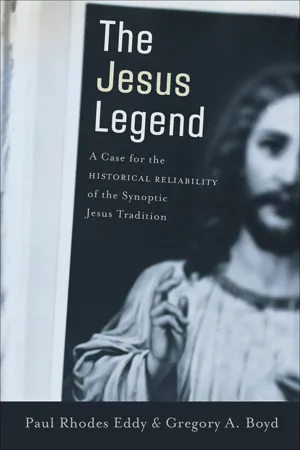
eBook - ePub
The Jesus Legend
A Case for the Historical Reliability of the Synoptic Jesus Tradition
- 480 pages
- English
- ePUB (mobile friendly)
- Available on iOS & Android
eBook - ePub
The Jesus Legend
A Case for the Historical Reliability of the Synoptic Jesus Tradition
About this book
Information
Part 1
HISTORICAL METHOD
AND THE JESUS TRADITION
AND THE JESUS TRADITION
MIRACLES, PARALLELS, AND FIRST-CENTURY PALESTINE
The New Testament accounts of Jesus present him as a radically unique individual. Indeed, according to the Gospel authors, his uniqueness extends to the realm of the supernatural, for Jesus is presented as the miracle-working, resurrected Son of Man/God. Part 1 of this work explores the question of whether—and, if so, in what manner and to what extent—these claims about Jesus can or cannot be investigated within the context of a critical historiography.
Scholars who contend that the portrait of Jesus in the Gospels is substantially legendary—those we are categorizing as “legendary-Jesus theorists”—uniformly argue that one cannot be a critical historical scholar while also accepting supernatural explanations for past events. While mythologically minded people of previous ages routinely explained unusual occurrences by appealing to supernatural forces, it is no longer possible for post-Enlightenment, critically minded scholars to do so. Thus, whatever critical scholars make of the Jesus tradition, legendary-Jesus theorists argue that, as a matter of principle, they cannot accept the reportedly supernatural occurrences of the Gospels as reflective of the actual past. Rather, these reports of supernatural events associated with Jesus clearly must be judged to be legendary (i.e., fictional) creations. We will discuss the complexities of this question in chapter 1.
If we accept that a truly critical approach to history requires us to a priori rule out all claims of supernatural occurrences in history, how are we to account for the swift rise of faith in Jesus as a miracle-working, resurrected divine savior in a first-century Jewish context? Here much depends on how one understands the first-century Jewish context. Legendary-Jesus theorists sometimes argue that the first-century Jewish context was actually a fairly natural environment for a legend about a wonderworking divine man to arise, for Judaism was significantly hellenized at this time. If so, we need not suppose there was anything so unique in the rise of the Jesus story that the sorts of explanations offered in the Gospels themselves are required to explain it. We will explore this issue in chapter 2.
Finally, many legendary-Jesus scholars argue that New Testament claims associated with Jesus are not without precedent in history and thus are not that difficult to explain. It is argued that throughout history we find other instances where recent figures reportedly made divine claims, performed miracles, and even rose from the dead. In chapter 3 we will investigate the case for accepting that certain legends parallel the Jesus story and that this helps us explain the Jesus tradition in purely natural, sociological/comparativist terms.
1
MIRACLES AND METHOD
THE HISTORICAL-CRITICAL METHOD
AND THE SUPERNATURAL
AND THE SUPERNATURAL
The Gospels claim that Jesus and his disciples performed miracles such as healing the sick and disabled, casting out demons, and even raising the dead.[1] To the thinking of many historical-critical scholars, this is enough to demonstrate that they are substantially legendary. The purpose of this chapter is to argue that this conclusion is unwarranted, for the historical-critical method that leads to it is problematic on a number of counts. In its place we will propose the outlines of a critical historiographical methodology that avoids these problems and therefore remains open to the possibility that reports of supernatural occurrences are, in some cases, reliable. We will call this the “open” historical-critical method.
We will begin by presenting a succinct history and overview of the main lines of argumentation that have been used in support of the classical historical-critical method. We will then offer a critique of the foundational assumption of the historical-critical method, one that forces it to rule out supernatural events as a matter of principle, lay out the main elements of the open historical-critical method we are proposing as an alternative, and respond to four objections that can be raised against it. Having assessed the foundational assumption of the historical-critical method, we will offer a critique of the foundational principle used to defend this method—what is called the “principle of analogy.” In its place we will offer an alternative formulation of the principle of analogy that is superior for a number of reasons and does not necessarily rule out the possibility of allowing for historical explanations that include supernatural occurrences. We will then conclude this chapter by drawing together elements of our assessment of the classical historical-critical method while developing further five important aspects of the alternative critical methodology we are advocating.
Naturalism and the Historical-Critical Method
The Rise of Modern Western Science
From the sixteenth to the eighteenth centuries the Western view of the world underwent a radical transformation. We discovered that by treating the universe as a closed system of natural causes and effects operating according to invariant laws, we could understand, predict, and more effectively use nature to our own advantage. The remarkable technological advances and increased standard of living the scientific approach to the world has brought us testifies to its general validity and practicality.
The scientific revolution made a profound impact on our understanding of history and therefore of the Bible. Among other things, it greatly affected the understanding of the supernatural on the part of many Western intellectuals. If nature uniformly operates by predictable laws of cause and effect, what are we to make of alleged reports of miracles? To many, the only rational and responsible answer was to reject them. Why should our understanding of history be less scientific than our understanding of the world? Hence, from the seventeenth century on, the general attitude among intellectuals toward ancient reports of supernatural events such as we find in the Gospels was that, as a matter of principle, they had to be judged as fictitious. They might be explained away as myth, as legend, as propaganda, as the result of emotional hysteria, or as hallucinations. But under the impact of the naturalistic, scientific worldview that had come to dominate the outlook of many Western intellectuals, they had to be explained away.
Hume’s Case for Naturalism
This general outlook is called “naturalism,” for it assumes that everything in the world, and in history, can be explained by appealing to “natural” laws. No appeals to supernatural forces are necessary. Perhaps the most famous philosophical critique of miracles was given by the eighteenth-century Scottish philosopher David Hume. Hume defined a miracle as “a transgression of a law of nature by a particular volition of the Deity, or by the interposition of some invisible agents.”[2] With this definition in hand, Hume concluded that it is always irrational to believe a miracle has occurred. To Hume’s way of thinking, one must weigh the probability of a claim that a “transgression” of a natural law (a miracle) had occurred against all confirmations of the relevant natural law. The result, of course, was that the alleged “transgression” was always ridiculously improbable and thus, according to Hume, irrational to accept. In Hume’s words:
There must, therefore, be a uniform experience against every miraculous event, otherwise it would not merit this appellation. And as a uniform experience amounts to a proof, there is here a direct and full proof, from the nature of the fact, against the experience of any miracle.[3]
For example, consider the claim that Jesus rose from the dead. According to Hume, this claim “transgresses” the consistent empirical observation (the “natural law”) that death is irreversible. The claim must therefore be weighed against every observed instance of this law being confirmed—that is, against every instance of people remaining dead. Viewed in this light, the probability of the claim that Jesus rose from the dead is one to the total number of people who have ever died and remained dead. This way of construing the matter obviously makes it irrational to believe that Jesus rose from the dead. Indeed, if accepted, Hume’s argument renders all possible historical arguments in favor of Jesus’s rising from the dead virtually irrelevant. For no conceivable historical evidence could possibly overturn such an overwhelmingly improbable claim—if, again, Hume’s argument is valid.
Troeltsch and the Historical-Critical Method
The general application of the scientific method to the study of history came to be known as the historical-critical method. Like the natural sciences, the historical-critical method operates on the basis of methodological naturalism. That is, the a priori rejection of the supernatural is built into its methodology.[4] For this reason, and to distinguish it from the alternative historical-critical method we shall be proposing later on, we shall henceforth refer to it as the naturalistic—or the classical—historical-critical method. The basic reasoning behind it is that just as the empirical sciences are methodologically committed to looking for natural causes for all phenomena, so critical historians should be methodologically committed to looking for natural explanations for all historical events. And just as advances in science come only by the refusal of scientists to accept supernatural explanations, so, it is argued, advances in our understanding of history come only by critical historians refusing to accept supernatural explanations. However improbable a natural explanation for an event may seem, therefore, it is, as a matter of principle, always to be preferred over a supernatural one. Clearly, as Ernst Troeltsch realized, a “whole world view lies behind the historico-critical method.”[5] It is a worldview that assumes that the world is closed to supernatural influences. It is the worldview of naturalism.
Troeltsch articulated three principles that should govern all truly critical historical investigation. These three principles—but especially the second, as we shall see—have exercised an incalculable influence on the application of the historical-critical method among academic historians, including New Testament scholars. Each of these three principles reinforces the assumption that claims of the miraculous simply cannot be accepted by critical historians.[6]
First, Troeltsch argued for “The Principle of Criticism.” This principle holds that all claims about the past can only be more or less probable, never certain. The principle itself is so obvious it would hardly warrant mentioning except for the fact that, when it is combined with Hume’s previously mentioned argument regarding the massive improbability of miraculous occurrences, this principle has the effect of reinforcing the assumption that naturalistic explanations are—by definition—always more probable than explanations that involve supernatural occurrences. In other words, if historical explanations are always a matter of probability, and if the probability of a violation of a law of nature is to be assessed by weighing it against all confirmations of that law, then miracles always, by definition, have a probability approaching zero.
Second, and most important, Troeltsch argued for “The Principle of Analogy.” This principle holds that our understanding of the past must always be analogically rooted in our experience of the present. Since Troeltsch and most other critical historians assumed people never experience supernatural events in the present, this principle led to the conclusion that it is outside the bounds of critical historiography to ever appeal to the supernatural.
Third, Troeltsch argued for “The Principle of Correlation.” This principle explicitly holds that every event must be understood within a nexus of natural causes and effects. In the thinking of Troeltsch and many others, this was a foundational assumption for all truly “critical” history. In the words of Troeltsch’s contemporary, F. H. Bradley, “The inevitability of law, and what loosely may be termed as causal connection, is the condition which makes history possible, and which, though not for her to prove, she must nonetheless presuppose as a principle and demonstrate as a result worked out in the whole field of her activity.”[7]
For Bradley, as for Troeltsch and most other modern critical historians, the assumption that all things are governed by natural law is what makes a critical and scientific approach to history possible. This assumption, Bradley argues, does not have to be proven: it is presupposed. Not surprisingly, the results “worked out in the whole field of her activity” serve to demonstrate the validity of the assumption. The great New Testament scholar, Rudolf Bultmann, advocates the same perspective when he writes, “The historical method includes the presupposition that history is a unity in the sense of a closed continuum of effects. . . . This closedness means that the continuum of historical happenings cannot be rent by the interference of supernatural, transcendent powers and that therefore there is no ‘miracle’ in this sense of the word.”[8]
For Bultmann, and many within the post-Bultmann stream of scholarship, one is a “critical” scholar only if one presupposes that history is a closed continuum of natural causes and effects. To be open to the idea that this “closedness” could be “rent by the interference of supernatural . . . powers” is to violate a working assumption of the historical-critical method.
Van Harvey’s Case for a Naturalistic Historiographical Methodology
A more recent thinker who has further explored the naturalistic commitments of the historical-critical method is Van Harvey. In his influential work, The Historian and the Believer, Harvey puts forth a sustained argument that he believes substantiates the naturalistic approach to history.[9]
To begin, Harvey argues that, in contrast to modern people, ancient people were generally “naive and mythologically minded folk without any conception of natural order or law. They lived in a mythological time in which unusual events of nature and history were attributed to supernatural beings of all kinds.”[10]
Because of this, he notes, miraculous claims are found in almost all religious traditions, especially surrounding their religious founders. The question Harvey poses is: What should be the stance of the critical historian toward these miraculous claims? We may summarize Harvey’s argument by highlighting four points.
First, adherents of one tradition typically believe the miraculous claims attributed to their founder and/or that are part of their tradition, while rejecting the miracle claims of other traditions. Such a biased approach is clearly unacceptable for critical historians, for the integrity of their work depends on their striving to be objective in their investigations. According to Harvey, therefore, critical historians must adopt a uniform approach to all miraculous claims and thus conclude, as a matter of methodological principle, that they are all myth, legend, or intentional fabrication.
Second, according to Harvey, accepting any miraculous claim as historical would put us back in the “naive and mythologically min...
Table of contents
- Cover
- Title Page
- Copyright Page
- Endorsement
- Dedication
- Contents
- Acknowledgments
- Abbreviations
- Introduction: The Case for the Legendary Jesus
- Part 1. Historical Method and the Jesus Tradition: Miracles, Parallels, and First-Century Palestine
- Part 2. Other Witnesses: Ancient Historians and the Apostle Paul
- Part 3. Between Jesus and the Gospels: The Early Oral Jesus Tradition
- Part 4. The Synoptic Gospels as Historical Sources for Jesus: Assessing the Evidence
- Index of Scripture and Ancient Writings
- General Index
- Notes
Trusted by 375,005 students
Access to over 1.5 million titles for a fair monthly price.
Study more efficiently using our study tools.
Frequently asked questions
Yes, you can cancel anytime from the Subscription tab in your account settings on the Perlego website. Your subscription will stay active until the end of your current billing period. Learn how to cancel your subscription
No, books cannot be downloaded as external files, such as PDFs, for use outside of Perlego. However, you can download books within the Perlego app for offline reading on mobile or tablet. Learn how to download books offline
Perlego offers two plans: Essential and Complete
- Essential is ideal for learners and professionals who enjoy exploring a wide range of subjects. Access the Essential Library with 800,000+ trusted titles and best-sellers across business, personal growth, and the humanities. Includes unlimited reading time and Standard Read Aloud voice.
- Complete: Perfect for advanced learners and researchers needing full, unrestricted access. Unlock 1.5M+ books across hundreds of subjects, including academic and specialized titles. The Complete Plan also includes advanced features like Premium Read Aloud and Research Assistant.
We are an online textbook subscription service, where you can get access to an entire online library for less than the price of a single book per month. With over 1.5 million books across 990+ topics, we’ve got you covered! Learn about our mission
Look out for the read-aloud symbol on your next book to see if you can listen to it. The read-aloud tool reads text aloud for you, highlighting the text as it is being read. You can pause it, speed it up and slow it down. Learn more about Read Aloud
Yes! You can use the Perlego app on both iOS and Android devices to read anytime, anywhere — even offline. Perfect for commutes or when you’re on the go.
Please note we cannot support devices running on iOS 13 and Android 7 or earlier. Learn more about using the app
Please note we cannot support devices running on iOS 13 and Android 7 or earlier. Learn more about using the app
Yes, you can access The Jesus Legend by Paul Rhodes Eddy,Gregory A. Boyd in PDF and/or ePUB format, as well as other popular books in Theology & Religion & Biblical Criticism & Interpretation. We have over 1.5 million books available in our catalogue for you to explore.