Explore the contemporary significance of the Old Testament and hear the Word of God afresh
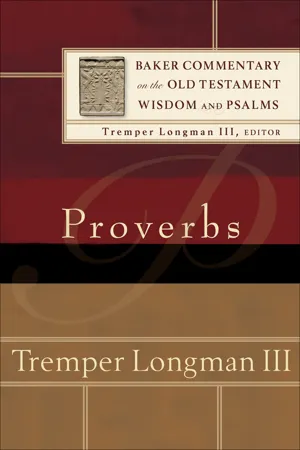
With Proverbs, veteran Old Testament scholar Tremper Longman III offers an accessible commentary on one of Scripture's most frequently quoted and visited books. With his deft exegetical and expositional skill, the resulting work is full of fresh insight into the meaning of the text.
In addition to paragraph-level commentary, all volumes of the Baker Commentary on the Old Testament series feature:
● A fresh translation of the Hebrew text
● Incisive comments based on the author's translation
● Linguistic, historical, and canonical insights
● Concluding reflections
● Footnotes addressing technical matters
Pastors, teachers, and all serious students of the Bible will find here an accessible commentary that will serve as an excellent resource for their study.
eBook - ePub
Proverbs (Baker Commentary on the Old Testament)
- 608 pages
- English
- ePUB (mobile friendly)
- Available on iOS & Android
eBook - ePub
Proverbs (Baker Commentary on the Old Testament)
About this book
Information
Topic
Theology & ReligionSubtopic
Biblical CommentaryPart 1
Extended Discourses on Wisdom
(1:1–9:18)
The first main division of Proverbs, constituting the first nine chapters, begins with a prologue (1:1–7) containing an authorship and genre designation as well as indications of the prospective audience. The prologue continues with a lengthy statement of purpose and concludes with the theological motto of the book (1:7). The rest of the first division contains sixteen discourses (see “The Structure of Proverbs” in the introduction), most of which are lectures from a father to his son (or sons) while some (1:20–33; 8:1–9:6) are the words of Woman Wisdom to all the men who pass by her. This division ends with a third speaker, Woman Folly, who competes with Woman Wisdom for the attention of the young men.
Proverbs 1–9 functions as a hermeneutical guide to Prov. 10–31. As we will see, the reader is confronted in chap. 9 with a choice between Woman Wisdom and Woman Folly. This is a theological decision between allegiance to Yahweh and the worship of idols and serves to bring theological profundity to the use of the words wisdom and folly and their associated terms throughout the book.
Chapter 1

Translation
1The proverbs of Solomon, the son of David, king of Israel—
2to know wisdom and discipline;
to understand insightful sayings;[a]
3to receive the teaching[b] of insight,[c]
righteousness, justice, and virtue;
4to give to the simple prudence,
to the young knowledge and discretion.
5Let the wise hear and increase teaching;
let those with understanding acquire guidance,
6so they may understand a proverb and a difficult saying,
the words of the wise and their enigmas.
7The fear of Yahweh is the beginning of knowledge,
but fools despise wisdom and discipline.
8Listen, my son, to the teaching[d] of your father;
don’t neglect the instruction of your mother.
9It is a garland of grace around your head,
and beads for your neck.
10My son, don’t let sinners entice you;
don’t accede[e] 11when they say:
“Come with us, and let’s set up a deadly ambush;
let’s lie in wait for the innocent for fun.
12Let’s swallow up the living like Sheol—
whole, like those who go down into the pit.
13We’ll find precious wealth;
we’ll fill our houses with plunder.
14Throw your lot in with us;
one bag of loot will be for all of us.”
15My son, don’t go on the way with them;
keep your feet from their trail,
16for their feet run toward evil,
and they hurry to shed blood.
17For in vain is a net cast[f]
in the sight of any bird.
18But they set up a deadly ambush;
they lie in wait for their lives.
19Thus is the way of all who seek profits by violence;[g]
they take the life of their owner.
20Wisdom shouts in the street;
in the public square she yells out.
21At the top of the noisy throng she calls out an invitation;
at the entrances to the gates in the city she says her piece:
22“How long, O simple, will you love simplemindedness,
and mockers hold their mocking dear,
and fools hate knowledge?
23You should respond to my correction.
I will pour forth my spirit to you;
I will make known to you my words
24Because I invited you, but you rejected me;
I extended my hand, but you paid no attention.
25You ignored all my advice,
and my correction you did not want.
26I will also laugh at your disaster;
I will ridicule when your fear comes.
27When your fear comes like a tempest,[h]
and your disaster arrives like a storm,
when distress and oppression come on you,
28then he will call me, and I will not answer;
he will seek me, but he will not find me.
29Because they hated knowledge
and did not choose the fear of Yahweh.
30They did not want my advice,
and they rejected all my reproof.
31They will eat from the fruit of their way,
and they will be sated from their own counsels,
32For the turning away of the simple will kill them,
and the complacency of fools will destroy them.
33Those who obey me will dwell securely;
they will be untroubled from the horror of evil.
Interpretation
1:1–7. Superscription and purpose of the book. The book of Proverbs opens with a superscription (1:1) that introduces the book as a whole. It is also the opening line of a seven-verse extended introduction that clearly states the purpose of the book that follows. Though the book is the result of bringing together different collections of wisdom over time (see “Authorship and Date” and “The Structure of Proverbs” in the introduction), this introduction must have been one of the latest additions to the final form of the book and one of the factors that give the final compilation a feeling of organic wholeness. This unit begins with a typical superscription, proceeds through a lengthy and technical description of its purpose, and then ends with what proves to be the underlying principle of the book’s teaching as a whole. This introductory passage is jam-packed with words that are important to wisdom literature and are repeated throughout the book. For this reason, we will reflect at some length on their meanings and refer back to this place when these words appear later in the book. Johnson is correct in saying that in these verses “the author first identified the material; second, he declared the objectives; third, he called the hopeful to receptivity; and fourth, he pointed up the motto of wisdom that aspiring ‘sages’ must never forget.”[1]
Proverbs is not unique in having a prologue such as 1:1–7, though it is unique in the specific content. Most Egyptian wisdom begins with an introduction before describing observations and offering advice. We offer as an example an excerpted quote from the prologue to Amenemope, which, like Proverbs, states its intention as well as its author.
Beginning of the teaching for life,
The instructions for well-being,
Every rule for relations with elders,
For conduct toward magistrates;
Knowing how to answer one who speaks,
To reply to one who sends a message.
So as to direct him on the paths of life,
To make him prosper upon earth;
To let his heart enter its shrine,
Steering clear of evil;
To save him from the mouth of strangers,
To let (him) be praised in the mouth of people.
Made by the overseer of fields, experienced in his office,
. . . . . . . . . . . . . . . . . . . . . .
Who has a chapel at Abydos,
Amenemope, the son of Kanakht,
The justified in Ta-wer.
[For] his son, the youngest of his children,
. . . . . . . . . . . . . . . . .
Hor-em-maakher is his true name. (Amenemope 1.1–13; 2.10–13; 3.4)[2]
1The proverbs of Solomon, the son of David, king of Israel—
The first verse is the superscription. Superscriptions appear at the beginning of many other biblical books, most consistently with works of prophecy. The superscription is like the title page of a modern book in that it provides information about the genre, author, and occasionally the subject matter and date of a book (e.g., Isa. 1:1; Jer. 1:1; Nah. 1:1). Superscriptions are found in other wisdom contexts (Eccles. 1:1; Song 1:1), and the one closest to the opening of Proverbs is found in Eccles. 1:1: “The words of Qoheleth, son of David, king in Jerusalem.” In Ecclesiastes, this is part of the frame narrator’s strategy of near identity between Qoheleth and Solomon.[3]
In the case of Proverbs, the book’s superscription provides the genre (“proverbs”) and an authorship designation (“Solomon, son of David, king of Israel”). The date is left unexpressed, and the subject matter is explicated in the lengthy description in vv. 2–6, which is appended to the superscription. That extension also delineates the original intended recipients.
The most natural reading of the superscription in wisdom and prophetic literature is that a second, subsequent hand added it. It is not impossible that the author or speaker wrote the superscription, referring to himself in the third person, but the only reason to argue in this direction is to defend a rather mechanical view of biblical inspiration and insist that only one author stands behind a single book.
For the term “proverbs” (mišlê, from māšāl), see “Genr...
Table of contents
- Cover
- Series Page
- Title Page
- Copyright Page
- Dedication
- Contents
- Series Preface
- Author’s Preface
- Abbreviations
- Introduction
- Part 1: Extended Discourses on Wisdom (1:1–9:18)
- Part 2: Proverbs of Solomon: Collection I (10:1–22:16)
- Part 3: Sayings of the Wise (22:17–24:34)
- Part 4: Proverbs of Solomon: Collection II (25:1–29:27)
- Part 5: Sayings of Agur and King Lemuel and Poem to the Virtuous Woman (30:1–31:31)
- Appendix: Topical Studies
- Notes
- Bibliography
- Subject Index
- Author Index
- Index of Scripture and Other Ancient Writings
- Back Cover
Trusted by 375,005 students
Access to over 1.5 million titles for a fair monthly price.
Study more efficiently using our study tools.
Frequently asked questions
Yes, you can cancel anytime from the Subscription tab in your account settings on the Perlego website. Your subscription will stay active until the end of your current billing period. Learn how to cancel your subscription
No, books cannot be downloaded as external files, such as PDFs, for use outside of Perlego. However, you can download books within the Perlego app for offline reading on mobile or tablet. Learn how to download books offline
Perlego offers two plans: Essential and Complete
- Essential is ideal for learners and professionals who enjoy exploring a wide range of subjects. Access the Essential Library with 800,000+ trusted titles and best-sellers across business, personal growth, and the humanities. Includes unlimited reading time and Standard Read Aloud voice.
- Complete: Perfect for advanced learners and researchers needing full, unrestricted access. Unlock 1.5M+ books across hundreds of subjects, including academic and specialized titles. The Complete Plan also includes advanced features like Premium Read Aloud and Research Assistant.
We are an online textbook subscription service, where you can get access to an entire online library for less than the price of a single book per month. With over 1.5 million books across 990+ topics, we’ve got you covered! Learn about our mission
Look out for the read-aloud symbol on your next book to see if you can listen to it. The read-aloud tool reads text aloud for you, highlighting the text as it is being read. You can pause it, speed it up and slow it down. Learn more about Read Aloud
Yes! You can use the Perlego app on both iOS and Android devices to read anytime, anywhere — even offline. Perfect for commutes or when you’re on the go.
Please note we cannot support devices running on iOS 13 and Android 7 or earlier. Learn more about using the app
Please note we cannot support devices running on iOS 13 and Android 7 or earlier. Learn more about using the app
Yes, you can access Proverbs (Baker Commentary on the Old Testament) by Tremper Longman, Longman, Tremper III, Tremper III Longman in PDF and/or ePUB format, as well as other popular books in Theology & Religion & Biblical Commentary. We have over 1.5 million books available in our catalogue for you to explore.