Since its publication in 1950, Protestant Biblical Interpretation has been a standard introduction to hermeneutics in evangelical colleges and seminaries. Twice revised, this textbook has sold well over 100,000 copies. Now this venerable resource is available in a paperback edition.
"Hermeneutics," writes the author, "is the science and art of Biblical interpretation. . . . As such it forms one of the most important members of the theological sciences. This is especially true for conservative Protestantism, which looks on the Bible as . . . the only authoritative voice of God to man."
After surveying the history of biblical interpretation, the author devotes seventy pages to explicating "the Protestant system of hermeneutics." He then discusses the doctrinal, devotional, and practical uses of the Bible. Following a chapter on the hermeneutical dimension of the problem of biblical inerrancy and secular science, he concludes with chapters on the interpretation of types, prophecy, and parables.
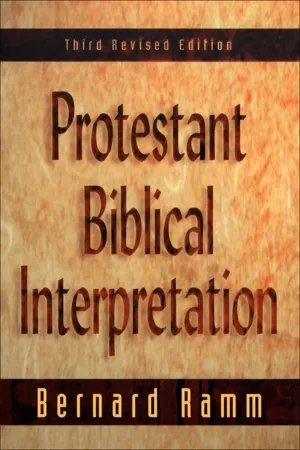
- 320 pages
- English
- ePUB (mobile friendly)
- Available on iOS & Android
eBook - ePub
About this book
Information
Topic
Theology & ReligionSubtopic
Biblical StudiesCHAPTER II
HISTORICAL SCHOOLS
FEW studies are so rewarding in granting insight and perspective into problems as historical studies. This is true of the history of hermeneutics.
Terry has well said:
A knowledge of the history of biblical interpretation is of inestimable value to the student of the Holy Scriptures. It serves to guard against errors and exhibits the activity and efforts of the human mind in its search after truth and in relation to noblest themes. It shows what influences have led to the misunderstanding of God’s word, and how acute minds, carried away by a misconception of the nature of the Bible, have sought mystic and manifold meanings in its content.[1]
One of the cardinal mistakes in interpretation is provincialism, i.e., believing that the system in which one has been trained is the only system. Another mistake is to assume that certain traditional or familiar interpretations are the only adequate interpretations. Certainly hermeneutics ought to be purged of subjectivism and provincialism, and fewer studies are more capable of doing this than historical studies in interpretation.
Rather than trace the long history of interpretation from Ezra until today, the typical schools of interpretation will be presented, and this will preserve much of the historical element.
A. ALLEGORICAL SCHOOLS
1. Greek Allegorism
Allegorical interpretation believes that beneath the letter (rhētē) or the obvious (phanera) is the real meaning (hyponoia) of the passage.[2] Allegory is defined by some as an extended metaphor. There is the literary allegory which is intentionally constructed by the author to tell a message under historical form. Bunyan’s Pilgrim’s Progress is such a one and such allegories occur in Scripture too.[3] If the writer states that he is writing an allegory and gives us the cue, or if the cue is very obvious (as in an allegorical political satire), the problem of interpretation is not too difficult. But if we presume that the document has a secret meaning (hyponoia) and there are no cues concerning the hidden meaning interpretation is difficult. In fact, the basic problem is to determine if the passage has such a meaning at all. The further problem arises whether the secret meaning was in the mind of the original writer or something found there by the interpreter. If there are no cues, hints, connections, or other associations which indicate that the record is an allegory, and what the allegory intends to teach, we are on very uncertain grounds.
It may seem strange to list as our first school of interpretation the Greek school, but this is necessary to understand the historical origins of allegorical interpretation. The Greeks were not concerned with Sacred Scripture but with their own writings, and in this sense it is improper to classify them within the context of Biblical interpretation. But in that their allegorical method was adopted by both Jew and Christian they deserve this special attention.
The Greeks had two noble traditions. (i) They had a religious heritage in Homer and Hesiod. Homer’s influence seemed to increase with the extension of time rather than diminish. The “Bible” of the Greek was the writings of Homer and Hesiod. To question or to doubt them was an irreligious or atheistic act. (ii) They had an astute philosophical (Thales, et al.) and historical tradition (Thucydides and Herodotus), which developed principles of logic, criticism, ethics, religion, and science.
The religious tradition had many elements which were fanciful, grotesque, absurd, or immoral The philosophical and historical tradition could not accept much of the religious tradition as it lay in the written documents. Yet, the hold of Homer and Hesiod was so great, popularly and with the thinkers, that Homer and Hesiod could not be declared worthless and forsaken. How was the tension of the two traditions to be resolved? The problem is at once apologetic and hermeneutical. It is interesting that the religious apology and the allegorical method of hermeneutics have the same historical root. The tension was relieved by allegorizing the religious heritage. The stories of the gods, and the writings of the poets, were not to be taken literally. Rather underneath is the secret or real meaning (hyponoia). Wolfson, Farrar, Geffcken and Smith have demonstrated how widespread this allegorical method became in Greek thought.
The important item to notice here is that this Greek tradition of allegorizing spread to Alexandria where there was a great Jewish population and eventually a large Christian population.
2. Jewish Allegorism
The Alexandrian Jew faced a problem similar to his fellow Greek. He was a child of Moses instructed in the law and the rest of a divine revelation. But as he mingled with the cosmopolitan population of Alexandria he soon learned of the Greek literature with its philosophical heritage. Some of these Jews were so impressed that they accepted the teachings of Greek philosophy.
The Greek faced the tension of a religious-poetic-myth tradition and a historical-philosophical tradition. The Jew faced the tension of his own national Sacred Scriptures and the Greek philosophical tradition (especially Plato). How could a Jew cling to both? The solution was identical to the Greek’s solution to his problem. In fact, the Jew even got it from the Greek for Farrar writes, “The Alexandrian Jews were not, however, driven to invent this allegorical method for themselves. They found it ready to their hands.”[4]
Here is one of the strange fates of history. The allegorical method arose to save the reputation of ancient Greek religious poets. This method of interpretation was adopted by the Alexandrian Greeks for the reasons stated above. Then it was bequeathed to the Christian Church. “By a singular concurrence of circumstances,” continues Farrar, “the Homeric studies of pagan philosophers suggested first to the Jews and then, through them, to Christians, a method of Scriptural interpretation before unheard of which remained unshaken for more than fifteen hundred years.”[5]
The first writer who seems to have written in this Jewish tradition of allegorism was Aristobulus (160 B.C.). His works exist only through fragments and quotations by other writers. Wolfson,[6] a leading Philonian scholar, believes that Philo actually cites from Aristobulus, thus aligning himself with those who believe that the writings (or oral teachings) of Aristobulus antedate Philo. Aristobulus asserted (i) that Greek philosophy borrowed from the Old Testament, especially from the Law of Moses; and (ii) that by employing the allegorical method the teachings of Greek philosophy could be found in Moses and the prophets.
The outstanding Jewish allegorist was Philo (born about 20 B.C.; died about A.D. 54). He was a thoroughly convinced Jew. To him the Scriptures (primarily in the Septuagint version) were superior to Plato and Greek philosophy. He teaches practically a dictation-theory of inspiration he so emphasizes the passivity of the prophet. Yet, he had a great fondness for Greek philosophy, especially Plato and Pythagoras. By a most elaborate system of allegorizing he was able to reconcile for himself his loyalty to his Hebrew faith and his love for Greek philosophy.
One scholar notes that Philo actually had about twenty rules which indicated that a given Scripture was to be treated allegorically. Most of his rules however, can be classed under general headings.[7] Philo did not think that the literal meaning was useless, but it represented the immature level of understanding. The literal sense was the body of Scripture, and the allegorical sense its soul. Accordingly the literal was for the immature, and the allegorical for the mature. Nor did Philo believe that the allegorical method denied the reality of the historical events.
There were three canons which dictated to the interpreter that a passage of Scripture was to be allegorically interpreted: (i) If a statement says anything unworthy of God; (ii) if a statement is contradictory with some other statement or in any other way presents us with a difficulty; and (iii) if the record itself is allegorical in nature.
However, these three canons spill over into many sub-canons. (i) Grammatical peculiarities are hints that underneath the record is a deeper spiritual truth. (ii) Stylistic elements of the passage (synonyms, repetition, etc.) indicate that deeper truth is present. (iii) Manipulation of punctuation, words, meaning of words, and new combinations of words can be so done as to extract new and deeper truth from the passage. (iv) Whenever symbols are present, we are to understand them figuratively not literally. (v) Spiritual truth may be obtained from etymologies of names. (vi) Finally, we have the law of double-application. Many natural objects signify spiritual things (heaven means the mind; earth means sensation; a field, revolt, etc.).
Actual examples of this method may be found in the literature. Some of this is sound (major canon iii, and sub-canon iv) for there are allegorical and figurative elements in Scripture. But most of it led to the fantastic and the absurd. For example, Abraham’s trek to Palestine is really the story of a Stoic philosopher who leaves Chaldea (sensual understanding) and stops at Haran, which means “holes,” and signifies the emptiness of knowing things by the holes, that is the senses. When he becomes Abraham he becomes a truly enlightened philosopher. To marry Sarah is to marry abstract wisdom.[8]
3. Christian and Patristic Allegorism
The allegorical system that arose among the pagan Greeks, copied by the Alexandrian Jews, was next adopted by the Christian church and largely dominated exegesis until the Reformation, with such notable exceptions as the Syrian school of Antioch and the Victorines of the Middle Ages.
The early Christian Fathers had as their Bible the Old Testament in Greek translation. This had been the Bible of Christ and the Apostles judging from their citations of the Old Testament in the New. One of the most basic convictions of the early church was that the Old Testament was a Christian document. C. H. Dodd’s work, According to the Scripture, is an effort to isolate out these testimonia of the New Testament wherein Old Testament Scriptures are used to show the Messianic witness of the Old Testament to Christianity. The New Testament itself is replete with Old Testament citations, allusions, and references. The apologetic of Matthew and Hebrews is directly a proof of the fulfilment of the Old in the New. The allegorical method of interpretation sprang from a proper motive, in spite of the fact that it was usually improper in practice.
The proper motive was the firm belief that the Old Testament was a Christian document. This ground the Church can never surrender without retreating to Marcionism in some revived form. The allegorical method was its primary means of making the Old Testament a Christian document.
It must also be kept in mind that although these writers used the allegorical method to excess, they did unconsciously use the literal method. If we underscore everything they interpret literally (even though they might not spend too much time defending the literal sense of Scripture), we discover how much the literal approach was used in actual practice. In some cases the historical (approximating the literal) is actually made part of their hermeneutical system.
Two things may be said for the allegorizing of the Fathers: (i) They were seeking to make the Old Testament a Christian document. With this judgment the Christian Church has universally agreed. (ii) They did emphasize the truths of the Gospel in their fancies. If they had not done this, they would have become sectarian.
The difficulties with the method are many. (i) There was a lack of a genuine historical sense in exegesis. The historical connections of a passage of Scripture were usually completely ignored. (ii) Their method of citing the Old Testament revealed that they had a very infantile understanding of the progress of revelation. They had the basic understanding that a great shift had taken place from the Old to the New Testament. But citing verses in the Old Testament, in themselves frequently very obscure, as if superior to verses in the New, revealed no understanding of the significance of historical and progressive revelation for hermeneutics. (iii) They considered the Old (especially) and the New Testaments filled with parables, enigmas, and riddles. The allegorical method alone sufficed to bring out the meaning of these parables, enigmas, and riddles. (iv) They confused the allegorical with the typical, and thus blurred the distinction between the legitimate and the improper interpretation of the Old Testament. The “allegorical,” the “mystical,” the “pneumatic,” and the “spiritual,” are practically synonymous. (v) They believed that Greek philosophy was in the Old Testament and it was the allegorical method which discovered it. (vi) In that the method is highly arbitrary, it eventually fostered dogmatic interpretation of the Scripture. Fullerton’s judgment against the allegorical method at this point is very sharp:
Instead of adopting a scientific principle of exegesis they introduce Church authority under the guise of Tradition as the norm of interpretation. The movement of thought which we have been following now becomes associated with the great dogmatic consolidations of the second and third centuries that led directly to ecclesiastical absolutism.[9]
The curse of the allegorical method is that it obscures the true meaning of the Word of God and had it not kept the Gospel truth central it would have become cultic and heretical. In fact, this is exactly what happened when the gnostics allegorized the New Testament. The Bible treated allegorically becomes putty in the hand of the exegete. Different doctrinal systems could emerge within the framework of allegorical hermeneutics and no way would exist to determine which were the true. This was precisely one of the problems in refuting the gnostics. The orthodox wished to allegorize the Old Testament, but not the New. The gnostics accused them of inconsistency. The only method of breaking an exegetical stalemate created by the use of the allegorical method is to return to the sober, proper and literal interpretation of the Scriptures. The allegorical method puts a premium on the subjective and the doleful result is the obscuration of the Word of God. To cite Fullerton again:
When the historical sense of a passage is once abandoned there is wanting any sound regulative principle to govern exegesis. . . . The mystical [allegorical] method of exegesis, is an uns...
Table of contents
- Cover
- Title Page
- Copyright Page
- Dedication
- Acknowledgments
- Foreword
- Author’s Prologue
- Preface
- Table of Contents
- I. Introduction
- II. Historical Schools
- III. The Protestant System of Hermeneutics
- IV. The Protestant System of Hermeneutics (Continued)
- V. The Protestant System of Hermeneutics (Continued)
- VI. The Doctrinal Use of the Bible
- VII. The Devotional and Practical Use of the Bible
- VIII. The Problem of Inerrancy and Secular Science in Relation to Hermeneutics
- IX. The Interpretation of Types
- X. The Interpretation of Prophecy
- XI. The Interpretation of Parables
- Epilogue
- Index of Names
- Index of Scripture
- Index of Topics
- Notes
- About the Author
- Other Books by Author
- Back Cover
Trusted by 375,005 students
Access to over 1.5 million titles for a fair monthly price.
Study more efficiently using our study tools.
Frequently asked questions
Yes, you can cancel anytime from the Subscription tab in your account settings on the Perlego website. Your subscription will stay active until the end of your current billing period. Learn how to cancel your subscription
No, books cannot be downloaded as external files, such as PDFs, for use outside of Perlego. However, you can download books within the Perlego app for offline reading on mobile or tablet. Learn how to download books offline
Perlego offers two plans: Essential and Complete
- Essential is ideal for learners and professionals who enjoy exploring a wide range of subjects. Access the Essential Library with 800,000+ trusted titles and best-sellers across business, personal growth, and the humanities. Includes unlimited reading time and Standard Read Aloud voice.
- Complete: Perfect for advanced learners and researchers needing full, unrestricted access. Unlock 1.5M+ books across hundreds of subjects, including academic and specialized titles. The Complete Plan also includes advanced features like Premium Read Aloud and Research Assistant.
We are an online textbook subscription service, where you can get access to an entire online library for less than the price of a single book per month. With over 1.5 million books across 990+ topics, we’ve got you covered! Learn about our mission
Look out for the read-aloud symbol on your next book to see if you can listen to it. The read-aloud tool reads text aloud for you, highlighting the text as it is being read. You can pause it, speed it up and slow it down. Learn more about Read Aloud
Yes! You can use the Perlego app on both iOS and Android devices to read anytime, anywhere — even offline. Perfect for commutes or when you’re on the go.
Please note we cannot support devices running on iOS 13 and Android 7 or earlier. Learn more about using the app
Please note we cannot support devices running on iOS 13 and Android 7 or earlier. Learn more about using the app
Yes, you can access Protestant Biblical Interpretation by Bernard Ramm in PDF and/or ePUB format, as well as other popular books in Theology & Religion & Biblical Studies. We have over 1.5 million books available in our catalogue for you to explore.