- 448 pages
- English
- ePUB (mobile friendly)
- Available on iOS & Android
eBook - ePub
New Testament Survey
About this book
Before coming to grips with an individual verse or passage in the New Testament, Bible students and expositors must understand how it relates to the theme of the book. This nontechnical survey offers readers a working understanding of the New Testament by providing the theological tools necessary to synthesize biblical passages into themes. It incorporates historical and cultural backgrounds without becoming a book on manners and customs and deals with the actual text of Scripture without becoming a verse-by-verse commentary. Pictures, charts, and outlines aid comprehension. This classic text, which has served students well for many years, is now available in paperback.
Information
1
BACKGROUNDS
Intertestamental History
To have a full, adequate understanding of the New Testament, one must have a working knowledge of Israel’s closing kingdom years, the seventy years of the Babylonian exile, the postcaptivity era, and the period between the testaments. This latter period has sometimes been called the “four hundred silent years” because there was no oral or written revelation communicated directly by God. Between the prediction of Elijah’s coming (Mal. 4:5) and the angelic announcement of the birth of John the Baptist (Luke 1:11-20), however, God was preparing the world for the advent of His Son. In the last two hundred years of Israel’s canonical history and the subsequent four-hundred-year interval, many significant political and religious developments occurred. For example, the Sadducees and the Pharisees were very prominent during Christ’s earthly ministry, but where did they come from? They are not mentioned anywhere in the Old Testament. The last historical book, Nehemiah, relates that Persia controlled Palestine, but the Gospels reveal the presence of Rome in Jerusalem. How did this Western empire come to have political influence in the East? Answers to these questions and others similar to them can only be found in the six centuries before Christ.
Babylon (626-539 B.C.)
After the conquest of the northern kingdom of Israel by Assyria (722 B.C.), Judah continued to function as a single political entity until Babylonian influence began to be felt in Palestine. Immediately after Babylon conquered Egypt at the second battle of Carchemish, Judah came under the political dominion of Nebuchadnezzar, king of Babylon (605 B.C). At this time the first deportation of exiles, including Daniel, occurred (Dan. 1:1-6). Much of the temple wealth was also confiscated and removed to Babylon. Shortly after, Jehoiakim, king of Judah, rebelled, but he was bound and carried off to Babylon. His son and successor, Jehoiachin, reigned only three months because he likewise rebelled (597 B.C.). At this time the second major deportation took place. Not only was Jehoiachin carried away to Babylon, but also his mother, wives, military consultants, soldiers, and craftsmen (II Kings 24:6-16; II Chron. 36:8-10). The remaining wealth of the temple and palace was removed. A young priest, Ezekiel, was also taken at this time (Ezek. 1:2). Only the poor remained in the land. Nebuchadnezzar then placed Jehoiachin’s uncle, Mattaniah, on the throne and changed the latter’s name to Zedekiah (II Kings 24:17-20). Against the advice of Jeremiah, Zedekiah aligned himself with Egypt in an attempt to overthrow the Babylonian yoke. When Egypt failed to support Judah, the city of Jerusalem fell to the Babylonians after a lengthy, tragic siege. After Zedekiah saw his sons slain, his eyes were blinded, and he was dragged in chains to Babylon. Solomon’s temple was then burned down, the walls of the city were destroyed, and the remaining inhabitants were led away in the third major deportation (586 B.C.; II Kings 25:1-21). The temple vessels were broken and carried away. The few people who remained were placed under the governorship of Gedaliah who was later assassinated by members of the royal family (II Kings 25:22-26). The Jewish kingdom which began with Saul about five hundred years before was now over. Henceforth there would not be a royal aspirant to the throne of David until Jesus’ offer of Himself to Israel as her king.
The seventy years of exile (605-535 B.C.) gave birth to orthodox Judaism. Since the temple and the sacrificial system had been destroyed, the exiles congregated themselves into assemblies or synagogues for the worship of God, the study of the Old Testament, and fellowship. In the centuries that followed, synagogues sprouted throughout the Mediterranean world wherever the Jews emigrated. They were never designed to become a substitute for the temple. Sacrifices were never offered in them because Jerusalem was the only God-appointed place of sacrifice. When the missionary outreach of the apostles began, these synagogues became strategic preaching centers. Out of them came the first Christian converts, believers who were Jews and Gentile proselytes to Judaism.
The captivity also saw the rise of the scribe. Since the priests could not practice their ministry, they undertook a serious study and copying of the Old Testament Scriptures. The more they copied, the more they learned. Soon they became the “theologians” of orthodox Judaism.
The Exile also produced the Diaspora. Later, when the exiles and their families were permitted to return to the land, many of the Jews chose to remain in Babylon. Whereas Jews were formerly located only in Palestine, the Exile saw the beginning of Jewish residence outside of the land. This takes on significance when one realizes that these converted, Diaspora Jews formed the nucleus of New Testament churches scattered throughout the Roman empire.
Idolatry, the chief cause of divine judgment, came to an abrupt end in the captivity. This sin which had plagued the nation ever since its inception (Exod. 32:15-28) no longer was a part of the national life. Chastisement produced this worthy fruit of repentance.
Persia (539-331 B.C.)
The Jews came under the dominion of the Medo-Persian empire when Cyrus conquered Babylon and Belshazzar in 539-538 B.C. (Dan. 5). Cyrus, once king of Anshan, a tributary to Media, rose to power with his conquest of Media. He then made claim to Assyria, Mesopotamia, Armenia, and Cappadocia. Later he defeated Lydia, took Greek Asia Minor, and moved eastward, absorbing into his empire Hyrcania, Parthia, Drangiana, Arachosia, Margiana, and Bactria. The Jews found in Cyrus a kind benefactor, however. He issued a decree permitting the exiles to return to Palestine with the express purpose of rebuilding the temple (Ezra 1-4). Under the leadership of Zerubbabel, 42,360 Jews and 7337 servants returned (Ezra 2:64-65) and laid the foundation of a new temple. When external opposition interrupted the work, labor ceased for the next fifteen years.
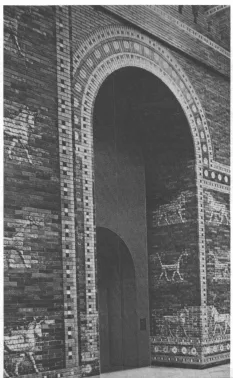
The Ishtar Gate of Babylon reconstructed. The structure is housed at the State Museum at Berlin.
In this interval, Cyrus died and was replaced by Cambyses who secretly murdered his brother, Smerdis. Cambyses defeated Egypt and advanced into Ethiopia. When a report came that a usurper, known as Pseudo-Smerdis, had taken the throne, he made haste to return to Persia. On the way back, however, he died. When the army of Cambyses came home, it put to death the usurper and placed Darius I on the throne.
During the reign of Darius, God raised up the prophets Haggai and Zechariah to convict the returned exiles of their sin of procrastination. Under the combined leadership of the prophets and Zerubbabel, the people returned to the reconstruction of the temple (Ezra 5-6). When the provincial governors questioned their actions, the Jews appealed to Darius to honor the decree of Cyrus. When Darius discovered the decree in the court records, he not only granted permission to the Jews but he authorized that the work should be subsidized with government funds (Ezra 6:7-12). With this encouragement, the Jews completed the task of rebuilding the temple in 516-515 B.C. This temple, later enlarged and renovated by Herod the Great (John 2:20), stood for the next five centuries; it was the prominent temple of New Testament activities.
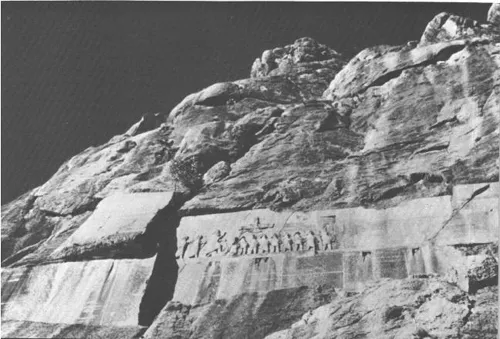
On this high mountain ledge, near Bihistun (Bisitun), the Persian ruler Darius the Great had his autobiography carved in rock. The trilingual inscription unlocked the Assyrio-Babylonian system of cuneiform writing.
Darius, politically ambitious, moved against Thrace, Macedonia, and the Scythians. Defeated by the Greeks at the battle of Marathon, he retreated to the mainland. This battle was significant, however, because it produced the first major encounter between East and West, the Persian empire and the Greek city states. His successor, Xerxes, after putting down rebellions within the empire in Babylon and in Egypt, also moved against Greece and succeeded in taking Athens. However, his fleet was defeated at the battle of Salamis. Xerxes then retreated, leaving the Greeks in control of their own land. In Biblical history, Xerxes is known as Ahasuerus, Esther’s husband. Although hostile to the Greeks, through the diplomacy of Esther and Mordecai he proved to be the deliverer of the Jews from the plot of Haman to exterminate all Jews.
His successor, Artaxerxes I, permitted Ezra the scribe to return to Palestine to teach the law to the returned exiles (Ezra 7-10). Shortly after Ezra’s return (458-457 B.C.), Nehemiah asked the king for permission to return to Jerusalem to rebuild the walls which were still in a state of disrepair (Neh. 1-2). When it was granted, Nehemiah led an expedition back to Palestine, organized the laborers, and reconstructed the walls of Jerusalem (445-444 B.C.). Then, under the combined leadership of Ezra and Nehemiah, a revival broke out. Certain features of the Feast of Tabernacles were reinstituted; confession of sin and separation from the Gentiles occurred; and a covenant was signed, pledging the obedience of the people of God in the instruction of their children, the observance of the Sabbath and the Sabbatical year, and the financial support of the temple (Neh. 8-10). With his work completed, Nehemiah returned to Persia. Upon his second visit to Palestine, he discovered that the people had broken their pledge. Under his supervision the offenders were disciplined (Neh. 13). At this point, the recorded history of the Old Testament ends. The Jews were back in the land with a rebuilt temple and reconstructed walls around Jerusalem. The prophetic era, begun with Moses, was also over. For the next four hundred years, no divinely authenticated prophet proclaimed new, authoritative truth.
History, however, continued. Persian dominion lasted another hundred years until the rise of Philip of Macedon and his son, Alexander.
Greece (331-323 B.C.)
Philip of Macedon laid the foundation for the Greek empire. He succeeded where others had failed before him in uniting the Greek city states under a single ruler. Upon his death his ambitious son, Alexander, took over. Alexander looked eastward to the vast areas controlled by the Greeks’ ancient enemy, the Persians. Leading his army, he crossed the Hellespont and defeated the Persians at the strategic Granicus River. This victory opened up the entire region of Asia Minor to him. He then encountered and defeated the Persian armies at Issus. Faced with a choice to go either east or south, Alexander advanced southward and gained Phoenicia, Palestine, and Egypt. Tradition st...
Table of contents
- Cover
- Title
- Copyright
- Dedication
- Contents
- List of Illustrations
- List of Maps
- List of Charts
- Illustration Credits
- Preface
- 1 BACKGROUNDS
- 2 INTRODUCTION
- 3 THE GOSPELS
- 4 MATTHEW
- 5 MARK
- 6 LUKE
- 7 JOHN
- 8 ACTS
- 9 ROMANS
- 10 FIRST CORINTHIANS
- 11 SECOND CORINTHIANS
- 12 GALATIANS
- 13 EPHESIANS
- 14 PHILIPPIANS
- 15 COLOSSIANS
- 16 FIRST THESSALONIANS
- 17 SECOND THESSALONIANS
- 18 FIRST TIMOTHY
- 19 SECOND TIMOTHY
- 20 TITUS
- 21 PHILEMON
- 22 HEBREWS
- 23 JAMES
- 24 FIRST PETER
- 25 SECOND PETER
- 26 FIRST JOHN
- 27 SECOND JOHN
- 28 THIRD JOHN
- 29 JUDE
- 30 REVELATION
- Bibliography
- General Index
- Scripture Index
- Notes
Trusted by 375,005 students
Access to over 1.5 million titles for a fair monthly price.
Study more efficiently using our study tools.
Frequently asked questions
Yes, you can cancel anytime from the Subscription tab in your account settings on the Perlego website. Your subscription will stay active until the end of your current billing period. Learn how to cancel your subscription
No, books cannot be downloaded as external files, such as PDFs, for use outside of Perlego. However, you can download books within the Perlego app for offline reading on mobile or tablet. Learn how to download books offline
We are an online textbook subscription service, where you can get access to an entire online library for less than the price of a single book per month. With over 1.5 million books across 990+ topics, we’ve got you covered! Learn about our mission
Look out for the read-aloud symbol on your next book to see if you can listen to it. The read-aloud tool reads text aloud for you, highlighting the text as it is being read. You can pause it, speed it up and slow it down. Learn more about Read Aloud
Yes! You can use the Perlego app on both iOS and Android devices to read anytime, anywhere — even offline. Perfect for commutes or when you’re on the go.
Please note we cannot support devices running on iOS 13 and Android 7 or earlier. Learn more about using the app
Please note we cannot support devices running on iOS 13 and Android 7 or earlier. Learn more about using the app
Yes, you can access New Testament Survey by Robert G. Gromacki in PDF and/or ePUB format, as well as other popular books in Theology & Religion & Biblical Criticism & Interpretation. We have over 1.5 million books available in our catalogue for you to explore.