- 336 pages
- English
- ePUB (mobile friendly)
- Available on iOS & Android
eBook - ePub
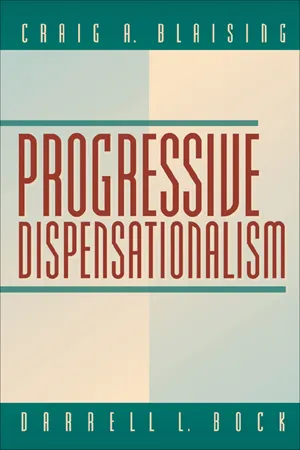
Progressive Dispensationalism
About this book
Thoughtful and accessible. An up-to-date, comprehensive overview of the most important issues in dispensationalism, underpinned with accurate scholarship and summarized with clarity.
Information
Subtopic
Théologie chrétiennePart One: History
Chapter One
The Extent and Varieties of Dispensationalism
Dispensationalism may not be a household term, but it designates one of the most widespread and influential traditions in evangelical theology today. If you are an evangelical Christian, it is most likely that you know of some who call themselves dispensationalists. And it is just as likely that you have certain beliefs and interpretations of Scripture that have been shaped in some way by dispensationalism.
This book explains a significant change presently taking place in dispensational interpretations of Scripture. This change affects the way dispensationalists understand key biblical themes such as the kingdom of God, the church in God’s redemptive program, the interrelationship of the biblical covenants, the historical and prophetic fulfillment of those covenants, and the role of Christ in that fulfillment.
Changes of this sort are not entirely new to dispensationalism, as we will see. And yet certain beliefs and emphases have remained much the same or have varied only slightly through the history of these changes. Such beliefs constitute the abiding identity of dispensationalism, while the process of rethinking and reinterpretation reveals its vitality.
Where did dispensationalism come from? How widespread is it? What are its common features, and what changes have taken place? This chapter seeks to answer these questions. The significance of the present form of dispensationalism can best be understood in this light, for it’s only as we know where we’ve come from and how we got here that we have a better appreciation for where we are.
The Rise and Spread of Dispensationalism
Dispensationalism first took shape in the Brethren Movement in early nineteenth century Britain. The Brethren Movement emphasized the unity of all believers in Christ and the freedom of Christians to gather in His name without regard for sectarian or denominational divisions. They rejected the special role of an ordained clergy, which perpetuated such ecclesiastical divisions, and stressed instead the spiritual giftedness of ordinary believers and their freedom, under the Spirit’s guidance, to teach and admonish each other from the Scripture.
By enhancing the integrity and responsibility of the laity, Brethrenism witnessed a surge of interest in Bible study and private devotions. The movement generated a large volume of expositional and devotional literature, some authors of which became well known, including John Nelson Darby, Benjamin Wills Newton, George Müller, Samuel P. Tregelles, William Kelly, William Trotter, and Charles Henry Mackintosh.
The writings of the Brethren had a broad impact on evangelical Protestantism. This is especially true in the United States, where they influenced prominent ministers such as D.L. Moody, James Inglis, James Hall Brookes, A.J. Gordon, J.R. Graves, and C.I. Scofield. While not following the Brethren in a radical rejection of clergy and denominational ministry, they founded a new forum alongside established ministries which promoted the Brethren experience of freely gathering in Christ to worship and study the Scripture: the Bible Conference. Beginning with the popular Niagara Bible Conference in the 1870s, Bible conferences began to spring up in various parts of the country, becoming what has been called the Bible Conference Movement by the early twentieth century.
C.I. Scofield, a participant in this movement, formed a board of Bible conference teachers and in 1909 produced through Oxford Press a reference Bible (second edition in 1917) which became famous throughout the United States and around the world. The Scofield Reference Bible was filled with expositional and theological annotations which put a “Bible Conference” into the hands of thousands of evangelical Christians. The interpretations presented in the notes formed a recognizable system of biblical interpretation. That system was soon tagged “dispensationalism,” a label which has come to mark the tradition which both led to and developed from the Scofield Reference Bible.
The term dispensationalism comes from the word dispensation which refers to a distinctive way in which God manages or arranges the relationship of human beings to Himself. Recognizing different dispensations in Scripture, such as the dispensation of Israel with its distinctive regulations and ceremonies and the dispensation of the church today, has been quite common in the history of biblical interpretation. Distinguishing between these different dispensations can be helpful in understanding the complexity and diversity of the Bible. Dispensationalists, however, had some distinctive views about these dispensations which differed from most other interpreters of Scripture. Because of this, they were especially tagged with the label dispensationalism whereas others who referred to different dispensations in Scripture were not. We will refer to some of these distinctives in the next sections of this chapter.
Through the Bible conferences and the Scofield Reference Bible, dispensationalism came to characterize the views and beliefs of a large constituency of American evangelicalism scattered throughout mainstream Protestantism. But it was especially concentrated in Presbyterian, Baptist, and Congregationalist circles. When the struggle between fundamentalism and modernism broke into the open, dispensationalists were found on the fundamentalist side, their ecumenical emphases contributing to the cohesion of the fundamentalist movement.
As fundamentalists proceeded to establish new churches and new denominations in reaction to the modernist control of traditional churches, dispensationalism came to characterize some of these resulting groups almost completely. These include, for example, The General Association of Regular Baptist Churches, The Conservative Baptist Association, The Fellowship of Grace Brethren Churches, and the Independent Fundamentalist Churches of America.
Some of the schools associated with these churches have become well known for teaching dispensationalism. They include Grace College and Grace Theological Seminary, Northwestern College, Grand Rapids Baptist Seminary, Western Conservative Baptist Seminary (now Western Seminary). Dispensationalism has also been taught (though not exclusively) at Denver Seminary (formerly Denver Conservative Baptist Seminary). Over the years, some of these schools have become more self-consciously “evangelical” than fundamentalist, and the dispensationalism which they teach has undergone changes as well.
Dispensationalism has also been well represented in other denominations such as the Evangelical Free Church of America, and dispensational theologians have taught at Trinity College and Trinity Evangelical Divinity School. The Christian and Missionary Alliance, of the holiness tradition, has advocated dispensational views. And dispensationalism has also impacted Pentecostal and charismatic churches as well.
A number of Bible schools, institutes, colleges, and seminaries have taught dispensationalism. Moody Bible Institute, founded through the revivalist ministry of D.L. Moody is a well known example. The Bible Institute of Los Angeles, founded on the model of Moody, is now Biola University and includes the Talbot School of Theology. Philadelphia College of Bible and Dallas Theological Seminary were direct products of the Bible Conference Movement. Graduates of Dallas Seminary have staffed many of the aforementioned dispensational schools and founded others, including, for example, Multnomah Bible College/Biblical Seminary and William Tyndale College (formerly Detroit Bible College).
Not only do graduates of these schools minister in the associations and denominations we have noted (including some mainline churches), but they have established and pastored a number of independent Bible churches so that the Bible Church Movement mostly reflects a dispensational exposition of Scripture.
In this century, the broadcast media has helped to highlight the ministries of prominent pastors, some of whom teach dispensational views. These would include, to name only a few, the late Donald Grey Barnhouse (Presbyterian), W.A. Criswell, Adrian Rogers, and Charles Stanley (Southern Baptist), and Chuck Swindoll (Evangelical Free Church). Popular radio ministries featuring a dispensational view of Scripture have included the late Charles Fuller and the “Old Fashioned Gospel Hour” (which led to the founding of Fuller Theological Seminary—though broadly evangelical today, Fuller’s early faculty included the well-known dispensationalists Wilber Smith and Everett Harrison), the late M.R. DeHaan and Richard DeHaan on the “Radio Bible Class,” the late Theodore Epp and Warren Wiersbe on the “Back to the Bible,” the late J. Vernon McGee’s “Through the Bible,” Jerry Falwell’s “Old Time Gospel Hour,” and Chuck Swindoll’s “Insight for Living.”
Dispensationalists have participated in and encouraged the founding of faith missions (such as Central American Mission, founded by C.I. Scofield) and parachurch ministries (such as Young Life, founded by Jim Rayburn). Dispensationalists have ministered with Campus Crusade for Christ, the Navigators, Youth For Christ, and InterVarsity Christian Fellowship. Dispensational themes appear in some of the teaching materials of these ministries. In addition, some of the most famous evangelists including Billy Graham have affirmed and taught dispensational views.[1]
In summary, clergy and laity alike who share dispensational views of Scripture can be found in most Protestant denominations, mission agencies, and parachurch ministries to varying degrees. From its introduction in the Bible conferences to the present day, dispensationalism has expanded to become one of the most common expressions of evangelical Christianity.
Dispensationalism is not a monolithic movement; diversity exists today on a number of matters of interpretation. However, there are some broad features which unite these diverse elements into a common tradition. Together, these features provide a descriptive definition of dispensationalism.
Common Features of the Dispensational Tradition
Authority of Scripture. From the early Brethren Movement, through the American Bible conferences, the Scofield Bible, Bible institutes, colleges and seminaries, to popular expositional ministries in churches and parachurch movements, dispensationalism has been known as a Bible exposition movement. It has produced a number of popular expositors of Scripture who not only helped spread dispensationalism but have impacted large portions of evangelicalism.
Dispensationalists have upheld the belief that the Bible is the sole inerrant verbal revelation of God available to the church today and that it provides a sure foundation for Christian life and faith. They believe that dispensational ideas and interpretations help people understand the Bible and help make the Scripture more intelligible to them, allowing them to more knowledgeably appropriate it in their everyday lives. Furthermore, the dispensational system of relating the various parts of Scripture together has helped to give people a sense of having an answer to attacks upon Scripture’s integrity by theological liberalism.
The Bible Conference Movement was an attempt to make the Bible a sure basis for evangelical ecumenicity—an ecumenicity that was not seen as structural, administrative, or denominational, but an ecumenicity of faith, hope, and love. Interdenominational schools and ministries have attempted to carry on that vision to varying degrees, a vision which has helped contribute to the sense of evangelical identity in some quarters of evangelicalism.
Dispensationalists, of course, were not the only evangelicals to emphasize the authority of the Bible. But their transdenominational vision and their practical orientation to expositional ministry made an emphasis on Scripture a hallmark of the movement, one that continues today as well.
Dispensations. The word dispensation refers to a particular arrangement by which God regulates the way human beings relate to Him.[2] Dispensationalism believes that God has planned a succession of different dispensations throughout history, both past, present, and future. Furthermore, dispensationalists believe that these dispensations are revealed in Scripture, in both biblical history and prophecy. Understanding these dispensations, these different relationships God has had and will have with humanity, is crucial for comprehending the teaching and message of the Bible.
Of course, a primary concern for us today is our own relationship with God. As a result, a dispensational exposition of Scripture will focus especially on the present dispensation and the Scripture dealing explicitly with it. We then seek to interpret other portions of Scripture in light of the dispensations to which they belong or of which they speak. We have a better understanding of how those Scripture texts relate to us when we know how their dispensation relates to or differs from our own. Consequently, understanding the dispensations is crucial to understanding how the whole of Scripture relates to Christian faith and practice.[3]
For example, suppose we speak of the old dispensation which covered Israel’s relationship to God under the Mosaic covenant. Then we speak of the present dispensation which refers to the church, the body of Christ, first constituted as such by Christ Himself on the Day of Pentecost just after His ascension to heaven. We then speak of the future dispensation as the arrangement of God’s relationship to humankind after Christ’s return to earth. Practically all of the Old Testament was written under—and most of it refers to—the old dispensation, as we have just defined it. Much of the New Testament refers to the present dispensation. But we find prophecies in the Old Testament and in the New Testament that speak of the future dispensation.

Also, when a Christian today reads the Old Testament, it helps to know that he or she is reading literature which speaks directly about Israel and her relationship to God under the old dispensation. God commanded certain forms of worship. He specifically instructed Israel on national policy as it related to events in the first and second millennia B.C.
God, of course, is the everlasting God. We are dealing today with the same God. So, there are a lot of lessons to learn from the way God related to people in the old dispensation. The New Testament guides us here. It also reveals the fact that God’s relationship to the church differs in some significant ways from the dispensation with Israel. In the present dispensation, God is blessing Jews and Gentiles equally with certain blessings of the Holy Spirit to a degree which he had only promised in the old dispensation. This includes, for example, the permanent indwelling of the Holy Spirit. There are also new forms of worship (as Jesus revealed to the Samaritan woman in John 4:21, 23). Consequently, although there are similaritie...
Table of contents
- Cover
- Title Page
- Copyright Page
- Endorsements
- Contents
- Preface to the Paperback Edition
- Part One: History
- Part Two: Hermeneutics
- Part Three: Exposition
- Part Four: Theology and Ministry
- Notes
- Select Subject and Person Index
- Scripture Index
- Back Cover
Trusted by 375,005 students
Access to over 1.5 million titles for a fair monthly price.
Study more efficiently using our study tools.
Frequently asked questions
Yes, you can cancel anytime from the Subscription tab in your account settings on the Perlego website. Your subscription will stay active until the end of your current billing period. Learn how to cancel your subscription
No, books cannot be downloaded as external files, such as PDFs, for use outside of Perlego. However, you can download books within the Perlego app for offline reading on mobile or tablet. Learn how to download books offline
Perlego offers two plans: Essential and Complete
- Essential is ideal for learners and professionals who enjoy exploring a wide range of subjects. Access the Essential Library with 800,000+ trusted titles and best-sellers across business, personal growth, and the humanities. Includes unlimited reading time and Standard Read Aloud voice.
- Complete: Perfect for advanced learners and researchers needing full, unrestricted access. Unlock 1.5M+ books across hundreds of subjects, including academic and specialized titles. The Complete Plan also includes advanced features like Premium Read Aloud and Research Assistant.
We are an online textbook subscription service, where you can get access to an entire online library for less than the price of a single book per month. With over 1.5 million books across 990+ topics, we’ve got you covered! Learn about our mission
Look out for the read-aloud symbol on your next book to see if you can listen to it. The read-aloud tool reads text aloud for you, highlighting the text as it is being read. You can pause it, speed it up and slow it down. Learn more about Read Aloud
Yes! You can use the Perlego app on both iOS and Android devices to read anytime, anywhere — even offline. Perfect for commutes or when you’re on the go.
Please note we cannot support devices running on iOS 13 and Android 7 or earlier. Learn more about using the app
Please note we cannot support devices running on iOS 13 and Android 7 or earlier. Learn more about using the app
Yes, you can access Progressive Dispensationalism by Craig A. Blaising,Darrell L. Bock in PDF and/or ePUB format, as well as other popular books in Théologie et religion & Théologie chrétienne. We have over 1.5 million books available in our catalogue for you to explore.