- 304 pages
- English
- ePUB (mobile friendly)
- Available on iOS & Android
eBook - ePub
About this book
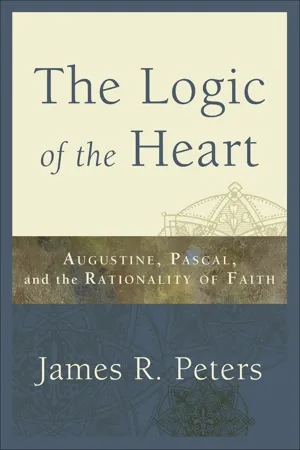
Philosopher James R. Peters defends the reasonableness of the Christian faith in The Logic of the Heart. He paves a middle road between the Enlightenment's worship of reason and postmodernism's emphasis on freedom and self-rule. He delves into the thought of theologian St. Augustine and philosopher-mathematician Blaise Pascal and engages the skeptic David Hume, who argued against the possibility of miracles. Throughout this process, Peters provides an alternative to postmodern thought as well as the widespread New Atheism. This work is appropriate for undergraduate and graduate students pursuing studies in philosophy of religion and historical theology. Since Peters writes in nontechnical language, readers interested in the relationship between faith and reason will also benefit from The Logic of the Heart.
Information
Topic
Theology & ReligionSubtopic
Christian Theology1
AUGUSTINE, PASCAL, AND HUME FOR THE POSTMODERN WORLD?
I would be quite happy to continue and to show here the whole chain of other truths that I had deduced from these first ones. . . . I have always remained firm in my resolve not to suppose any principle but the one I have just used to demonstrate the existence of God and the soul, and to take nothing to be true that does not seem to me clearer and more certain than have the demonstrations of the geometricians been previously. And still I dare say not only that I have found the means of satisfying myself in a short time regarding all the main difficulties commonly treated in philosophy, but also I have noted certain laws that God has so established in nature and has impressed in our souls such notions of these laws that, after having reflected sufficiently, we cannot deny that they are strictly adhered to in everything that exists or occurs in the world.
René Descartes, Discourse on Method, part 5[1]
Objectivity, in practice, means that one studies or teaches one’s subject as such, without concern for its relation to other subjects or to the world—that is, without concern for its truth. If one is concerned, if one cares, about the truth or falsity of anything, one cannot be objective: one is glad if it is true and sorry if it is false; one believes it if it is judged to be true and disbelieves it if it is judged to be false. Moreover, the truth and falsity of some things cannot be objectively demonstrated, but must be determined by feeling and appearance, intuition and experience. And this work of judgment cannot take place at all with respect to one thing or one subject alone. The issue of truth rises out of the comparison of one thing with another, out of the study of the relations and influences between one thing and another and between something and many others.
Wendell Berry, Home Economics[2]
In this chapter I will set forth my case that the three philosophers I have chosen for my inquiry are especially relevant for the postmodern era, for a time when a diverse array of thinkers in many different disciplines have called into question major presuppositions and fundamental convictions of modern philosophy. Given the great resurgence of interest among philosophers and theologians today concerning how we should now assess the rationality of religious faith in the wake of the demise of modernity’s doctrine of autonomous reason, and, indeed, whether it even makes sense to talk of objective truth, it is especially worthwhile to examine closely the Humean, Pascalian, and Augustinian views on the complex relationship of rationality, theistic belief, and human nature. These philosophers not only acknowledge that people cannot live by “hard” evidence alone, and that certain of our fundamental beliefs are neither self-evident nor incorrigible, but they also develop in a somewhat similar fashion a justification for these fundamental beliefs in terms of the indispensable role they play in human life. Yet Hume, unlike Pascal and Augustine, is determined to expose the lack of evidential grounding for theistic beliefs as a major defect and, indeed, as an insuperable impediment to faith.
For Augustine, Pascal, and Hume, the fundamental question about faith is not simply whether such belief is based on reason—that is, a belief supported by empirical or logical premises—but whether it is wise, given our lack of unambiguous evidence, to assent to the existence of, and indeed commit our lives to, a transcendent God.[3] By directing our attention away from the simple matter of the presence or absence of objective evidence to the question of how people can believe wisely, Augustine, Hume, and Pascal recognize that the justification of a person’s religious commitment ultimately hinges on an account of human nature. For Augustine and Pascal, Christian faith is rationally justified insofar as it makes sense of the human condition and enables us to align ourselves with our true nature. In sharp contrast, for Hume, Christian faith and theism in general ultimately are rationally unjustified because they violate our human nature and impair our efforts to align ourselves with our true nature.
Skeptics of Modernity: Embedded Rationality versus Rational Autonomy
The madman is not the man who has lost his reason. The madman is the man who has lost everything except his reason.
G. K. Chesterton, Orthodoxy[4]
One particularly significant insight shared by Hume, Pascal, and Augustine centers on the importance of the passions in guiding the dictates of reason. These three philosophers insist that reason must not be permitted complete autonomy from the life of the passions. While their specific accounts of the proper role of the passions in human ethical and religious judgments differ markedly, they agree that reason alone, operating in isolation from our passions, is insufficient for the tasks of determining how we ought to live and of guiding us to live properly in accordance with our human limitations. To appreciate something of their basic stance on the necessity of the passions, it may be instructive to compare the characteristically modern form of philosophical rhetoric, the propositional assertion [P], with a different form of persuasion, the metaphoric mode of expression [M], characteristic of the craft of the literary or dramatic poet. Consider, for example, the following two statements:
[M] “How sharper than a serpent’s tooth it is
To have a thankless child” (King Lear 1.4.295–96).
To have a thankless child” (King Lear 1.4.295–96).
[P] The daughter’s cold ingratitude evoked in her father a piercing sense of betrayal and regret.
Unless we already had been discipled in the wisdom of twentieth-century Anglo-American positivistic philosophy of language, or some other modern account of meaning that divorces fact from value, we would not presume that the statements [M] and [P] are identical in their cognitive meaning; most of us, at least in our preenlightened condition of everyday life, would intuitively recognize a crucial difference between the poetical [M] and the “merely descriptive” [P] forms of utterance, a difference that would not be reducible to some noncognitive, “aesthetic” embellishment inherent only in the poetical. For while both assertions more or less describe the same painful human experience, their forms of expression differ so poignantly that few but the most artless of readers would dare presume that the meaning of [M] may be reduced without loss of significance or cognitive content to that of [P].
And yet what is it about the poetic utterance of King Lear that moves us deeply and strikes us as so vivid and instructive? Is it not that the uniqueness of the poetic is a function of its brilliant use of metaphor? But then, we might well ask, “What makes the metaphor in this case so powerful?” Is not the special power of metaphor here that Lear’s utterance moves us not only to think but also to feel something of the sharpness and bitterness of a child’s ingratitude? We recoil from the idea of the thankless child through our grasp of Shakespeare’s metaphor: our impression of the serpent’s tooth evokes in us a sense of revulsion; we feel a loathing of the bite of serpentine fangs that, in its juxtaposition with the weight of human ingratitude, clarifies for us what it means to dishonor our parents. And, clearly, we fail to “grasp” the metaphor adequately if we do not feel its power, as it is meant to evoke in us a bitter, stinging sense of disapproval. In moving us both to think and to feel this distaste, Shakespeare shows us what it means for a parent to be treated with ingratitude and what it means for all of us who are children to neglect our parents: in pursuit of our own selfish ambitions, all of us, like Lear’s daughters, have failed to love and honor those who have sacrificed years for our benefit. Through metaphor, the poetic utterance has the power to evoke in us a feeling recognition of the wrongfulness of betraying one’s parents. Such a feeling recognition fuses heart and intellect in such a way that to divorce the component of cognitive judgment from our affections would be to distort the essential character of that very recognition.
By use of metaphor, in other words, Shakespeare transforms us from being indifferent, neutral spectators in the audience to being sympathetic participants in Lear’s distress. On the one hand, a neutral spectator could view Lear’s suffering merely as a fact. On the other hand, a feeling participant who understands Lear’s pain knows that betrayal is more than a neutral fact; betrayal is essentially an ethical phenomenon—it is cruel, ugly, and repugnant. As witnesses of Lear’s fall into madness, if we fail to feel revulsion at the cruelty of Lear’s two older daughters, we simply fail to function properly as embedded cognitive persons. To grasp the essence of filial ingratitude we must go beyond a mere spectator’s knowledge of the necessary and sufficient conditions of filial ingratitude as a “moral phenomenon”; in other words, an adequate understanding of filial ingratitude requires more from the viewer than simply a neutral type of knowing that. More importantly, knowing the nature of filial ingratitude requires acknowledging and even sympathetically feeling its repugnant and dehumanizing character. And yet such acknowledgment is unattainable to one lacking in a proper response of the will and the affections, for acknowledging the reality of ingratitude requires that one not be indifferent or neutral toward either its perpetrator or its victim. Put more precisely, acknowledging the ethical status of ingratitude necessitates in the beholder a form of personal participation: the sympathetic knower must enter into the suffering of Lear and must empathize with his pain in order to acknowledge its real character as a moral offense. In this act of personal knowing—“I acknowledge the dignity of the sufferer and recoil from the offense of ingratitude”—the viewer cannot reason properly and thus believe truly without engaging in a complex activity of ethical acknowledgment in which thinking, willing, and feeling are inextricably intertwined. Knowledge as participation thus binds together thinking and being: only by becoming a sympathetic participant in suffering can the viewer acknowledge Lear’s plight and thus think truthfully about its meaning. This remarkable form of passionate knowledge, rooted in a unique kind of participation and enacted through acknowledgment, unites “being in the truth” with “thinking about the truth,” fusing being and thinking in a complex form of knowing as acknowledging. In this act of acknowledging moral reality, rational cognition cannot be merely abstract or indifferent, for it is embedded within a way of being that esteems and evaluates, rather than a way that merely observes.
Now the power of the poet’s art to evoke in us this form of feeling knowledge, a knowledge available to us only by participation in an emotional response and unavailable to the detached or “purely objective” intellectual, has particular relevance for our study of Hume, Pascal, and Augustine, all of whom agree that ethical first principles cannot be discovered through disinterested “pure reason.” Moreover, they all contend that our ethical judgments ultimately arise from uncertain, fallible intuitions that are essentially bound up with our passions of approval and disapproval—put more precisely, in the case of Augustine, with the order and nature of our loves. They all seek in their own distinctive ways to persuade us of the role of “passion” or the “heart” in forming the fabric of our moral world. As philosophers, Hume, Pascal, and Augustine may well succeed in defending the place of the passions in our ethical lives and in clarifying for us the nature of our ethical concerns. But the poet or novelist has the special power to move us to a feeling recognition and proper estimation of ethical reality. The art of the poet thus shows rather than tells, presents rather than merely describes or defends, our ethical landscape. What the philosopher describes, and then attempts to defend by argument, the poet can show with the immediacy of concrete experience. The relative advantage of poetical language is that it more forcefully and directly engages our passions and thereby brings us to feel such complex sentiments as ingratitude; by awakening our ethical sentiments, the poet enables us to understand the ethical dimensions of our lives. One of the poet’s advantages over the reflective philosopher turns on the fact that fundamental insights about the human condition are available to us only as we are moved either to approve or to disapprove of actions and events that cause joy or sorrow to people. The philosopher, in turn, has the relative advantage of serving as the reflective critic who creates an interpretive space within which we are able to check the potential prejudices and shortcomings of our sentiments. The philosopher enjoys the special power and freedom of self-conscious reflection; from this vantage point the philosopher may articulate, clarify, and subject to critical analysis the complex matrix of individual beliefs and sentiments, as well as the social forms and practices that constitute our embedded moral lives. In their own distinctive ways, Hume, Pascal, and Augustine, as inheritors of the Socratic tradition of the philosophical quest for self-understanding, acknowledge the dependence of rational reflection on the affections and yet defend in no uncertain terms the supreme importance of rational reflection and criticism.
Clearly then, for Hume, Pascal, and Augustine ethical insights require more than a mere intellectual and disinterested apprehension of facts. Indeed, for these philosophers the very ability to perceive ethical or religious “facts” depends on the proper ordering of our passions. Hume, for example, insists that our ethical judgments about human character and action can arise only through the proper engagement of our sentiments. In a similar way, for Pascal ethical knowledge is fundamentally a matter of knowledge of the heart. And for Augustine the interconnected knowledge of self and God depends on the purifying effect of the virtue of charity. Each offers an analysis of reason and sentiment that makes sense of the special power of poetic metaphor and literary narrative to reveal what is true. While the literary artist, through image and metaphor, can move our hearts and thus bring us to a feeling of recognition of the forms and contours of our ethical world, the particular province of the philosopher is to reflect on and assess our ethical beliefs and practices; indeed, such philosophical reflection without the enrichment of lived, existential intuitions will not only be empty but may also misdirect and blind us as to who we really are.
Personal Knowing in Dickens’s Hard Times
Modernity certainly has its literary artists who oppose, as do Pascal and Hume, modern philosophy’s excessive reliance on reason apart from feeling and passion. Charles Dickens’s Hard Times is a good example of a work of literature that shows narratively rather than tells philosophically of the folly of living by “reason” alone. As a preface to our inquiry into the thought of Hume and Pascal, it may be instructive to consider Dickens’s narrative argument in its relation to the modern philosophical quest for rational progress.
Riding in the wake of modern reformers such as Francis Bacon, René Descartes, and Jeremy Bentham, Dickens’s character, Sir Thomas Gradgrind, opens Hard Times by proclaiming his revolutionary vision of a brave new world of rational “Facts”: “Now, what I want is, Facts. Teach these boys and girls nothing but Facts. Facts alone are wanted in life. Plant nothing else, and root out everything else. You can only form the minds of reasoning animals upon Facts; nothing else will ever be of any service to them. This is the principle on which I bring up these children. Stick to the Facts, sir!”[5]
Gradgrind, a “man of facts and calculations,” seeks to found a new social world liberated from the forces of fancy and ignorance and peopled by rational citizens, who, rooted in the soil of genuine Facts, could enjoy the fruits of real happiness. For modern progressives such as Gradgrind, rational social progress awaits the dawning of a new era enlightened by a renewed reason. And he is confident that in this age of progress the march of knowledge will not falter, for its feet will be planted firmly on a pathway of hard Facts. Yet as we discover through Dickens’s narrative of self-deception and false enlightenment, Gradgrind comes, through the suffering of his beloved, eldest daughter, to see that people cannot live by Facts alone, for the so-called Facts that Gradgrind espouses allow no room for the needs of the human heart, for sentiments beyond primitive self-interest, and, in particular, for those most essentially human of sentiments, trust and love. Gradgrind begins to understand this defect in his vision when finally confronted by the suffering and desperation of his unhappy daughter Louisa:
“Father, you have trained me from my cradle?”
“Yes, Louisa.”
“I curse the hour in which I was born to such a destiny.”
He looked at her in doubt and dread, vacantly repeating: “Curse the hour? Curse the hour?”
“How could you give me life, and take from me all the inappreciable things that raise it from the state of conscious death? Where are the graces of my soul? Where are the sentiments of my heart? What have you done, O father, what have you done with the garden that should have bloomed once, in this great wilderness here?”
She struck herself with both her hands upon her bosom.
“If it had ever been here, its ashes alone would save me from the void in which my whole life sinks. I did not mean to say this; but, father, you remember the last time we conversed in this room?”
He had been so wholly unprepared for what he heard now, that it was with difficulty he answered, “Yes, Louisa.”
“What has risen to my lips now, would have risen to my lips then, if you had given me a moment’s help. I don’t reproach you, father. What you have never nurtured in me, you have never nurtured in yourself; but O! If you had only done so long ago, or if you had only neglected me, what a much better and much happier creature I should have been this day!”
On hearing this, after all his care, he bowed his head upon his hand and groaned aloud.
“Father, if you had known, when we were last together here, what even I feared while I strove against it—as it has been my task from infancy to strive against every natural prompting that has arisen in my heart; if you had known that there lingered in my breast sensibilities, affections, weaknesses capable of being cherished into strength, defying all the calculations ever made by man, and no more known to his arithmetic than his Creator is—would you have given me to the husband whom I am now sure that I hate?”
He said, “No. No, my poor child.”
“Would you have doomed me, at any time, to the frost and blight that have hardened and spoiled me? Would you have robbed me—for no one’s enrichment—only for the greater desolation of this world—of the immaterial part of my life, the spring and summer of my belief, my refuge from what is sordid and bad in the real things around me, my school in which I should have learned to be more humble and more trusting with them, and to hope in my little sphere to make them better?”[6]
As he painfully comes to realize, the Facts of Gradgrind’s world constitute a barren landscape, for they include no more than the material features of a self-seeking, industrial world, the statistics of material efficiency, and the principle...
Table of contents
- Cover
- Title Page
- Copyright Page
- Epigraph
- Contents
- Acknowledgments
- Introduction: Augustine, Pascal, and Hume on the “Embeddedness” of Reason
- 1. Augustine, Pascal, and Hume for the Postmodern World?
- 2. Hume’s Skepticism and the Wisdom of the Heart
- 3. Pascal, Paradox, and the Wisdom of the Heart
- 4. A Dialectical Defense of Pascal’s Paradox Argument: Pascal versus Radical Postmodernism
- Bibliography
- Index
- Notes
Trusted by 375,005 students
Access to over 1.5 million titles for a fair monthly price.
Study more efficiently using our study tools.
Frequently asked questions
Yes, you can cancel anytime from the Subscription tab in your account settings on the Perlego website. Your subscription will stay active until the end of your current billing period. Learn how to cancel your subscription
No, books cannot be downloaded as external files, such as PDFs, for use outside of Perlego. However, you can download books within the Perlego app for offline reading on mobile or tablet. Learn how to download books offline
Perlego offers two plans: Essential and Complete
- Essential is ideal for learners and professionals who enjoy exploring a wide range of subjects. Access the Essential Library with 800,000+ trusted titles and best-sellers across business, personal growth, and the humanities. Includes unlimited reading time and Standard Read Aloud voice.
- Complete: Perfect for advanced learners and researchers needing full, unrestricted access. Unlock 1.5M+ books across hundreds of subjects, including academic and specialized titles. The Complete Plan also includes advanced features like Premium Read Aloud and Research Assistant.
We are an online textbook subscription service, where you can get access to an entire online library for less than the price of a single book per month. With over 1.5 million books across 990+ topics, we’ve got you covered! Learn about our mission
Look out for the read-aloud symbol on your next book to see if you can listen to it. The read-aloud tool reads text aloud for you, highlighting the text as it is being read. You can pause it, speed it up and slow it down. Learn more about Read Aloud
Yes! You can use the Perlego app on both iOS and Android devices to read anytime, anywhere — even offline. Perfect for commutes or when you’re on the go.
Please note we cannot support devices running on iOS 13 and Android 7 or earlier. Learn more about using the app
Please note we cannot support devices running on iOS 13 and Android 7 or earlier. Learn more about using the app
Yes, you can access The Logic of the Heart by James R. Peters in PDF and/or ePUB format, as well as other popular books in Theology & Religion & Christian Theology. We have over 1.5 million books available in our catalogue for you to explore.