- 430 pages
- English
- ePUB (mobile friendly)
- Available on iOS & Android
eBook - ePub
About this book
Essential to an understanding of the New Testament is a comprehension of the individuals, events, and social movements that shaped the setting from which Jesus and his followers emerged. Unfortunately, many accounts by historians can leave readers feeling overwhelmed and confused. New Testament History provides a worthy solution to this problem. A well-known expert on the social situation of the New Testament, Ben Witherington offers an engaging look into the world that gave birth to the Christian faith.
Information
Topic
Theology & ReligionSubtopic
Biblical StudiesChapter 1
From Alexander to Alexandra and Beyond
356–67 B.C.
To the casual reader of the Bible who proceeds directly from Malachi to Matthew, it can come as something of a shock to discover the gap of several hundred years between the end of the narrative in the Hebrew Scriptures and the beginning of the narrative in Matthew. It is not just the time lag that surprises, however, but also the difference in the character of the people of God. During the time of Ezra and Nehemiah, the Hebrews had returned from Babylonian exile and tried to reestablish themselves in Israel. While they may well have picked up various Persian customs and indeed many gained some facility in Aramaic, none of that could account for the following two facts: (1) the entire New Testament is written (by Jews!) in Greek; (2) the most widely used version of the Old Testament by the turn of the era was also in Greek—the Septuagint. How had it happened that Jews had become so Hellenized between the end of the Old Testament era and the beginning of the New Testament era? To answer this question we must consider the remarkable figure of Alexander the Great and the legacy he and his successors left to early Judaism.
Illustration 1.1 Jewish History before Roman Occupation
| Date | Event |
| 1000–960 B.C. | Reign of David |
| 722–721 B.C. | Assyrian conquest of Israel; Assyrian exile begins |
| 575–450 B.C. | Babylonian exile |
| 332 B.C. | Alexander the Great conquers Palestine |
| 311 B.C. | Ptolemaic Empire in Egypt dominates Palestine |
| 198 B.C. | Antiochus III of Syria takes Palestine |
| 168 B.C. | Antiochus IV tries to abolish Jewish faith |
| 166 B.C. | Judas Maccabeus starts rebellion |
| 164 B.C. | Jerusalem reopened–Feast of Hanukkah |
| 143 B.C. | Simon, Judas's brother, routs forces of Antiochus VI |
| 134–104 B.C. | Rule of John Hyrcanus |
| 103–76 B.C. | Rule of Alexander Janneus |
| 76–67 B.C. | Rule of Alexandra |
| 63 B.C. | Roman general Pompey conquers Jerusalem |
Alexander
Born in 356 B.C. in Pella, Alexander was the son of King Philip II of Macedon. His father, while not quite the world ruler Alexander became, provided the pattern of aggressive military behavior that his son later would follow. One of the main motivating factors for this warlike behavior of both Philip and Alexander seems to have been that Macedonians were viewed by the Greeks who lived in the city-states south of Macedon as uncouth of speech, unsophisticated in culture, ethically unreliable, politically inept, and militarily weak. In other words, Philip and Alexander suffered from a cultural inferiority complex, and they were determined to prove the Greeks wrong at every point of their characterization of Macedonians. It needs to be borne steadily in view that the ancients viewed human personality as determined by geography, generation, and gender. By and large, they did not judge people as individuals, but according to their ethnic or geographical group. What we would call a stereotype, they would call an ethnic character type (cf., e.g., the evaluation by a Cretan poet of the character of his own people in Titus 1:12).
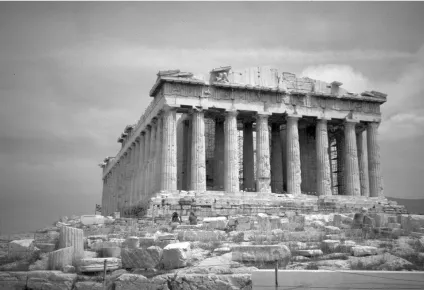
Illustration 1.2 The chief symbol of classical Greek culture—the Parthenon.
At the birth of Alexander, Philip had just come off of four years’ worth of military triumphs that had transformed Macedonia from a backwater into one of the most powerful states in all of the Greek mainland. It would be helpful if we knew more about the childhood of Alexander, but most of the evidence we have from Plutarch and others is the stuff of legend. There is some reason to think that he was indeed precocious as a young man, and we know that he identified himself with Achilles, who was said to be an ancestor of his mother. On his father’s side, the lineage was traced back to Heracles (whom we call Hercules), thus providing Alexander with two powerful figures from his past to emulate. But the one he admired and emulated the most was his own father.
Of his tutors, two stand out as worthy of comment. There was Leonidas, a strong disciplinarian who placed great emphasis on physical training and endurance. The most famous anecdote of this period was that Alexander complained that Leonidas’s idea of breakfast was a long night march, and of supper a light breakfast.[1] Yet this physical regimen was to serve him well when he went out on campaign. I will say more of his other and more famous tutor, Aristotle, shortly.
Another important trait of Alexander was that he had a remarkable memory, seldom forgot a slight, and certainly never forgave one. When Leonidas chastised the boy for throwing too much incense into the sacrificial fire and sarcastically suggested that he could be so extravagant only after he conquered the spice-bearing regions of the world, Alexander answered years later by conquering Gaza and sending his former teacher eighteen tons of incense and spices. Alexander was not a man to be taunted or crossed. Nor was he a man who ever lacked courage. The story of the young man Alexander taming the wild horse Bucephalas when others much older than he had failed is typical.
In March of 346, after various notable Macedonian military triumphs had come to the attention of the Athenians, the famous rhetorician Isocrates published his Address to Philip, calling for a crusade by all true Hellenes against Persia. Isocrates had made such an appeal before (in 380) to the democratic states of Greece to no avail, but now his speech notes the advantages of one-man rule as a way of uniting all of Hellas. Indeed, in a notable piece of rhetorical flourish he encourages Philip to consider all Hellas “your fatherland,” a piece of advice Philip was to take quite literally as he took over Greece. Philip liked the sound of these suggestions, but he knew there was preparatory work to be done first. Accordingly, in the winter of 343-342 Philip sent out an invitation to a boyhood friend to return to the Macedonian court and become the main tutor of his son. This man had studied with the famous Plato and had been serving for some time as an emissary between Philip and other rulers. His name was Aristotle. Philip decided that Alexander needed to be removed from the distractions of the court and the capital, and so Aristotle and Alexander were sent to a small village north of Beroea to complete his education. Alexander was already concerned even as a young teenager that he get the proper training so that he might be a great king.
Undoubtedly, Alexander learned many things from Aristotle. Recall that in his Politics, Aristotle argues that the only justification for a monarchy rather than a republic is that a particular leader have such outstanding areté (moral excellence) that a royal ruler becomes preferable to a more democratic arrangement. Aristotle was, furthermore, extremely ethnocentric. The Persians were barbarians ruled by their passions, and when Alexander conquered them, he was to rule them like a despot, while it would only be necessary to lead the Greeks. Barbaroi (a word that originally meant non-Greek-speaking peoples), reasoned Aristotle, were slaves by nature and needed to be treated as such. The opposite of a barbarian was a well-educated Greek-speaking person who valued most highly the virtues of self-denial and self-control. This basic teaching Alexander put rigorously into practice, treating Greeks as near equals and all others as peoples who required an iron authoritarian hand to rule them. Alexander studied a variety of subjects with Aristotle: medicine, biology, geometry, astronomy, and rhetoric (particularly the art of arguing both sides of a question equally well). For three years Alexander studied with Aristotle, and what he learned then would shape him for the rest of his life, especially the lesson about the inherent superiority of the Greek language and culture to all other forms of human expression.
When one considers the later period in Alexander’s life, with all of his military victories across Asia Minor into Babylonia and indeed on to India, it is good to bear in mind that it was not his idea but Philip’s to engage in a panhellenic crusade against Persia. Alexander, to be sure, though only a lad of eighteen, had been instrumental in the victory against the Greek forces at Chaeronea in 339, which in effect united Greece under Philip’s rule; but it was Philip’s dream originally to be the great Persian conqueror and he who originally had set up the Hellenic League. But Philip and Alexander were all too well aware that Greece would remain a divided land, not least because Darius already had some fifteen thousand Greek mercenaries on his payroll in 338, which is more than twice as many Greek men as the Hellenic League would initially muster to fight against Darius!
Yet Philip was undaunted, and in the early spring of 336 his troops crossed over into Asia Minor and met with success; indeed, they were welcomed with open arms by some of the Greek cities, including Ephesus, which placed a statue of Philip next to that of Artemis in the great temple of Artemis in the city. Coupled with a coup in Persia that led to the assassination of Darius II, things looked good for Philip’s crusade against Persia. But in June of 336 all this was to change suddenly when one of Philip’s own bodyguards stabbed him when the games were about to be celebrated. Historians have long debated whether Alexander, or Alexander’s mother, or others might have long been plotting against Philip, since he seemed determined to raise up another heir to rule instead of allowing Alexander to do so, but the verdict on this must be “unproved.”[2] In any event, the outcome was that Alexander assumed the mantle of kingship and the task of completing the job his father had begun in conquering Persia. It took him a while to consolidate his control of his kingdom, but in the early spring of 334 he was finally ready to cross the Dardanelles into Asia Minor and begin the campaign.
The Hellenization of the Holy Land
The Hellenizing of the Holy Land was not merely intensive in some places but also extensive. From Tel Dan in the far northern part of the land comes a bilingual inscription from the late third or early second century B.C. The text is in Greek (at the top) and Aramaic, and reads, “To the god in Dan, Zoilos discharges his vow.” Notice that the god in question is not given a name, which in theory could mean that the Hebrew God is being referred to, but most scholars have thought it more likely that some pagan or non-Jewish Semitic (Nabatean?) god is meant. The name Zoilos may be a barbarism for Silas. Whatever we conclude about the god addressed in this inscription, the fact that the inscription is in both Greek and Aramaic suggests that we are dealing with a Jewish, or at least a Semitic, person who also knows some Greek. We see evidence already well before the time of Christ of the influence of Hellenism on the region, even when it came to matters of religion. (NewDocs 1:105)
In regard to Alexander’s activities in the region of prime concern for this study, we know that after the long siege and capture of Tyre in 332, he proceeded down the coastal plain with only Gaza offering resistance. Ant. 11.326–According to a surely legendary account, Josephus (339) reports that Alexander visited Jerusalem and was greeted by an elaborately robed high priest named Jaddua, who presented to Alexander the acknowledgement of the capitulation of the city. The tale further relates that Alexander offered sacrifice in the temple and read the Book of Daniel, in which his conquest had been recorded! What is noteworthy about this account, which is surely mostly fiction, is that it contains no evidence of conflict between the representative of Hellenism and the representative of Judaism.[3] It is probably true that Alexander largely left intact the Persian structures of governance in Jerusalem, and perhaps also true that he allowed some Jews to join his military forces, permitting them to continue to observe their own religious customs (see Josephus, Ant. 11.338–339).
Alexander then proceeded on to Egypt, where he was crowned pharaoh in November of that same year (332). His first royal act, prompted by a dream, was to plan the building of a great port city (Alexandria). Especially from Egypt was the Hellenizing influence to radiate into the promised land over the succeeding centuries. It is no accident that the translation of the Hebrew Scriptures into Greek took place in the Jewish community in Egypt and from thence came to influence the believing community in Jerusalem, Judea, and even Galilee.
When finally Alexander engaged and defeated Darius III in 331, it became evident that he would be a world ruler quite unlike the Persian kings. His desire was for a unified world culture of a Hellenized type, to which end he forced ten thousand of his Greek soldiers to marry ten thousand Persian women. The experiment does not seem to have accomplished a great deal in itself, but it revealed the pattern that Alexander saw as desirable. His successors were to implement the policy of Hellenization to one degree or another over the coming century and a half.
It is not necessary to chronicle the long string of battles and victories Alexander was involved in during the last decade of his life (333–323), but several crucial points need to be made: First, Alexander conquered the entire region surrounding Israel, including Syria and Egypt. Second, the Hellenizing influence on the region was not limited to the time of Alexander’s conquests, but continued during the era of his successors, the Ptolemies and the Seleucids, who consolidated the cultural impact of the Greek invasions. Third, while Alexander was a conqueror, and his true genius was as a field commander, his successors were rulers and administrators, and it is to them that we may credit the lion’s share of Hellenizing influence on Jewish peoples both in the Holy Land and in the Diaspora. Fourth, and perhaps the most crucial point to bear in mind, many Jews during the period of 332–67 B.C. came to believe the claim that Greek culture and language were superior forms of human culture and expression and sought to emulate that culture by (1) adopting Greek educational practices (including learning rhetoric); (2) embracing Greek views about physical education and training, to the extent of being willing to build gymnasia even in Israel and to participate in Olympic style games (even if it required surgery to remove the marks of circumcision!); (3) accepting Greek ideals about independence and democracy. Let us consider how this transpired during the time of Alexander’s successors, 323–167 B.C.
Alexander’s Successors
Ptolemy, a high-ranking Macedonian general and longtime confidant of Alexander, was perhaps the wisest of his successors. Rather than becoming embroiled in disputes over who would rule the entire Alexandrian empire, Ptolemy chose to try to gain control over the region he saw as most strategic and promising within that empire—Egypt. It was Ptolemy who stole the body of Alexander and took it to Egypt, where he constructed a gre...
Table of contents
- COVER PAGE
- TITLE PAGE
- COPYRIGHT PAGE
- DEDICATION
- CONTENTS
- PREFACE
- ABBREVIATIONS
- PROLEGOMENON: OF HISTORY, HISTORIANS, AND BIOGRAPHERS
- 1. FROM ALEXANDER TO ALEXANDRA AND BEYOND (356–67 B.C.)
- 2. THE RISE OF THE HERODIANS, THE BIRTH OF JESUS, AND THE DAWN OF AN EMPIRE (63–4 B.C.)
- 3. THE HERODIANS AND THEIR PROPHETIC ADVERSARIES: JOHN AND JESUS (4 B.C.– A.D. 27)
- 4. THE COMING OF THE PREFECT AND OF THE PERFECT: PILATE OF ROME AND JESUS OF NAZARETH (A.D. 26–29)
- 5. THE TRIALS AND TRIBULATIONS OF JESUS (A.D. 29–30)
- 6. THE RISING OF THE SON AND THE BIRTH OF THE CHURCH (A.D. 30–33)
- 7. THE ROADS FROM JERUSALEM (A.D. 33–37)
- 8. DARK PASSAGES (A.D. 37–47)
- 9. THE GENTILE MISSION AND THE JERUSALEM COUNCIL (A.D. 48–49)
- 10. GOOD NEWS HEADING WEST (A.D. 50–52)
- 11. THE EXPANSION OF THE ENTERPRISE (A.D. 53–57)
- 12. TRIALS AND EXECUTIONS: SIGNS UPON THE EARTH (A.D. 58–62)
- 13. THROUGH THE REFINER’S FIRE (A.D. 63–68)
- 14. THE DAWN OF THE AGE OF INSPIRATION (A.D. 68–70)
- 15. BEYOND JERUSALEM, JAMNIA, AND THE JULIO-CLAUDIANS (A.D. 70–81)
- 16. THE DOMINION OF DOMITIAN (A.D. 81–96)
- SCRIPTURE INDEX
- ANCIENT WRITINGS
- SUBJECT INDEX
Trusted by 375,005 students
Access to over 1.5 million titles for a fair monthly price.
Study more efficiently using our study tools.
Frequently asked questions
Yes, you can cancel anytime from the Subscription tab in your account settings on the Perlego website. Your subscription will stay active until the end of your current billing period. Learn how to cancel your subscription
No, books cannot be downloaded as external files, such as PDFs, for use outside of Perlego. However, you can download books within the Perlego app for offline reading on mobile or tablet. Learn how to download books offline
Perlego offers two plans: Essential and Complete
- Essential is ideal for learners and professionals who enjoy exploring a wide range of subjects. Access the Essential Library with 800,000+ trusted titles and best-sellers across business, personal growth, and the humanities. Includes unlimited reading time and Standard Read Aloud voice.
- Complete: Perfect for advanced learners and researchers needing full, unrestricted access. Unlock 1.5M+ books across hundreds of subjects, including academic and specialized titles. The Complete Plan also includes advanced features like Premium Read Aloud and Research Assistant.
We are an online textbook subscription service, where you can get access to an entire online library for less than the price of a single book per month. With over 1.5 million books across 990+ topics, we’ve got you covered! Learn about our mission
Look out for the read-aloud symbol on your next book to see if you can listen to it. The read-aloud tool reads text aloud for you, highlighting the text as it is being read. You can pause it, speed it up and slow it down. Learn more about Read Aloud
Yes! You can use the Perlego app on both iOS and Android devices to read anytime, anywhere — even offline. Perfect for commutes or when you’re on the go.
Please note we cannot support devices running on iOS 13 and Android 7 or earlier. Learn more about using the app
Please note we cannot support devices running on iOS 13 and Android 7 or earlier. Learn more about using the app
Yes, you can access New Testament History by Ben Witherington in PDF and/or ePUB format, as well as other popular books in Theology & Religion & Biblical Studies. We have over 1.5 million books available in our catalogue for you to explore.