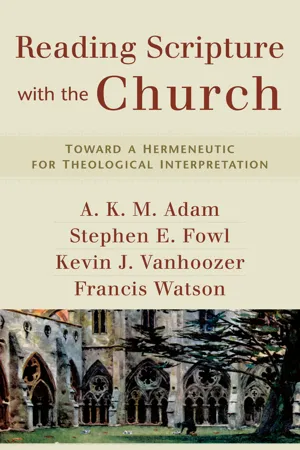
eBook - ePub
Reading Scripture with the Church
Toward a Hermeneutic for Theological Interpretation
- 156 pages
- English
- ePUB (mobile friendly)
- Available on iOS & Android
eBook - ePub
Reading Scripture with the Church
Toward a Hermeneutic for Theological Interpretation
About this book
Theological interpretation of the Bible is key to the health and vitality as well as the belief and practice of the church. Just how it is done has been the subject of much discussion and debate over the centuries. In Reading Scripture with the Church, four leading biblical scholars make the case for theological interpretation. Each author is given the opportunity to interact with the other three, and all four interact with premodern, modern, and postmodern approaches to biblical interpretation. This is an important book for pastors, teachers, and other serious students of the Bible who will be motivated to embrace the task of interpreting the Bible with greater energy, caution, and precision.
Information
PART 1
ESSAYS
1
Poaching on Zion
Biblical Theology as Signifying Practice
Poaching on Zion
Biblical Theology as Signifying Practice
A. K. M. ADAM
From its beginnings, the discourse concerning biblical theology has been marked by a sense of loss, of lack. Sometimes the lack was deliberate, as when biblical theologians deliberately excluded dogmatic considerations from their interpretations of biblical texts; at other times, however, they bemoaned the lack of richness, strength, and vigor that theologians and their readers sought when they turned to biblical theology. Some scholars make that lament their explicit theme; others pursue their deliberations in the silent shadow of the wound of biblical theology, aiming to revive, to mend, what has been missed.
The problems that beset biblical theology are many faceted, and only a fool would attempt to resolve all aspects of them at once. One element of these problems, however, derives from the linguistic captivity of biblical interpretation, the constricted understanding of semiotics that takes “language” as its paradigm. This narrow approach to theological meaning restricts interpretation to a model that lends itself to polemics and exclusion, to the enclosure of a realm of expression in which meaning’s abundance can be confined to authorized, legitimized expressions. The reflections that follow will propose a hermeneutic that opens the Scriptures to interpretations that are not authorized in advance—in the trust that a biblical theology that develops out of the divine abundance of semiosis1 will more powerfully equip the imagination of the saints for their work of ministry, for the signifying practice of making known the good news of God’s joy and peace to all people.
The Background of Lack
The “lack” to which I refer comes to light in a variety of ways. The most explicit manifestation of lack comes from the titles of prominent works in the history of the field; we may take The Strange Silence of the Bible in the Church and Biblical Theology in Crisis as two examples of the genre,2 but very little effort would disclose numerous other, more recent examples of books and essays that bemoan the absence of some elusive, desired characteristic.3
We should not be surprised if something seems amiss in the field of the theological interpretation of the Bible; the discourses of biblical theology emerge under vexatious circumstances. If we agree to the common judgment that Johannes Gabler founded this study as an academic endeavor (in his own inaugural lecture of 1787) then we can detect several ominous midwives attending the discipline’s birth. Gabler proposes in the lecture’s title (“On the Proper Distinction between Biblical and Dogmatic Theology”) that biblical theology serve as a limit and guide to systematic theology. The very opening words of Gabler’s essay invoke “the fatal discords of the various sects.”4 In the course of his essay, he contrasts biblical theology with the simple faith of pious people—biblical theology must be more learned, more rigorous than simple religion.5 He distinguishes biblical theology from spiritual interpretation: “Let us not by applying tropes forge new dogmas about which the authors themselves never thought.”6 Gabler advocates a synthetic, critical approach in preference to what he took to be literalism and proof-texting.
Over the two centuries since Gabler gave formal birth to the field, biblical theology has stood over against a variety of alternatives: over against strictly historical analysis (as when biblical theology stands for the good, appropriately theological way of reading Scripture), and over against skepticism on one hand or fundamentalism on the other. Biblical theology can stand for objective scholarship (when contrasted with “pneumatic” exegesis) or for subjectivity (when contrasted with interpretations by theologically disinterested scholars). Through all these transitions and conflicts, biblical theology has borne the marks of its polemical upbringing; since the Bible occupies uniquely desirable high ground in the theological battle zone, the discourses that seek to define biblical theology have continually been implicated in the very theological struggles they set out to resolve.7 While every discipline may be able to tell a story of its birth from the fire of controversy, biblical theology shows a particularly long-lasting inclination to enlist, or to be drafted into, ever-new struggles for interpretive authority.
As biblical theology has grown in persistent conflict, so its adherents have tended to cast their rhetoric in terms of stark alternatives, some of which have attained the status of commonplaces. We have already observed the distinctions between biblical and dogmatic theology, between theology and religion; we can likewise cite distinctions between theology and history, between historical study of the Bible and pastoral or devotional study, between church and academy, between theological interpretation of Scripture and the history of early Christian religion. This pattern of refinement, of constriction, has contributed to an interpretive ethos within which the appropriate method of reading Scripture has been enclosed in order to fend off erroneous, misguided interpreters and to defend the correct approach to interpretation (always, of course, as we practice it) from the possibility that dangerous others might propose plausible readings of Scripture that undermine the stature of our legitimate interpretive modes.
If I were to devote more time to this element of my argument, I would explore the possibility that this flattening of discourse into polarities accelerated with the Reformation. When one may fairly expect that almost everyone is a Christian of roughly the same sort, acknowledging roughly the same structures of authority, then one will expect to see interpretive diversity concomitant with the catholicity of the church’s teaching authority. Once Christian bodies defined themselves in opposition to the catholic tradition and cited the Bible as their primary criterion for that separation, each debater needed to erect an interpretive enclosure that sequestered the Bible on their home terrain. If I am right—and I emphasize that I make no claim to having plumbed the history of ecclesiastical controversy to back up this speculation— then as Protestant, Bible-identified bodies distinguish themselves from one another as well as from the catholic church, we might expect to find that the temperature in conflicts over biblical interpretation would also rise. As factional polemicists draft the (silent) Bible as a witness for partisan pleading, those who volunteer to tell us what the Bible really means show an increasing tendency toward minimizing the ambiguity of their evidence, toward maximizing the certainty of their conclusions. The heat of ecclesiastical battle sacrifices nuance and precision to the cause of clear, simple, undebatable interpretive axioms.
Controversy has not supplied the only force that drives biblical interpretation toward oversimplified polar extremes, however. Such forced choices correspond to the work most typically associated with biblical scholarship, namely, translation. However sophisticated one’s theory of translation, however erudite one’s grasp of the subtleties of Greek and Hebrew, Latin and Aramaic, when one prepares a translation one eventually must select a single expression in the target language to correspond to the expression in the original, ancient text.8 A translator does not usually enjoy the liberty to translate the preface to Luke’s Gospel like this:
Inasmuch as many have set their hands, really sort of “tried,” if you know what I mean, to compile, or put together, a narrative concerning the things that have taken place—really, “fulfilled” as you might say—among us, just as those who were eyewitnesses or who became ministers of the word handed them down to us, I too figured that after having followed everything precisely in order from the beginning, to write for you (most excellent Theophilus, which means “Godlover”), in order that you might learn (with overtones of “recognize”) about the things you have been instructed, the certainty—or “you might learn the secure facts about what you’ve been taught.”
Instead, the translator gets one unit of translated expression for each unit of text—and may indicate a few alternative readings only in footnotes. The translator’s responsibility militates against ambivalence.
The habits that derive from translation shape the behavior of biblical interpreters, however, even when they are off translation duty. Our articles and essays promulgate the assumption that we are restricted, in our interpretive reading, to a single best option for apprehending any given passage from the Bible. Our exegetical arguments assert with vigor that now, at last, we have detected the decisive clue for clarifying interpretations that have eluded two thousand years of close readers. We treat the biblical texts as cryptograms with a concealed key that, once discovered, will reveal a recognizably definite correct answer beyond any shadow of disagreement. Yet disagreements remain, demonstrating by their very durability that the mirage of textual determination has again retreated beyond the grasp of its pursuers, however brilliant, however faithful.
The paradigm that identifies all the work of biblical interpretation more or less forcefully with translation exercises further power over our imaginations to the extent that we assent to the conduit metaphor for language.9 According to many figures of speech in English, words serve as vessels of meaning, containers or pipelines through which one pumps a meaning that one can distinguish from the pipe that contains it. We say, “I cannot get into that book” or “I could not get anything out of it”; we commonly define exegesis as “leading meaning out of the text” (as opposed to eisegesis: “reading meaning into the text”); we discuss interpretation as though meaning were within the words we exchange and as though we arrive at a successful understanding by siphoning the meaning out from its containment in words.
The combination of the translation paradigm, the conduit metaphor, and the ethos of interpretive competitiveness brings about a sort of enclosure of meaning. On the accounts of meaning that prevail in biblical theology, the church should permit only expert biblical scholars to determine the meaning of scriptural texts; these experts alone can correctly translate the best possible representation of the text’s meaning into the language of the contemporary church. These scholars should study the text with no partiality, but if scholars communicate their interpretive conclusions in a way that does not evoke fervent affirmation of the gospel, then—apparently—something is lacking.
From Lack to Abundance
It is odd that anyone might perceive a lack in biblical interpretation, since the Bible must be one of the most interpreted texts in the world. The sheer staggering plenitude of biblical interpretation may to some extent account for scholars’ artificial restriction on attention-worthy interpretations: if we wall off the sorts of interpretation to which we need to pay attention, we stand a slightly better chance of managing the flow of interpretations. We can carve out a space where the rules are clearer, the price of entry higher, the permitted gestures more limited. Once we have established this manageable domain of hermeneutical tidiness, we can name it “true biblical theology” or “legitimate theological interpretation” or what we will.
This safe zone of orderly biblical interpretation will remain, however, a fortified outpost isolated from the teeming flux of signification outside its secure walls. While cloistered biblical theologians debate the developmental pattern (or lack thereof) of the Pauline epistles, emergent-church congregations gather and grow, flourish and dwindle, worship and preach and argue. Theological interpretation thrives outside the walled precincts of academic biblical theology even as biblical theologians wonder how they lost their mojo.
The “enclosed” version of biblical theology aptly illustrates Michel de Certeau’s analyses of reading and meaning.10 De Cer-teau notes that intellectuals tend to establish informal regimes that regulate interpretive legitimacy; schools, public criticism, and lectures all inculcate the sense that there is a right way of reading to which the highly trained, sensitive interpreter is privy. These interpreters commonly represent such a restrictive gesture as necessary due to the nature of the text or the well-being of less expert readers (who might be misled without help from accredited scholars):11
The use made of the book by privileged readers constitutes it as a secret of which they are the “true” interpreters. It interposes a frontier between the text and its readers that can be crossed only if one has a passport delivered by these official interpreters, who transform their own meani...
Table of contents
- Cover Page
- Title Page
- Copyright Page
- Table of Contents
- List of Contributors
- Preface
- Part 1: Essays
- Part 2: Responses
Trusted by 375,005 students
Access to over 1.5 million titles for a fair monthly price.
Study more efficiently using our study tools.
Frequently asked questions
Yes, you can cancel anytime from the Subscription tab in your account settings on the Perlego website. Your subscription will stay active until the end of your current billing period. Learn how to cancel your subscription
No, books cannot be downloaded as external files, such as PDFs, for use outside of Perlego. However, you can download books within the Perlego app for offline reading on mobile or tablet. Learn how to download books offline
Perlego offers two plans: Essential and Complete
- Essential is ideal for learners and professionals who enjoy exploring a wide range of subjects. Access the Essential Library with 800,000+ trusted titles and best-sellers across business, personal growth, and the humanities. Includes unlimited reading time and Standard Read Aloud voice.
- Complete: Perfect for advanced learners and researchers needing full, unrestricted access. Unlock 1.5M+ books across hundreds of subjects, including academic and specialized titles. The Complete Plan also includes advanced features like Premium Read Aloud and Research Assistant.
We are an online textbook subscription service, where you can get access to an entire online library for less than the price of a single book per month. With over 1.5 million books across 990+ topics, we’ve got you covered! Learn about our mission
Look out for the read-aloud symbol on your next book to see if you can listen to it. The read-aloud tool reads text aloud for you, highlighting the text as it is being read. You can pause it, speed it up and slow it down. Learn more about Read Aloud
Yes! You can use the Perlego app on both iOS and Android devices to read anytime, anywhere — even offline. Perfect for commutes or when you’re on the go.
Please note we cannot support devices running on iOS 13 and Android 7 or earlier. Learn more about using the app
Please note we cannot support devices running on iOS 13 and Android 7 or earlier. Learn more about using the app
Yes, you can access Reading Scripture with the Church by A. K. M. Adam,Stephen E. Fowl,Kevin J. Vanhoozer,Francis Watson in PDF and/or ePUB format, as well as other popular books in Theology & Religion & Biblical Criticism & Interpretation. We have over 1.5 million books available in our catalogue for you to explore.