What is the ultimate purpose of pastoral ministry? What emphases and priorities should take precedence? In the day-to-day emphasis on various pastoral roles and pragmatic concerns, what can sometimes get lost is the theological foundation for understanding pastoral ministry.
James Thompson is a New Testament scholar with a concern for relating biblical studies to practical ministry. Here he does a careful study of several of Paul's epistles in order to see what Paul's vision and purpose were for his own ministry. He finds that Paul's aim was an ethical transformation of the communities (not just individuals) with which he worked, so that they would live lives worthy of the gospel until Christ's return. Using this as a framework, Thompson offers suggestions for practical application to contemporary ministry.
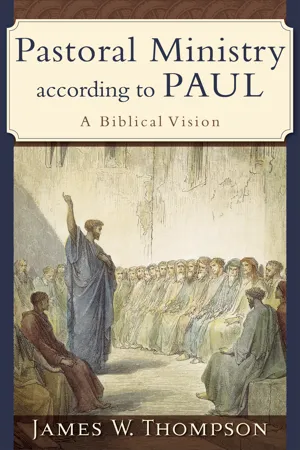
- 174 pages
- English
- ePUB (mobile friendly)
- Available on iOS & Android
eBook - ePub
About this book
Information
1
Discovering a Pauline
Pastoral Theology
Discovering a Pauline
Pastoral Theology
After years of educating future ministers, my colleagues and I finally took on the task of writing a vision statement to serve as a foundation for our curriculum and to describe the ministry for which we were preparing our students. After I took the responsibility of chairing the committee and drafting the vision statement, I realized what a difficult task I had, offering a coherent vision that would reflect the faculty’s shared understanding of the ministry. This challenge was especially remarkable in that faculty members could reach agreement on the final draft only after extended discussion even though we had been shaped in the same theological tradition and were preparing students for ministry within this tradition. We discovered that we work with many unstated and differing assumptions about the nature of the ministry.
When I talk to pulpit search committees who are prospective employers of our graduates, I discover that their vision of ministry scarcely corresponds to the vision that we hammered out as a faculty. These search committees present job descriptions with very specific expectations for ministerial candidates. Although these job descriptions do not articulate a theology of ministry, they reflect assumptions about the nature of the ministry. The assumptions derive primarily from the committees’ own past experiences and observation of what appeared to be effective ministries.
From what I have learned from colleagues in other seminaries, my experience is not unique. Everyone has unstated assumptions about the nature of the ministry that are evident in the various alternative—even competing—models. Jackson Carroll has indicated that theological traditions have differing understandings of ministry. Denominations in the Reformed tradition emphasize a learned presentation of the faith whereas Methodists place great value on interpersonal skills. Southern Baptists emphasize evangelistic skills whereas Orthodox Christians expect liturgical leadership.1 In the North American context, however, expectations have changed over a period of time, often crossing denominational lines.
My observation of developments within my own tradition correspond in large measure to the historical delineation described by John B. Cobb and Joseph Hough for developments in many denominations.2 For an earlier generation, the ideal minister was the evangelist who was measured by his success in persuading large numbers of people to become Christians. Some were traveling revivalists, and countless others worked in local congregations where they were appointed primarily for evangelistic purposes. In a second era, congregational expectations for the minister shifted from outreach to nurturing the congregation and responding to the needs of individuals. In this era, ministers learned the techniques of the therapist and placed considerable value on pastoral care and counseling. Their task was to meet the ever-increasing perceived needs of the people in the congregation. In the present era, the minister is ultimately measured by the ability to organize, build, and manage a complex organization. Congregations continue to assume that the minister will maintain the traditional roles of marrying and burying, but they believe that the ultimate goal of the minister is to take the congregation to a new level of growth. The minister must be both an effective communicator and an administrator. In a competitive religious marketplace, the task of the minister is to ensure that the congregation maintains its place among religious consumers. Often search committees no longer look for someone who conforms to one of these models. Instead they seek someone who is a combination of, for instance, Jay Leno, Lee Iacocca, and Dr. Phil.
These often unstated assumptions indicate that the missing dimension in the conversation about ministry is a theologically coherent understanding of the purpose of ministry that incorporates the numerous roles of the minister. According to Thomas Oden, “no systematic, scripturally grounded pastoral theology has been written for an English-speaking ecumenical audience since Washington Gladden’s The Christian Pastor (1898).”3 The literature on the various tasks of the minister is abundant, but we lack a comprehensive theological understanding that provides the foundation for the minister’s many tasks.
We are searching for a unifying, centered view of ministry. Regrettably, the disciplines serving the modern pastoral office have become segmented into wandering, at times, prodigal, subspecializations. Although we have produced an abundance of literature on pastoral counseling, the question remains as to what is “pastoral” (distinctively pastoral) about so-called pastoral counseling. Sermons abound, and sermonic aids superabound, but few operate out of an integrated conception of the pastoral office that melds liturgical, catechetical, counseling, and equipping ministries. Having borrowed heavily from pragmatic management procedure while forgetting much of their traditional rootage, church administration has become an orphan discipline vaguely wondering about its true parentage. The loss of a centered identity in ministry is mirrored in the excessive drive toward specialization of the disciplines intended to serve and unify ministry.4
The seminary curriculum does little to produce a coherent understanding of the telos of ministry. The division of the curriculum into separate areas of specialization, developed under the influence of the German model at the end of the nineteenth century, exacerbates the problem by separating ministry from the other theological disciplines.5 Edward Farley has described the separation of the theological disciplines under the influence of German scholarship, indicating that contemporary theological schools have inherited the nineteenth-century understanding of the place of practical theology within a theological curriculum. Farley traces the development from the time when “practical theology” designated all theological study to the time when it became a separate discipline. In the initial step toward this separation, practical theology included moral theology, church polity, and other pastoral activities. As specialization increased, practical theology was distinguished from moral theology as an area pertaining to the church’s fundamental activities.6 The focus turned to the necessary skills for the maintenance of the church and the care of troubled people. Practical theology became segmented into a variety of subdisciplines. With this focus on the skills necessary for maintaining the church, seminaries and churches offered alternative, if not competing, definitions of pastoral care. Although the seminary degree requires both theory and praxis, the two areas are insufficiently related to each other to provide a theological foundation for ministry. Without a theological foundation, the minister too easily becomes the one who ensures the church’s competitive edge in the marketplace of consumer religion.
Despite the pressures that often come from the church and society to define the minister’s role in pragmatic terms as the maintenance and growth of the institution, the answer to the question of ministerial identity, as Ellen Charry has argued, is a theological one.7 In this book I address this missing dimension in the conversation about ministry by offering a pastoral theology that rests on a conversation with recent interpreters of Pauline theology. Examining the theological foundations and goals of Paul’s pastoral work, I argue that the Pauline vision will contribute to the discussion that now occupies churches and seminaries throughout North America: What is a minister? For what roles do we prepare future ministers? What are the goals of ministry? As a New Testament scholar who often works on the boundary between biblical studies and practical ministry, I wish to initiate a conversation between the two disciplines, for Paul provides a coherent pastoral vision that can be the basis for a contemporary pastoral theology. My purpose is to move beyond the focus on the roles of the minister and the how-to literature of ministry in order to determine the ultimate aims of our work. Others have challenged us to renew this theological dimension by returning to the classical texts concerning ministry.8 Although engagement with the classical texts is a valuable exercise, I propose that we consider going beyond these ancient texts to a reconsideration of the significance of Pauline theology for defining the goals of ministry.
Paul is not the only guide for a pastoral theology, as several interpreters have shown. Eugene Peterson suggests that the Megilloth—Song of Solomon, Ruth, Lamentations, Ecclesiastes, and Lamentations—served an important pastoral purpose in ancient Israel, one that can be useful for shaping the imagination of the contemporary church.9 Gustav Stählin affirms that “the New Testament is through and through a pastoral book,” but he gives special emphasis to Matthew’s narrative as an example of pastoral care.10 Matthew shows pastoral concern for the situation of his readers; the combination of story and instruction gives joy and direction to a community in distress. Paul Walaskay finds the theological foundation for pastoral care in the healing traditions of the Old Testament and the Gospels.11 Others look to the portraits of Jesus in the Gospels to identify a basic orientation for pastoral care.12 Nevertheless, Paul’s letters have a special value in delineating an understanding of the ultimate goal of ministry. The letters allow us to overhear Paul’s pastoral guidance for his churches and to observe his pastoral theology in practice. They present a partial longitudinal study of Paul’s role as evangelist, church planter, and pastor. Because such a comprehensive understanding of the goal of ministry is unparalleled among other biblical writers, Pauline theology constitutes an indispensable guide to us as we reflect on the ultimate goal of our ministry.
To engage Pauline and pastoral studies in conversation is to face methodological issues that arise from several factors. First, we lack a single definition of ministry or pastoral care as a basis for comparison with Paul. Second, neither Paul nor his coworkers functioned in a way parallel to the modern concept of the minister; ministry in our time is vastly different from anything in Jewish and Christian history or the New Testament.13 And third, we face the hermeneutical challenge of appropriating Paul’s ministry to the contemporary situation, for one cannot simply read a pastoral theology off the pages of the Bible without merging the horizons of the Bible’s world and our own.14 These problems indicate the methodological difficulty of discovering a Pauline theology of pastoral care.
Still, I am convinced that we may find that insight into Paul provides a foundation for the contemporary church. Since it would be fruitless to begin with our own definitions of ministry and then examine the Pauline corpus to find a corollary, I suggest that we begin with a preliminary and general definition in which we see points of contact between our own understanding and that found in the Pauline Letters. One such point of contact is the recognition that Paul is the evangelist who not only initiates his converts into the faith but also has “anxiety for all of the churches” (2 Cor. 11:28). We may also observe functional similarities between our own understanding of the ministry and the activities of Paul in his concern for his converts.15 Although emphases have varied through the centuries, certain elements have proved constant, including the offer of compassion, nurture, and comfort to others, especially members of the Christian community. Paul’s work is sufficiently analogous to our own understanding of ministry for us to recognize in him a model for ministry, especially in the goals that he sets forth.
Pauline Pastoral Theology in Previous Study
I am not the first to suggest that Paul is the basis for a pastoral theology. Indeed, interpreters appeal to Paul’s letters to support the alternative views of the goals of ministry mentioned above. For some, Paul is the basis for understanding the minister primarily as an evangelist; for others, Paul is the basis for understanding the minister as therapist. And according to recent literature on church growth, Paul provides the theological basis for the minister as a church planter and builder. Paul’s statement “I planted, Apollos watered, but God gave the growth” (1 Cor. 3:6) is the foundation for a ministry focused on church growth. The mission of the church, according to this view, is to grow and extend God’s reign through the planting and developing of churches.16 Paul’s metaphor of the building in 1 Corinthians 3:10–17 provides a further image of the minister as one who builds the congregation through effective planning and organization.
Although Paul employs the language of church growth in 1 Corinthians 3:6–9, he does not use the language in a way that supports the contemporary appeal to this Pauline passage. The context of the passage indicates that Paul’s major concern is not with numerical growth but with the maturation of the church that he planted. In 1 Corinthians 3:1–5, Paul has used the imagery of infancy and maturity to describe the development of the church that he desires. The Corinthians, however, have not grown out of infancy, for they are engaged in the petty jealousy that characterized them before they became Christians. With their partisan politics—“I am of Paul, I am of Apollos”—they demonstrate that they are still in their infancy. The focus of Paul’s imagery of planting and growth is that, despite the Corinthians’ focus on individual leaders, “God gives the increase.” In the images of planting, growth, and building, Paul’s emphasis is on the maturing of the congregation. Although we may assume that Paul anticipates numerical growth, his emphasis here is on growing up to maturity. He uses the building metaphor to ensure that the community’s leaders build a community that will withstand the ultimate test.
Earlier interpreters appealed to the Protestant focus on the Pauline doctrine of justification by faith, commonly understood as the center of his theology, to develop a pastoral theology. This understanding of justification by faith has contributed two dimensions to the traditional understanding of ministry. In the first place, the traditional view of justification by faith as the salvation of the individual has been the foundation for understanding the minister as the evangelist who offers God’s grace to individuals and invites them to respond in faith. For those who understand justification by faith as a theology about “getting into” a relationship with God, ministry becomes the practice of getting people into God’s grace through evange...
Table of contents
- Cover Page
- Title Page
- Copyright Page
- Table of Contents
- 1. Discovering a Pauline Pastoral Theology
- 2. Blameless at His Coming: Paul’s Pastoral Vision in Philippians and 1 Thessalonians
- 3. L iving between the Times: Pauline Anthropology and the Problem of Transformation in Galatians
- 4. Romans as Pastoral Theology
- 5. Building the Community: Pastoral Theology as Community Formation in the Corinthian Letters
- Conclusion: Transformation and Pastoral Theology
Trusted by 375,005 students
Access to over 1.5 million titles for a fair monthly price.
Study more efficiently using our study tools.
Frequently asked questions
Yes, you can cancel anytime from the Subscription tab in your account settings on the Perlego website. Your subscription will stay active until the end of your current billing period. Learn how to cancel your subscription
No, books cannot be downloaded as external files, such as PDFs, for use outside of Perlego. However, you can download books within the Perlego app for offline reading on mobile or tablet. Learn how to download books offline
Perlego offers two plans: Essential and Complete
- Essential is ideal for learners and professionals who enjoy exploring a wide range of subjects. Access the Essential Library with 800,000+ trusted titles and best-sellers across business, personal growth, and the humanities. Includes unlimited reading time and Standard Read Aloud voice.
- Complete: Perfect for advanced learners and researchers needing full, unrestricted access. Unlock 1.5M+ books across hundreds of subjects, including academic and specialized titles. The Complete Plan also includes advanced features like Premium Read Aloud and Research Assistant.
We are an online textbook subscription service, where you can get access to an entire online library for less than the price of a single book per month. With over 1.5 million books across 990+ topics, we’ve got you covered! Learn about our mission
Look out for the read-aloud symbol on your next book to see if you can listen to it. The read-aloud tool reads text aloud for you, highlighting the text as it is being read. You can pause it, speed it up and slow it down. Learn more about Read Aloud
Yes! You can use the Perlego app on both iOS and Android devices to read anytime, anywhere — even offline. Perfect for commutes or when you’re on the go.
Please note we cannot support devices running on iOS 13 and Android 7 or earlier. Learn more about using the app
Please note we cannot support devices running on iOS 13 and Android 7 or earlier. Learn more about using the app
Yes, you can access Pastoral Ministry according to Paul by James W. Thompson in PDF and/or ePUB format, as well as other popular books in Theology & Religion & Biblical Criticism & Interpretation. We have over 1.5 million books available in our catalogue for you to explore.