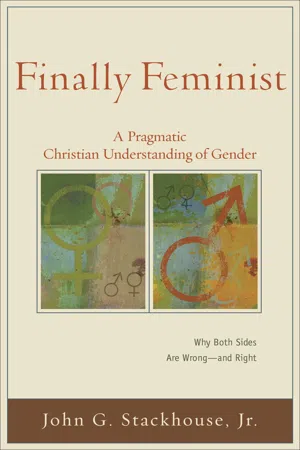
Discussions about gender continue in many Christian denominations. With good people and solid arguments on each side of the divide, there seems to be little hope for a synthesis or even constructive dialogue. In this brief book, John Stackhouse proposes a way forward. Stackhouse provides biblical, theological, and practical arguments for his own understanding of the issue: Equality is the biblical ideal, but patriarchy is allowed and regulated by a God who has larger kingdom purposes in mind. Thought provoking and distinctive in its clarity and honesty, Finally Feminist will be extremely useful for deepening the gender conversation in the church.
- 140 pages
- English
- ePUB (mobile friendly)
- Available on iOS & Android
eBook - ePub
About this book
Information
Topic
Theology & ReligionSubtopic
Christian Theology1
Toward a New Paradigm
The Problem
How can one be a Christian feminist?
For many people, “Christian feminist” is a contradiction in terms. Christians are supposed to believe in patriarchy—in male leadership in church and home, if not also in society at large. And most Christians have, in fact, so believed—regardless of age, race, class, or gender, across hundreds of cultures and two thousand years. Most Christians still believe in patriarchy, for the majority of Christians live outside the so-called developed countries in which feminism has made some important inroads. It is obvious, furthermore, that within those developed countries—and perhaps conspicuously in the largest and most influential of these, the United States of America—many Christians of almost every denominational stripe continue to believe that the Bible and Christian tradition are best understood as advocating the submission of women to the authority of men at least in home and church.
For its part, feminism, in the minds of many of these Christians, has been related to a wide range of social pathologies. Feminism has been implicated in the so-called sexual liberation of women—in terms of both liberal mores (women are free to be as promiscuous as men have been) and controversial reproductive technologies (the Pill and the ready availability of abortion). Feminism has been coupled with radical changes in the public workplace that have brought many women into jobs outside the home, including jobs previously dominated by men. This availability of female labor has been blamed for the depression of wages and the loss of benefits in many occupations that previously paid a “living wage” for a man and his family. Feminism has been held responsible for children having to go to day care or to let themselves in to their homes in the afternoon with their “latchkeys” because both parents are working outside the home—or, worse, because the parents are divorced and the single parent is still at work. Feminism has been associated with lesbianism and misanthropy—so much so that many young women refuse to identify themselves as feminists for fear they will be labeled “man haters.” And feminism has been linked to hatred of the Christian church and its Scriptures, as feminists have traced the oppression of women in our culture particularly to the patriarchy endorsed by Christian teaching throughout the ages.
So “Christian feminist” seems to many people to be the “square circle” of our time. The suggestion of linking “Christian” and “feminist” strikes many contemporaries as both intellectually preposterous and morally outrageous—from both a traditional Christian and a radical feminist point of view.
I respond to this situation from two, apparently opposed, directions. On the one hand, I am a white, middle-class, heterosexual, evangelical Christian man—and thus clearly not everyone’s idea of a feminist. Indeed, one might think that I would have a lot to lose in supporting the equal treatment of women in every sphere of life—whether one sees that loss as “legitimate authority” or “scandalous privilege.” On the other hand, I am also a career academician, someone who has earned degrees from two secular universities, has held appointments at three more, and has had books published by the presses of yet two others. Someone with that sort of mainstream scholarly background can be expected to be a feminist, of course. But one might not expect such a person to be an orthodox Bible believer.
In this book, then, I try to show how one can be both authentically feminist and authentically Christian. In particular, I try to show how the Bible, which has often been understood by both feminists and patriarchalists to be inimical to feminism, properly can be seen to support feminism in our time.[1]
The noun feminist can mean several things, but this is what I mean by it: someone who champions the dignity, rights, responsibilities, and glories of women as equal in importance to those of men and who therefore refuses discrimination against women. Thus, in this book, feminist and egalitarian are synonyms. Yes, women and men are biologically different, and so some sex-specific zones are real and therefore not arbitrary.[2] I expect that the folk wisdom is true that men and women differ also in other essential ways, although there is currently nothing approaching a cultural consensus as to what those ways are. Feminists, then, do not have to be blind to real differences and their implications. In fact, many feminists emphasize that women and men are indeed different and that a large part of the feminist concern is that those differences be acknowledged and incorporated into our life together.[3] Feminists of the sort I represent are those who resist what they judge to be arbitrary, ungrounded distinctions between men and women and the discrimination that attends such distinctions.[4]
Those on the other side of this Christian debate are called traditionalists, patriarchalists, and considerably less-flattering names. The term many of them now prefer is complementarian, reflecting their contention that women and men are fully human and reflect the image of God but are sometimes called by God to different and “complementary” roles on the basis of their sex. Furthermore, when social power is in view (as opposed to, say, the power to bear children), then men and women complement each other in that men are to wield it—beneficently, to be sure—and women are to subordinate themselves to it as, indeed, an ordinance of God.
Many have observed that the terms complementarian and egalitarian can be applied to aspects of each side’s viewpoint. Acknowledging that ambiguity, we still need labels, and none better has yet emerged. Therefore, they are used here in what is still the common sense of each.[5]
Most of this book is theological argument. But it really does represent a kind of intellectual and ethical “conversion experience.” So let me begin by opting for the more traditional mode of autobiography—indeed, a sort of “conversion narrative.”
My Problem—and the Way Forward
I was raised in a Christian home—indeed, a really Christian home: a Plymouth Brethren home, with Brethren roots reaching back for several generations on both sides. Those who know about this small, Protestant denomination know that people in its circles tend to be pretty serious about Christian faith—about Christian doctrine, Christian morality, Christian evangelism, and other good things.
It was not only a Christian home. It was a Focus on the Family–type home. Dad was the full-time breadwinner (a surgeon), and Mom was the full-time homemaker (having quit schoolteaching to bear the first of four children). Dad was an elder in our church and occasionally preached and taught Sunday school, while Mom was an exemplary “Mrs. Elder,” helping the church ladies (yes, “ladies”: to call them “women” back then would have been impolite) run a myriad of service organizations and charities. She also took her turn playing the piano for worship services.
The Plymouth Brethren have a liturgical tradition that raised the question of gender for me at an early age. Typically, the Brethren celebrate communion at an early service on Sunday mornings, before the main preaching service. The service proceeds with virtually no fixed order of service except perhaps for a formal greeting from a presiding elder and a subsequent closing, with the passing of the bread and the cup sometime toward the end of the meeting. During the meeting, anyone can rise and suggest a hymn, which the congregation then sings, or pray aloud, or even offer an exposition of Scripture. Some people prepare well in advance for their participation in the service; others jump up on the spur of an inspiration. The Brethren believe that the Holy Spirit guides the service quite directly, leading first one, then another, to participate—just as 1 Corinthians 14 indicates he will. This free-form openness to the Spirit’s leadership amounts to a kind of “charismatic” worship, yet without any tongues-speaking, prophecies, healings, or other spectacular manifestations of the Spirit that would have caused consternation, not celebration, among the Brethren, who are scrupulously opposed to anything “pentecostal.”
This kind of meeting—which I often found quite moving—raised the gender question in a fundamental respect. Anyone could lead in this service, not just clergy, for the Brethren are unusual in having no such thing as ordination and therefore no formal clergy. Young people were encouraged to participate as freely as older ones. Anyone, I say, could lead—as long as that one was male.
Thus, I sat in the family pew and observed various men participating week after week. Some did so with evident skill and passion. But others seemed to do so by rote, with little attendant blessing reported by anyone else. I began to wonder why my mother, who was otherwise so esteemed as a leader in our church, remained demurely silent week after week and year after year while Mr. So-and-So rose to bore us once again with his meanderings through Scripture and Mr. Such-and-Such followed with his interminable prayer. When young Bill or even younger Bobby was encouraged to lead in the service while their mothers and grandmothers silently looked on, my wonder deepened.
In my later teens, I began to ask the elders questions about gender. I did so also at the Brethren Bible school I attended and subsequently in the church I attended while at university. I received answers that did not satisfy.
At the same time, I began to encounter more and more Christian women who seemed easily to be the spiritual equals of the men I had seen in church leadership: the sponsor of my high school Christian fellowship, Mrs. Krucker; my aunt Jan, who during the year I boarded with my relatives while at Bible school taught me about the mysteries of women, dating, and marriage in the evenings while my uncle Nelson taught me the New Testament during the days; two other wise and spiritual aunts, Donna-Jean and Valerie, whom I visited whenever I could during my undergraduate years; and the capable InterVarsity Christian Fellowship staff workers I met. I also met women among my fellow students who were obviously at least as mature, at least as wise, at least as gifted, and at least as pious as any of us young men. Radiant among these impressive women was Kari Sleeth, who became my wife, and whose first serious conversation with me was an extended midnight discussion about gender in the church and its apologetical implications. (Yes, it is of such magical moments that true romance is born.)
This was the late 1970s, and therefore all these developments in my life were happening within a broad social transformation of gender. People my age were seeing women enter all occupations, and we were learning to use new, generic titles for them: police officers, firefighters, and flight attendants. There was new talk of a “glass ceiling” that was keeping women from the very top positions in business and the professions, but the fact that it was recognized meant that the glass would shatter soon, as it did in many places. Society at large was making way for women everywhere, if sometimes grudgingly, and increasingly it was scandalous even to grumble about such changes, let alone resist them.
By this point in my life, to echo Thomas Kuhn’s helpful terminology in The Structure of Scientific Revolutions, the anomalies in my experience were accumulating at a rate too great to be accommodated by my paradigm.[6] And my mental situation was mirrored in my matrimonial one: Kari and I got married after I had completed my first degree, and I left for graduate school with an egalitarian marriage but without a thoroughly constructed theological basis for it. Finally, one afternoon, while studying in the tiny living room of our student apartment in Chicago while Kari was at work at the hospital across the street, I underwent an explosive paradigm shift. Yes, we come at last to the promised key to the lock, the clue to the puzzle, the Answer to the Problem.
I had been struggling with gender questions again and had been reading about various sides of the issue. At the crucial moment I have described, I had been reading yet another explanation of 1 Timothy 2:11–15, easily one of the most obscure of the classic passages on this matter. I remember quite clearly now—more than twenty years later—putting the book down on my lap and realizing this insight: Nobody could explain this passage.
To be sure, I had been reading more than a dozen attempts to explain this passage. Some of them were ingenious; a few were even likely. But it struck me with paradigm-shaking force that no one could explain all the clauses in this passage with full plausibility. I then began to think that this problem was true not only of expositions of this one text but of the whole gender question. No one I had read (and I had read quite a few) could put all the relevant texts together into a single, finished puzzle with no pieces left over, with none manufactured to fill in gaps, and with none forced into place. I began to recall, with mounting excitement, how champions of one view typically ignored or explained away the leading texts of champions of other views. (This phenomenon is what lawyers call avoiding or finessing the “bad facts” of a case.)
I came to a principle of general theological method out of this wrestling with a particular issue, that of gender: We should not wait to come to a theological conclusion until the happy day in which we have perfectly arranged all the relevant texts. Instead, we should look at all the texts as open-mindedly as possible and see if among the various competing interpretations there is one that makes the most sense of the most texts and especially the most important ones. We should look, in basic epistemological terms, for the preponderance of warrants or grounds to believe p instead of q. If no such preponderance is evident, then we should suspend making a decision. But if we do conclude that a preponderance is discernible, then we should acknowledge it—indeed, be grateful for it—and proceed to act on that basis. For what else can we do in theology?
Jaroslav Pelikan, among many other historians of doctrine, has shown how the New Testament provides texts about the nature of the incarnation that can fairly be read as supporting various heresies (such as adoptionism, Arianism, modalism, and Nestorianism), while the church has concluded that the best reading of the most texts, including the most important texts, leads to the conclusions of the Chalcedonian definition of 451.[7] Predestination and free will, faith and works, so-called charismatic phenomena, the nature of the end times—who can seriously suggest that there is one and only one theological position on such controversies that provides the best interpretation of every single relevant text and packages them together in an effortlessly coherent whole? (Christians have done exactly that for centuries, of course. I just think they have been wrong to do so.)
So, I concluded, the theological task is not to be understood as “figuring it all out” so that one day a person or a church can finally say, “There, now! That’s the answer!” with precision and certainty. The task instead is to dwell on the Bible, with the help of the Holy Spirit and the church; to make the best decision one can make about what Scripture means; and then to respond to it in faith, obedience, and gratitude. Indeed, such a posture of interpretative humility entails remaining continually open to refinement of one’s interpretations and even to the acceptance of quite different positions as the Holy Spirit gives one more light. (I hope you will maintain that posture as you read, just in case the Holy Spirit offers something new to you as you do so.)
I went on to recognize that champions of various positions sometimes attacked one another’s views—and often one another—on grounds that were not theological. Feminists accused traditionalists of sexism: Traditionalists claimed to believe that women and men are equal but then relegated women to subservient positions in church and home—and society too, in the case of telling women to stay home and look after their husbands and children. Traditionalists could never explain why it was better for all women everywhere to remain in these domestic roles while all men everywhere were to be breadwinners out in the marketplace. Wasn’t this scheme simply a baptized version of modern social sector differentiation, a phenomenon that emerged only in postagrarian industrial societies? This domestic arrangement was not in fact traditional at all—except in the historically shortsighted sense of “what Mom and Dad did back in the 1950s and 1960s.” So why should such roles be acclaimed as perennially normative?[8]
Furthermore, feminists argued, there did not seem to be anything essential to being a woman that made her unfit for leadership in home, church, or society, and traditionalists rarely suggested (anymore) that there was an inherent flaw of this sort. In the bad old days, women were derided as emotional, irrational, illogical, defensive, and the like and therefore truly seemed unfit for important responsibilities.[9] (One can still, alas, make a lot of money telling people that “men are from Mars and women are from Venus.”)[10] Thus, women were instead put in charge of children (!) and given other domestic jobs that, for men in the marketplace and in church leadership, were relatively uninteresting and unimportant. And that all made a kind of sense: If women couldn’t handle leadership, then it was best that they wer...
Table of contents
- Cover
- Title Page
- Copyright Page
- Endorsements
- Dedication
- Contents
- Preface
- 1. Toward a New Paradigm
- 2. The Paradigm
- 3. Responses to Arguments
- Appendix A: How Not to Decide about Gender
- Appendix B: A Woman’s Place Is in . . . Theology?
- Subject Index
- Scripture Index
- Notes
Trusted by 375,005 students
Access to over 1.5 million titles for a fair monthly price.
Study more efficiently using our study tools.
Frequently asked questions
Yes, you can cancel anytime from the Subscription tab in your account settings on the Perlego website. Your subscription will stay active until the end of your current billing period. Learn how to cancel your subscription
No, books cannot be downloaded as external files, such as PDFs, for use outside of Perlego. However, you can download books within the Perlego app for offline reading on mobile or tablet. Learn how to download books offline
Perlego offers two plans: Essential and Complete
- Essential is ideal for learners and professionals who enjoy exploring a wide range of subjects. Access the Essential Library with 800,000+ trusted titles and best-sellers across business, personal growth, and the humanities. Includes unlimited reading time and Standard Read Aloud voice.
- Complete: Perfect for advanced learners and researchers needing full, unrestricted access. Unlock 1.5M+ books across hundreds of subjects, including academic and specialized titles. The Complete Plan also includes advanced features like Premium Read Aloud and Research Assistant.
We are an online textbook subscription service, where you can get access to an entire online library for less than the price of a single book per month. With over 1.5 million books across 990+ topics, we’ve got you covered! Learn about our mission
Look out for the read-aloud symbol on your next book to see if you can listen to it. The read-aloud tool reads text aloud for you, highlighting the text as it is being read. You can pause it, speed it up and slow it down. Learn more about Read Aloud
Yes! You can use the Perlego app on both iOS and Android devices to read anytime, anywhere — even offline. Perfect for commutes or when you’re on the go.
Please note we cannot support devices running on iOS 13 and Android 7 or earlier. Learn more about using the app
Please note we cannot support devices running on iOS 13 and Android 7 or earlier. Learn more about using the app
Yes, you can access Finally Feminist (Acadia Studies in Bible and Theology) by in PDF and/or ePUB format, as well as other popular books in Theology & Religion & Christian Theology. We have over 1.5 million books available in our catalogue for you to explore.