It's the end of the church as we know it. In a digitally connected world, people are seeking spiritual answers through pop culture. Instead of retreating, Christians must "rethink the sacred" and enter global conversations about God--in film, literature, TV, and music--or face extinction, argues Barry Taylor in Entertainment Theology.
Taking snapshots from theology, cultural studies, sociology, and pop culture, Taylor explores a myriad of factors affecting religious life since the 1970s, including technology, fashion, celebrity, and global communications. He exhorts a move away from traditional Christian religion, proposing instead a manifestation of Christianity as a religion not of the past but of the present and the future.
For scholars, seminary students, culture watchers, and emerging-church readers, Entertainment Theology offers thought-provoking hope for Christianity's future.
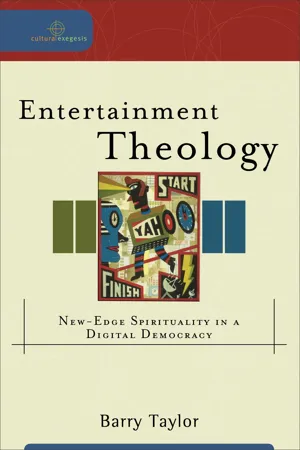
eBook - ePub
Entertainment Theology (Cultural Exegesis)
New-Edge Spirituality in a Digital Democracy
- 256 pages
- English
- ePUB (mobile friendly)
- Available on iOS & Android
eBook - ePub
Entertainment Theology (Cultural Exegesis)
New-Edge Spirituality in a Digital Democracy
About this book
Information
Topic
Theology & ReligionSubtopic
Christian TheologyPart 1
New Horizons
New Horizons
Religion, it has been said, is a social production and as such can be understood only in context. For me, the contexts for understanding religion in our culture have changed dramatically:
[If] in modernity, contexts for understanding religion included our reliance upon science and technology, the presence of industrial development and the growth of urbanism, of the nation state, and of bureaucratic organization, along with an outlook generally framed by the notion of progress, then what has changed?1
In light of this change in understandings about religion, we must discuss the philosophical, cultural, and social dynamics that combine to lay the foundation for the emergence of renewed interest in religion: the contemporary “return to god.” I believe there are three key and interwoven dynamics that need to be explored: the reenchantment of Western culture,2 the rise of postsecular society,3 and the democratization of spirit. These three are not distinct and separate but form an ever-expanding context into which ideas and reflections from many disciplines and fields of study converge to create new contexts. The three elements explored in this section give rise to certain characteristics that make up the postsecular condition. These characteristics include:
• a renewed interest in the spiritual life that reflects a relaxation of the suspicion toward spiritual issues that marked much of the modern era;
• a recognition that secular rights and freedoms of expression are a prerequisite to the renewal of spiritual interest and exploration;
• an embrace of spiritual and intellectual pluralism: “east and west”;
• the emergence of a global culture linked by media, technology, and shared experiences.
Key dynamics at work to produce the new religious permutations are:
• the collapse of modern political ideologies that compete with Western democratic capitalism;
• the implosion of modernity via postmodernity;
• the manifest failure of secularism as a totalizing theory;
• the emergence and advance of post-Newtonian chaotic-observer aware science;
• information and communication technology;
• spiritually aware art, music, film, literature, and philosophy.
To chart this rise is complex; finding figures and statistics to prove the rise of alternative faith expressions is difficult, particularly when what is occurring is as much a mood as it is a movement, and whatever kind of movement it might be it is certainly not a unified movement with particular and universal tendencies. The entire way people think about life is changing, and how we think about faith is changing just as radically. It is much easier to chart the decline of traditional faiths, which has been done quite often. To chart the emergence of new expressions of religion, we must turn to alternative sites for information and perspective.
Magical, Mystical Polish
The Reenchantment of Western Culture
The Reenchantment of Western Culture
The emergence of the postmodern has fostered postsecular thinking.
Graham Ward, Blackwell Companion to Postmodern Theology
In spite of the predictions of many over the past two hundred years, religion is back and once again at the forefront of Western imagination. The many theories and philosophies decrying our need of and the place for religion in our culture (even our world) have begun to crumble even as the very foundation on which they were built—secularism—itself implodes. According to William Connolly, “The historical modus vivendi called secularism is coming apart at the seams.”1 Here I follow Bryan Wilson’s definition of secularization: “the process whereby religious thinking, practice, and institutions lose social significance.”2 The last two centuries of Western civilization have been a reflection of this definition. Traditional belief in God has changed and church attendance has declined dramatically; the church has lost its voice in society and is often viewed as marginal and a bit of an anomaly left over from another age. Lonnie Kliever observes:
This mid-century crisis of faith was partly a side effect of certain changes in the social structures of modern life that were brought about by the scientific revolution. Most telling of all the changes was the loss of the Church’s thousand-year monopoly on defining the nature of reality, the order of society, and the destiny of individuals.3
Much has been written on the crisis of faith and no time will be taken here to explore it, since the focus of this work is the return of God and religion to the center of social space, not religion’s preceding demise. In our “mediated”4 world we are experiencing a reenchantment of considerable proportion—“God,” as they say, has made a comeback. God looks remarkably different in the new context but is back nonetheless. “Religious sentiment is itself a social product,” wrote Karl Marx.5 Marx was deeply influenced by Ludwig Feuerbach’s book The Essence of Christianity, in which Feuerbach argued that God is a “projection of humanity.”6 Believing that religion had been explained once and for all by Feuerbach, Marx essentially adopted his theory in toto without engaging in any additional reflection of his own. Marx, of course, was attempting to eradicate the religious from the world, and Feuerbach’s theories supported and fueled his efforts. “Religion is only the illusory sun which revolves around man so long as he does not revolve around himself,” Marx wrote.7 Marx’s anthropocentric view is but one of many reveling in modernity’s fascination with itself and focused on humanity.
Regardless of our views of Marx or Marxism, he and Feuerbach were not alone in their theories about religion as a product of society, and today we find that many of those theories have become widely accepted. For instance, commenting on Emile Durkheim’s belief in the social functions of religion, Alan Aldridge wrote that Durkheim believed there was indeed a reality behind religion. That reality, however, is not God but society. The religion he spoke of was regarded as fulfilling important social and psychological functions.8 He also believed that if a society did not have a religion, it would not have a proper consciousness of itself. The heart of religion, according to Durkheim, is that through it society is presented to itself as religion expresses, dramatizes, and symbolizes social relationships.9 This is but one of many views floating around in the universe today, and all of them contribute in some way to contemporary views about God and religion.
I am inclined to agree with this theory, because I believe that religion is a social production. Having traveled quite extensively to many different cultures, I find it easy to see that different cultural contexts contribute to the ways particular societies manifest their beliefs. What I find really interesting today is that given our movement toward a more global context for the human experience and the fact that few of us live in sociocultural isolation anymore, the production of religion is now not simply a matter of particular cultural expression but is a sort of global mélange or bricolage of ideas that create new and diverse manifestations of the religious impulse that I think beats within the heart of all humans.
The idea that religion is a social production raises the question of what kind of religion is being produced today and why. How is Western society and, alongside this, an emerging global society representing itself through religion today? What is being dramatized and symbolized through the contemporary religious experience? The social production of religion in the postmodern era is complex, contradictory, and often confusing. Richard Cimino and Don Lattin note the growing gap between personal spirituality and religious institutions in their book Shopping for Faith.10 Addressing what they see as a divorce between spirituality and traditional religion, they quote a monk, Brother David Steindl-Rast: “There is something happening in our time. . . . The emphasis is moving from the institution to the personal experience . . . the institution has become so rigid and ossified it is collapsing under its own weight.”11 In spite of the authors’ best efforts, however, they fail to make a serious distinction between institution and personal experience. They simply highlight the shift in cultural preference for one over the other and the perception that it means something entirely different. But as I argued in my introduction at the risk of added confusion, spirituality is the religion of postsecular times. Spirituality, as expressed today, often refers to a belief in faith but a rejection of formalized or institutionalized forms of religious expression. It tends to be a reflection of a highly individuated form of faith.12 This interest in refashioned faith, devoid of dogma and hierarchical structure, points to a shift toward the reenchantment of society. It is a new form of religious construction.
Max Weber wrote of the “disenchantment of the world” (die Entzauberung der Welt), believing that magic and mystery had been driven from the world by the dominance of bureaucracy. Modernity according to Weber can be characterized by rationalization—the rule of experts, the bureaucrats: “Specialists without spirit, sensualists without heart, this nullity imagines that it has attained a level of civilization never before achieved.”13 He argued that rationalization meant the spread of legal-rational systems of domination embodied in bureaucratic systems of administration in which authority is impersonal, top down, and vested in rules rather than the traditional or charismatic forms of authority that were in operation in premodern times. In such a system, rules are followed not because of charismatic leadership or personal authority on the part of the issuer but simply because they have been issued by the appropriate officeholder. Devotion to leadership is replaced with meticulous implementation of regulations in conformity to a chain of command. He went on to declare bureaucracy as the reason for the decline of religious significance in modernity and described it as an “iron cage” in which we are imprisoned.14
This dominance of bureaucracy is, for Weber, at the root of the decline of the social significance of religion in the modern world. Weber also declared that modernity’s forest was managed, not enchanted.15 The iron cage of bureaucracy that Weber called one of the defining characteristics of modernity has burst open in the postmodern world, and rationalization and bureaucracy have been largely rejected as a viable means of managing the world. In fact, the postmodernist is not looking to manage his or her world as much as to discover the mystery and magic in it— hello enchantment! What is interesting is that the very technology and rationalism—scientific rationalism, in fact—that Weber identified as the means by which the world was disenchanted has proven to be the tool by which reenchantment has occurred.
In an essay titled “Faith and Knowledge,” Jacques Derrida had this to say about the reenchantment of the world: “Because one increasingly uses artifacts and prostheses of which one is totally ignorant, in a growing disproportion between knowledge and know-how, the space of such technical experience tends to become more animistic, magical, mystical.”16 The reenchantment of the world is linked to our use of technology. The access to the fruits of modernity, the age of scientific rationalism, is what allows us ultimately to reenchant our lives. Technology, both the written word that perhaps marks the dawning of the modern age and the computer technologies that herald its morphing into a new stage, provides the means by which a bureaucratized culture finds its way back to the mystical. As Ward observes:
Rather than scientific reasoning and instrumental thinking leading to reductive, positivist and behaviorist accounts of the way things are, such reasoning and thinking has promoted itself through emphasizing its inventive power, its creativity, its imaginative scope. Allied with the glitter of the media and advanced telecommunications, technology has become sexy, seductive and the bearer of messianic possibilities.17
Ward goes on to say that science no longer exists simply to provide the means for mastery of the planet or for our personal benefit. Instead it provides the milieu in which we live.18 We are immersed in technology and we use that technology to investigate and create new possibilities for our lives, leading to a form of techno-transcendence.
My fascination with and interest in the return of the mystical and magical have certainly been fueled by the sheer volume of material that has permeated popular culture since the dawn of the last decade of the twentieth century. Popular culture is another avenue by which reenchantment occurs in postsecular times. Millions of copies of the Harry Potter books have re-acquainted schoolchildren not only with the joy and thrill of reading but also with ideas about magic and mystery and the paranormal.19
And not only children. So successful and intergenerational are the stories that new editions have been released with covers and text styles marketed directly to adults.20 But it is not only Harry Potter books. Blockbuster Hollywood versions of the books were translated into films and found immense, worldwide box-office success. At the same time the runaway success of the film versions of J. R. R. Tolkien’s trilogy, The Lord of the Rings, has met with similar, if not even greater, box-office success.
This reenchantment of popular culture is not limited to occasional movies or children’s novels. For instance, the music video for the song “There There” by the United Kingdom band Radiohead was directed by Chris Hopewell and is based on a series of children’s stories called Bagpuss by Oliver Postgate. The story takes place in an enchanted forest inhabited by woodland creatures who act like humans; in other words, they have been “civilized”—they live in homes and dress like humans, read newspapers and gather in organized meetings, and are “married” by puritan-like crows. The lead singer, Thom Yorke, is led through the forest to a luminous white coat and magical shoes, which, after he has put them on, completely change the dynamics in the forest! The forest reclaims all the civilization, turning everything, including the singer himself, back into forest. Here is a visual example of the reclamation of magic and mystery and a rejection of the bureaucratized, managed forest/world.21
The emergence of spiritually aware art of all kinds and in a broad variety of incarnations—music, film, painting, and literature—mediated to us via popular culture is a key informational source for understanding the present context. Consider, for example, that in the past few years over 150 million books related to spirituality have been sold. Released in 1993, James Redfield’s Celestine Prophecy,22 which has sold twelve million copies to date, was one of the first books on spirituality to penetrate deep into supposedly secular contemporary culture. Since that time the various works of Deepak Chopra have sold over twenty million copies; empowerment writer and speaker Wayne Dyer’s count is twenty titles with thirty million copies sold. The Alchemist,23 Paolo Coehlo’s book of spiritual musings, has sold around twenty-seven million copies and counting. Alongside these books are others, such as Rick Warren’s Purpose-Driven Life,24 which has sold fifty million copies so far, and the untold number of the Left Behind25 series by Jerry Jenkins and Tim LaHaye.26 The bulk of these books inform and help shape contemporary cultural expressions of faith. Actor Matthew Settle, who is playing John Woodson, the main character in The Celestine Prophecy,of Western culture, a return in a film version of the book, had this to say in a recent magazine article about the significance of his character for the contemporary religious quest:
What I liked about the story is the restoration of wonder to this person’s life. John is kind of walking through life with a blasé, meaningless existence, just doesn’t feel like he has a sense of purpose. And when he starts recognizing coincidences and trusting his uncertainty, he finds a new certainty in trusting a lack of certainty, you know? He finds confidence in life, confidence in a God-force, and gives himself over to this thing that would otherwise be scary territory. It’s a walk in faith.27
This “restoration of wonder” is yet another example of the reenchantment of Western culture, a return of magic and mystery to life. Again, this sense of wonder has been aided by advanced media technologies, which are able to produce incredible visual experiences that stretch our horizons of wha...
Table of contents
- Cover Page
- Title Page
- Copyright Page
- Table of Contents
- Acknowledgments
- Introduction
- Part 1: New Horizons
- Part 2: New Edges
- Part 3: New Orthodoxies
- A Final Thought
- Notes
- Bibliography
Trusted by 375,005 students
Access to over 1.5 million titles for a fair monthly price.
Study more efficiently using our study tools.
Frequently asked questions
Yes, you can cancel anytime from the Subscription tab in your account settings on the Perlego website. Your subscription will stay active until the end of your current billing period. Learn how to cancel your subscription
No, books cannot be downloaded as external files, such as PDFs, for use outside of Perlego. However, you can download books within the Perlego app for offline reading on mobile or tablet. Learn how to download books offline
Perlego offers two plans: Essential and Complete
- Essential is ideal for learners and professionals who enjoy exploring a wide range of subjects. Access the Essential Library with 800,000+ trusted titles and best-sellers across business, personal growth, and the humanities. Includes unlimited reading time and Standard Read Aloud voice.
- Complete: Perfect for advanced learners and researchers needing full, unrestricted access. Unlock 1.5M+ books across hundreds of subjects, including academic and specialized titles. The Complete Plan also includes advanced features like Premium Read Aloud and Research Assistant.
We are an online textbook subscription service, where you can get access to an entire online library for less than the price of a single book per month. With over 1.5 million books across 990+ topics, we’ve got you covered! Learn about our mission
Look out for the read-aloud symbol on your next book to see if you can listen to it. The read-aloud tool reads text aloud for you, highlighting the text as it is being read. You can pause it, speed it up and slow it down. Learn more about Read Aloud
Yes! You can use the Perlego app on both iOS and Android devices to read anytime, anywhere — even offline. Perfect for commutes or when you’re on the go.
Please note we cannot support devices running on iOS 13 and Android 7 or earlier. Learn more about using the app
Please note we cannot support devices running on iOS 13 and Android 7 or earlier. Learn more about using the app
Yes, you can access Entertainment Theology (Cultural Exegesis) by Barry Taylor, Johnston, Robert K., Dyrness, William, Robert K. Johnston,William Dyrness in PDF and/or ePUB format, as well as other popular books in Theology & Religion & Christian Theology. We have over 1.5 million books available in our catalogue for you to explore.