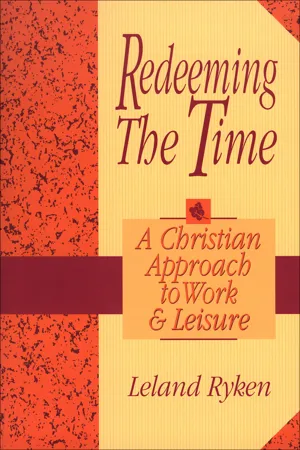
Very few works attempt to analyze and apply the biblical principles that relate to work and leisure. Leland Ryken hopes to change that, reframing labor and leisure around God's purposes for a holistic lifestyle.
Ryken finds the answers in Scripture and in the rich heritage of theological thinking, while weaving together insights drawn from a wide array of sources. The result is one of the most informed and practical studies on our day-to-day activities.
- 302 pages
- English
- ePUB (mobile friendly)
- Available on iOS & Android
eBook - ePub
About this book
Information
Subtopic
Religion
1
“There Is No Fine Thing But Needs Much Laboring”
The Many Faces of Work

Before we analyze the problems of work and leisure, and before we explore Christian solutions, we need to understand the nature of work and leisure. Sociological studies of both work and leisure have poured from the presses during the past two decades. They tell us much that we need to know.
The Nature of Work
We need to begin by distinguishing between job and work. Work for which we are paid or by which we earn our livelihood goes by the common name of job or labor. But this is only part of the work that we do. Discussions that limit work to one’s job end up being much less helpful than they seem. We need, of course, to develop a Christian perspective on labor, but to stop there is to leave some of the most problematic areas of our daily lives untouched. We also need to make sense of vacuuming the house, taking out the garbage, and driving children to music lessons. The problem of work is often most acute in these areas because getting paid for labor at once lends a kind of sanction to it that is lacking in other work.
Work, then, includes the job or labor for which we are paid, but it extends well beyond that. It includes all that we are obliged to do to meet our physical and social needs. With this basic definition in place, we can look at some complementary ways by which we can understand the nature or meaning of work. In doing so, we will be exploring the answers that people give when they are asked, “Why do you work?”
Work as a Means of Providing for Life’s Needs and Wants
At the most elemental level, work is a means of providing for the needs and desires of life. As such, it is basically utilitarian. Whatever else work may add to life, it supplies the money or materials by which we acquire goods and services, and it makes life around the house possible. To live our lives, we need to cook meals and take the car to the gas station and mow the lawn.
Of course this acquisitive view of work that links it to consumption extends to more than satisfying the necessities of life. It also becomes the means toward supplying the products and activities that make up a total lifestyle. It is apparent, then, how drastically work becomes affected by the consumer society in which we live, given further impetus by the expectation of upward social mobility.
Such a view of work is on a collision course with certain basic Christian values, as we will see later in this book. If not balanced by other attitudes, the view of work as a source of income robs work of intrinsic value and of other ends besides personal advancement and consumption, and it quickly produces the workaholic syndrome. Still, there is no reason to disparage the role of work in supplying what we need and want for living. To be deprived of such work is the most damaging work problem of all.
Work as Toil: The Curse of Work
Regarding work as a necessity because it supplies the basic needs and wants of life does not have to turn it into a curse, but in fact it often does so because it accentuates the obligatory nature of work. We tend to find burdensome anything to which we are driven by necessity. This link is suggested by the biblical account of how work became toil as a result of the curse pronounced after the fall (Genesis 3:17, 19):
cursed is the ground because of you;
in toil you shall eat of it all the days of your life. . . .
in toil you shall eat of it all the days of your life. . . .
In the sweat of your face
you shall eat bread.
you shall eat bread.
Here the curse of work is put into a context of earning our daily sustenance, and by extension it applies to all work that we are required to do in order to obtain something we want.
The element of curse in work is intrinsic to life in a fallen world. The sociological data that I will explore in chapter 4, as well as people’s mutterings about work, all point in this direction, even when people do not acknowledge the theological context of the Fall. Modern poet William Butler Yeats summed it up in his poem entitled “Adam’s Curse” when he wrote, “It’s certain there is no fine thing / Since Adam’s fall but needs much laboring.” By “much laboring,” Yeats meant toilsome work.
The curse of work cannot be ignored, though we can partly redeem work from its curse. Any naive glorification of work is refuted by a long, hard look around us, as well as by some introspection into our own feelings toward what we do in a typical day. Nor does the Christian faith take a naively optimistic attitude toward work. Taking out the garbage and cleaning the bathroom are nothing less than unpleasant in themselves.
Work as a Means of Production
Work must also be viewed from an economic perspective. Viewed thus, it is a means of production, to be measured in terms of its value to the employer or the laborer. Given this economic context, labor becomes something that an employer “buys” and that a worker “sells.” Both work and worker become something that are “worth” this or that amount. Labor becomes another commodity on the market.
Of course this dimension of work carries inherent opportunities for perverted attitudes toward work. Work can become as impersonal as the machinery in a factory. It is sold and bought at the market rate, with the result that some workers naturally view their work as less valuable than that of others. Instead of being viewed as a calling with inherent worth, work often becomes mercenary, a means to financial ends. The laborer’s worth and identity become linked to the size of his or her paycheck. And the question, “What good does this work accomplish?” is replaced by, “How much does it pay?” Here is one of the problems about work that the Christian faith must address.
Work as Human Achievement
Thus far I have viewed work in terms of its extrinsic motivations and rewards. But a more idealized view is also possible, quite apart from religious considerations. Some types of work carry their own reward because we regard them in terms of personal accomplishment. The sense of achievement can include either the product resulting from the work or the activity of doing the work itself. The attitude of accomplishment, moreover, often extends to work that in itself is unpleasant or even drudgery. Completing such tasks is perceived as an accomplishment in itself.
There is something primordial about work. It answers a deep-seated human urge to be useful, to master something, to do something skillfully, to produce something tangible. Robert Cohen put it this way:
Labor is the very touchstone for man’s self-realization, the medium of creating the world of his desire. . . . Man labors . . . to transform his world, to put his own mark on it, to make it his, and to make himself at home in it.[1]
Of course this view of work as achievement can lead to either a humanistic view of human greatness or a Christian view of stewardship in which ability and opportunity are accepted humbly as a gift from God.
Work as Psychological Satisfaction
Work can also be studied in psychological terms. Freud theorized that love and work are the two central activities by which people give meaning to life.[2] The importance that Freud attached to work seems plausible when we consider the wide range of psychological needs that work satisfies.
One need is self-esteem, or a sense of personal worth. This is most easily seen in the collapse of self-worth that afflicts the unemployed.[3] It also explains why a study that addressed the question, “Do the poor want to work?” found that poor people “identify their self-esteem with work as strongly as do the nonpoor.”[4] The sense of uselessness that accompanies the inability to work only confirms this need. During the summer that I broke both of my arms and was unable even to feed myself or shave I came to feel how debilitating to one’s well-being it is to be unable to work. I eventually longed to be able to do even such despised work as taking out the garbage and cutting back the trumpet vines (which had occasioned my accident with the ladder).
Work is also a major determinant in a person’s identity. “What do you do for a living?” is a typical question we ask someone we have just met. “Do you have a job outside the home?” we ask women with children. The answers to these questions quickly establish people’s identity and status, both in their own eyes and those of others.
Work also serves a social function in our lives. Except for tasks done in solitude, work brings us into contact with other people. These social contacts carry either reward or frustration, but in either case they determine a great deal of what we think and feel in a given day. Retired people, moreover, often complain of the loss of social satisfaction that accompanied their work situations.
Yet another psychological need that work satisfies is the need for activity, which some psychologists regard as a basic human need. Work, whether it consists of one’s job or tasks around the house, keeps us occupied. It also lends structure to the day. During the summer of my enforced inactivity, I found myself unable to watch the morning news as I ate breakfast, even though this had been my usual practice, because I sensed that the world of weather forecasts belonged only to the world of active people, and I was not a part of it.
Work as Service
Thus far we have viewed work in terms of self-interest, or what we get out of it. There is, however, a final ingredient in work that pushes it in the direction of altruism. Work is a service to others.
Here the focus shifts outward to the effect one’s work has on other individuals and on society as a whole. This, too, is one of the rewards of work: it benefits others as well as oneself. We acknowledge this aspect whenever we pay tribute to a person for what he or she has done for humanity. Of course this ideal is more easily discerned in service-oriented jobs or volunteer work that serves the public. Correspondingly, one of the problems with assembly line or warehouse work, where one does not see the results of one’s labor, is that the sense of service tends to evaporate.
Summary
Understanding work requires that we think about it in at least six dimensions. Work provides for life’s needs and wants and is a means of economic production. It carries with it a constant possibility of being a curse or drudgery, but it has the potential to supply a sense of human achievement, psychological satisfaction, and service to humanity. These are points at which work intersects with the Christian faith, as we will see in Part 5.
The Ethics of Work
Another general framework within which work must be understood is its ethical dimensions. Here too I will eventually relate the principles to a specifically Christian framework, but for the moment I am interested in the more general ethical terms that apply to work.
The Idea of a “Work Ethic”
The very phrase work ethic suggests one such ethical category. It is no doubt true that there are many specific work ethics, but when we use the term in the singular we acknowledge a moral viewpoint that values work and regards it as something good.
A work ethic implies several related things. It assumes that the active life and not simply the contemplative life is worthy. It implies that industriousness and a degree of self-reliance are private and public virtues. In addition, a work ethic usually implies a social concern for the health of society, and this is often tinged with a feeling of patriotism.
There is no standard term for the ethical viewpoint that opposes the work ethic, but there clearly are individuals and societies that lack a work ethic. They are characterized by a high degree of idleness, low economic achievement, lack of pride in their work, low regard for the quality of work, tolerance of laziness, and a parasitic reliance on others to sustain their life.
Utilitarianism and Service
Another ethical outlook that fosters work is util...
Table of contents
- Cover
- Other Books by Leland Ryken
- Title Page
- Copyright Page
- Dedication
- Contents
- Preface
- Introduction
- Part 1: Understanding Work and Leisure
- Part 2: The Trouble with Work and Leisure Is . . .
- Part 3: Lessons from History: How We Got Where We Are
- Part 4: Inadequate Solutions
- Part 5: Recovering the Lost Keys: What the Bible Says about Work and Leisure
- Conclusion: The Divine Harmony: Work, Leisure, and Christian Living: Scripture Index
- Notes
- Scripture Index
- Subject Index
Trusted by 375,005 students
Access to over 1.5 million titles for a fair monthly price.
Study more efficiently using our study tools.
Frequently asked questions
Yes, you can cancel anytime from the Subscription tab in your account settings on the Perlego website. Your subscription will stay active until the end of your current billing period. Learn how to cancel your subscription
No, books cannot be downloaded as external files, such as PDFs, for use outside of Perlego. However, you can download books within the Perlego app for offline reading on mobile or tablet. Learn how to download books offline
Perlego offers two plans: Essential and Complete
- Essential is ideal for learners and professionals who enjoy exploring a wide range of subjects. Access the Essential Library with 800,000+ trusted titles and best-sellers across business, personal growth, and the humanities. Includes unlimited reading time and Standard Read Aloud voice.
- Complete: Perfect for advanced learners and researchers needing full, unrestricted access. Unlock 1.5M+ books across hundreds of subjects, including academic and specialized titles. The Complete Plan also includes advanced features like Premium Read Aloud and Research Assistant.
We are an online textbook subscription service, where you can get access to an entire online library for less than the price of a single book per month. With over 1.5 million books across 990+ topics, we’ve got you covered! Learn about our mission
Look out for the read-aloud symbol on your next book to see if you can listen to it. The read-aloud tool reads text aloud for you, highlighting the text as it is being read. You can pause it, speed it up and slow it down. Learn more about Read Aloud
Yes! You can use the Perlego app on both iOS and Android devices to read anytime, anywhere — even offline. Perfect for commutes or when you’re on the go.
Please note we cannot support devices running on iOS 13 and Android 7 or earlier. Learn more about using the app
Please note we cannot support devices running on iOS 13 and Android 7 or earlier. Learn more about using the app
Yes, you can access Redeeming the Time by Leland Ryken in PDF and/or ePUB format, as well as other popular books in Théologie et religion & Religion. We have over 1.5 million books available in our catalogue for you to explore.