eBook - ePub
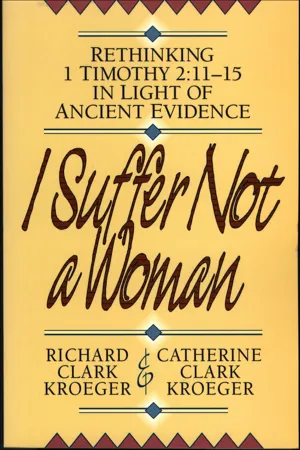
I Suffer Not a Woman
Rethinking I Timothy 2:11-15 in Light of Ancient Evidence
- 250 pages
- English
- ePUB (mobile friendly)
- Available on iOS & Android
eBook - ePub
I Suffer Not a Woman
Rethinking I Timothy 2:11-15 in Light of Ancient Evidence
About this book
Solid scriptural and archaeological evidence refutes the traditional interpretation used to bar women from leadership.
Information
Topic
Theology & ReligionSubtopic
Biblical Studies
1
Approaching the Bible with Faith
All of us need to be equipped to come to the Bible with our perplexities, especially when we do not know where to turn for human help. Blessedly, certain guiding principles can give us direction when we are bewildered as to God’s will and purpose for our life. Any time that we are dealing with controversial issues, it is important to keep these principles before us.
The Bible’s Basic Message
When we approach the study of Scripture, we need first to think of the scope of its message. The Bible is not a book of oppression—for women or anyone else. It has repeatedly proven to be an instrument of liberation for God’s people. It records the deliverance of the children of Israel from slavery, it relates how Israel was delivered again and again from the hand of her oppressors, and it insists upon humane treatment for disadvantaged persons. It goes on to tell of our deliverance from the manifold bondage of sin. It offers hope for the poor, comfort for the afflicted, identity for the disenfranchised, and justice for the dispossessed. A stated purpose is to set the prisoner free.
The most powerful exaltation of the Word of God, Psalm 119, contains within it a corollary message of liberation. The psalmist describes again and again the oppression which he endures and states his confidence that he will find deliverance by means of the Scriptures. Those who dwell upon God’s Word are encouraged to find liberation within it:
Plead thou my cause and set me free, quicken me according to thy word (v. 154).
Behold mine affliction, and deliver me, for I do not forget thy law (v. 153).
I have done justice and righteousness; thou wilt not leave me to mine oppressors (v. 121).
Be surety for thy servant for good; let not the proud oppress me (v. 122).
Set me free from the oppression of man, and I will observe thy precepts (v. 134).
Though the psalm is a long one, the reader will be rewarded by studying it, especially verses 22, 44–46, 49–51, 86, 92–95, 117. The psalmist declares that the commandments of God vindicate themselves (v. 151), that they are righteous and faithful (v. 138), and that they bring deliverance to the oppressed (vv. 39–42). Is not our God a God of justice and love, and did not Jesus say that he came to preach liberty to those who were oppressed?
The twofold message of liberation and commitment to Scripture speaks directly to the dilemma that faces us in 1 Timothy 2:12. We are caught between the apparent contradictions with regard to women and our belief that all of the Bible is truly God’s message to us. Often it seems that we must abandon either our view of the Bible as our only infallible rule of faith and practice, or else we must deny the full equality of all persons before God.
The Rule of Faith and Practice
Long ago, when we were students, Inter Varsity Christian Fellowship had introduced a one-month lay training institute to prepare Christian college students to deal with the attacks upon the Christian faith which were our daily lot in the secular classroom. Our instructor was Cornelius Van Til of Westminster Theological Seminary. He taught us that the Bible, if it is truly the Word of God, will hold up to intense scrutiny; that we can dissect it, shake it in a test tube, grind it fine, and analyze it carefully. If we find apparent contradictions, this is an invitation, not to discard the Bible, but to study further.
We need to come to the Bible with just such a faith when we deal with the hard issues—not only those of doctrine but also those of Christian behavior. If we can develop a hermeneutic of faith which will apply to the better understanding of gender roles in the economy of God, the same methodology may well serve us in circumstances which the church of Jesus Christ cannot now fully envision. The twenty-first century will surely bring theological debates of a nature different from any we have known, but the same Lord can guide us into all truth through the Word of God which shall not pass away.
In our own day, one of these legitimate questions concerns the biblical role and status of women. Some point to Genesis 3:16, 20 and to the restrictive statements of the apostle Paul and lay out a carefully circumscribed area of women’s activities in church, home, and society. Others lay hold of Galatians 3:28 and claim the traditions of Deborah, Miriam, and Hulda, and of the women who at Christ’s command first went to herald to the men their resurrected Lord. The issue is far from resolved and calls for commitments of which we would like to speak.
We are not dealing simply with a collection of ancient texts. This is the Word of God, given as light for our minds, cleansing for our souls, and nourishment for our spirits. We believe that in the Bible God has truly spoken to us. If that Word appears oppressive, contradictory, and unjust, then there are questions which need to be asked, alternatives which need to be pursued; but it is still the Word of God, still to be heeded as the words of life.
Here is where faith comes in. We believe that the Bible may contain paradoxes, perplexities, and problems but not outright contradictions. If God gave us a message, it is one which may be believed and acted upon, one upon which we may stake our very lives. And so we must travel with the faith that there is a resolution for this issue, even if that resolution is not immediately apparent.
David said, “Righteous art thou, O Lord, and right are thy judgments. Thou hast appointed thy testimonies in righteouness and in all faithfulness” (Ps. 119:137–38). We cannot abandon our belief that the Bible is indeed a message and not just a muddle. We do not denigrate Paul or his theology; rather, we must say that Paul deserves to be further studied.
Steps of Faith
What, then, are we to do? First, let us resort to the weapon of prayer, spread out our perplexities before God, and ask for the wisdom which is promised to any who will ask. We believe that the Holy Spirit is the one who gave us the Scriptures and that the Holy Spirit is our foremost teacher in understanding them.
A hermeneutic of faith also asks for commitment. We must be willing to be changed by what we read. In the conclusion to this book, we shall argue that 1 Timothy 2:9–15 has a positive, life-changing message of empowerment for women. Let us approach the Word of God with silence and submission (1 Tim. 2:11). The phrase silence and submission, a formula used in the ancient Near East, indicates readiness to hear the will of God and to obey it. God asks of us receptivity to heed and to obey.
This does not mean that we will be able to approach the Bible completely without preconceived notions. All of us bring our prejudices with us. It is important, though, to be honest about this. It is much better to admit to ourselves and others that we have certain viewpoints and to understand what presuppositions we have held as we read. We need to ask, have we read our own convictions into the text? Have we been fair to other viewpoints? Then we must be ready to alter our perspectives in accordance with light from the Word.
Loving God with Our Minds
The Bible tells us that God is love, and that the outcome of that love was a divine gift. When we read the Scriptures, it is because we love the Author and long for a deeper understanding of God. We are told to love God with all of our hearts, and in turn we may trust that marvelous and everlasting Love, even when we are confronted with a seemingly harsh passage.
The Bible further commands us to love God with all our minds. We must at this point get out our scholarly tools and apply them diligently. We need to obey the command to compare Scripture with Scripture. No less a thoroughgoing fundamentalist than the late L. E. Maxwell, president of Prairie Bible Institute, declared that more than a hundred passages in the Bible affirm women in roles of leadership, and fewer than half a dozen appear to be in opposition. We need to go through all of the relevant passages carefully. Could we be mistaken about Deborah, the prophet, judge, and general? Do we understand what it was that Jesus directed the women to do on Easter morning? Why does Micah say, “Have I not sent Moses and Aaron and Miriam before thee to lead thee?” (Mic. 6:4). Against these must be balanced the difficult Pauline passages, as well as all their exegetical problems, in 1 Corinthians 11:3–14; 14:34–35; and 1 Timothy 2:11–15.
It would be quite easy to give up, rather smug in our belief that the larger set of positive passages is quite direct, whereas the passages apparently representing a negative point of view are plagued with problems.[1] But they are still the Word of God, still God’s message to us. We cannot deny the difficulties or ignore them. We believe that there is a resolution to the difficulties if we search for it with faith and diligent study. Jesus said, “Seek, and ye shall find.” Part of our faith is that, like wrestling Jacob, we do not let go until we have reached a satisfactory conclusion.
Inspiration and Interpretation
We need to make a careful distinction between inspiration, the action by which God gave the Word to humanity, and interpretation, the human process by which we perceive its meaning. The divine message came through some ordinary people—farmers, fishermen, shepherds—but through them and their very human experiences, God spoke. Many types of literary endeavors were involved. Poets, dreamers, and prosaic chroniclers made their contribution, and editors played their part, all under the guidance of the Holy Spirit. That is God’s side.
Then there is our side. We might think of our response to a work of art. It has been created by an artist, but we must respond with our own imagination, knowledge, and creativity to what we see before us. We might imagine something wholly fanciful, especially if we are looking at surrealistic art, but sometimes the artist supplies objective reality by labeling the work “Geraniums in the kitchen window” or “Portrait of the artist by himself.” Then our interpretive response should include this knowledge. We may be helped further by an acquaintance with the artist’s concerns and particular interests, teachers, family, nationality, period in history, sources of inspiration and influence, colleagues, and so forth.
If we read a book or hear a piece of music, we must expend our own energy to draw significance from it. The more effort we invest in the process, the better we shall understand the work and the intent of the author or composer. This is interpretation. It is not a purely subjective exercise, though it includes a personal element. Just so the Bible requires interpretation, and the process is a challenging one.
Some methods of interpretation appear more legitimate than others. One gigantic man tired of Cathie’s efforts to deal with the original language and context of 1 Timothy 2:12. He pulled himself up to the full extent of his enormous height and said, “I think God has given an indication of who should have the power by giving one sex bigger muscles.” This is not one of the preferred methods of interpretation, and we shall suggest other routes to understanding the text.
Interpretation
Essentially, this is a book about the interpretation of 1 Timothy 2:9–15. Most people are quick to tell you that the passage is a difficult one and requires careful interpretation. This is surely true, and not everyone will have the same perspective. The same might be said of many another passage of Scripture. We all know earnest, Bible-believing folk who may interpret a given passage differently from others and organize whole churches around their own interpretation.
Some Christians maintain that the correct interpretation of 1 Timothy 2:9–15 is the traditional one. They feel that no interpretation is necessary. Yet all of us interpret every passage of the Bible in one way or another. For instance, few of us understand Psalm 23 to mean that God is literally leading us through the Palestinian wilderness or causing us to feed upon vegetation suitable for sheep. Ordinarily we interpret this psalm as a beautiful allegory of God’s loving provision for us. If we were to construe this portion of Scripture literally, we should gain a most bizarre comprehension of God’s relationship with his people. Instead we look carefully at all the material we can assemble about sheep-herding in the ancient Near East. The practices were quite different from modern American sheep-raising with its watering troughs, barbed-wire fences, and herding with a pick-up truck. David had spent his own youth caring for sheep; about three thousand years ago, he composed a song based upon personal experience. As any Bible teacher knows, research into the ways of a Hebrew shepherd will give us a grasp of what David was describing. With this picture in our minds, we can then make a spiritual application to our own lives. God does not literally lead us as sheep, but the Lord’s care is as tender and complete as was that of the ancient shepherd. Like sheep, we must follow the guidance of our heavenly Shepherd. The psalm is an extended metaphor, and we can comprehend it only if we accept it as such and understand something of its context.
In the same manner, the story of Jesus’ arrest, trial, and crucifixion would make little sense to us if we did not understand something about Roman and Jewish systems of government and justice. We must comprehend the role of the temple and the Roman soldiers, what the Sanhedrin was, why three trials were involved before Jesus could be executed, the official status of Pontius Pilate, the nature of Herod’s relationship to the Roman government, how crucifixion was carried out, and the accepted mode of Jewish burial. When we tell the story of Christ’s death, we are careful to include these explanations so that people can understand the narrative as it appears in the Gospels. A knowledge of the context is necessary to clarify the biblical account. Otherwise the story might be open to serious misunderstanding.
Such a consideration of context is essential in approaching the Pauline passages on women. We need first to see Paul as one trained at the feet of Gamaliel in rabbinic tradition. As such, he was fully aware of the consequences of a Jewish woman removing her veil in a public gathering. But Paul was also a Roman citizen who was at home in the Greco-Roman world. He alone of the apostles appears to have been comfortable in dealing with non-Judaized Gentiles.
If we would understand the rationale of this missionary to the Gentiles, we must understand the worship practices of pagan women, for they differed extensively from those of men. We must also recognize that Paul had been born at Tarsus and retained a deep commitment to proclaiming the gospel in his native Asia Minor. His missionary travels repeatedly took him deep into the heart of Anatolia, to an intimate knowledge of those forms of religion which were practiced there, especially by women. We must look closely at the religious currents which swirled around Ephesus on the west coast of Asia Minor, to which 1 Timothy 2:9–15 is addressed.
Principles of Exegesis
Historical and cultural context is important, but there are many other considerations as well. As we begin, we need to examine the textual tradition. Is it reliable? For instance, 1 Corinthians 14:34–35 occurs at two separate points in some of the early texts. This raises a question as to whether it might not originally have been a gloss which slipped into the text. The mandate occurs in all versions of 1 Corinthians 14, however, and appears to be an authentic part of the epistle.
Next we should ask, “What does the text say?” Here a knowledge of the biblical languages is critical. Too often we leave mastery of the Bible in its original tongues to a rarefied and élitist group. We need instead a far stronger and more widespread competence in Greek, Hebrew, and other related languages. In each new generation, we must return to the te...
Table of contents
- Cover
- Title Page
- Copyright Page
- Dedication
- Contents
- Abbreviations
- Preface
- Introduction: Problems with a Traditional Interpretation
- Part 1: Approaching the Text in Its Context
- Part 2: The Prohibition (1 Tim. 2:12)
- Part 3: The Prohibition’s Rationale (1 Tim. 2:13–15)
- Appendices
- Endnotes
- Index of Authors and Subjects
- Index of Scripture, Apocrypha, and Pseudepigrapha
- Back Cover
Trusted by 375,005 students
Access to over 1.5 million titles for a fair monthly price.
Study more efficiently using our study tools.
Frequently asked questions
Yes, you can cancel anytime from the Subscription tab in your account settings on the Perlego website. Your subscription will stay active until the end of your current billing period. Learn how to cancel your subscription
No, books cannot be downloaded as external files, such as PDFs, for use outside of Perlego. However, you can download books within the Perlego app for offline reading on mobile or tablet. Learn how to download books offline
Perlego offers two plans: Essential and Complete
- Essential is ideal for learners and professionals who enjoy exploring a wide range of subjects. Access the Essential Library with 800,000+ trusted titles and best-sellers across business, personal growth, and the humanities. Includes unlimited reading time and Standard Read Aloud voice.
- Complete: Perfect for advanced learners and researchers needing full, unrestricted access. Unlock 1.5M+ books across hundreds of subjects, including academic and specialized titles. The Complete Plan also includes advanced features like Premium Read Aloud and Research Assistant.
We are an online textbook subscription service, where you can get access to an entire online library for less than the price of a single book per month. With over 1.5 million books across 990+ topics, we’ve got you covered! Learn about our mission
Look out for the read-aloud symbol on your next book to see if you can listen to it. The read-aloud tool reads text aloud for you, highlighting the text as it is being read. You can pause it, speed it up and slow it down. Learn more about Read Aloud
Yes! You can use the Perlego app on both iOS and Android devices to read anytime, anywhere — even offline. Perfect for commutes or when you’re on the go.
Please note we cannot support devices running on iOS 13 and Android 7 or earlier. Learn more about using the app
Please note we cannot support devices running on iOS 13 and Android 7 or earlier. Learn more about using the app
Yes, you can access I Suffer Not a Woman by Richard Clark Kroeger,Catherine Clark Kroeger in PDF and/or ePUB format, as well as other popular books in Theology & Religion & Biblical Studies. We have over 1.5 million books available in our catalogue for you to explore.