- 142 pages
- English
- ePUB (mobile friendly)
- Available on iOS & Android
eBook - ePub
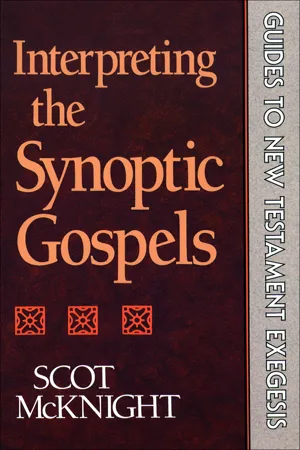
Interpreting the Synoptic Gospels (Guides to New Testament Exegesis)
About this book
McKnight critiques various interpretive methods and suggests how students with some knowledge of Greek can benefit from different analyses.
Information
Subtopic
Études bibliques

Students of the Gospels are probably least interested in introductory questions dealing with authorship, provenance, and Sitz im Leben. This disinterest is unfortunate since the results of these issues affect, however subtly, the exegesis of a large number of passages.
In examining introductory issues, students will encounter discussions about the authorship, date, provenance (origin), structure, and Sitz im Leben of a given Gospel. Some issues are unique to a particular Gospel (e.g., the text-critical problem in Mark). In this chapter, we shall look briefly at the basic issues affecting synoptic exegesis. However, before briefly examining these introductory questions, some recommendations are necessary.
Preliminary Recommendations
Each student should own the following introductions. The standard evangelical work is D. Guthrie’s New Testament Introduction.[1] Guthrie includes a comprehensive survey of various positions and the evidence used for each position taken; the bibliographies, though somewhat dated, remain useful. W. G. Kümmel’s Introduction to the New Testament represents a contrasting perspective.[2] A mediating view is expressed by R. P. Martin in New Testament Foundations: A Guide for Christian Students.[3] It is imperative that the student read introductions written by scholars representing different viewpoints in order to grasp the issues more fully. In addition, students should also peruse introductions to the Gospels in three or four standard critical commentaries (see the Selected Bibliography).
How, then, should one approach introductory issues? Frequently, a student reads an introduction and simply accepts what he or she has read. Or the student reads several introductions and commentaries, and then assumes the most tenable position. Finally, the student may read introductions and commentaries, carefully scrutinize the arguments and evidence presented by each author, and then compose a brief introduction to each Gospel for reference (and later revision when other material is read). The latter approach is recommended.
Introductory Questions
Authorship and Date
The names of the synoptic authors (Matthew, Mark, and Luke) are almost certainly not original to the text itself. Rather, they were probably added by later scribes who, perhaps with solid evidence, decided not to leave the authors anonymous.[4]
If this is the case, then it would be wise for evangelicals to refrain from insisting that conclusions regarding authorship are simply a matter of conservative versus liberal interpretation; if the inscriptions are later additions then they are not inspired and may be inaccurate.
In determining the authorship and date of a particular Gospel, students need to consider internal evidence (what the Gospel itself says about authorship and/or date), external evidence (what the early church has preserved), and comparative evidence (the relationship of the Synoptics).
An important consideration in this connection is the slippery logic often used by conservative evangelicals when discussing authorship. The standard approach is as follows:
Early church tradition affirms Luke as the author.
Liberal arguments contrary to this affirmation are lacking.
Therefore, Luke wrote the Gospel of Luke.
What such logic demonstrates is that the arguments against Lukan authorship are not compelling; it does not prove that Luke actually wrote the Gospel. This logic also demonstrates that there is nothing that disproves the tradition of the early church. However, irrefutable evidence for traditional authorship is difficult to find. One might be able to disprove antitraditional views and muster evidence which confirms Luke’s authorship (medical concerns and language), but it must be admitted, even by conservative evangelicals, that the evidence for traditional authorship consists solely of early church testimony.[5] However, just because Luke’s authorship is affirmed only by the early church fathers does not imply that it is inaccurate. In order clearly to disprove that ascription, positive evidence must be offered which grants credence to another. In light of the lack of solid evidence it is better to admit ignorance than to argue for another author.
If we can determine with reasonable probability that a given author wrote a Gospel, then we also have a good clue as to its date. Even in cases where a scholar contends that traditional authorship is either impossible to validate or remains undetermined, legitimate inferences as to date can be made (e.g., that Matt. 22:7 reflects a post–A.D. 70 setting).
Provenance
The provenance (origin) of the Gospels, like authorship, is a matter about which little consensus has been reached. There are basically two kinds of evidence for provenance: external (comments found in early church writings) and internal (inferences from the text). The earliest writings (external evidence) usually associate Matthew with Palestine and both Mark and Luke with Rome. As far as internal evidence, two examples must suffice. Some scholars contend that persecution references (8:34–38; 10:38–39; 13:9–13) and Latinisms (4:21; 5:9, 15; 6:27) in the Gospel of Mark point to Rome as its likely place of origin, while the mention of two drachmae might point toward Antioch in the case of Matthew (that was the value of the temple tax there; see Matt. 17:24–27). However, inferences like these must be weighed carefully before being used for exegetical decisions.
Sitz im Leben
The German expression Sitz im Leben (“occasion,” “setting in life”) is used frequently in Gospel studies. Like authorship and provenance, the precise Sitz im Leben of the Gospels cannot be determined conclusively; consequently, a multitude of theories has been articulated for each Gospel.
Generally, Sitz im Leben theorists conclude that the Gospels were written: (1) to meet liturgical needs; (2) to settle polemical issues (either within or outside the Christian community); (3) to provide information about Jesus; (4) to instruct new converts in Christian living; or (5) to evangelize nonbelievers. Scholars are usually led to these conclusions on the basis of inference from distinctive or characteristic tendencies in one Gospel. The problem is distinguishing a tendency from an accurate report about Jesus.
Such theories, while worthy of the student’s attention, are so speculative that they should not be utilized as a hermeneutical grid through which every pericope in a Gospel is filtered. Valuable as they might be, Sitz im Leben studies are best left as suggestive conclusions at the end, rather than the beginning, of a commentary.[6]
Structure
The structure of a Gospel is not subject to such speculative difficulties. A proposal for the structure of a book is nothing other than an attempt to outline the whole of a Gospel in order to make sense of its individual pericopes. In composing such an outline, a student may choose to consult a commentary or an introduction and simply copy an outline without personal reflection. The more advanced student may examine the proposals in several introductions and commentaries and then choose the most compelling structural outline. A third approach, followed by the serious student, is a careful examination of several introductions and the standard commentaries, accompanied by intense study of the Gospel, until a satisfactory proposal of structure has been obtained.
It is necessary for the student to work through the Gospels individually to determine the structure of each because such a procedure will greatly aid the exegesis and future study of them. The following procedure is suggested:
- In the first column, list every paragraph in the Gospel by chapter and verse.
- Read through the Gospel, and give a simple summary of each paragraph in the second column.
- Use additional columns to give general descriptions of larger units.
For example, Matthew 1:1–2:23 constitutes the prologue to the Gospel. Simple summaries of a pericope are listed on the left; more general structural descriptions of larger units occur on the right. (A basic outline will eventually appear in the far right margin.)
After completing an outline, the student should read the structural proposals of scholars, using at least three good introductions and commentaries. At this stage, the student should interact with the various positions and gradually arrive at a structural proposal which is both personal and conversant with the major scholarly positions. Because scholarly opinions on this matter are often quite different, some comments about organizing these proposals are in order.
Table 3
Structural Proposals for the Gospel of Mark*


| 1:1–17 | Genealogy | Genealogy | Genealogy | Prologue |
| 1:18–25 | Birth | OT Prophecy re: Name | OT Prophecies | |
| 2:1–12 | Magi | OT Prophecy re: Place | ||
| 2:13–15 | Flight | OT Prophecy re: Flight | ||
| 2:16–18 | Rachel | OT Prophecy re: Threats | ||
| 2:19–23 | Nazareth | OT Prophecy re: Residence |
One way of cataloguing various proposals is to follow this procedure:
- List the scholars, in chronological order, in the right margin of a page.
- List the chapters of the Gospel across the top of the page.
- Mark each scholar’s divisions of that Gospel at the appropriate point in the chart.
If a wide sheet of paper is used, the scholar’s descriptions for the major divisions may be written in the chart. In doing this, especially if the scholars are listed in chronological order, the student can readily observe the major positions as well as the history of research. Table 3 provides an example of such a chart.
By carefully examining this chart, one can readily see that there is some unanimity among scholars in the ordering of Mark. (Only rarely should students differ radically from the majority of scholars.)
We have investigated some preliminary issues affecting exegesis, namely, authorship, provenance, Sitz im Leben, and structure. Before discussing the basic steps of exegesis, background studies and the relationship of the synoptic Gospels must be examined.

The student’s knowledge of the ancient world greatly affects exegesis. Just as it is important to have certain “interpretative grids” in our minds as we read the Chicago Tribune or Allan Bloom’s Closing of the American Mind, so it is crucial for the New Testament student to be able to think like first-century Jews, to hear their expressions, to share their customs, and to experience their social milieu. Yet “background” does not imply that we need to know everything about the ancient world before we can comprehend the Gospels. In fact, the process is a circular one: as we understand more about the Gospels, we understand more about that world; and as we understand more about that world, so we understand more about the Gospels.
Background considerations are necessary if the student is to uncover elements in the text that were simply assumed by the first-century writer and his audience in order to understand the intention of the author as made known in the text. By the original author and his readers, this knowledge was shared; due to historical distance, this information is arcane to us. And there is much the Gospel traveler will need to know in order to be a perceptive visitor in that world.[1]
In this connection, discipline is necessary in background studies. The student must limit investigation to that which is pertinent for interpretation. For example, if one decides to investigate the nature and purpose of genealogies (e.g., Matt. 1:1–17), one may become overwhelmed in the attempt to access all available source...
Table of contents
- Cover
- Series Page
- Title Page
- Copyright Page
- Dedication
- Contents
- Editor’s Preface
- Author’s Preface
- Introduction
- Part 1 Preliminary Steps of Synoptic Exegesis
- Part 2 Basic Steps of Synoptic Exegesis
- Conclusion
- Appendix: Literary Criticism
- Selected Bibliography
- Notes
- Back Cover
Trusted by 375,005 students
Access to over 1.5 million titles for a fair monthly price.
Study more efficiently using our study tools.
Frequently asked questions
Yes, you can cancel anytime from the Subscription tab in your account settings on the Perlego website. Your subscription will stay active until the end of your current billing period. Learn how to cancel your subscription
No, books cannot be downloaded as external files, such as PDFs, for use outside of Perlego. However, you can download books within the Perlego app for offline reading on mobile or tablet. Learn how to download books offline
Perlego offers two plans: Essential and Complete
- Essential is ideal for learners and professionals who enjoy exploring a wide range of subjects. Access the Essential Library with 800,000+ trusted titles and best-sellers across business, personal growth, and the humanities. Includes unlimited reading time and Standard Read Aloud voice.
- Complete: Perfect for advanced learners and researchers needing full, unrestricted access. Unlock 1.5M+ books across hundreds of subjects, including academic and specialized titles. The Complete Plan also includes advanced features like Premium Read Aloud and Research Assistant.
We are an online textbook subscription service, where you can get access to an entire online library for less than the price of a single book per month. With over 1.5 million books across 990+ topics, we’ve got you covered! Learn about our mission
Look out for the read-aloud symbol on your next book to see if you can listen to it. The read-aloud tool reads text aloud for you, highlighting the text as it is being read. You can pause it, speed it up and slow it down. Learn more about Read Aloud
Yes! You can use the Perlego app on both iOS and Android devices to read anytime, anywhere — even offline. Perfect for commutes or when you’re on the go.
Please note we cannot support devices running on iOS 13 and Android 7 or earlier. Learn more about using the app
Please note we cannot support devices running on iOS 13 and Android 7 or earlier. Learn more about using the app
Yes, you can access Interpreting the Synoptic Gospels (Guides to New Testament Exegesis) by Scot McKnight in PDF and/or ePUB format, as well as other popular books in Théologie et religion & Études bibliques. We have over 1.5 million books available in our catalogue for you to explore.