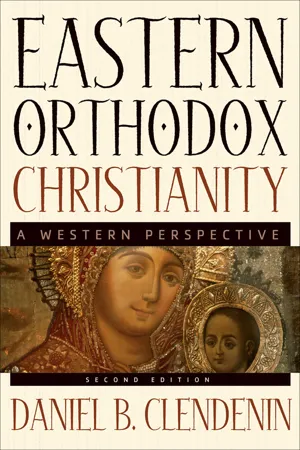
In this reliable and engaging survey, Daniel Clendenin introduces Protestants to Eastern Orthodox history and theology with the hope that the two groups will come to see their traditions as complementary and learn to approach one another with a "hermeneutic of love" that fosters "mutual respect, toleration, and even support."
This revised edition includes a new preface, a new chapter, and an updated bibliography. In addition to updated demographic information, Clendenin examines at length a particular aspect of Orthodoxy's intersection with Protestantism-its growing exchange with evangelicalism.
- 192 pages
- English
- ePUB (mobile friendly)
- Available on iOS & Android
eBook - ePub
About this book
Information
Topic
Theology & ReligionSubtopic
Christian Denominations
We do not wish to embark on a “comparative theology”: still less to renew confessional disputes. We confine ourselves here to stating the fact of a dogmatic dissimilarity between the Christian East and the Christian West. . . . If while remaining loyal to our respective dogmatic standpoints we could succeed in getting to know each other, above all in those points in which we differ, this would undoubtedly be a surer way towards unity than that which would leave differences on one side. For, in the words of Karl Barth, “the union of the Churches is not made, but we discover it.”
—Vladimir Lossky
They come from radically different backgrounds. Franky Schaeffer, son of the late evangelical theologian Francis Schaeffer, grew up as a Presbyterian. Anthony Scott and Tom Walker were Southern Baptists. Paul O’Callaghan came from a devoted ethnic, Roman Catholic family. John Morris, a Fulbright scholar and a professor of history, was raised in the United Methodist Church. Maria King, an associate professor of nursing at the Medical College of Georgia, was an Episcopalian nun who had served as a missionary in Liberia for two years. David Giffey had spent several months in a Hindu monastery. Tom Avramis was a campus leader and course instructor for Campus Crusade for Christ. Gordon Walker and Peter Gillquist likewise hailed from Campus Crusade. Others have come from organizations like Youth for Christ, Young Life, the Evangelical Free Church, and the Christian and Missionary Alliance.
They attended radically different schools: Oral Roberts University, Fuller Seminary, Dallas Theological Seminary, Wheaton College, Columbia Bible College, Westminster Theological Seminary, Western Conservative Baptist Seminary, Biola University, Asbury Seminary, Southwestern Baptist Theological Seminary, Luther Rice Seminary, Trinity Evangelical Divinity School, General Theological Seminary, Louisville Presbyterian Seminary, Nyack College, and Zion Bible College.[1]
Despite these varied backgrounds, all of these people have a common story to tell: they are all Christians who have converted to Orthodox Christianity. Many if not most of these converts have traveled deeply personal and private journeys to the Eastern church.[2] Others converted en masse, as did the group led by Peter Gillquist.[3] It was in 1987 that Gillquist and several close friends culminated a fifteen-year theological pilgrimage by leading a group of two thousand believers from seventeen congregations to join the Antiochian Orthodox Christian Archdiocese of North America. Since then, another fifteen congregations have followed suit; and today, according to Gillquist, who is an archpriest and chairman of the archdiocese’s Department of Missions and Evangelism, “there are so many inquiries, I don’t have time to scratch up new contacts. Evangelicals have a growing awareness of reductionism—what’s been left out—and a true hunger for worship. They need something more.”[4]
Within Orthodoxy itself there are signs of growing vigor and renewal. At St. Vladimir’s Orthodox Seminary in New York 50 percent of the students are from non-Orthodox backgrounds. In the Orthodox Church in America about half of the bishops are from non-Orthodox backgrounds. Strongly evangelical movements within Orthodoxy include the “Zoe” movement in Greece, the “Lord’s Army” in Romania, the “Orthodox Brotherhood of Saint Simeon the New Theologian” in America (led by Archimandrite Eusebius Stephanou, an evangelical charismatic priest of the Greek Orthodox diocese), and the denominational merger of the Evangelical Orthodox Church with the Antiochian Orthodox Church of North America in 1987.[5] One publisher today even advertises a specifically Orthodox study Bible.
Despite numerous difficulties faced by converts to Orthodoxy, they often convey a sense of having found a pearl of great price or a long lost treasure.[6] Just what is it that has attracted such a diversity of Christians to the common denominator of Orthodoxy? How can we explain what draws a xenos (outsider) to a largely immigrant church which by its own admission is often plagued by intense ethnocentrism? Why would Christians leave familiar communities of worship, and often their families, for the strange world of smells and bells, of incense, icons, priestly vestments, and a liturgy that is often still chanted in a foreign language? Exactly what deficiency in their previous Christian experience has Orthodoxy filled for these converts? More starkly put, to recall Peter Gillquist’s words in reference to the experience of his parishioners, “Whatever would so possess two thousand Bible-believing, blood-bought, Gospel-preaching, Christ-centered, lifelong evangelical Protestants to come to embrace this Orthodox faith so enthusiastically?”[7]
These questions are as complex as they are fascinating, and one purpose of this book is to explore possible answers.[8] The beauty and power of Orthodoxy’s liturgical ornament, liberation from arid and reductionistic rationalism, the celebration of “sacred materialism” free from legalism, the wholehearted embrace of majesty and mystery, and stability that outlasts the latest theological or ecclesiastical innovations and that is born of an unwavering devotion to the theology and life of the patristic fathers—all these are common themes cited by converts to Orthodoxy. They are also strange-sounding themes to some Western believers, and they set us on notice that in large part and for most people in the West Orthodoxy is either completely unknown or a religious enigma.
The World of Orthodoxy: Anonymity and Mystery
For the most part Orthodoxy in America has had to endure a certain degree of anonymity or cultural invisibility.[9] Devotees, and in particular highly committed converts like those listed at the beginning of this chapter, like to think of Orthodoxy as America’s best-kept secret, but more realistic is the judgment of Thomas Doulis that “Orthodox Christianity is the great unknown among American religious denominations.”[10] James Stamoolis notes that until Orthodoxy was recognized as America’s fourth major religion, the identification tags of Orthodox believers who served in the American military bore the inscription Protestant.[11] Several factors converge to explain this anonymity of Orthodoxy.
First, most Americans have been conditioned to think about religion in America in terms of the Big Three. Thus Will Herberg’s significant sociological study of religion in America was entitled Protestant, Catholic, Jew (1955). Many textbooks and seminary courses in church history barely cast a fleeting glance at the unique contributions and ethos of Eastern Christianity. Others omit it altogether; the Pelican History of the Church series, for example, contains no volume on Eastern Christianity.[12]
Second, for the most part the Orthodox Church in America, like some other denominations here (German Baptists, the Scandinavian Free Church, and Latvian Evangelical Lutherans), has been primarily an immigrant church, a “tribal domain” to use Doulis’s description, whose strength and weakness have both resided in its pervasive ethnicity. Consequently, its presence in any given larger community is likely to be small and in some ways socially marginal. Assimilation into the larger arena of American religious life and society has not been a hallmark of Orthodoxy. Despite the specific cases mentioned earlier, the efforts and success of this tribal domain at attracting new converts, as Doulis notes, have been typically restricted to the spouses of ethnic believers.
Third, specifically Russian Orthodox Christians in America have faced the political prejudice of growing up in a country where as recently as the late 1980s the popular media, culture, and even the church stigmatized and stereotyped their homeland and forebears as “the evil empire.” America, on the other hand, in this scenario, was the object of God’s special favor and delight. Recall the movie Rocky IV where Sylvester Stallone defeats a bionic-looking Russian, or the gush of patriotism over the American Olympic hockey team’s victory at Lake Placid, and then imagine the reaction of a Russian-American believer. And how many of us have heard passionate sermons based on Ezekiel or some other prophet that pretentiously offer up an intricate interpretation of future history in which Russia is the great beast swooping down upon Israel?[13] It rarely occurs to Americans that Holy Russia was home to Christianity eight hundred years before the United States became a nation. In short, the Cold War legacy has prevented many of us from knowing, or even wanting to know, Russian Christians.
Finally, Orthodoxy has operated with a degree of anonymity because of its confusion with Catholicism (and that despite being lumped together with Protestantism!). The German Protestant theologian Ernst Benz notes our “natural tendency to confound the ideas and customs of the Orthodox Church with familiar parallels in Roman Catholicism.”[14] For the casual observer, some outward similarities make this confusion understandable, especially from the vantage point of Protestantism. But it is also a gross error, for the religious and political history, theology, worship, and entire frame of reference of Orthodoxy are all very different from Catholicism. Indeed, from the Orthodox perspective, Protestantism and Catholicism are simply opposite sides of the same coin, and much more similar to each other than either is to Orthodoxy. Eastern Christianity is a different world altogether. The nineteenth-century Russian lay theologian Alexei Khomiakov (1804–60) put it this way: “All Protestants are Crypto-Papists. . . . To use the concise language of algebra, all the West knows but one datum a; whether it be preceded by the positive sign +, as with the Romanists, or with the negative sign –, as with the Protestants, the a remains the same. Now a passage to Orthodoxy seems indeed like an apostasy from the past, from its science, creed and life. It is rushing into a new and unknown world.”[15] Orthodoxy is not Catholicism, and if we are to understand it we must leave behind this common misconception.
Even among those who should know, Orthodoxy is often an unknown entity. I well remember my shock and dismay as a doctoral student when on one of my comprehensive examinations I encountered a question that required me to interact with some theologians I had never heard of; I am sure I had never seen their names before. They were complete unknowns to me. To my embarrassment, I was ignorant of some great Orthodox theologians. Patrick Henry’s words applied to me, and no doubt to many Western Christians today, that “ignorance of Eastern Orthodoxy is the scandal of Western Christianity.”[16]
Most of those Western people who have in some way encountered Orthodoxy experience its religious life as strange and peculiar, even awesome and exotic, something totally foreign to and different from almost all other expressions of Christianity they have known in the West. Not unlike the emissaries of Russia’s Prince Vladimir who were awestruck at the liturgy they encountered at the Church of Holy Wisdom in Constantinople,[17] it is not uncommon for converts to Orthodoxy to recall with vivid clarity the first Orthodox liturgy they ever experienced.[18] I will always remember my first Orthodox liturgy, which I experienced in Nizhni Novgorod (formerly Gorki), Russia. Even before entering the church one is taken aback by the unusual architecture—the glittering onion domes that sparkle like diamonds on a sunny day. Once inside, the Western Christian is likely to experience a virtual sensory overload: the absence of any chairs or pews; the dim lighting; the scarves worn by all the women as a sign of reverence; the multitude of icons and frescoes that cover almost every inch of space on the walls and ceilings; the massive iconostasis separating the priest and worshipers; the smoky smell of incense and the crackling of hundreds of candles that burn in memory of the dead; the priest resplendent in his ornate vestments, massive beard, and resonant voice; the worshipers who repeatedly prostrate themselves, kiss the icons, and make the sign of the cross; and, in Russia, the chanting of the liturgy in ninth-century Church Slavonic along with the professional choirs whose voices echo from the balconies throughout the high ceilings of the church. All of this is accompanied by a sense of extreme awe and reverence, as I soon discovered. In Saint Petersburg I made the mistake of standing with my hands in my pockets, only to have an old babushka order me to remove them. In Moscow I made the mistake of standing on a small piece of carpet that ran beneath a lectern, and was ordered to get off by a babushka—I was standing on holy ground! The sum total of the Orthodox liturgical experience creates an atmosphere that is worlds away from the typical Protestant church found in most American communities.
It is no wonder, then, that even those who have some familiarity with Orthodoxy find it a very strange and mysterious environment, certainly far removed from most expressions of Christianity in America. Khomiakov was right when he advised that Western Christians will find Orthodox Christianity to be “a new and unknown world” where not only the answers but even the questions are very different. Timothy Ware, himself a convert to Orthodoxy, draws attention to this insight from Khomiakov and suggests that Orthodoxy “is not just a kind of Roman Catholicism without the Pope [a badly mistaken judgment likely to be made by Protestants], but something quite distinct from any religious system in the west.”[19] Would-be converts to Orthodoxy have been warned and even discouraged by Orthodox priests about the drastic differences between Eastern, Greek ways of thinking and Western, Latin patterns of Christian worship, life, and thought.
Thus most Christians in the West encounter Orthodoxy from the perspective of near total ignorance or mystification bordering on suspicion. Nor is this feeling merely a religious xenophobia or ethnocentrism; as Khomiakov observed, the differences between Eastern and Western Christianity are very real. If that is so, why, indeed, should Western believers even concern themselves with Orthodoxy?
The Case for Examining Orthodoxy
If we want to dispel the anonymity and mystery of Orthodoxy, we do not need to search very long or hard to discover a number of compelling reasons to enter into its world. First, as we have already mentioned, today Orthodoxy is recognized as the fourth major religion in America.[20] Despite its immigrant roots, limited social stature beyond its own ethnic communities, and the stigma of political prejudice, Orthodox Christians in America now number more than 6 million adherents.[21] If we enlarge our scope to consider the Orthodox believers worldwide, they number around 185 million. Russia alone is home to about 70 million Orthodox Christians, not including millions of other non-Orthodox Christians. These facts should give pause to American Christians tempted to neglect or spurn their Eastern counterparts. Such estimates have fluctuated, of course, because of such variables as the definition of an adherent, the inclusion or exclusion of nominal members, the fortunes of Orthodoxy before and after the vicious onslaught of atheistic communism (e.g., by 1941 some 98 percent of Orthodox churches had been closed by the Communists), but by any measure Orthodoxy in the East and the West counts a considerable number of followers and on that basis alone merits study.
Second, Christians in the evangelical tradition, who have always been characterized by a strong defense of the fundamental truths of Christianity and a calculated rejection of such doctrinal modifications as the nineteenth-century liberalism of Friedrich Schleiermacher and the contemporary pluralism of John Hick, will find Orthodoxy to be a mutual friend and stalwart defender of the basic truths of Christianity. Indeed, “the greatest insult one could pay to any [Orthodox] theologian . . . would be to call him a ‘creative mind.’”[22] Fidelity and an unwavering loyalty to the apostolic faith characterize Eastern Christianity. One of the most common reasons that converts to Orthodoxy give to explain their new allegiance is their frustration with liberal theology or faddish innovations found in their former churches. They have longed and sought for an authentic expression of New Testament Christianity. For many of these converts Orthodoxy provides a sturdy doctrinal anchor that they have missed.
Orthodoxy is so steeped in the traditions of the early church that it proudly identifies itself as the Church of the Seven Councils (see pp. 35–38). In fact, like evangelicalism it is sometimes criticized for being stuck in a static, backward-looking posture that is out of step with contemporary society. In some ways the criticism is just. But for Orthodoxy, intent on maintaining a direct link with its apostolic, patristic heritage, that criticism is a badge of pride, not of embarrassment. All good Orthodox Christians cherish the words of the great Eastern theologian John of Damascus (c. 675–749) that “we do not change the everlasting boundaries which our fathers have set, but we keep the traditions just as we received them.”[23] There are some important areas where evangelicals will disagree with Orthodoxy (sacramentalism, the veneration of Mary), but upon close inspection one finds that on almost all the major doctrines of Christianity Orthodoxy places itself squarely within the tradition of what Vincent of Lérins said (c. 434) was believed by Christians “everywhere, always, and by all.” This unquestioning loyalty to the boundaries of orthodox Christianit...
Table of contents
- Cover
- Title Page
- Copyright Page
- Contents
- Preface to the Second Edition
- Preface to the First Edition
- 1: On Smells and Bells: An Apologia for Orthodoxy
- 2: The Forgotten Family: A Brief History
- 3: The Mystery of God: Apophatic Vision
- 4: The Image of Christ: Theology in Color
- 5: The Witness of the Spirit: Scripture and Tradition
- 6: The Deification of Humanity: Theosis
- 7: A Hermeneutic of Love
- Epilogue Orthodox-Evangelical Dialogue: Past, Present, and Future
- Bibliography
- Scripture Index
- Subject Index
- Notes
Trusted by 375,005 students
Access to over 1.5 million titles for a fair monthly price.
Study more efficiently using our study tools.
Frequently asked questions
Yes, you can cancel anytime from the Subscription tab in your account settings on the Perlego website. Your subscription will stay active until the end of your current billing period. Learn how to cancel your subscription
No, books cannot be downloaded as external files, such as PDFs, for use outside of Perlego. However, you can download books within the Perlego app for offline reading on mobile or tablet. Learn how to download books offline
Perlego offers two plans: Essential and Complete
- Essential is ideal for learners and professionals who enjoy exploring a wide range of subjects. Access the Essential Library with 800,000+ trusted titles and best-sellers across business, personal growth, and the humanities. Includes unlimited reading time and Standard Read Aloud voice.
- Complete: Perfect for advanced learners and researchers needing full, unrestricted access. Unlock 1.5M+ books across hundreds of subjects, including academic and specialized titles. The Complete Plan also includes advanced features like Premium Read Aloud and Research Assistant.
We are an online textbook subscription service, where you can get access to an entire online library for less than the price of a single book per month. With over 1.5 million books across 990+ topics, we’ve got you covered! Learn about our mission
Look out for the read-aloud symbol on your next book to see if you can listen to it. The read-aloud tool reads text aloud for you, highlighting the text as it is being read. You can pause it, speed it up and slow it down. Learn more about Read Aloud
Yes! You can use the Perlego app on both iOS and Android devices to read anytime, anywhere — even offline. Perfect for commutes or when you’re on the go.
Please note we cannot support devices running on iOS 13 and Android 7 or earlier. Learn more about using the app
Please note we cannot support devices running on iOS 13 and Android 7 or earlier. Learn more about using the app
Yes, you can access Eastern Orthodox Christianity by Daniel B. Clendenin in PDF and/or ePUB format, as well as other popular books in Theology & Religion & Christian Denominations. We have over 1.5 million books available in our catalogue for you to explore.