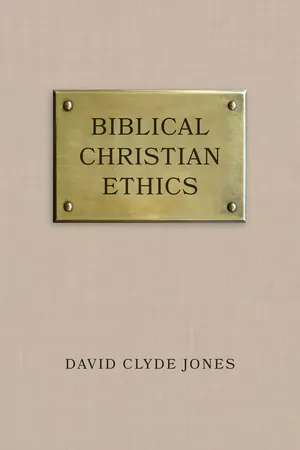
Consistent, rational thinking about ends, motives, and means distinguishes ethical decisions that are "Christian" and "biblical" in Biblical Christian Ethics.
Taking as his starting point Romans 12:1-2 and its call to believers to be living sacrifices, David Clyde Jones finds the central theme of ethics in the statement that our "chief end is to glorify God and to enjoy him forever."
Jones approaches ethics as a study of a way of life that conforms to the will of God. He examines principles and casuistry in such matters as the sanctity of life, sexuality, economic justice, and truthfulness. He discusses how love is reflected in law, the appropriate approach to moral conflict, and specific issues involving marriage and the family. And he applies biblical principles to dilemmas arising from divorce and marriage.
Throughout, the book draws together and explains the central ideas of philosophers and ethicists from Aristotle to Smedes.
- 216 pages
- English
- ePUB (mobile friendly)
- Available on iOS & Android
eBook - ePub
Biblical Christian Ethics
About this book
Information
Topic
Theology & ReligionSubtopic
Religion1
The Questions of Ethics
What goals ought we to pursue in life? What sort of persons ought we to be? What practices ought we to follow? These are the great questions the discipline of ethics seeks to answer.
The questions imply that human conduct is subject to a threefold evaluation from a moral point of view. First, the end the agent seeks to realize must be good, intrinsically worthy of human pursuit. Second, the motive of the agent must also be good, so that the end is sought because it is worthwhile, the mark of a good character. Third, the means to the end must be good, conforming to the standard of what is right, since neither a good end nor a good motive is compatible with a bad means. For conduct to be morally praiseworthy it must be good in all three respects, not least because end, motive, and means are not finally separable.
Moral evaluation, of course, implies standards of judgment. Ends are judged good or evil by criteria of intrinsic value; agents are judged good or bad by criteria of moral virtue; actions (including mental acts or attitudes) are judged right or wrong by criteria of moral obligation. What are these criteria, and how do we know them? This is the most pressing question of ethics; no particular instance of ethical choice can be resolved without presupposing an answer to it. The answer is necessarily dependent upon some broader philosophical perspective, some view of human beings and their place in the universe.
From a biblical point of view, the question of criteria for goals, persons, and practices comes down to this: What is God calling us to be and to do? Since God’s salvific call is not a bare invitation but a manifestation of his sovereignty and power, the question is more fully: What is God summoning and enabling us, his redeemed people, to be and to do?[1]
Effectual calling has been helpfully defined by Anthony Hoekema as “that sovereign action of God through his Holy Spirit whereby he enables the hearer of the gospel call to respond to his summons with repentance, faith, and obedience.”[2] By including obedience within the definition, Hoekema draws our attention to the goal-directed aspect of effectual calling that often emerges in the New Testament. We are called to salvation by the sanctifying work of the Holy Spirit and belief of the truth so that we may share in the glory of our Lord Jesus Christ (2 Thess. 2:13–14). The ultimate goal of our calling is eternal life (1 Tim. 6:12), the heavenly prize (Phil. 3:14), God’s kingdom and glory (1 Thess. 2:12). We are called to belong to Christ (Rom. 1:6), and since our calling brings us into fellowship with him (1 Cor. 1:9), we are called to live a holy life (1 Thess. 4:7) and to follow his example of suffering for righteousness’ sake (1 Pet. 2:21).
In effectual calling we are united to Christ and consequently called to a distinctive way of life in him, a way of life made possible by divine grace. The classic text is Romans 12:1–2, which in the unsurpassed cadence of the King James Version reads:
I beseech you therefore, brethren,[3] by the mercies of God, that ye present your bodies a living sacrifice, holy, acceptable unto God, which is your reasonable service. And be not conformed to this world: but be ye transformed by the renewing of your mind, that ye may prove what is that good, and acceptable, and perfect, will of God.
The chief interest of this text for ethics lies in its climactic description of the will of God as the standard of the Christian life. But the truths about human nature presupposed in the terms of Paul’s appeal ought not to be overlooked.
“By the mercies of God” (the plural represents the Hebrew raḥamim, translated “tender mercies” in the Psalms) alerts us to the affectional aspect of human nature. Motivation in ethics must reach the dispositional complex of desire and feeling that Scripture calls “the heart.” The full extent of God’s mercy is revealed in the cross, as Paul earlier has said: “God demonstrates his own love for us in this: While we were still sinners, Christ died for us” (Rom. 5:8). This is the profound truth by which we are moved to respond to God’s call. “We love because he first loved us” (1 John 4:19).
“To present your bodies” brings into sharp focus the volitional aspect of human nature. Paul’s powerful appeal is addressed to free agents whose choices are morally significant. It assumes that human conduct involves acts of conscious determination toward good or evil. As Christ voluntarily laid down his life for sinners, so Christians, having been made alive by the Spirit of God, are called willingly and actively to offer themselves to God as perpetual oblations of thankfulness and praise. The best commentary on “living sacrifices” is Hebrews 13:15–16: “Through Jesus, therefore, let us continually offer to God a sacrifice of praise—the fruit of lips that confess his name. And do not forget to do good and to share with others, for with such sacrifices God is pleased.”
“Which is your reasonable service” highlights the ethical significance of human nature as rational. Both the New International Version and the New Revised Standard Version have “spiritual worship” instead of “reasonable service,” but the latter appears to be closer to the sense of the original. The word translated “worship” or “service” is latreia, which in the Septuagint and the New Testament always means “divine service,” predominantly with reference to the offices of the tabernacle and the temple. Under the new covenant believers are themselves said to be the temple where God dwells by his Spirit. Since in the context it is the whole of life that is to be consecrated to God, “service” would seem to be the more suitable translation than “worship,” especially in view of the broad use of the related verb latreuō (to serve) in both Testaments (e.g., Deut. 10:12; Luke 1:74–75; Acts 27:23; Heb. 9:14).
More importantly, the modifier translated “spiritual” or “reasonable” (NRSV has “spiritual” in the text and “reasonable” in the margin) is logikos. Although the word is rare in biblical Greek, the only other instance being 1 Peter 2:2, it was commonly used in contemporary philosophical discourse with reference to human nature as “possessed of reason, intellectual.” There is no cause to suppose that Paul’s use is fundamentally different; his usual term for “spiritual” is pneumatikos, yet here he says logikos, “rational.” This nuance suits the context well. Christian service is not a matter of unthinking activity or rote performance; it engages the mind as well as the heart and the will.
Human nature is affectional, volitional, and rational; it is also fallen. Thus Paul issues the twofold exhortation, “Be not conformed . . . be transformed,” so that, renewed by God’s grace, we may be able to “approve” the will of God, making God’s moral judgments our own and putting them into practice. “The will of God” is in apposition to “the good, and acceptable, and perfect”; each term bears a particular ethical significance.
“The good.” The prophet Amos long ago called for adherence to what in philosophical discussion is referred to as the first principle of practical reason: “Seek good, not evil . . . hate evil, love good” (Amos 5:14–15; cf. Rom. 12:9, which is practically identical, and Rom. 16:19, “I want you to be wise about what is good, and innocent about what is evil”). “Good” is the most comprehensive term for what human beings ought to be and to do. The biblical ethic is distinctive in that it identifies the good with the revealed will of God. In the great summary declaration of the prophet Micah: “He has showed you, O man, what is good. And what does the LORD require of you? To act justly and to love mercy and to walk humbly with your God” (Mic. 6:8). To this verse, with its threefold specification of what the Lord requires of his people, we will in due course return. For now we simply note its assertion of God’s revelation of the good that human beings ought to seek.
“The acceptable.” The will of God is further described as euarestos, “acceptable” or “well-pleasing” to God. This word-group (euaresteō, areskō, and derivatives) figures prominently in the New Testament vocabulary for moral conduct. The benediction of Hebrews 13:20–21 is typical: “May the God of peace . . . equip you with everything good for doing his will, and may he work in us what is pleasing to him, through Jesus Christ, to whom be glory for ever and ever.” It is God’s approval that ultimately counts in ethics, doing “what is right in his eyes,” as the Old Testament puts it (e.g., Exod. 15:26; Deut. 12:28; 1 Kings 11:38). The standard to which we are called to conform is not impersonal law, but rather the personal will of our Creator and Redeemer.
“The perfect.” The will of God is finally described as “perfect” or “complete.” The true fulfillment of human nature consists in being conformed to the will of God, which is essentially God’s own moral perfection transcribed for creaturely imitation. As Jesus says in the Sermon on the Mount, “Be perfect, therefore, as your heavenly Father is perfect” (Matt. 5:48). Self-denial in the Christian life is aimed not at eradication of the human personality but rather at eradication of sin. The goal of sanctification is the perfection of human nature created in the image of God.
To sum up, Christian ethics may be defined as the study of the way of life that conforms to the will of God—the way of life that is good, that pleases God and fulfills human nature.[4] This leads to practical questions: How do we know the will of God? How do we know what God is calling us to be and to do?
“The will of God” can refer either to God’s decree or to God’s purpose and direction. Where human response is called for, the latter sense is intended. God does not reveal what he has decreed as a guide for human decision-making; what he has revealed is his direction, his law (in Hebrew torah, divine instruction in the way of life) by which his purpose and desire for his people may be realized. The question is more precisely: How do we know the revealed will of God? The short answer is: By knowing the holy Scriptures, Which are able to make us wise for salvation through faith in Christ Jesus (2 Tim. 3:15). The Scriptures are both clear and sufficient for this purpose, so that we may be thoroughly equipped for every good work (v. 16).
Even so, the answer is not as simple as it might seem. The will of God must be discerned through a whole-souled engagement of heart and mind and will. This is the perspective of Philippians 1:9–11, which may be rendered in English as follows:
And this [is what] I am praying: that your love may abound more and more in knowledge and all insight for [the purpose of your being able] to approve the values that excel, that you may be pure and blameless unto the day of Christ, filled with the fruit of righteousness which is through Jesus Christ to the glory and praise of God.
This comprehensive prayer begins with the impelling motive of the Christian life (love) and ends with its controlling purpose (the glory of God). Paul prays for love’s increase in both knowledge (epignōsis), which denotes an intelligent understanding of the directing principles of the Christian life, and insight (aisthēsis), which is the existential grasp of their application in concrete circumstances.[5] Christians whose love abounds in this twofold way will be able to make true moral judgments and approve the values that excel (ta diapheronta), which is equivalent to knowing the will of God (cf. Rom. 2:18, “if you know his will and approve of what is superior [ta diapheronta] because you are instructed by the law”).[6]
The biblical view of values is that they are objective and normative. It says, “These things are valuable and therefore ought to be desired and sought.” This stands in opposition to the subjective or descriptive view, which says, “These things are desired and sought; therefore they are valuable, at least to those who seek them.” As one author puts it, “Human beings are value and whatever they value is value.”[7] But some human beings value revenge, others cruelty, still others forms of sexual activity aptly labeled “bondage.” Such practices obviously do not represent intrinsic human goods; so far from being values, they are instead disvalues, destroying rather than fulfilling human nature.
Paul’s classic list of the values that excel, values that are objectively true and intrinsically worthy of human pursuit, is found in Philippians 4:8–9.
Whatever is true, whatever is noble, whatever is right, whatever is pure, whatever is lovely, whatever is admirable—if anything is excellent or praise worthy—think about such things. Whatever you have learned or received or heard from me, or seen in me—put it into practice.
The double imperative (“these things think . . . these things practice”) brings out the unity of contemplation and action in the pursuit of moral excellence. Without going into a detailed analysis of each item in Paul’s list, we may note that there is an objective world of value grounded in the God of truth to which we are invited to attend with all our mind. We are not called to create our own values but rather to contemplate the values God has ordained. Contemplation through the renewal of the Holy Spirit leads to the desire to embody these values in our lives, so that the things communicated by apostolic teaching and example may be put into practice.
The apostolic witness points us to Christ, the definitive embodiment of moral excellence. And as the writer of Hebrews reminds us, “Jesus Christ is the same yesterday and today and forever” (Heb. 13:8). Though we live in a changing world, God does not change, nor does his ideal purpose for human beings made in his image. Consequently the world of values does not change, however complex our world may become through advances in technology. We have in Christ and the holy Scriptures the permanent deposit of the directing principles of the Christian life, to be learned and applied in our own day through the illuminating and enabling work of the Holy Spirit.
Thus, by way of summary, Christian ethics is the study of the way of life that conforms to the will of God as revealed in Christ and the holy Scriptures and illuminated by the Holy Spirit. It seeks to answer the practical question, What is God calling us, his redeemed people, to be and to do? Expressed in term of goals, persons, and practices, a threefold answer may be proposed: The controlling purpose of the Christian life is the glory of God; the impelling motive of the Christian life is love for God; and the directing principle of the Christian life is the will of God as revealed in Christ and the holy Scriptures.[8] These basic propositions will be the subject of the next three chapters.
2
The Goal of the Christian Life
What is the chief end of man?” Generations of children brought up on the Westminster Shorter Catechism have been taught to answer, “Man’s chief end is to glorify God and to enjoy him forever.” It’s a good answer. So good, perhaps, that few pause to ask why the Catechism begins with this particular question. Only the child who hasn’t yet memorized the answer is likely to stall by asking, “What do you mean ‘chief end,’ and why do you want to know?” It’s a good question.
The Catechism presupposes that there is some supreme purpose for human beings, some ultimate goal or telos that fulfills human nature, some highest good of intrinsic value that is to be most sought after in life. It thus identifies with the goal-oriented or teleological tradition in Christian ethics encapsulated in the famous saying of Augustine: “[T]hou hast made us for thyself, and restless is our heart until it comes to rest in thee.”[1] The Catechism begins the way it does because it understands that we are purposeful beings, that “whatever else man may be—emotional, rationalizing, mortal, brutish, reasonable, whatever—he is very much a teleological animal.”[2] It wants to know what we should aim at in life as a whole, for this will determine all our notions of virtue and duty and sustain our commitment to them. There is, of course, a history behind its remarkably comprehensive and concise answer.[3]
By the time Augustine was converted to Christianity the question of the highest good or summum bonum had long been the subject of philosophical discussion. Aristotle, for example, taught that the end or goal (telos) of human existence is eudaimonia, traditionally translated “happiness” but now commonly rendered “flourishing” in an attempt to express in one word Aristotle’s complex notion of being good ...
Table of contents
- Cover
- Title Page
- Copyright Page
- Contents
- Preface
- Abbreviations
- 1. The Questions of Ethics
- 2. The Goal of the Christian Life
- 3. The Motive of the Christian Life
- 4. The Direction of the Christian Life
- 5. The Primary Forms of Love
- 6. The Universal Norms of Love
- 7. The Resolution of Moral Conflicts
- 8. Marriage and the Family
- 9. Divorce and Remarriage
- Appendix
- Index of Subjects
- Index of Scripture
- Notes
- Back Cover
Trusted by 375,005 students
Access to over 1.5 million titles for a fair monthly price.
Study more efficiently using our study tools.
Frequently asked questions
Yes, you can cancel anytime from the Subscription tab in your account settings on the Perlego website. Your subscription will stay active until the end of your current billing period. Learn how to cancel your subscription
No, books cannot be downloaded as external files, such as PDFs, for use outside of Perlego. However, you can download books within the Perlego app for offline reading on mobile or tablet. Learn how to download books offline
Perlego offers two plans: Essential and Complete
- Essential is ideal for learners and professionals who enjoy exploring a wide range of subjects. Access the Essential Library with 800,000+ trusted titles and best-sellers across business, personal growth, and the humanities. Includes unlimited reading time and Standard Read Aloud voice.
- Complete: Perfect for advanced learners and researchers needing full, unrestricted access. Unlock 1.5M+ books across hundreds of subjects, including academic and specialized titles. The Complete Plan also includes advanced features like Premium Read Aloud and Research Assistant.
We are an online textbook subscription service, where you can get access to an entire online library for less than the price of a single book per month. With over 1.5 million books across 990+ topics, we’ve got you covered! Learn about our mission
Look out for the read-aloud symbol on your next book to see if you can listen to it. The read-aloud tool reads text aloud for you, highlighting the text as it is being read. You can pause it, speed it up and slow it down. Learn more about Read Aloud
Yes! You can use the Perlego app on both iOS and Android devices to read anytime, anywhere — even offline. Perfect for commutes or when you’re on the go.
Please note we cannot support devices running on iOS 13 and Android 7 or earlier. Learn more about using the app
Please note we cannot support devices running on iOS 13 and Android 7 or earlier. Learn more about using the app
Yes, you can access Biblical Christian Ethics by David Clyde Jones in PDF and/or ePUB format, as well as other popular books in Theology & Religion & Religion. We have over 1.5 million books available in our catalogue for you to explore.