This work examines key aspects of the development of the Heidelberg Catechism, including historical background, socio-political origins, purpose, authorship, sources, and theology. The book includes the first ever English translations of two major sources of the Heidelberg Catechism--Ursinus's Smaller and Larger Catechisms--and a bibliography of research on the document since 1900.
Students of the Reformed tradition and the Protestant Reformation will value this resource.
eBook - ePub
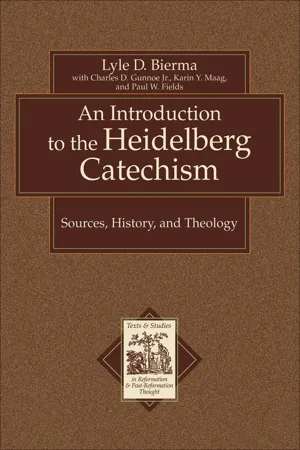
An Introduction to the Heidelberg Catechism (Texts and Studies in Reformation and Post-Reformation Thought)
Sources, History, and Theology
- 224 pages
- English
- ePUB (mobile friendly)
- Available on iOS & Android
eBook - ePub
An Introduction to the Heidelberg Catechism (Texts and Studies in Reformation and Post-Reformation Thought)
Sources, History, and Theology
About this book
Information
Topic
Theology & ReligionSubtopic
Christian Theology
1
The Reformation of the Palatinate and the Origins of the Heidelberg Catechism, 1500-1562
The city of Heidelberg is famed for its romantic setting along the Neckar River and especially for its impressive castle ruins, which loom over the old city—a large part of which was built during the Reformation period. As the home of the oldest university within the current boundaries of Germany and of scholarly luminaries such as Max Weber and Karl Jaspers, it is also rightly renowned as an intellectual center. The famous fossil remains of a hominid known as Heidelberg Man (homo heidelbergensis) were found a few kilometers southeast of Heidelberg in 1907. The city was also one of the few German towns to escape World War II relatively unscathed, and over the last decades, thousands of Americans have come to know Heidelberg as the headquarters of the U.S. Army in Europe.
For Reformed Protestants, however, the city is chiefly famous for lending its name to the Heidelberg Catechism. While the HC is a defining confessional document of Reformed Protestantism, when seen from the broader perspective of central European history, the story of the catechism’s origin is more appropriately reckoned to that of an important signpost in the tragic sequence of events that would eventually lead to the Thirty Years’ War. In this chapter, I will attempt to outline the political, cultural, and social milieu that gave birth to the Heidelberg Catechism (HC). Dynastic rivalries, shifting imperial power blocks, a tradition of openness to innovative ideas, a latent impulse toward religious reform, and especially growing pressure from below were some of the factors that went into the mix that ultimately gave birth to a document that has proven itself to be an enduring and inspiring monument to the Reformed faith.[1]
Origins of the Rhineland-Palatinate
The context for the HC was the Palatinate, one of the leading principalities of the Holy Roman Empire in the early modern period. In the sixteenth century, the Palatinate consisted of two major components, the Rhenish “Lower Palatinate” with its capital in Heidelberg and the North Bavarian “Upper Palatinate.” The territories of the Lower Palatinate were widely dispersed on both banks of the Rhine alongside those of the bishoprics of Worms, Speyer, and Mainz. The territory’s ruler, the Elector Palatine, enjoyed the highest place of honor among all the secular princes of the empire. However, the Palatinate’s aspirations to greater glory generally exceeded the resources of its modest territorial base. To understand the Palatinate’s basic predicament, one must turn to the territory’s origin in the High Middle Ages.
The first oddity of Palatine history is that the title of the officeholder, “count palatine,”[2] came into existence before the southwest German territory known as the “Palatinate” (Pfalz). As the title suggests, a count palatine was originally a palace official, and the position originated at the Merovingian court in the early Middle Ages. In the high medieval period the count palatine of Lotharingia established a territorial base in the upper Rhine region along the borders of the older “stem” duchies of Swabia and Franconia. As the original stem duchies broke apart, the Palatinate was one of the new territorial states, alongside Württemberg, that rose to prominence. The powerful Wittelsbach family received the Palatinate from the Hohenstaufen Emperor Frederick II in 1214. In the Treaty of Pavia (1329) the Wittelsbach family divided its holdings. The elder branch of the dynasty assumed possession of a geographically divided state consisting of the Rhine territories, known as the Rhine Palatinate or Lower Palatinate, and the North Bavarian territory, henceforth known as the Upper Palatinate. The younger branch of the family continued to rule the remaining Bavarian districts. Over the coming centuries, the Bavarian Wittelsbachs, who controlled a larger, contiguous, and more compact territory, would prove formidable rivals for their Rhenish cousins, the Palatine Wittelsbachs.[3]
The late medieval period (ca. 1250-1500 A.D.) was a traumatic time in the political history of the Holy Roman Empire. The medieval Holy Roman Empire encompassed the modern-day countries of Germany, Austria, the Netherlands, Belgium, Luxembourg, Switzerland, and the Czech Republic in addition to large portions of Italy, France, and Poland. While in the tenth and eleventh centuries the Holy Roman Empire had been the most powerful centralized state in Western Europe, the long struggle with the papacy and the rising power of regional princes gradually undermined the position of the emperor. The denouement of the long struggles of the Hohenstaufen dynasty against the pope and his Italian allies came with the execution of the young Conradin, the last heir of the Hohenstaufen house, in 1268. After enduring a long interregnum in the late thirteenth century, in which there was no universally recognized reigning monarch, the Holy Roman Empire stabilized as an elected monarchy in the fourteenth century. The signal moment in this consolidation was the proclamation of the Golden Bull by Emperor Charles IV in 1356. The Golden Bull recognized the right of three ecclesiastical and four secular electors to take part in imperial elections.[4] In bestowing other special privileges and obligations upon these electors (Kurfürsten), the Golden Bull raised these princes above their peers in the empire. The Elector Palatine (a.k.a. “count palatine on the Rhine”) was one of the elevated princes—much to the chagrin of the Bavarian Wittelsbachs.[5] The Elector Palatine also enjoyed the ceremonial status of imperial steward (Erztruchseβ) and acted as imperial vicar (Reichsvikar), along with the duke of Saxony, in the case of a vacancy of imperial office.
Solidified by the provisions of the Golden Bull, the Palatine Wittelsbachs played an impressive role in the imperial history in the fifteenth century, and even placed one of their members, Ruprecht (r. 1400-1410), on the imperial throne.[6] However, like most Germanic dynasties in this period, the Wittelsbachs did not practice strict primogeniture but tended to divide their territories among their heirs.[7] This is why when we come to the late-medieval era we do not find one Saxony, Bavaria, or Austria but two or more. Ruprecht divided his holdings among his many heirs and thus created an abundance of cadet lines—all of which bore the title of “count palatine on the Rhine and duke in Bavaria.” At the height of this splintering in 1618 there were some eleven branches of the Palatine house, and of course all this time there was the second Wittelsbach line who actually held Bavaria.[8] The Electoral Palatinate nevertheless continued its upward momentum, especially during the reign of Elector Frederick I the Victorious (r. 1449-1476). Around the turn of the sixteenth century, the Palatinate appeared poised to emerge as the dominant power in southwest Germany.
The decisive development that upset this train was the Bavarian War of Succession (Landshuter Erbfolgekrieg, 1503-1505). In brief, Georg the Rich, the last duke of Bavaria-Landshut, attempted to pass his holdings on to his daughter Elizabeth and her husband, Ruprecht, the son of the Elector Palatine Philip the Upright (r. 1476-1508). Because this plan flew in the face of accepted legal principles (in the absence of a male heir, lands were to revert to the Bavarian Wittelsbach house) and ran counter to the interests of the Emperor Maximilian I and Duke Albrecht IV of Bavaria, the Palatinate faced a powerful coalition of rivals in implementing Georg’s will. Upon Georg’s death in 1503, Elizabeth and Ruprecht sought to claim what they thought to be their rightful inheritance with the backing of Elector Philip, “who was foolish enough to believe,” in the words of Henry Cohn, “that he could augment his territories at the expense of all his neighbors simultaneously.”[9] This was an imprudent decision for Philip; the Palatinate and its allies generally faired the worse in the ensuing war. Not only did he fail to secure the lower Bavarian lands for the Palatine house, but he was also forced to surrender some of the Rhenish holdings to his rivals. The Bavarian Wittelsbachs emerged strengthened; they were able to reunify upper and lower Bavaria by incorporating most of Duke Georg’s holdings.[10] The Cologne Arbitration of 1505 created the small principality known as Pfalz-Neuburg as a settlement for Georg’s heirs, but the Palatinate was the real loser of the war.[11]
The defeat of the Palatinate in the Bavarian War of Succession set up the basic political challenge that the Palatinate faced in the early years of the Reformation. Many of the territories to the south, gained in the previous century, were lost, and the diplomatic setting was precarious. The Bavarian Wittelsbachs had won a major victory at the Palatinate’s expense, and sought to complete their triumph by securing the long-desired electoral dignity. Other local rivals such as Hesse and Württemberg had also gained in the Palatinate’s loss. For the Palatinate, the safest strategy for the coming years would be one of careful consolidation working in close alliance with the reigning Habsburg dynasty.[12]
While the Palatinate could afford no experiments on the political front, the intellectual-religious milieu seems to have provided a well-disposed environment for Martin Luther’s fledgling movement. Heidelberg had been a leading center of the Northern Renaissance, at one time hosting a circle of humanists including the likes of Jacob Wimpfeling, Johann von Dalberg, Rudolf Agricola, Johannes Reuchlin, Johannes Trithemius, and Conrad Celtis.[13] Interestingly, the University of Heidelberg proved largely resistant to the Humanists’ leavening influence.[14] While most of the elder generation of humanists remained loyal to Catholicism after the advent of the Reformation, they did provide an important initial audience for the reception of Luther’s attack on indulgences, and many of their younger comrades went over to the Protestant cause.[15]
The Palatinate also possessed a healthy domestic tradition of anticlericalism, and the Palatine electors had long usurped the rights of the responsible bishops in administering their churches in the region under their control.[16] Also in favor of a ready reception of the Reformation in the Palatinate was the close connection between the Palatine Wittelsbachs and the electoral Saxon court.[17] We thus encounter the basic matrix of Palatine church history for the first three decades of the Reformation era. Reforming ideas found numerous avenues to penetrate the territory and many elements of the populace were open to the message; however the political leadership had been schooled by past overreaching and desperately wanted to maintain cordial relations with the ruling Habsburgs.[18]
The “Pre-Reformation”
The traditional view of the church history of the Palatinate is that the territory more or less remained loyal to the Roman Catholic church during the early phase of the Reformation, except for a fleeting flirtation in the 1540s, only to embrace Lutheranism in 1556, and then swing to full-blown Calvinism in 1563. Such a picture is a gross oversimplification that downplays the strands of continuity in the development of Palatine religious history. The Reformation in the Palatinate underwent the longest incubation phase of any major German territory. German historians conventionally refer to this period as the “Pre-Reformation” of the Palatinate, because, while the territory did not officially embrace Protestantism, the evangelical cause made important inroads into the Palatinate that facilitated its official move into the Protestant camp at mid-century.
When the German Reformation began in 1517, Ludwig V (r. 1508-1544) reigned as Elector Palatine, though in theory he shared power with his starry-eyed brother, Count Palatine Frederick (later Elector Frederick II) who was frequently occupied as a Habsburg representative in the early decades of the century. Contemporary observers as well as modern historians have not been particularly impressed by Ludwig. Volker Press commented that he was one of the most colorless figures among the princes of the first decades of the Reformation and also suggested that “cautious” or “hesitant” might be more appropriate adjectives to describe this prince often hailed as “the peaceful” (Pacificus).[19] The problems of the Palatinate were not of his making, however, and he labored under both financial exigency and strategic weakness. His shortage of funds—huge debts were a chief inheritance of his more open-handed forebears—had a deleterious impact on the cultural life of the Palatinate.[20] The Palatinate was no longer a major center of German humanism, and the famed University of Heidelberg went into decline. The general lack of cultural patronage was also a matter of priorities. Not unlike most of his peers, Ludwig was much more interested in hunting than in poetry. “A good humanist education,” commented Meinrad Schaab, “later showed few effects.”[21] The only cultural endeavor that captured his imagination was the expansion of the Heidelberg Castle.[22] (Luther himself enjoyed a personal tour of the castle during his famous visit in 1518.)
It is nearly obligatory to begin a discussion of the Reformation of the Palatinate with a retelling of Luther’s appearance before the chapter of the Augustinian Hermits in Heidelberg in April 1518. Hosting this “Heidelberg Disputation” and giving birth to Philip Melanchthon are the two bragging points of the Palatinate’s otherwise humble place in early Protestant history. The Heidelberg Disputation was a defining moment in the evolution of Lutheran theology. In his Heidelberg Theses, Luther asserted a Christocentric “theology of the cross” which he contrasted with the “theology of glory” of the medieval schoolmen.[23] It must be conceded from the outset, however, that the Heidelberg Disputation had a modest immediate impact on the Palatinate itself. The Heidelberg Disputation was like a wave whose initial pass...
Table of contents
- Cover
- Series Page
- Title Page
- Copyright Page
- Table of Contents
- Contributors
- Series Preface
- Preface
- Part 1: Historical Introduction
- Part 2: Translations of Ursinus’s Catechisms
- Notes
- Back Cover
Trusted by 375,005 students
Access to over 1.5 million titles for a fair monthly price.
Study more efficiently using our study tools.
Frequently asked questions
Yes, you can cancel anytime from the Subscription tab in your account settings on the Perlego website. Your subscription will stay active until the end of your current billing period. Learn how to cancel your subscription
No, books cannot be downloaded as external files, such as PDFs, for use outside of Perlego. However, you can download books within the Perlego app for offline reading on mobile or tablet. Learn how to download books offline
We are an online textbook subscription service, where you can get access to an entire online library for less than the price of a single book per month. With over 1.5 million books across 990+ topics, we’ve got you covered! Learn about our mission
Look out for the read-aloud symbol on your next book to see if you can listen to it. The read-aloud tool reads text aloud for you, highlighting the text as it is being read. You can pause it, speed it up and slow it down. Learn more about Read Aloud
Yes! You can use the Perlego app on both iOS and Android devices to read anytime, anywhere — even offline. Perfect for commutes or when you’re on the go.
Please note we cannot support devices running on iOS 13 and Android 7 or earlier. Learn more about using the app
Please note we cannot support devices running on iOS 13 and Android 7 or earlier. Learn more about using the app
Yes, you can access An Introduction to the Heidelberg Catechism (Texts and Studies in Reformation and Post-Reformation Thought) by Lyle D. Bierma,Charles D. Gunnoe,Karin Maag,Paul W. Fields in PDF and/or ePUB format, as well as other popular books in Theology & Religion & Christian Theology. We have over 1.5 million books available in our catalogue for you to explore.