While forgiveness has historically been regarded as a religious concern, it has also become a popular topic in contemporary psychology. Unfortunately, there has been little effort to combine a Christian understanding of forgiveness with psychology. The Faces of Forgiveness, winner of the Narramore Award from the Christian Association for Psychological Studies, steps in to fill this void.
The authors fuse Christian forgiveness and psychology with the unifying motif of the face; thereby building on the considerable psychological research linking emotions related to forgiveness with the human face. At a deeper level, the face can serve as a metaphor for integrating forgiveness, wholeness, and salvation. The authors argue that forgiveness should take a central role in our understanding of salvation because it is warranted by the Bible and engages our postmodern context.
Pastors, psychologists, family counselors, and students of psychology and theology will find The Faces of Forgiveness a helpful resource.
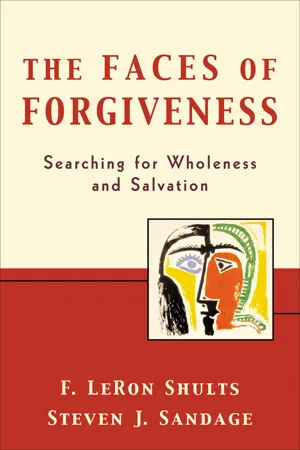
eBook - ePub
The Faces of Forgiveness
Searching for Wholeness and Salvation
- 270 pages
- English
- ePUB (mobile friendly)
- Available on iOS & Android
eBook - ePub
About this book
Information
Topic
Theology & ReligionSubtopic
Christian Theology1
INTRODUCTION
The word forgiveness evokes a variety of powerful emotions. Thinking about forgiveness, some of us smile as we are reminded of a process in our lives that led to the overcoming of pain and bitterness through the healing of an estranged relationship. Others of us grimace as we imagine angry faces trying to coerce us into a passive surrender of our resistance to abuse, betrayal, or injustice. As we reflect on forgiveness, particular human faces can rise to the surface of our consciousness—faces we have forgiven, faces who have forgiven us, or faces we have vowed never to forgive. All of us carry particular moral, political, religious, and therapeutic values into our attempts to understand and practice forgiveness. Our struggle with and for forgiveness is shaped by our deepest hopes and fears as we search for wholeness and salvation in a fragmented and oppressive world. We wonder . . . is forgiveness really good for us?
Forgiveness has become a popular topic in contemporary psychology. Clinicians have been interested in the potential therapeutic benefits of forgiveness for decades,[1] but scientific research on forgiveness rapidly accumulated in recent years.[2] There are now substantial bodies of psychological research on forgiveness in the areas of moral development, social and personality psychology, health psychology, psychology of religion, and group interventions. Most of this work focuses on how people forgive others as a way of coping with the hurt and anger generated by interpersonal transgressions. Somewhat less attention is paid to the dynamics of seeking forgiveness from others and of self-forgiveness. Much recent research on forgiveness relates to an emerging interest in positive psychology, that is, the scientific study of the psychological strengths and virtues that shape human flourishing. Forgiveness is proposed as a human strength (or virtue) that may contribute to personal and relational health.
For centuries, particular theological construals of the concept of forgiveness in Christianity dominated the way it was understood and practiced in much of Western society. Since the Enlightenment, however, some of the traditional ways of speaking about forgiveness in Christian theology have been challenged. On the one hand, the Christian idea that we ought to forgive our enemies came under the suspicion of philosophers like Nietzsche and psychoanalysts like Freud. The suggestion that a victim should simply forgive her oppressor was taken as a mask for weakness or as a defensive illusion based on a projected fear of condemnation. On the other hand, the idea that humans receive divine forgiveness only on the basis of a payment made by (or the punishment of) God’s innocent Son was intensely criticized. In what sense is this forgiveness if a full payment of the debt was required? Does it make sense to speak of one person’s being forgiven on the basis of some other person’s taking their place?[3] Research into the history of theology compelled many scholars to conclude that some of the older formulations of divine forgiveness are so enmeshed in ancient or medieval theories of jurisprudence that we must move beyond them and explore new ways to articulate the Christian doctrine of salvation.
Our book engages these developments in psychology and theology and outlines some new models for understanding and practicing forgiveness. At least three factors make our contribution to the dialogue unique, and this introductory chapter will spell these out in more detail. First, both authors find an emphasis on “relationality” illuminating not only in our own disciplines, but also in the task of tracing connections between disciplines. As a psychologist and a theologian working together, we hope to enhance understanding on both sides. Second, our approach is integrated by a focus on the theme of the hermeneutics of the face. Interpreting the formative power of facing and being faced in the practice of forgiveness may enable us to discern the therapeutic and redemptive dynamics that promote wholeness and salvation. Third, we delineate three fields of meaning in which the term forgiveness is most commonly used. Carefully differentiating these semantic domains and observing their interrelation will help us clarify some of the difficult issues in the dialogue among psychologists and theologians regarding forgiveness. This introductory chapter outlines the unique formal aspects of our treatment of the search for wholeness and salvation and provides an overview of the material contours of our modeling of the dynamics of the faces of forgiveness in psychology and theology.
Relationality and Interdisciplinarity
Our treatment of the topic of forgiveness takes an explicitly interdisciplinary approach, focusing on the essentially relational patterns of human knowing, acting, and being. We believe that careful attention to the philosophical “turn to relationality”[4] opens up new conceptual space for understanding the dynamics of forgiveness. This shift from an emphasis on substances to relational categories and its broader impact on contemporary science and culture will be traced throughout the book. Our primary interest, however, is in the psychological and theological insights that emerge when we consider the idea of forgiveness in the context of the relational interfacings that shape and transform the systems of human existence.
In psychology, the influence of the turn to relationality is illustrated in relational models of psychoanalysis[5] and in empirical research validating the role of relational factors in child development and psychotherapeutic change.[6] Intersubjective psychoanalytic theorists suggest that the self is formed and reshaped through a systemic context of reciprocally interacting subjectivities.[7] A fascination with the other is one of the primary traits of what is commonly called the “postmodern.” Many postmodernists in psychology and psychotherapy emphasize and celebrate difference or “alterity” and view the self as constituted and embedded within relationships. This relational view of the self embodied in community is far removed from the classical definition of persons as “individual substances,” immaterial souls imprisoned in material bodies. In the individualistic, modernist view, neither social identity (e.g., race, ethnicity, gender) nor communal affiliations (e.g., religious tradition) is considered an important dimension of the true self. In part 1, Steve examines this new view in which the self is mediated to itself through relation to the other and the implications for forgiveness. Chapter 2 describes the role of intersubjectivity in the formation of dispositional capacities for forgivingness. This focus on relationality, intersubjectivity, and otherness serves to broaden models of forgiveness in the social sciences, which tend to focus more exclusively on the individual subject attempting to forgive others intrapsychically. Interpersonal conflicts always involve a dynamic intersubjective relationship between at least two people in the systemic context of their respective subjectivities. Dilemmas of forgiveness are embedded in a social process of saving and losing face. Chapter 3 connects intersubjectivity to the social, spiritual, and psychological dynamics of facing and forgiveness.
In Christian theology it might be more appropriate to refer to a return to relationality. Most of the key doctrines that emerged early in the Christian religion are inherently relational; this applies, for example, to the uniquely Christian views of God, revelation, and redemption. The doctrine of the Trinity teaches that God is three persons in relation. The incarnation of the word of God in Jesus Christ discloses the relation between human and divine nature. Believers are redeemed through their intimate relation with the Holy Spirit, who constitutes and builds up the relational unity of the Christian community. In part 2, LeRon traces the impact of the turn to relationality in late modernity on the theory and practice of Christian forgiveness. Chapter 4 outlines the importance of the concepts of facing and forgiveness for theology and describes the theological loss of relational categories in early modernity and the broader philosophical factors in late modernity that have contributed to a renewed emphasis on the explanatory power of the category of relation over substance. This renewal took shape in the retrieval of the ideas of Infinity, Trinity, and Futurity in the doctrine of God in the twentieth century. The doctrine of God inevitably shapes the doctrine of salvation, and chapter 5 explores the implications of these developments for understanding and practicing forgiveness. The emphasis on relationality leads to a new appreciation of the systemic and communal dynamics that are often overshadowed in traditional treatments that focus merely on the individual’s appropriation of divine forgiveness.
In addition to gaining material insights, a vigorous thematization of relationality also illuminates the formal dimensions of the process of inquiry itself. For example, it raises our awareness of the way in which a person’s general social location and particular relations in community both shape her identity and mediate her understanding of and criteria for forgiving. It highlights the danger of the domination of one group over another, drawing out the potential for the abuse of forgiveness as a tool to maintain inequities in social power. Social exclusion and marginalization play a formative role in the dynamics of forgiveness and unforgiveness. Reaching across boundaries, we try to pay special attention to voices from the margins, voices that have previously been excluded from discourse. Both of the authors of this book are white Protestant males and teach in a Christian seminary. This social location influences how we ourselves relate to the process and possibilities of forgiveness. Attending to the relationality that pervades our own psychological and theological inquiry, we are led to acknowledge that we are embedded in our own matrix of concerns; we bring our own particular fears and desires to the text. In these and other ways, starting with communal relationality instead of self-sufficient individuality provides a different perspective on forgiveness.
Attention to relationality also leads to a new awareness of the permeable boundaries between disciplines and invites interdisciplinary dialogue. Not only social locations in general, but also our particular academic contexts shape our approach to forgiveness. Our goal is to reach across these boundaries as well. An emphasis on the intrinsic connections between disciplines leads us to be wary of disciplinary idolatry—allowing one discipline (in this case, psychology or theology) to trump the other discipline when approaching a topic like forgiveness. Dismissing the value of the other discipline can also be a form of hegemony. The science-and-religion multidiscipline can benefit from a dialogue that includes diverse disciplines and methodologies.[8] After the demise of positivism, most scholars recognize that theories in both the social sciences and in theology are in some sense socially constructed and located within traditions. This does not mean that there are no criteria for evaluating theories. It does mean that theories are thoroughly value laden and related to broader conceptual webs. We can recognize this embeddedness without giving up on the search for more adequate models to explain human experience.
Theological proposals must be connected to real lived experience, not only in our communities of faith, but also in our actual experiences of the general systems in which human life is embedded. Conversely, the social sciences should deal with the religious experiences of persons in faith communities. By acknowledging the overlapping interests and interdependence of these disciplines, social scientists and theologians can become dialogical partners in constructive theory development. Of particular importance for the study of forgiveness is the interrelatedness of construals of ethics and health, which have traditionally been two distinct spheres of inquiry. Ethics was in the domain of philosophical and theological reflection, while health was in the domain of the physical and social sciences. This separation has the advantage of working against the age-old problem of equating health problems with moral failure. It can also occlude the real connection between some moral behaviors or dispositions and physical or psychological health. It is easy to find scholarly treatments of ethical or moral questions of forgiveness from philosophical or theological perspectives, and numerous books and articles in the fields of psychology and psychotherapy relate forgiveness to questions of mental health and wholeness. Only a few books, however, attempt to address both the ethical and health-related questions of forgiveness.[9]
Our emphasis on relationality and interdisciplinarity is connected to the broader debate in academe over postmodernity. Broadly speaking, “the postmodern turn”[10] involves a critique of aspects of the modern worldview that has dominated Western culture since the Enlightenment(s) of the seventeenth and eighteenth centuries. Many postmodern voices focus on the deconstruction of modernist metanarratives, the ideals of objective science, and universal truth claims. But not all postmodern perspectives are the same. Pauline Rosenau distinguishes skeptical postmodernism from affirmative postmodernism.[11] Skeptical postmodernism engages in the critical function of unmasking and deconstructing power agendas that lurk behind claims of universal truth and authoritative interpretations of texts. Operating from a strong hermeneutic of suspicion and generally reluctant to articulate ethical or political positions regarding virtue or the good,[12] skeptical postmodernists in the field of psychotherapy deny having a conceptual ideal for healthy human functioning and tend to appeal to pragmatism.
In contrast, affirmative postmodernists are wary of relativism and more open to the value of new ethical and political proposals. Therefore, they are more willing to articulate theories of health, virtue, and justice and are more optimistic about constructing new and less oppressive models of identity, knowledge, and community using interdisciplinary methodologies that incorporate empirical science. For example, Robert Kegan’s notion of “reconstructive postmodernism”[13] involves an attempt to move beyond the deconstructive task of critique and to engage in the perennial search for more integrated models for understanding human experience. Our approach in this book is reconstructive in this sense, although the phrase late modern[14] might be less misleading since we do not believe that post modernism has simply left behind the concerns of the Enlightenment. Contemporary social science and theology continue to operate in a dialectical relation with modern values, critically discerning and refiguring them in the ongoing task of reconstruction. Our goal in the current study is not so much to interpret the phenomena of the postmodern as it is to engage in a transversal performance of interpretation, to make sense out of the search for wholeness and salvation in a way that makes sense in and to contemporary culture.[15]
Hermeneutics and the Face
Our emphasis on relationality and our attempt to interpret forgiveness across disciplinary boundaries inevitably raise hermeneutical questions. Facing the challenges of hermeneutics leads us to reflect on the hermeneutics of facing. We suggest that the face represents a powerful interpersonal “text” that evokes an attempt to interpret the feelings and dispositions of the other. We call the ambiguous hermeneutical process that occurs in interpersonal relationships “facial hermeneutics.” The multifaceted text of the face is itself shaped intertextually through interaction with a multitude of other faces, accompanied by interpersonal challenges that influence forgiveness and unforgiveness. Psychological research suggests that we are constantly interpreting one another, making attributions about the motives and actions of others. We will review research that suggests that certain kinds of attributions and interpretations significantly impact the process of forgiveness. The early experiences of being faced by caregivers may even serve the formation of internal representations of the face of God, affecting our attribution of emotions to the divine. The following chapters explore the developmental and theolog...
Table of contents
- Cover
- Title Page
- Copyright Page
- Dedication
- Contents
- Acknowledgments
- 1. Introduction
- Part 1: Faces of Forgiveness in Psychology Steven J. Sandage
- Part 2: Faces of Forgiveness in Theology F. Leron Shults
- Part 3: Modeling Forgiveness: Interdisciplinary Explorations Steven J. Sandage and F. Leron Shults
- Bibliography
- Index
- Notes
Trusted by 375,005 students
Access to over 1.5 million titles for a fair monthly price.
Study more efficiently using our study tools.
Frequently asked questions
Yes, you can cancel anytime from the Subscription tab in your account settings on the Perlego website. Your subscription will stay active until the end of your current billing period. Learn how to cancel your subscription
No, books cannot be downloaded as external files, such as PDFs, for use outside of Perlego. However, you can download books within the Perlego app for offline reading on mobile or tablet. Learn how to download books offline
Perlego offers two plans: Essential and Complete
- Essential is ideal for learners and professionals who enjoy exploring a wide range of subjects. Access the Essential Library with 800,000+ trusted titles and best-sellers across business, personal growth, and the humanities. Includes unlimited reading time and Standard Read Aloud voice.
- Complete: Perfect for advanced learners and researchers needing full, unrestricted access. Unlock 1.5M+ books across hundreds of subjects, including academic and specialized titles. The Complete Plan also includes advanced features like Premium Read Aloud and Research Assistant.
We are an online textbook subscription service, where you can get access to an entire online library for less than the price of a single book per month. With over 1.5 million books across 990+ topics, we’ve got you covered! Learn about our mission
Look out for the read-aloud symbol on your next book to see if you can listen to it. The read-aloud tool reads text aloud for you, highlighting the text as it is being read. You can pause it, speed it up and slow it down. Learn more about Read Aloud
Yes! You can use the Perlego app on both iOS and Android devices to read anytime, anywhere — even offline. Perfect for commutes or when you’re on the go.
Please note we cannot support devices running on iOS 13 and Android 7 or earlier. Learn more about using the app
Please note we cannot support devices running on iOS 13 and Android 7 or earlier. Learn more about using the app
Yes, you can access The Faces of Forgiveness by F. LeRon Shults,Steven J. Sandage in PDF and/or ePUB format, as well as other popular books in Theology & Religion & Christian Theology. We have over 1.5 million books available in our catalogue for you to explore.