The New Testament is the foundation of the Christian church, but some question its historical accuracy. Others have claimed that Paul's teaching differs from that of the Gospels. How can we reconcile the seemingly different messages of Jesus and Paul? What is the relevance of the New Testament in our world today, in cultures far removed by time and space from the first-century Mediterranean world? What principles can we use to make appropriate applications?
In Making Sense of the New Testament, Craig Blomberg offers a reasonable, well-informed response to these crucial questions encountered by Bible readers. Grounded in sound scholarship but written in an accessible style, this book offers reliable guidance to pastors, students, and anyone interested in a better understanding of the New Testament.
eBook - ePub
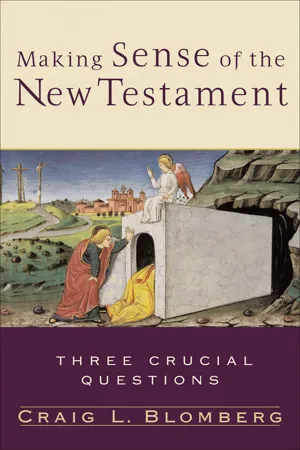
Making Sense of the New Testament (Three Crucial Questions)
Three Crucial Questions
- 190 pages
- English
- ePUB (mobile friendly)
- Available on iOS & Android
eBook - ePub
Making Sense of the New Testament (Three Crucial Questions)
Three Crucial Questions
About this book
Information
Topic
Theology & ReligionSubtopic
Biblical StudiesCHAPTER 1
Is the New Testament Historically Reliable?
Jesus and Christian origins continue to fascinate the American public. The religion shelves of all major bookstore chains stock numerous titles on these topics. Unfortunately, they range all the way from books written by responsible scholars to works of sheer fiction, foisted on the unsuspecting reader as the latest “true discovery” about the beginnings of Christianity. We may discern three categories of such volumes that lie beyond the mainstream of serious, biblical scholarship.
First, and most disturbing of all, are books based on no genuine historical evidence of any kind. A retired professor of atmospheric science at a major state university becomes enthralled with UFOs and publishes two books about an alleged Aramaic document, found in the Middle East but then (conveniently) lost again, preserved only in German translation by a “UFOlogist,” that rewrites the Gospel of Matthew. In this document, Jesus becomes an alien from outer space, visiting earth to teach doctrine similar to modern “New Age” philosophy![1] Or again, a best-selling collection of ancient and more recent Christian fiction, called The Archko Volume, purports to release to the public the true accounts of Jesus and early Christianity, without admitting that no responsible historian anywhere believes a shred of its contents to reflect historical fact.[2]
A second category involves the distortion of newly discovered evidence. When the Dead Sea Scrolls were unearthed shortly after World War II, all kinds of sensationalist claims were made for how they would radically rewrite the history of Christian origins. That never happened, but another flurry of fanciful exaggerations emerged in the early 1990s when the last round of very fragmentary documents from Qumran, the site of the Dead Sea sect, was finally published and translated. One of the most famous sets of charges comes from a series of works by the Australian writer Barbara Thiering. She alleges that various characters in the documents that describe the members of the Qumran community, and others in the Jewish world of its day, are code names for John the Baptist, Jesus, and some of his followers![3] There is, however, no reason to suspect that Qumran invented such codes, not least because the vast majority of its documents predate the first century and the birth of Christ. Not surprisingly, Thiering has garnered no significant following among fellow scholars.
Distortions of new discoveries can also come from conservative circles. Carsten Thiede, a German evangelical, has written several recent works arguing that tiny fragments of Greek manuscripts found at Qumran, containing just a few letters each, actually represent verses from the Gospel of Mark. If true, these finds would require a date for that Gospel earlier than that which even conservative scholars have usually defended. Thiede also believes that a copy of Matthew in Greek, long preserved in the Magdalen College, Oxford, library, dates to the mid–first century. But virtually all other scholars who have examined these claims find the equation of the Qumran fragments with Mark in error and the Oxford papyrus to have come from the same codex (or book) to which papyri dating to the 200s, now housed in Paris and Barcelona, belonged.[4] Conservative Christians might wish that Thiede’s hypotheses proved likely, but it rightly discredits them in the eyes of others if they try to support highly improbable theses simply for the sake of furthering their apologetic.
The third category brings us even closer to the boundaries of responsible scholarship. There are fully credentialed New Testament scholars on the theological “far left” who do bona fide research, but present their opinions as if they reflected a consensus of scholarship when in fact they represent the “radical fringe.” By far the most famous example of this in recent years was the “Jesus Seminar,” a group of individuals, mostly New Testament scholars (though many had not specialized in historical-Jesus research), who initially numbered more than two hundred but eventually dwindled to less than fifty, and who courted media attention for their semiannual conferences throughout the late 1980s and 1990s. Voting on every saying and deed attributed to Jesus in the four Gospels, plus the apocryphal Gospel of Thomas,[5] the Jesus Seminar concluded that only 18 percent of the sayings and 16 percent of the actions of Jesus in these five documents represented something close to what Jesus really said or did.[6]
These conclusions, however, were virtually determined by the Seminar’s presuppositions and method. In a particularly candid listing of these presuppositions, the Seminar explains that miracles cannot happen, so that all of the supernatural events of the Gospels are rejected from the outset, and that Jesus never talked about himself, or about the future, or about final judgment (a topic unworthy of an enlightened teacher).[7] These latter presuppositions go far beyond the anti-supernatural bias of the former, which would conclude that Jesus could not have believed himself to be divine or have predicted the future inerrantly. Instead, they affirm what has been true of no other religious leader in history, namely, that Jesus did not make any claims about his identity or speculate at all about coming events. And, while it may be true that certain modern liberals cannot stomach the notion of a judgment day when all humanity will be brought to account before God, such a belief was nearly universal in Jesus’ world, so it would be astonishing if he did not reflect on the topic.
The Jesus Seminar has now completed its work and disbanded but, at the beginning of the new millennium, a comparable Acts Seminar was formed and initial results published, which suggest that the same flawed approaches are being adopted.[8] Fortunately, it has received far less media attention; one can hope that it will simply fizzle out altogether.
Meanwhile, one of the better-kept secrets from the twenty-first-century public is that the so-called Third Quest for the historical Jesus over the past quarter-century has for the most part been proving more and more optimistic about how much we can know about the founder of Christianity. Ben Witherington’s survey of approaches in the mid-1990s offers an excellent overview. Focusing on different portions of the Gospels’ portraits and comparing them with the unprecedented quantity of information now available about the first-century Jewish, Greek, and Roman worlds, responsible mainstream New Testament scholars have demonstrated the numerous ways in which Jesus was a Spirit-filled prophet of a coming new age, a social reformer, a wise sage, and a marginalized messiah.[9] Only slightly less intense is a renewed scholarly scrutiny of the apostle Paul, which Witherington has similarly surveyed, including a rehabilitation of the historical value of the Book of Acts, especially those sections that deal with Paul’s ministry.[10]
But outside of distinctively evangelical circles, even in mainstream, centrist New Testament scholarship, it is still by no means believed that any substantial majority of the Gospels or Acts is historically accurate. Standard criteria are employed to separate the more historical from the less historical parts.[11] Yet here again, recent studies have suggested that these criteria prove inadequate for what they claim to accomplish. The two most common criteria in Gospels scholarship have become known as “dissimilarity” and “multiple attestation.” The dissimilarity criterion accepts as authentic that which sets an event or saying in the Gospels off from both the conventional Jewish world of Jesus’ day as well as from subsequent Christianity, since it is then unlikely that any other Jew or Christian would have invented it. The criterion of multiple attestation accepts as more probably historical that which is presented in more than one Gospel or in more than one literary form or source that the Gospels employed. Both of these criteria can point out elements that are securely anchored in the ministry of the historical Jesus, but they cannot logically eliminate items that do not pass the two tests. Jesus overlapped with his Jewish predecessors, while early Christians accurately imitated him in numerous respects. Solitary witnesses may also communicate historical truth. So we need more sophisticated criteria if we are going to challenge details in the Gospels as not reflecting accurate history.[12]
In fact, several scholars have recently developed a four-part criterion that makes it more likely that large swaths of the Gospels are historically accurate. N. T. Wright, bishop of Durham, England, and arguably evangelicalism’s leading New Testament scholar today, calls it the double dissimilarity and similarity criterion. German scholars Gerd Theissen, Annette Merz, and Dagmar Winter all speak of the criterion of historical plausibility. In each case, it is argued, numerous features in the Gospels simultaneously demonstrate (1) enough continuity with Jewish backgrounds to be credible in an Israelite setting from the first third of the first century; (2) enough discontinuity with conventional Judaism to suggest it would not have been invented by an average Jew; (3) enough continuity with early Christianity to show that Jesus was not uniformly misunderstood by his followers; and (4) enough discontinuity with the early Jesus movement to suggest that one of the first Christians did not invent it. When all four of these conditions are fulfilled, we may be very confident that the Gospels present us with accurate information. Wright is more optimistic than the trio of Germans about how much material meets these conditions, but even the writings of the latter accept many of the central themes of the Gospels, certainly many more details than modern, highly skeptical German scholarship usually has acknowledged.[13]
The modest scope of this book prevents me from commenting, even briefly, on each of the central themes or portions of the New Testament data. But I can point to numerous more general features that support a substantial measure of confidence in the historical trustworthiness of the five New Testament books that traditionally have been assumed to present a faithful record of the life of Jesus and the first generation of Christian history—the Gospels of Matthew, Mark, Luke, and John, and the Book of Acts. In doing so, we don our historians’ hats and try, for the moment, to bracket Christian belief. We do not want to be guilty of doing what we so sharply criticize the Jesus Seminar for doing, which is to presuppose our conclusions.[14] But even if we limit ourselves to the approaches taken by the classical historians who study other people, events, and institutions from the ancient Jewish, Greek, and Roman worlds, a cumulative case emerges which suggests that the Gospels and Acts are very historically reliable.
Textual Criticism
The standard starting point for investigating the trustworthiness of an ancient document does not deal with the credibility of its contents, per se, but rather asks if we can even be confident we have anything close to what the author of that document originally wrote. In most cases, the oldest copies we have of a given book date from centuries after it was first written. Nor do very many copies of a given book typically exist from the eras before the printing press was invented. For example, there are only nine or ten good manuscripts for Caesar’s Gallic War, and the oldest derives from nine hundred years after the dates of the events described. Only thirty-five of Livy’s 142 books of Roman history survive, and these in about twenty manuscripts, only one of which is as old as the fourth century. Only four and one-half of Tacitus’s fourteen books of Roman history have survived, and these in only two manuscripts dating to the ninth and eleventh centuries.[15]
By contrast, the textual evidence for the New Testament from the first centuries after it was written is staggering. Scholars of almost every theological stripe agree that Christian scribes copied the New Testament with extraordinary care, matched only by the accuracy of Jewish scribes copying the Hebrew Scriptures (the Christian Old Testament). In the original Greek alone, more than five thousand manuscripts or manuscript fragments of portions of the New Testament have been preserved from the centuries during which the Bible was copied by hand. The oldest of these is a scrap of papyrus designated p52 that contains parts of John 18:31–33 and 37–38 and dates from the first third of the second century A.D., no more than forty years after John’s Gospel was first written in the 90s. More than thirty papyri date from the late second through early third centuries. Some of these contain large portions of entire New Testament books. One of these covers most of the Gospels and Acts (p45); another, most of the letters of Paul (p46). Four very reliable and nearly complete New Testaments date from the fourth (x and B) and fifth centuries (A and C).
All kinds of minor variations distinguish these manuscripts from one another, but the vast majority of these variations involve mere changes in spelling, grammar, and style, or accidental omissions or duplications of letters, words, or phrases. Only about four hundred (less than one per page in an average English translation) have any significant bearing on the meaning of the passage at hand, and the most important variations are usually noted in the footnotes of modern-language translations of the Bible. The only textual variants that affect more than a sentence or two (and most affect only individual words or phrases) are John 7:53–8:11 and Mark 16:9–20. Neither of these passages very likely reflects what John or Mark originally wrote, though the story in John—about the woman caught in adultery—still stands a fairly good chance of being historically accurate. But overall, 97 to 99 percent of the original Greek New Testament can be reconstructed beyond any reasonable doubt. Moreover, no Christian doctrine is founded solely, or even primarily, on any textually disputed passage.[16]
Thus even the most liberal members of the Jesus Seminar agree with very conservative, evangelical scholars that there is no historical evidence whatsoever to support the claims of some modern-day Mormons or Muslims that the text of the New Testament became so corrupted over the centuries that we have no way of being sure what the original contained. These claims in fact contradict the official teachings of both religions. Joseph Smith’s declarations, enshrined in the distinctive, additional Scriptures of the Latter-day Saints, and Islam’s holy book, the Qur’an, both refer to the Bible as the Word of God and strongly support the accuracy of its contents, while stopping short of affirming full-fledged inerrancy. But the unofficial teachings of many leaders in both movements have, unjustifiably, often called this accuracy into question.[17]
Authorship and Date
Once we have established that we have a trustworthy reconstruction of what an ancient document contained, based on the comparison of the manuscripts that exist from a later date, we are ready to begin to assess the truthfulness of its contents. The next standard question for historians of antiquity is if we can determine the author of the document and the date at which it was written. If the author turns out to be someone who was in a position to know the facts about the people or the events described, if we can determine that his or her character was generally trustworthy, our conviction about the reliability of the document increases. If the date at which the work was written was within the lifetime of eyewitnesses of the events narrated, our confidence similarly rises. If these conditions are not fulfilled, we become more skeptical about the contents of the history that is narrated.
How do the Gospels and Acts fare when tested by these criteria? Remarkably well, at least by ancient standards. Strictly speaking, the authors of these five books are anonymous, since the names Matthew, Mark, Luke, and ...
Table of contents
- Cover
- Title Page
- Copyright Page
- Dedication
- Contents
- List of Abbreviations
- Preface
- Introduction
- 1. Is the New Testament Historically Reliable?
- 2. Was Paul the True Founder of Christianity?
- 3. How Is the Christian to Apply the New Testament to Life?
- Summary
- Notes
- Subject Index
- Scripture Index
Trusted by 375,005 students
Access to over 1.5 million titles for a fair monthly price.
Study more efficiently using our study tools.
Frequently asked questions
Yes, you can cancel anytime from the Subscription tab in your account settings on the Perlego website. Your subscription will stay active until the end of your current billing period. Learn how to cancel your subscription
No, books cannot be downloaded as external files, such as PDFs, for use outside of Perlego. However, you can download books within the Perlego app for offline reading on mobile or tablet. Learn how to download books offline
Perlego offers two plans: Essential and Complete
- Essential is ideal for learners and professionals who enjoy exploring a wide range of subjects. Access the Essential Library with 800,000+ trusted titles and best-sellers across business, personal growth, and the humanities. Includes unlimited reading time and Standard Read Aloud voice.
- Complete: Perfect for advanced learners and researchers needing full, unrestricted access. Unlock 1.5M+ books across hundreds of subjects, including academic and specialized titles. The Complete Plan also includes advanced features like Premium Read Aloud and Research Assistant.
We are an online textbook subscription service, where you can get access to an entire online library for less than the price of a single book per month. With over 1.5 million books across 990+ topics, we’ve got you covered! Learn about our mission
Look out for the read-aloud symbol on your next book to see if you can listen to it. The read-aloud tool reads text aloud for you, highlighting the text as it is being read. You can pause it, speed it up and slow it down. Learn more about Read Aloud
Yes! You can use the Perlego app on both iOS and Android devices to read anytime, anywhere — even offline. Perfect for commutes or when you’re on the go.
Please note we cannot support devices running on iOS 13 and Android 7 or earlier. Learn more about using the app
Please note we cannot support devices running on iOS 13 and Android 7 or earlier. Learn more about using the app
Yes, you can access Making Sense of the New Testament (Three Crucial Questions) by Craig L. Blomberg in PDF and/or ePUB format, as well as other popular books in Theology & Religion & Biblical Studies. We have over 1.5 million books available in our catalogue for you to explore.