Examine the New Testament from within the living tradition of the Catholic Church
In this third volume of the Catholic Commentary on Sacred Scripture (CCSS), Peter Williamson interprets Ephesians for pastoral ministers and lay readers alike.
The CCSS relates Scripture to Christian life today, is faithfully Catholic, and is supplemented by features designed to help pastoral ministers, lay readers, and students better comprehend the Bible and use it more effectively.
Commentary features include:
● Biblical text from the New American Bible, Revised Edition (NABRE)
● References to the Catechism, the Lectionary, and related biblical texts
● Theological insights from Church fathers, saints, and popes
● Reflection and application sections for daily Christian living
● Suggested resources and an index of pastoral subjects
Attractively packaged and accessibly written, the CCSS aims to help readers understand their faith more deeply, nourish their spiritual life, and share the good news with others.
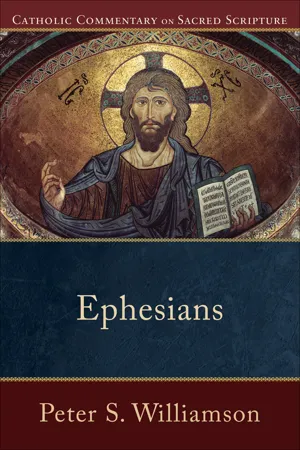
eBook - ePub
Ephesians (Catholic Commentary on Sacred Scripture)
- 222 pages
- English
- ePUB (mobile friendly)
- Available on iOS & Android
eBook - ePub
Ephesians (Catholic Commentary on Sacred Scripture)
About this book
Information
Topic
Theology & ReligionSubtopic
Biblical CommentaryBlessing God for Every Spiritual Blessing
Ephesians 1:1–14
Like a majestic overture before a symphony, a hymn of praise at the beginning of Ephesians arouses our anticipation of what is to come by sounding the great themes of salvation and setting the tone for the entire letter. The grandeur of these truths inspires awe at God’s amazing plan.
Greeting (1:1–2)
1Paul, an apostle of Christ Jesus by the will of God, to the holy ones who are [in Ephesus] faithful in Christ Jesus: 2grace to you and peace from God our Father and the Lord Jesus Christ.
NT: Col 1:1–2
Catechism: members of the Church called “saints,” 823
[1:1] Paul briefly introduces himself and salutes his readers with his customary greeting. The word apostle comes from the Greek verb “to send” and means someone who has been “sent” as an official representative. Paul refers to the one who sent him by his title, Christ Jesus. Just as Jesus’ appointment of the Twelve was in accord with the will of the Father—it followed a night of prayer (Luke 6:12–13)—so Paul’s appointment as the †Messiah’s authorized delegate (Acts 26:15–18) is by the will of God.
The holy ones or “†saints” whom Paul addresses are the members of the Church.[1] Christians are †holy in the deepest sense not because of heroic virtue but because they have been made holy (sanctified) by a holy God and belong to him. God sanctified them through the death and resurrection of Jesus and has communicated this holiness to them through baptism and the gift of the Spirit.[2]
The NAB places in Ephesus in brackets because it is missing in some important manuscripts (see the introduction). It is likely that Ephesians was written as a circular letter (an “encyclical”) to a number of churches in the Roman province of Asia (located in modern-day Turkey).
Paul also refers to these “holy ones” as faithful in Christ Jesus. The Greek word pistoi can be translated “faithful,” “reliable,” or “believing.” This adjective often functions as a shorthand way of referring to Christians—“believers” or “the faithful”—since it is †faith in Jesus that makes us Christians.
[1:2] Paul’s greeting—grace to you and peace from God our Father and the Lord Jesus Christ—can be understood either as a prayer-wish, customary in letters of that period, or as Paul’s bestowing a blessing on behalf of those he represents, namely, God the Father and the Lord Jesus.
Among Greek-speaking people in Paul’s day, the common greeting at the beginning of letters was chairein—“rejoice”—indicating that the sender wished happiness to the recipient. Paul’s word “†grace” (charis) is similar but refers instead to a divine “gift” or “†favor.” The common greeting among Jews was shalom, usually translated in English as “peace,” although the Hebrew word has a wider range of meaning, signifying complete well-being.
It is worth noting how Paul refers here to the first two persons of the Trinity. He refers to God familiarly as our Father—in the words Jesus taught his disciples and with the filial confidence that the Spirit inspires (Rom 8:15; Gal 4:6). Paul refers to Jesus by the solemn titles that reveal his identity. He is Lord and Christ (see Acts 2:36; Phil 2:11; Rev 11:15). “Christ” means Messiah (see sidebar on p. 29). Lord, kyrios, means “master” and is the way that the †Septuagint, the Greek translation of the Hebrew Bible, translates the divine name “Yahweh.” Jesus’ divine status is further indicated by the fact that he is named alongside God as the source of “grace . . . and peace.”
Opening Blessing (1:3–14)
Paul begins his letter by fervently praising God for his generosity toward the people who belong to Christ. He adopts a form of prayer found in the Old Testament (Gen 14:20; 1 Kings 8:15; Ps 66:20) called a berakah, the Hebrew word for “blessing”—a prayer form that is still used by Jews today. A berakah begins with the words “Blessed be God” and immediately states why God should be praised by naming the benefits received from him. Paul’s blessing differs from Jewish blessings by identifying God as the Father of Jesus and by making repeated references to Christ.

What Does “Christ” Mean?
The name “Christ” appears three times in the first two verses and forty-six times in the whole of Ephesians. To most people today “Christ” is simply part of Jesus’ name. But to the New Testament authors and the first-century men and women who were evangelized by Jewish believers, “Christ” meant “Messiah.”
The word “Christ” comes from the Greek christos, the Septuagint translation of the Hebrew word mashiah (English “messiah”), meaning “anointed.” In the Old Testament, priests, kings, and (occasionally) †prophets were consecrated by being anointed with oil. The books of Samuel and Psalms often refer to the king of Israel as the Lord’s “anointed” (1 Sam 16:6; Ps 2:2). God promised through the prophets that he would place a descendant of David on the throne of Israel who would save God’s people and establish an everlasting kingdom (2 Sam 7:12–13; Isa 9:1–7; Jer 33:14–22). In the two centuries before the birth of Jesus, Jews increasingly used the term “the messiah” (“the christ”) to refer to this promised redeemer-king.
When Jesus began his ministry, many Jews were eagerly awaiting the coming of this royal messiah, and some wondered if Jesus was the one (Matt 26:63; John 1:19–25; 7:31). Jesus was born of the line of David (Luke 2:4) and revealed himself as “anointed” by the Spirit (Luke 4:18). Peter confessed him to be the Christ, the promised Messiah (Mark 8:29),a and the resurrection confirmed his identity as God’s †eschatological savior. The apostles preached Jesus as the Messiah (Acts 5:42; 9:22). Since the messianic promise was fulfilled in Jesus, the title christos became affixed to his name—“Christ Jesus” or “Jesus Christ”—much the way people combine name and title when they say “King David” or “Queen Elizabeth.” But the meaning of “Christ” remains: the Messiah, the descendant of David whom God anointed to save and reign forever over his people and the world.
a. The NAB and NRSV usually translate christos as “Messiah” in the Gospels, as “Christ” or “Messiah” in Acts, and as “Christ” in the rest of the New Testament. The use of “Messiah” better conveys the meaning to contemporary Christians, while the use of “Christ” has the advantage of familiarity and liturgical usage. I will use the terms interchangeably.
The Greek text of Eph 1:3–14 forms one complex sentence—the longest in the New Testament. Most English translations wisely break down the blessing into many sentences in two or three paragraphs. Even so, it takes considerable effort to understand the rich cluster of ideas and images contained in it.
Paul begins by blessing (that is, praising) God for having bestowed on Christians every possible divine blessing (that is, every divine gift and favor; 1:3). The rest of the prayer explains what those blessings are (1:4–10) and how they have come both to Jews and †Gentiles who have believed in Jesus (1:11–14). It is possible to count four, six, seven, eight, or more blessings, depending on how finely a reader wishes to distinguish them from one another. Rather than list these blessings in a neat, orderly way, Paul brims over with praises that explain or add to blessings already mentioned.
Although these verses appear as a distinct prayer of praise, they are linked to the rest of Ephesians, introducing themes that occur throughout the letter. This prayer fulfills one of the main purposes of the letter, namely, to help Christians appreciate the extraordinary gifts we have received through Christ.
Scholars hold a variety of opinions about the structure of this blessing. I will follow the division indicated by the paragraph headings in the NAB, which highlights the Trinitarian structure of the prayer, but I will treat the first verse as a separate unit:
Overview of the Blessing (1:3)
The Father’s Plan of Salvation (1:4–6)
Fulfillment of the Plan through Christ (1:7–10)
Inheritance through the Spirit (1:11–14)
The Father’s Plan of Salvation (1:4–6)
Fulfillment of the Plan through Christ (1:7–10)
Inheritance through the Spirit (1:11–14)
This three-part structure also highlights three phases of God’s plan of salvation: creation, redemption, and †inheritance. To get the full impact of this wonderful prayer of praise, I suggest reading all of 1:3–14 aloud once or twice before continuing with the commentary below.
Summary of the Blessing (1:3)
3Blessed be the God and Father of our Lord Jesus Christ, who has blessed us in Christ with every spiritual blessing in the heavens,
NT: 2 Cor 1:3; 1 Pet 1:3
Catechism: meaning of “blessing,” 1078–79; God revealed as Father of the Son, 240
Lectionary: 1:3–6, 11–12: Immaculate Conception, Commons of the Blessed Virgin Mary; 1:3–10, 13–14: Christian Initiation Apart from the Easter Vigil; 1:3–14: Consecration of Virgins and Religious Profession
[1:3] This opening makes an extraordinary declaration. It praises (blesses) God the Father for having already bestowed on us Christians every blessing of †heaven! Every word of this statement bears further examination.
Rather than referring to God as “King of the Universe” or “the God of Israel,” as Jewish blessings typically do, this blessing identifies God as the “Father” of our Lord Jesus Christ (as in 2 Cor 1:3 and 1 Pet 1:3). Ever since Jesus’ death and resurrection, Christians cannot think about God apart from Jesus or about Jesus except as God’s Son. Jesus is himself described in a particular way as “our Lord.” The possessive pronoun “our” conveys a warmth of mutual belonging and the words “†Lord” and “Christ” express a sense of our accountability to him. Paul likes to speak of “our Lord”; he uses this expression twelve times in Romans, ten times in 1 Corinthians, and five times in Ephesians (1:17; 3:11; 5:20; 6:24). Paul usually completes the phrase “our Lord” with his name and title, “Jesus Christ.” Jesus is the one whom Christians acknowledge and obey as our Lord and †Messiah. Pronouncing his name arouses devotion among those who know him.
Paul now states his reason for praising God: because God has blessed us. There is intentional wordplay on the different meanings of “bless.” The verb “to bless” (eulogeō) and the noun “blessing” (eulogia) are both related to the first word of the sentence, “Blessed (eulogētos) be God.” When people bless God, they praise him. When God blesses, he confers a benefit.
The text tells us that God has blessed us in Christ. The expression “in Christ” (en Christō) occurs very often in Ephesians; if we include equivalent phrases, such as “in him,” it occurs eleven times in this opening blessing alone. In Greek this phrase i...
Table of contents
- Cover
- Tilte Page
- Copyright Page
- Endorsements
- Contents
- Illustrations
- Editors’ Preface
- Abbreviations
- Introduction
- Outline of the Letter to the Ephesians
- Part 1: Proclamation of God’s Gracious Plan of Salvation in Christ
- Part 2: Exhortation to Christian Conduct
- Suggested Resources
- Glossary
- Index of Pastoral Topics
- Index of Sidebars
- Map
- Notes
- Back Cover
Trusted by 375,005 students
Access to over 1.5 million titles for a fair monthly price.
Study more efficiently using our study tools.
Frequently asked questions
Yes, you can cancel anytime from the Subscription tab in your account settings on the Perlego website. Your subscription will stay active until the end of your current billing period. Learn how to cancel your subscription
No, books cannot be downloaded as external files, such as PDFs, for use outside of Perlego. However, you can download books within the Perlego app for offline reading on mobile or tablet. Learn how to download books offline
Perlego offers two plans: Essential and Complete
- Essential is ideal for learners and professionals who enjoy exploring a wide range of subjects. Access the Essential Library with 800,000+ trusted titles and best-sellers across business, personal growth, and the humanities. Includes unlimited reading time and Standard Read Aloud voice.
- Complete: Perfect for advanced learners and researchers needing full, unrestricted access. Unlock 1.5M+ books across hundreds of subjects, including academic and specialized titles. The Complete Plan also includes advanced features like Premium Read Aloud and Research Assistant.
We are an online textbook subscription service, where you can get access to an entire online library for less than the price of a single book per month. With over 1.5 million books across 990+ topics, we’ve got you covered! Learn about our mission
Look out for the read-aloud symbol on your next book to see if you can listen to it. The read-aloud tool reads text aloud for you, highlighting the text as it is being read. You can pause it, speed it up and slow it down. Learn more about Read Aloud
Yes! You can use the Perlego app on both iOS and Android devices to read anytime, anywhere — even offline. Perfect for commutes or when you’re on the go.
Please note we cannot support devices running on iOS 13 and Android 7 or earlier. Learn more about using the app
Please note we cannot support devices running on iOS 13 and Android 7 or earlier. Learn more about using the app
Yes, you can access Ephesians (Catholic Commentary on Sacred Scripture) by Peter S. Williamson, Williamson, Peter S., Healy, Mary, Peter S. Williamson,Mary Healy in PDF and/or ePUB format, as well as other popular books in Theology & Religion & Biblical Commentary. We have over 1.5 million books available in our catalogue for you to explore.