At a time of deep disagreements about the nature and purpose of academic biblical studies, Markus Bockmuehl advocates the recovery of a plural but common conversation on the subject of what the New Testament is about.
Seeing the Word begins with an assessment of current New Testament studies, identifying both persistent challenges and some promising proposals. Subsequent chapters explore two such proposals. First, ground for common conversation lies in taking seriously the readers and readings the text implies. Second, Bockmuehl explores the text's early effective history by a study of apostolic memory in the early church.
All serious students of the Bible and theology will find much of interest, and much to discuss, in this first volume in the Studies in Theological Interpretation series.
eBook - ePub
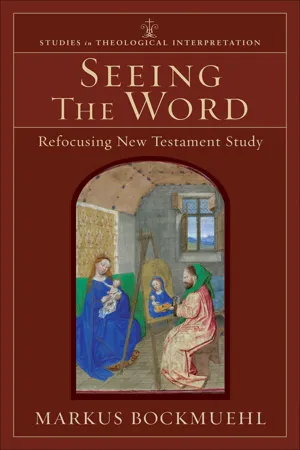
Seeing the Word (Studies in Theological Interpretation)
Refocusing New Testament Study
- 298 pages
- English
- ePUB (mobile friendly)
- Available on iOS & Android
eBook - ePub
Seeing the Word (Studies in Theological Interpretation)
Refocusing New Testament Study
About this book
Information
1
THE TROUBLED FORTUNES OF NEW TESTAMENT SCHOLARSHIP
One Tuesday afternoon in June 1936, Cambridge’s newly installed Norris-Hulse Professor of Divinity set out to deliver his inaugural lecture (Dodd 1936b). As he stepped up to the podium to address his distinguished audience, his subject stretched out before him in a wide-open vista, clear and uncluttered, inviting him to enter into the inheritance of a century or more of definitive scientific investigation. The man was C. H. Dodd (1884–1973); his title, “The Present Task in New Testament Studies.”
At 52, Dodd was no youngster, and even after two generations the depth and substance of his remarks make it amply clear that we are dealing with a mature and seasoned master of his trade. One indication of this expertise is the accuracy with which his lecture discerned and predicted several necessary and important developments in subsequent New Testament scholarship. These included the increasing importance of Jewish studies, the inadequacy of attempting (e.g., in the history of religions school) to construe early Christian beliefs and practices simply from an “amalgam of half-digested ideas drawn from Hellenistic sources” (cf. Dodd 1936b: 15), and perhaps especially the need for renewed and serious study of the Fourth Gospel. Some of these perspectives would have found a ready audience in the Cambridge of F. C. Burkitt (1864–1935) and E. C. Hoskyns (1884–1937). At the same time, Dodd’s anticipation of these developments in part already manifests a certain wariness of latent dangers they might entail, for example, for a coherently Christian interpretation of the New Testament.[1]
All that being said, it is precisely the maturity of Dodd’s statement that makes the supreme ease and confidence of many of his methodological assumptions seem all the more startling after threescore and ten years have passed. A handful of examples will suffice to illustrate this point. The critical task of New Testament study, Dodd believed, must be undertaken in five successive stages. Each of these builds on the results of the earlier ones, even where those results may be preliminary or incomplete:
- text criticism, to establish the original autograph form of the texts
- so-called higher criticism, to address questions of Einleitung and historical setting
- detailed linguistic exegesis
- comparative study of ancient Jewish, Hellenistic, and early patristic religious beliefs
- biblical theology, to serve as the culmination and capstone of the whole edifice
In temperamentally conservative circles, whether wedded to evangelical, liberal, or secular confessional presuppositions, some such model of New Testament studies may survive to this day. And given the size especially of a conservative evangelical constituency in the United States, the classic “layer cake” methodology may still generate rapport in some lecture halls.[2]
Elsewhere, however, this model is now widely seen to beg serious questions, to leave large lacunae, and to be generally behind the times. One might ask, for instance, whether the aim of textual criticism as the “bottom layer” should really be the reconstruction of a hypothetical autograph—rather than, say, to document the extended genesis of the canonical shape of the text and to trace the history of its development. Assertions about biblical theology, along with classic higher criticism’s confident identifications of authors and settings or separation of sources and redactional layers, still find some support but are widely taken with a generous pinch of salt. Most contemporary interpreters will also be struck by the complete absence of any reference to the role of the reader, whether implied or stated, ancient or modern, male or female, gay or straight, rich or poor or postcolonial.
It would of course be churlish to blame our forebears for failing to address questions that have arisen only out of subsequent experience and reflection. What nevertheless seems amazing about Dodd’s statement, however, is the self-evident clarity of the task as it presents itself to him. His overall argument is that work on several of these five stages has been largely completed, so that we can now move on to the later ones. He views B. F. Westcott (1825–1901) and F. J. A. Hort (1828–92) as having reliably settled the question of the New Testament text, and he celebrates the later nineteenth century’s successful resolution of all the major critical issues: “The Synoptic Problem was, in principle, solved, the Pauline Corpus, within limits, fixed, and the general succession of the New Testament literature determined on lines which all subsequent study assumes as a basis. . . . The major problems had in a measure been solved” (1936b: 10).
Thus it has become possible to build on the certainties reliably established by Dodd’s predecessors: “The solution of the Synoptic Problem can be stated with an artistic completeness and elegance which charms the critical mind” (1936b: 25). What is left, therefore, is mere “tidying up” of critical issues (1936b: 11).
The higher criticism of the Fourth Gospel is one of the important subjects still to be addressed, but otherwise the time has come to move on from the problems of criticism to the task of interpretation proper (1936b: 31). This task involves assessing both the diversity and the unity of the New Testament as documenting “that significant phenomenon in history which is early Christianity” (1936b: 37; cf. 35). The newly minted professor resolved to enter that first-century world in all its strangeness and difference and return from it to explain its truth in the terms of our own world (1936b: 40–41).
A Discipline in Search of Its Identity
Thus far Professor Dodd’s lecture. How times have changed! In this chapter it is not my purpose to trace the history of New Testament studies since Dodd’s day; others have done that more competently than I could (see the surveys by Neill and Wright 1988; Riches 1993; Baird 1992–2003; and Hayes 2004). I wish instead to shine a searchlight on the contemporary state of the discipline by asking what someone of Dodd’s stature might make of the status quo of New Testament studies as it presents itself a lifetime later, at the beginning of the twenty-first century. This exercise will necessitate a sustained exposé and critique of current problems and cul-de-sacs and of the way that the academic study of the New Testament has come to be practiced and taught. I will conclude by offering two more positive proposals that may assist a constructive exit from the present malaise.
What, then, might C. H. Dodd have made of it all? To facilitate a few intelligent guesses at that question, I would like to propose a little thought experiment. We are taking Professor Dodd to a major specialist library in biblical studies. Without wasting too much time on bewildering new technologies and networked electronic resources, we begin our introduction to the current state of the discipline by drawing his attention to New Testament Abstracts, a thrice-yearly publication whose sole purpose is to offer brief one-paragraph summaries of about two thousand scholarly articles and one thousand books a year solely on the New Testament. Reassuringly for him, this publication is still available in print. We then allow him a day or two in the library to browse through the back issues for the last few decades and to chase up whatever references seem worth chasing. What sort of assessment might he come up with?
It seems safe to suggest that the following factors would probably form part of the picture gained from such an exercise.
The Disappearance of Method and Criteria
Professor Dodd would soon discover that his discipline no longer enjoys any agreement either about the methods of study or even about the criteria by which one might agree about appropriate methods and criteria. Only a small handful of senior authors have had the courage to face this explicitly. Klyne R. Snodgrass, for instance, fittingly begins an important article on the Gospel of Thomas with the words, “One of the most embarrassing facts about New Testament studies is the almost total collapse of method by which scholars do their work. No where [sic] is this more evident than with the study of the Gospel of Thomas” (1990: 19).[3] Similar comments have been voiced by outside observers, including Rowan Williams, who, writing about historical criticism in particular, comments that “it is far from clear any longer what counts as a serious argument” (2003: 218).
But regardless of whether particular scholars or reviewers will in fact admit to it, Dodd would soon discover a startling degree of dissent about what is a good book and what is bad, what constitutes good evidence and argument. One and the same work can be said to be required reading, “combining the best elements of all the current approaches . . . to fashion a fair and even-handed reconstruction,” while others will dismiss it out of hand for having neglected to advance this or that reviewer’s favorite subdiscipline, or even as altogether unsatisfactory for “both New Testament scholars and theologians.” What for one reader is “an immensely learned and comprehensive study” is for another self-evident proof that the author simply “has not done his homework.”[4]
Other questions loom implicitly behind every review: what is the relationship of New Testament scholarship with Christian theology, with ancient history and the social sciences, or for that matter with any other discipline at all? What is the methodological connection of the academic study of these texts with the contemporary world in general and especially with the over two billion people who today consciously inhabit its symbolic world? In that respect, a vital but unanswered question is whether scholars of the New Testament relate to their subject matter most appropriately in descriptive and antiquarian terms like professors of Egyptology or in a more practical mode like professors of music or medicine.
Dodd might find some familiar ground among those who engage in what is now often called “diachronic” inquiry, that is, the traditional cluster of historical-critical studies along with a few newer methods adopted from fields like social history and cultural anthropology, rhetoric, and modern archeology. He would more likely find himself adrift among many of the so-called “synchronic” approaches, with their sociolinguistic, poststructuralist, or broadly literary pursuits, their miscellaneous queer or cultural studies, liberationist or postcolonialist ideological criticism, and the sometimes unabashedly partisan relativism of their hermeneutics. At the same time, he might well be impressed by the richness of fresh questions and perspectives opened up by this unfamiliar methodological avalanche.
However, what would surely alarm him more than anything is the extent to which these different approaches very largely operate in splendid isolation. Once in a while a musty historical critic may doff his cap to the problems of hermeneutical relativity and perspective. Perhaps a postmodern deconstructor could, in a moment of weakness, concede that the texts may of course have originated in a particular historical setting in which questions of reference were not reducible without remainder to late modern political fashions. But after such passing mental instability, both sorts of interpreters will quickly pinch themselves and move on with renewed vigor to their respective tasks at hand, as if nothing had happened. Indeed, a number of contemporary scholars appear to welcome methodological insularity and polarization as a decidedly good thing.[5]
The Infinite Library
This extraordinary degree of isolation and fragmentation pertains not merely in matters of method, but in virtually every aspect of the discipline. By any standard it is now impossible to keep up with the sheer quantity of publications, increased exponentially by two and a half decades of word-processing technology.[6] Jorge Luis Borges’s famous short story “The Library of Babel,” first published before World War II, has never seemed more eerily prophetic than in the digital age.[7] The “publish or perish” mentality, long since dreaded especially by junior scholars, has become an all-encompassing output culture that is at once wholly unrealistic in its expectations and encouraging of staggering superficiality in its Diktat to leave no thought unpublished. In Britain, these effects are further aggravated by a government-imposed “research assessment” culture, whose obsession with the regular appraisal of individual “outputs” leaves the very survival of some departments hostage to an intellectual short-termism biased against the traditional testing and maturing over time of research projects large or small.
Of course the ever-rising tide of secondary literature is a difficulty affecting other disciplines as well. As David Damrosch puts it in his influential analysis of the state of North American higher education: “In most fields scholars find themselves increasingly unable to ‘keep up with,’ or bear up under, the drifting accumulation of masses of specialized scholarship, across whose surface there play the shifting lights of a vertiginous succession of competing theoretical models” (1995: 4).[8] No one could reasonably take issue with that assessment, whose implications afflict all of us. In light of that, one might well dispute whether the quantity or diversity of publications is itself the problem. One important difference, however, is that most other disciplines have far more scope for the meaningful exploration of uncharted sources. In our particular case, the sheer flood of both printed and electronic publication has massively advanced the balkanization of a subject that any commonsense observer would regard as concerned with a fairly manageable source text—a mere 138,000 words.
Perhaps understandably, most specialist monographs now seem of necessity to ignore systematic engagement with the flood of look-alike commentaries. Even full-scale commentators aiming at greater breadth typically cite and endorse or dismiss hundreds of studies so summarily that one must conclude they cannot possibly have read them. To some extent this is invariably a question not only of time but also of money: nowadays even most libraries in rich countries cannot usually afford the full flood of publications, and the increasing availability of online journals and other resources has thus far proved no more than a very partial solution.
The Great Unread
Anyone seeking to write on a mainstream topic of New Testament scholarship is thus soon trapped in Borges’s library. A corollary of that previous point, however, is the extent to which New Testament scholarship’s fragmentation has in recent years been further accelerated by its practitioners’ increasingly restricted field of reference and linguistic competence. Scholars tend to concern themselves with primary and secondary literature only in their own postage-stamp-sized bailiwick. A generation ago, lip service was still paid to “keeping up” with scholarship in other languages, even if it was already a custom more honored in the breach than in the observance. For anyone inclined to the old-fashioned view (still widely held in the natural sciences) that serious scholarly inquiry is at least in principle a global enterprise, it can only be disheartening to observe how often footnotes in English remain remarkably untouched by directly pertinent recent publications in German, French, or Spanish—and vice versa. Rare is the scholar who bothers comprehensively with the key international publications, in part because many (formerly) distinguished institutions no longer insist that their graduate students acquire competence in the leading ancient and modern research languages.[9] Where an author’s foreign-language citations are both few in number and strikingly long in the tooth, it is hard to resist the uncharitable suspicion that they have been “recycled.”
Paradoxically, this linguistic atrophy comes at a time when postcolonial thought and economic globalization have emphatically drawn our attention to the fact that responsible intellectual discourse can no longer simply function as a Western European and North American pastime. The demographics of Christianity’s rapid expansion in the global South and East urgently call the North Atlantic academy to a more serious intellectual engagement with the majority of the world’s Bible readers. The elite Society of New Testament Studies, whose international membership is restricted to the leading research scholars in the field, has for a number of years diverted some resources to the support of libraries and conferences in Eastern Europe as well as travel funds for scholars from the non-Western world; and in 1999 it held its annual meeting in Pretoria, South Africa, the first time outside Western Europe or North America.[10] Recently we saw the publication of the first deliberately “global” attempt at a commentary on Scripture—a genre that was, ironically, invented in Africa.[11]
But while these are welcome beginnings, they are still little more than token efforts. In an age of globalization, it seems increasingly imperative for the health of this discipline that its invest...
Table of contents
- Cover
- Series Page
- Title Page
- Copyright Page
- Endorsements
- Contents
- Series Preface
- Acknowledgments
- Introduction: Watching Luke Paint the Virgin
- 1. The Troubled Fortunes of New Testament Scholarship
- 2. The Wisdom of the Implied Exegete
- 3. Humpty Dumpty and the Range of Implied Readings
- 4. The Icon of Peter and Paul between History and Reception
- 5. What’s under the Microscope?
- 6. Living Memory and Apostolic History
- 7. Seeing the Son of David
- Epilogue: Seeing the Word of Life
- Works Cited
- Index of Scripture and Other Ancient Writings
- Index of Authors
- Index of Subjects
- Notes
Trusted by 375,005 students
Access to over 1.5 million titles for a fair monthly price.
Study more efficiently using our study tools.
Frequently asked questions
Yes, you can cancel anytime from the Subscription tab in your account settings on the Perlego website. Your subscription will stay active until the end of your current billing period. Learn how to cancel your subscription
No, books cannot be downloaded as external files, such as PDFs, for use outside of Perlego. However, you can download books within the Perlego app for offline reading on mobile or tablet. Learn how to download books offline
Perlego offers two plans: Essential and Complete
- Essential is ideal for learners and professionals who enjoy exploring a wide range of subjects. Access the Essential Library with 800,000+ trusted titles and best-sellers across business, personal growth, and the humanities. Includes unlimited reading time and Standard Read Aloud voice.
- Complete: Perfect for advanced learners and researchers needing full, unrestricted access. Unlock 1.5M+ books across hundreds of subjects, including academic and specialized titles. The Complete Plan also includes advanced features like Premium Read Aloud and Research Assistant.
We are an online textbook subscription service, where you can get access to an entire online library for less than the price of a single book per month. With over 1.5 million books across 990+ topics, we’ve got you covered! Learn about our mission
Look out for the read-aloud symbol on your next book to see if you can listen to it. The read-aloud tool reads text aloud for you, highlighting the text as it is being read. You can pause it, speed it up and slow it down. Learn more about Read Aloud
Yes! You can use the Perlego app on both iOS and Android devices to read anytime, anywhere — even offline. Perfect for commutes or when you’re on the go.
Please note we cannot support devices running on iOS 13 and Android 7 or earlier. Learn more about using the app
Please note we cannot support devices running on iOS 13 and Android 7 or earlier. Learn more about using the app
Yes, you can access Seeing the Word (Studies in Theological Interpretation) by Markus Bockmuehl, Bartholomew, Craig G., Green, Joel, Seitz, Christopher, Craig G. Bartholomew,Joel Green,Christopher Seitz in PDF and/or ePUB format, as well as other popular books in Theology & Religion & Biblical Criticism & Interpretation. We have over 1.5 million books available in our catalogue for you to explore.