Can evangelical Christianity be postmodern? In The Next Reformation, Carl Raschke describes the impact of postmodernism on evangelical thought and argues that the two ideologies are not mutually exclusive. Instead, Christians must learn to worship and minister within the framework of postmodernism or risk becoming irrelevant. In this significant and timely discussion, Raschke demonstrates how to reconcile postmodernism with Christian faith.
This book will appeal to readers interested in the relationship between postmodernism and Christian faith as well as church leaders and pastors wrestling with the practical implications of cultural changes for worship and ministry.
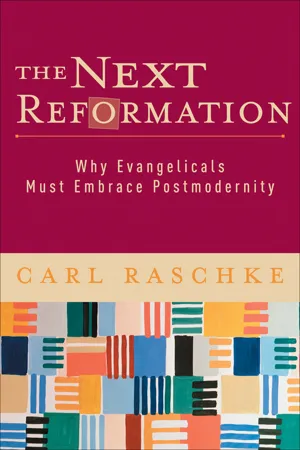
- 240 pages
- English
- ePUB (mobile friendly)
- Available on iOS & Android
eBook - ePub
About this book
Information
Topic
Theology & ReligionSubtopic
Christianity1
POSTMODERNISM AND THE CRISIS OF EVANGELICAL THOUGHT
POSTMODERNISM AND THE CRISIS OF EVANGELICAL THOUGHT
THE CHALLENGE OF POSTMODERNISM
It is no secret that evangelical thought today is in crisis. The crisis has blown up from within as well as from without. Just about the time international communism collapsed at the start of the 1990s, evangelical Christianity in the West began eyeballing an intellectual challenge of a magnitude it had never before confronted. The challenge was protean and elusive. It was neither a heresy that undermined the essentials of the faith, nor an obvious new style of paganism in competition with classical Christianity. It could not be strictly or reliably characterized, but at least it had a name: postmodernism.
During the past several decades, while postmodernism has altered the face of academic culture, particularly in the arts and humanities, it has only recently begun to pound at the door of evangelical thought and faith. Although “postmodern ministry” has become something of a buzz term among new urban evangelicals, it denotes more cultural style than theoretical weight. Overall, postmodern theology and philosophy have been reviled in the evangelical community as a kind of agent provocateur—an outlook and habit of thinking that fosters nihilism, moral relativism, as well as emotionalism and irrationalism.
Interestingly, these accusations are the same sorts of calumny that liberal theology brought against postmodernism over a decade ago. The caricatures are symptomatic of the breakdown of the modernist paradigm of rationality and religious discourse that has reigned since at least the seventeenth century and has powerfully influenced evangelical Protestantism. The malaise of modernism has grown profound as we enter the third millennium. The efforts of evangelical theology to shore up its fundamental commitment to scriptural authority have been damaged by its own dependence on various sorts of metaphysical theories of truth, such as inerrancy, which are neither truly biblical in origin nor persuasive to nonbelievers.
Postmodernism—or “pomo,” if one wants to be colloquial—was already stirring up dust in both popular and academic literature long before it became a bone of contention in the evangelical world. The locution had even entered the American political lexicon, largely as a shibboleth of the culture wars that were then raging in the university and gaining rapt attention in the media. Social conservatives—or neoconservatives, as they are called—roundly condemned postmodernism. They deployed many of the same terms old liberals had drawn upon during the 1960s to condemn the campus protests and the arguments of what was known in those days as the New Left. They cited a familiar syllabus of dangerous and erroneous isms—anarchism, relativism, and nihilism.
Mainline liberals, called neoliberals, were equally and instinctively suspicious as well. But they had slightly different cause for anxiety. They despised postmodernists as incurably narcissistic and individualistic.
Political liberals feared they were rendering an entire generation of political activists apolitical. Theological liberals were aghast that the postmodernists seemed to be erasing their long and hard-won success in making Christianity socially relevant and scientifically acceptable. They regarded religious postmodernism tout suite as a kind of scholarly spiritualism, as a sophisticated subterfuge for speaking in tongues, where obscure and baffling pronouncements by the gurus of the movement were adulated, validated, and circulated with little shame, only to corrode the critical and moral armor of the greater populace.
At the center of the cyclone was Jacques Derrida, an Algerian Jew from France who had scorned protocol not merely by accenting the last syllable of his surname, but also by making himself into an intellectual celebrity without leaving himself beholden to any academic institution or constituency. Not only did he write book after book that was translated from French into English for the leading university publishers; he also became the darling of both the Parisian café scene and the American bicoastal media culture. And he did so with a panache that even the most astute academic entrepreneurs in this country could barely imagine, let alone bring off. A philosopher by training and temperament, Derrida gained fame initially, and in the beginning almost exclusively, within the literary set. Though he did not actually coin the word, Derrida became known almost singularly in the 1970s and early 1980s for having invented a new, and disarming, method for reading literary texts: deconstruction. The expression alone was unsettling, especially to those who were unable to follow his seemingly ad-libbed style of composition that came across as a curious combination of anthropological obiter dicta, couch confessions, notebook jottings, and tedious exposition of passages from ancient sources in their original languages. It was often daunting to understand what Derrida was actually saying. One had simply to follow along and try to catch the drift, which often required reading him as rapidly as he could churn out one book after another.
Because Derrida in both profile and profession shattered every conceivable mold, he became an object of both reverence and derision. He was the quintessential Frenchman, which was bad enough. A joke that made all the rounds during the early Reagan years (at a time when the Godfather movies created a mystique for the Italian Mafia) summed up all the primal fear and fascination that America’s learned elites had toward the Derridean phenomenon. Question: “What happens when you meet a deconstructionist in a dark alley?” Answer: “He offers you a deal you can’t understand.” Though Americans feared they couldn’t understand postmodernism at all, they knew they had to deal with it and to take it seriously—very seriously.
By the late 1980s postmodernism and deconstruction fortunately were no longer identified in the public mind as one and the same. In a relentless effort to communicate Gallic sensibility to America’s barbaric soul, the French ministry of culture began subsidizing a stream of English translations of many of Derrida’s own intellectual contemporaries. Derrida himself had never had the pride of place in Paris that he was enjoying in New York, Boston, San Francisco, and southern California. Because he was a philosopher and not one of the abundant cultural theorists of his day who spoke almost exclusively to French concerns and French dissatisfactions, his reputation in the United States far surpassed his influence on the Continent. Derrida was an exotic attraction to which American arts and letters, chafing from years of dowdy academicism, were drawn like a moth to the flame. But his popularity also whetted the American appetite for everything French and trendy. A motley assortment of postwar figures—such as Giles Deleuze, Jean Baudrillard, Emmanuel Lévinas, and Maurice Blanchot—well known for years among the Parisian set, began to see their works increasingly appear in translation. Soon the concept of postmodernism increasingly came to mean everything and anything that was au courant among the intelligentsia.
In another brief interval the phrase came to be applied to thinkers, writers, and forms of writing that were not distinctive in any sense other than they were novel and perchance controversial. Not too many years later, Marxists in both the English-speaking world and on the European continent began to speak out against the Derridean phenomenon as self-indulgent and injurious to the mobilization of the masses. Ironically, neoconservatives in this country had at the same time been making the opposite point. Deconstruction was no different than Marxism, they harangued, because it weakened cultural backbone and the norms of truth and authority. Neoconservatives, of course, had been training their assaults on the tenured radicals in academia who had gone from revolution in the streets of the 1960s to renovation of the curriculum in the 1980s, replacing Shakespeare with contemporary feminist novelists, the speeches of Lincoln with the biographies of black slaves, Plato and Aristotle with the Little Red Book of Mao-Tse Tung, and so forth. These people were Marxists, or at least Marxists of the more rarefied variety, and the fact that they also read and talked about Derrida was sufficient proof that deconstruction had been cut from precisely the same cloth.
With the fall of the Berlin Wall in 1989 and the collapse of the Soviet Union two years later, on the other hand, the Marxists received their comeuppance. Suddenly and spectacularly, the allure of free markets and open societies in the former Soviet client states made Marxism seem economically irrelevant. “Cultural Marxism”—an expression invented again by conservative critics of what was going on in colleges and universities—had already captured the flag during the curriculum wars of the previous decade. And these unreformed detractors now began to sneer publicly at the emergent global consumer civilization with the same verve as conservatives once had attacked the Marxists themselves. Frederic Jameson, one of America’s leading cultural Marxists, referred to postmodernism as the “cultural logic of late capitalism.”1 Updating Marxism, which for a century and a half had regularly predicted the culminating crisis of capitalism, Jameson construed postmodernism as a true sign of the end. The worldwide span of capitalism no longer depended on the accumulation and control of capital in the financial sense. Yet, Jameson insisted, it had now spread its tentacles even across former Communist societies. Through mass media and pop culture it was enchaining them not through outright poverty, but by stuffing their heads with name brands and celebrity puffery, alchemizing them into mindless consumers.
A similar, but more idiosyncratic, interpretation citing the rise of cyberculture was proffered by Jean Baudrillard, who talked about something called hyperreality. Hyperreality was “more real than real,” Baudrillard crooned. It was an unreal reality where effigies produced by dancing electrons on television and computer screens were no longer distinguishable from real places and real things. Baudrillard’s philosophy, which had always been mildly Marxist and was now at its height of popularity in France, inspired the groundbreaking motion picture The Matrix, released in 1999. The cultural Marxists succeeded in doing in reverse what their conservative opponents had also done ten years before. They popularized the concept of postmodernism even more by virulently attacking it. Now postmodernism was becoming something of a bon mot among conservatives, even religious conservatives. Malls and megachurches were now labeled postmodern, along with the new hip, informal fashions of so-called Generation X, which was amassing publicity. When evangelical Christianity began adapting its message and ministerial modus operandi to the new cultural landscape, particularly with music and styles of worship, all at once something recognizable as the postmodern church flashed onto the screen. But past controversies continued to haunt the environs.
EVANGELICAL BROADSIDES
In his book Truth Decay: Defending Christianity against the Challenges of Postmodernism, Doug Groothuis, professor of apologetics at Denver Seminary in Colorado, launched the same vicious volley of imprecations against “postmodern Christianity” that neoconservatives had hurled against cultural Marxists a decade earlier. The “postmodern temptation,” Groothuis asserted, “is to entice souls to create a self-styled spirituality of one’s own, or to revert to the spiritual tradition of one’s ethnic or racial group without a concern for objective truth or rationality.” Furthermore, said Groothuis, postmodernism is the same as “nihilism,” the fashionable view, emerging in the late-nineteenth century, that there is no supreme or enduring truth other than what anyone arbitrarily wills or chooses that truth to be. “Truth decay is a cultural condition in which the very idea of absolute, objective, and universal truth is considered implausible, held in open contempt, or not even seriously considered.”2 The fault is wholly that of postmodernism. For “postmodernist thinkers,” according to Groothuis, “the very idea of truth has decayed and disintegrated. It is no longer something knowable by anyone who engages in the proper forms of investigation and study. Truth is not over and above us, something that can be conveyed across cultures and over time. It is inseparable from our cultural conditioning, our psychology, our race, and our gender. At the end of the day, truth is simply what we, as individuals and as communities, make it to be—and nothing more. Truth dissolves into a host of disconnected ‘truths.’”3
The value of Groothuis’s book was not that it had anything of substance to say, philosophically or theologically, against postmodernism. Groothuis rarely cited or presented the offending texts of postmodernist writers, preferring instead to use the familiar rhetorical device of associating the term “postmodernist” with every avant-garde intellectual trend that has come down the pike since the Vietnam era. Postmodernism thus was equivalent to virtually all the isms of the twentieth century that traditionalists had been pounding against for more than a hundred years—libertarianism, subjectivism, feminism, relativism, sociologism, psychologism, Marxism, social constructivism, fascism, and so forth. In an interview with the online magazine Antithesis, Groothuis went so far as to identify postmodernism with everything (wrong) about American culture itself.
If you think critically, in terms of either/or or antithesis, then you can’t hold contradictory beliefs, and your goal—your ideal—as a thoughtful being is to have a consistent and coherent set of beliefs that matches reality, that corresponds to fact. And I’m afraid that many Americans, in their sense of spirituality, have lost that as an intellectual ideal. It’s like a smorgasbord: take a little of this and a little of that. As long as you don’t get indigestion—“What’s the problem!? A little bit of Buddhism, a little bit of Taoism. . . . Oh, Jesus was a wonderful spiritual figure. . . . I go to church—sometimes I go to New Age seminars—and I find they all help me. It’s not what is true, what is rational, but what feels right—what seems right, what helps me and gives me a sense of community and solidarity and so forth.”4
Of course, Groothuis found himself making many of the same arguments against postmodernists that American and British philosophers had been making against the claims of Christianity for generations. Oddly enough, Groothuis sounded a lot like Bertrand Russell in his famous, or infamous, essay Why I Am Not a Christian. In that essay, delivered in 1927 to the National Secular Society in London, Russell lambasted the history of the church as a record of “irrational” enthusiasms. Christians are silly and stupid people because they base their beliefs on emotion rather than “argumentation,” Russell huffed. Christian beliefs are nonnegotiable when it comes to the use of logical analysis and scientific evidence. The basic quarrel science has with Christianity concerns the doctrine of divine revelation, which reason finds repugnant. Russell put forth as an alternative to Christianity the method of scientific experiment and the rational sifting of details and data which, he opined, allows us to “conquer the world by intelligence.”5 If the world is not as reason would have us envision it, then “we ought to make the best we can of the world, and if it is not so good as we wish, after all it will still be better than what these others [such as Christians] have made of it in all these ages.” But now Christianity itself can play the role that Russell envisioned for science, according to Groothuis, as a “cogent explanation for a whole range of facts in accordance with the essential tenets of logic and criteria for evidence that are required for all critical thinking.” Christianity must aggressively challenge “the postmodernist worldview,” which “collapses in on itself.” Postmodernism “is ultimately a house of cards,” the same sort of metaphor Russell used for his attack on the “Christian” worldview.
EVANGELICAL COUNTERPUNCHES
In a little essay simply entitled “Postmodernism,” Graeme Codrington points out that postmodernism has carried the day because the kind of rationalism both Russell and Groothuis commend has failed miserably to slake the spiritual hunger in today’s world. “Postmodernism is a reaction to the rationalistic outlook of modernism,” Codrington writes, “specifically a reaction to the concept that truth can be discovered by simple rationalistic induction. The most common caricature of postmodernism is that it is a complete denial of truth, thus relativizing everything. Postmodern people, however, do not deny that there is truth and objective reality. What they question is our ability to distinguish truth from nontruth.”6 Codrington further suggests that this inability to draw such a distinction is what makes postmodernism attractive to believers. Christians, he maintains, do not, and cannot, make judgments concerning truth in accord with their own capacity for systematic thought. The truth that makes us free as Christians comes to us as direct dispensation from Christ. It is a result of our encounter with him. It is not the product of some convoluted, or clever, Aristotelian syllogism.
Stan Wallace adopts much the same approach. Postmodernism redresses many of the intellectual imbalances that modernist thinking, sustaining a siege over many centuries against basic Christian beliefs, left with Western civilization. Culminating in the European Enlightenment of the eighteenth century, modernism exalted the independent rational subject over the Deity himself in a quest for scientific certainty. It substituted the hypothesis of human progress and social control for God’s providential direction and ordering of history. “Concerning reason,” Wallace asserts, “postmodernists shun modernist views which inflate reason to the status of an entirely independent, neutral, unbiased and objective instrument with which truth can and will be found.” On the subject of historical progress, “postmodernists are quick to point out that, contrary to the optimistic outlook of modernity, we are not ‘every day, in every way, getting better and better’ [Émile Coué], but rather, in some cases we are creating survival-threatening conditions by the unbridled rush toward technological ‘progress.’” It is the same with the premium modernism places on individual autonomy and freedom. “Modernity placed freedom and human autonomy as one of the highest values to be embraced,” while the postmodernist suggests our freedom is an illusion.7
Wallace, however, concurs with Groothuis that the postmodernist critique of scientific rationality does not necessarily mean the partisans of postmodernism are dependable allies of Christianity. The postmodernist metaphysic, or theory of ultimate reality, is what Wallace calls nominalistic. Nominalism was a movement in European philosophy that began during the late Middle Ages and challenged the classical view, typically called realism, that knowledge mirrors the world as it actually is. Concepts are not “things,” the nominalists proposed. They are merely tags, labels, or “names” that we attach to the specific and discrete phenomena we encounter. Postmodernism, so far as Wallace is concerned, follows the nominalist route of rendering the relationship between cognition and reality. Postmodernism is “the rejection of truth as correspondence to an objective, m...
Table of contents
- Cover Page
- Title Page
- Copyright Page
- Table of Contents
- Preface
- 1. Postmodernism and the Crisis of Evangelical Thought
- 2. The New French Revolution: Derrida and the Origins of Postmodernism
- 3. The Religious Left Bank: Origins of Religious Postmodernism
- 4. Sola Fide: Beyond Worldviews
- 5. Sola Scriptura: Beyond Inerrancy
- 6. The Priesthood of All Worshippers: From Hierarchy to Relationality
- 7. Thoroughly Postmodern Ministry: Postmodern Revivalism
- 8. Dancing with the Lord: Charismatic Renewal and the Deconstruction of Worship
- 9. The End of Theology: The Next Reformation
- Notes
Trusted by 375,005 students
Access to over 1.5 million titles for a fair monthly price.
Study more efficiently using our study tools.
Frequently asked questions
Yes, you can cancel anytime from the Subscription tab in your account settings on the Perlego website. Your subscription will stay active until the end of your current billing period. Learn how to cancel your subscription
No, books cannot be downloaded as external files, such as PDFs, for use outside of Perlego. However, you can download books within the Perlego app for offline reading on mobile or tablet. Learn how to download books offline
Perlego offers two plans: Essential and Complete
- Essential is ideal for learners and professionals who enjoy exploring a wide range of subjects. Access the Essential Library with 800,000+ trusted titles and best-sellers across business, personal growth, and the humanities. Includes unlimited reading time and Standard Read Aloud voice.
- Complete: Perfect for advanced learners and researchers needing full, unrestricted access. Unlock 1.5M+ books across hundreds of subjects, including academic and specialized titles. The Complete Plan also includes advanced features like Premium Read Aloud and Research Assistant.
We are an online textbook subscription service, where you can get access to an entire online library for less than the price of a single book per month. With over 1.5 million books across 990+ topics, we’ve got you covered! Learn about our mission
Look out for the read-aloud symbol on your next book to see if you can listen to it. The read-aloud tool reads text aloud for you, highlighting the text as it is being read. You can pause it, speed it up and slow it down. Learn more about Read Aloud
Yes! You can use the Perlego app on both iOS and Android devices to read anytime, anywhere — even offline. Perfect for commutes or when you’re on the go.
Please note we cannot support devices running on iOS 13 and Android 7 or earlier. Learn more about using the app
Please note we cannot support devices running on iOS 13 and Android 7 or earlier. Learn more about using the app
Yes, you can access The Next Reformation by Carl Raschke in PDF and/or ePUB format, as well as other popular books in Theology & Religion & Christianity. We have over 1.5 million books available in our catalogue for you to explore.