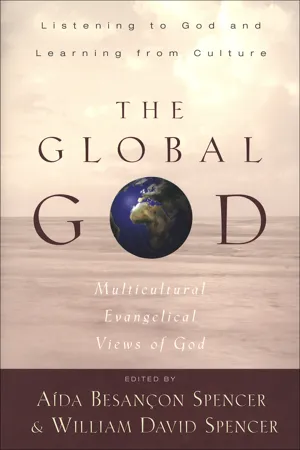
eBook - ePub
The Global God
Multicultural Evangelical Views of God
- 282 pages
- English
- ePUB (mobile friendly)
- Available on iOS & Android
eBook - ePub
The Global God
Multicultural Evangelical Views of God
About this book
A global Christian manifesto in which contributors examine attributes of God--the ones that are most understood in today's culture and the ones that need to be more fully apprehended.
Information
Topic
Theology & ReligionSubtopic
Christian Theology
The God of the Bible
Aída Besançon Spencer
Aída Besançon Spencer, born and reared in Santo Domingo, Dominican Republic, is professor of New Testament at Gordon-Conwell Theological Seminary and pastor of organization with Pilgrim Church. She earned the Ph.D. from Southern Baptist Theological Seminary, Th.M. and M.Div. from Princeton Theological Seminary and B.A. from Douglass College. She has written numerous articles, essays, and books including The Goddess Revival, God through the Looking Glass, Beyond the Curse, and The Prayer Life of Jesus. She has worked with Hispanic Americans as a social worker, English as a second language teacher, and Bible teacher.
Individualized instruction is what all astute educators talk about, but few do. When our son began kindergarten no one had told us that preschool was a prerequisite. Within weeks he was behind. He was being taught to read phonetically, at a fast pace (since it really was a review for most students). In phonetics a word is broken into its parts and then joined together again. My husband asked my son if he wanted to learn to read. And he nodded, “Yes.” So, my husband took out Laubach’s literacy manuals, which he had been using for adults. In two weeks our son learned how to read. Laubach uses the whole word approach. A word such as “bird” is placed next to a picture of a bird: “b—bird, b—bird.” The student repeats the sound b, the word “bird,” and thereby learns to read. Even at a fast pace our son learned.
That is individualized instruction. It is not merely instruction done by an individual to an individual, but even more, an individual teacher using an instructional method that especially suits an individual student’s learning style. The content still remains the same. In this case, literacy, the ability to read. The style or method of teaching varies.
God uses individualized instruction with humans also. God decides, “It is not good for Adam to be alone, I will make for him a helper that corresponds to him” (Gen. 2:18). However, what does God then do? Create the helper? No, God brings the animals and birds he had created to Adam so that in the intimate process of naming them Adam could learn whether any of them could be appropriate corresponding (literally, “as if in front”) helpers for him. None of them, Adam discovers, will be satisfactory (Gen. 2:20). However, when God creates a woman from Adam’s very side, like him in every way, Adam decides she really is that equal helper he had sought, explaining why a wife can be a more than worthwhile reward for leaving parents (Gen. 2:23–24). God had already decided what Adam needed before Adam ever expressed such a need. However, God created an educational process for Adam that would help Adam perceive his need and appreciate its fulfillment. In the same way, God teaches humans about God’s self. God acts. Sometimes those actions are individualized. God interprets, especially with the listener in mind.
In this chapter we will highlight what we can learn about God from the first chapter of Genesis and from what the Bible presents as God’s own verbal self-revelations.
What Creation Teaches about God
The primary method God employs to communicate to humans is by action: “In the beginning when God began to create the heavens and the earth, the earth was nothing and empty” (Gen. 1:1–2). The human learns about God by inductive observation. Nothing existed before God made it exist. Therefore, everything is under God’s control. “The Spirit of God hovered over the face of the earth” (Gen. 1:2). “Hovered over” is a metaphor here. It is used literally for mother birds who “hover over” their young (Deut. 32:11).
A second method God uses to communicate to humans is figurative language. Why cannot God be more literally described? God has no form. God is a Spirit. Moses explicitly explains to the Israelites:
Since you saw no form when the LORD spoke to you at Horeb out of the fire, take care and watch yourselves closely, so that you do not act corruptly by making an idol for yourselves, in the form of any figure—the likeness of male or female, the likeness of any animal that is on the earth, the likeness of any winged bird that flies in the air, the likeness of anything that creeps on the ground, the likeness of any fish that is in the water under the earth. And when you look up to the heavens and see the sun, the moon, and the stars, all the host of the heaven, do not be led astray and bow down to them and serve them. (Deut. 4:15–19)
No human, animal, or inanimate thing has God’s form. Jesus reiterates in New Testament times that God is spirit (John 4:24). Therefore, to learn about God we humans need to observe the results of God’s work in the world (in other words, God’s action) and use analogies to describe God from God’s formed creations. To paraphrase Jesus’ teachings to Nicodemus, we can observe the working of God’s Spirit but we cannot see the Spirit (John 3:8).
Even when God takes on form at the incarnation (John 1:1, 14), the form itself, the human body, is never described as “God.” Jesus is the image of the invisible God.[1] Jesus was in the form (morphē) of God before the incarnation. In other words, Jesus before the incarnation, looked on the outside what he was on the inside. At the incarnation, Jesus took on the form (morphē) of a slave (Phil. 2:6–7). The metaphor “slave” fully describes God’s loving, others-oriented character, dying even on a criminal’s cross so that humans could approach God. Jesus also was born in human likeness (homoiōma, schēma; Phil. 2:7–8). The outward form was fully human. But unlike other humans, Jesus never sinned (Rom. 8:3; 2 Cor. 5:21). Jesus was fully God and fully human. But, being human is not a full reflection of God.
Thus, when God’s Spirit “hovers over” the “face” of the earth, we learn that God’s relation to creation was an intimate, loving one as a mother hen protecting her chicks, a metaphor God when on earth will repeat (Luke 13:34). God is not a mother hen or an eagle. God has no form. But God is like a hen or an eagle in some ways, being caring and protecting. God is also unlike a hen or an eagle. Their intelligence is limited; God’s is not. Their care and protection is more biological than a conscious desire. All metaphors and similes are like and unlike the concept they claim to explain.[2]
“Then God said, ‘Let there be light’; and there was light” (Gen. 1:3). God’s word is powerful. Christians differ over whether creations like light came instantaneously or over time. But, the key deduction from this act is that God’s creative ability flows successfully and powerfully from intention.
From action now God moves to contemplation and appreciation: “And God saw that the light was good” (Gen. 1:4). Everything God creates is good. Therefore, we humans can deduce that God is good. “From their fruits, you will know them,” Jesus said about humans (Matt. 7:20). What a person really believes is demonstrated by action, not merely words (James 2:22–26). Those people who say “Jesus is Lord” but do not treat Jesus as a Lord they must obey, are not, in God’s sight, Christians at all (Matt. 7:21–23). Similarly, from God’s actions we can deduce God’s character. Thus, David the psalmist sings and exhorts others: “Give thanks to the LORD, because God is good; for forever is his love” (1 Chron. 16:34).
God Communicates through Verbal Self-Revelations
The Bible also has a third method of revelation: interpretive words, descriptive adjectives and nouns. Sometimes actions can be misinterpreted. When I was a community organizer among Hispanic Americans in New Jersey, at one get-together the director of Adult Education, the director of the Young Women’s Christian Association (who was Jewish), and a prominent Hispanic woman came to compliment me on my work as an organizer. (Believe me, genuine compliments are rare in any profession!) I knew then that if my actions remained uninterpreted, I would simply get credit as a “good person.” I replied, in much fear and trembling, “The reason I am a good community organizer is because I am a Christian.” That statement caused a pause in the conversation, but then one of the women replied, “Because I have seen your actions, I take seriously your claims.”
So God too interprets God’s actions. That is the focus of this chapter. But, as I mentioned, God’s interpretations, although always true to God’s character or “content,” are also individualized toward the person(s) listening. God also accepts and affirms any descriptive adjectives by humans which are accurate. God’s character is constant and eternal. But all of God’s character is not fully explained in every revelational moment. However, no revelational moment gives an untrue description of God.
God of Seeing
The first name for God recorded in the Bible is given by a human, a woman, a slave of color. When Hagar runs away into the wilderness from Sarai’s harsh treatment of her, God sends an angel to communicate to her God’s concern and promise. She responds by calling God “a God of seeing,” for God had seen her and she had seen God’s messenger and yet remained alive (Gen. 16:13). The name she gave God was an accurate one. Therefore, it was acceptable to God.
Similarly, today different people of different nations may give God different names, which is an appropriate action as long as they refer to the same God. Giving the God of the Bible the same name as other gods is not acceptable, because those other names refer to other gods.
What self-descriptions in words does God use? The twelve self-descriptions of this chapter are keys to interpreting God’s actions and God’s character. In my study of the Bible I have found God’s self-revelations to refer to God’s various attributes and actions and to individual persons and places. The attributes often interpret specific actions.
God Almighty
For instance, the Bible’s first recorded adjectival self-revelation given by God, “I am God Almighty” (Gen. 17:1), precedes a command and a promise that God will make. It occurs after a lengthy relationship between Abraham and God. Abraham is already ninety-nine years old. Possibly Abraham knew about God as a child when his father Terah decided to go to Canaan (Gen. 11:31). Abraham was himself called to go to Canaan when he was seventy-five (Gen. 12:4). Thus, as far as we know, Abraham had known God for at least twenty-four years before the adjective “almighty” was disclosed by God to Abraham. Self-revelation is not required of God. It is a response of love to love. As the apostle Paul, paraphrasing Isaiah 64:4, writes: “What eye has not seen and ear has not heard and upon a human heart has not arisen, that (very thing) God has prepared for those loving him” (1 Cor. 2:9).
Because God is “almighty,” Abraham therefore should daily walk conscious of God’s presence (“walk before my face”) and should be “whole, complete, perfect,” fully mature (Gen. 17:1). “Almighty” (shaday) may come from shad, “female breast” (e.g., Lam. 4:3) or shod, “violence, havoc, devastation” (e.g., Isa. 22:4).[3] If the former, God thereby is saying to Abraham, I am personally concerned in your well-being as a mother to her young. Remember my love and concern. I want you to mature fully from child to mature human. If the latter, God thereby is saying to Abraham, be conscious of my personal presence and become fully mature. I have the power to help you and to punish you. Power is especially important with the promise God will make: “And I will make my covenant between me and you, and I will multiply you with all might” (Gen. 17:2). Before God promises Abraham he would be the ancestor of many nations, God uses the self-description, “all powerful.” Or possibly, only a God who is like a nursing mother could enable Abraham to be the first of many. God also uses the same adjective “almighty” when communicating to Jacob and again the title holds the promise for an ancestor of many. Jacob is also commanded to “be fruitful and multiply” because “a nation and a company of nations shall come from you, and kings shall spring from you” (Gen. 35:11). God as “almighty” has the power of parentage.[4]
God I Will Be
The second recorded adjectival description by God comes as an answer to Moses’ request. After God observes the suffering of Abraham’s descendants at the hands of the jealous Egyptians, God responds in compassion and chooses to deliver them by sending Moses to Pharaoh (Exod. 3:7–10). When Moses responds in terror at the idea, God allays his fears by telling him “I will be with you” (Exod. 3:12). Is Moses simply trying to deflect God again when he tells God that of all things, the Egyptians would most want to learn God’s name? Nevertheless, the name God gives Moses is “I will be” (Exod. 3:14).
I always read this with a smile. I see it as God’s humor. What kind of name is this—“I will be”? Nevertheless, even amidst the gentle humor are many profound points. “I will be” at least is a reminder to Moses that God promised “I will be with you.” The God who answered the Israelites’ cry will be with them in their distress and with Moses in his deliverance. Moses learns that at any time the people can call on their God because God will be with them (Deut. 4:7; Ps. 145:18). The Jewish Paul too explains thousands of years later to the Gentiles of his time that God always will be with them because in God “we are living and we are moving and we are being” (Acts 17:28). Jesus highlights this name also during his lifetime, declaring, “I myself am the bread of life,” “I myself am the light of the world,” “I myself am the gate of the sheep,” “I myself am the good shepherd,” “I myself am the resurrection and the life,” “I myself am the way and the truth and the life,” “I myself am the true vine.”[5] When Jesus tells his fellow Jews, “before Abraham was born, I myself existed” (John 8:58), his listeners knew he was claiming identity with God and they sought to stone him as a blasphemer (John 8:59).
God uses the verb “I will be” as a reminder of God’s promise to Moses. It is also a way to suggest G...
Table of contents
- Cover
- Title Page
- Copyright Page
- Contents
- Dedication
- Preface
- Introduction
- 1. The God of the Bible Aída Besançon Spencer
- 2. God of Power versus God of Love: The United States of America William David Spencer
- 3. The Complementarity of God’s Love and God’s Righteousness: The United States of America Gretchen Gaebelein Hull
- 4. God the Stranger: An Intercultural Hispanic American Perspective Aída Besançon Spencer
- 5. Transcendent but Not Remote: The Caribbean Dieumème Noëlliste
- 6. Unapproachable God: The High God of African Traditional Religion Tokunboh Adeyemo
- 7. The God above Tradition Who Speaks to All Traditions: An African (Ghanaian) Perspective Edward John Osei-Bonsu
- 8. Viewing God through the Twin Lenses of Holiness and Mercy: A Chinese American Perspective Grace Y. May
- 9. Shang-di: God from the Chinese Perspective Tsu-Kung Chuang
- 10. Communicating the Biblical Concept of God to Koreans Bong Rin Ro
- 11. The Korean American Dream and the Blessings ofHananim (God) Tae-Ju Moon
- Conclusion
- Notes
- Subject Index
- Scripture Index
- Other Books by the Authors
Trusted by 375,005 students
Access to over 1.5 million titles for a fair monthly price.
Study more efficiently using our study tools.
Frequently asked questions
Yes, you can cancel anytime from the Subscription tab in your account settings on the Perlego website. Your subscription will stay active until the end of your current billing period. Learn how to cancel your subscription
No, books cannot be downloaded as external files, such as PDFs, for use outside of Perlego. However, you can download books within the Perlego app for offline reading on mobile or tablet. Learn how to download books offline
We are an online textbook subscription service, where you can get access to an entire online library for less than the price of a single book per month. With over 1.5 million books across 990+ topics, we’ve got you covered! Learn about our mission
Look out for the read-aloud symbol on your next book to see if you can listen to it. The read-aloud tool reads text aloud for you, highlighting the text as it is being read. You can pause it, speed it up and slow it down. Learn more about Read Aloud
Yes! You can use the Perlego app on both iOS and Android devices to read anytime, anywhere — even offline. Perfect for commutes or when you’re on the go.
Please note we cannot support devices running on iOS 13 and Android 7 or earlier. Learn more about using the app
Please note we cannot support devices running on iOS 13 and Android 7 or earlier. Learn more about using the app
Yes, you can access The Global God by Spencer, Aída Besançon, Spencer, William David, Aída Besançon Spencer,William David Spencer in PDF and/or ePUB format, as well as other popular books in Theology & Religion & Christian Theology. We have over 1.5 million books available in our catalogue for you to explore.