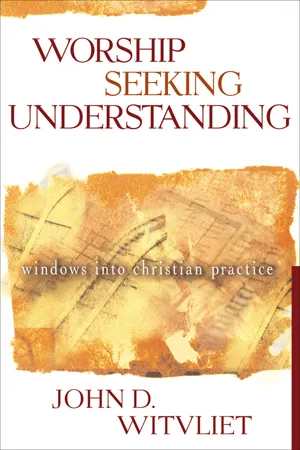
What exactly is worship? How can we account for its power? In Worship Seeking Understanding, noted worship expert John Witvliet mines the riches of the Bible, theology, history, music, and pastoral research to provide windows into the practice of Christian worship.
With this work, Witvliet attempts to build bridges between theory and practice, among various worship-related disciplines, and across denominational lines. If worship renewal is to occur, each bridge must be formed. His hope is that this work will not only articulate questions about worship but also enrich the practice of worship in congregations today. Witvliet's broad scope and insightful advice will be welcomed by pastors, worship leaders, church leaders, and students.
- 320 pages
- English
- ePUB (mobile friendly)
- Available on iOS & Android
eBook - ePub
About this book
Information
Topic
Theology & ReligionSubtopic
Christianity
1
The Former Prophets and the Practice of Christian Worship
Although the Former Prophets[1] contain extended descriptions of exemplary and nonexemplary liturgical events, noteworthy examples of specific liturgical acts (sermons, canticles, and prayers), and descriptions of the work of liturgical leaders (Levites, prophets, priests, judges, and musicians), relatively little work has probed how these books might either function in our worship services today or help us to better understand and articulate the deep meaning and purpose of worship. For the most part, contemporary worship specialists are busy sorting out recent innovations in worship practices. When liturgical theologians probe the connections between the Bible and worship, the Former Prophets are not the first place they look. Biblical theologians, busy honing skills in one form of criticism or another, often have limited time to draw out the implications of their work for the practices of the Christian community—and then only rarely for the practice of worship.
There are, of course, extremely helpful and encyclopedic descriptions of the worship and liturgical practices of ancient Israel, including classic works by Hans Joachim Kraus, H. H. Rowley, Roland de Vaux, and a more recent survey by Patrick D. Miller.[2] These works are complemented by focused, highly detailed, comparative historical studies of aspects of worship treated in the Former Prophets.[3] Most of these works are confined to straightforward historical description and, occasionally, historical speculation. Alongside these are a number of outstanding works of form, source, and literary criticism that treat texts with explicitly liturgical themes and implications.[4] These works helpfully amass voluminous canonical and extracanonical sources and provide historical and rhetorical resources for more savvy handling of a given text. Yet few, if any, of these books attempt to address the link between these ancient sources and either our understanding or our practice of worship today.
Still, some biblical theologians have probed connections between Old Testament narratives and either contemporary Christian thought or practice. Walter Brueggemann’s Israel’s Praise and Samuel E. Balentine’s The Torah’s Vision of Worship come to mind, among others.[5] Rarely, however, is any of this work dedicated to the Former Prophets, a mostly neglected part of the Old Testament.
Similarly, an exhaustive study of liturgical scholarship reveals little, if any, work on the Former Prophets. The top one hundred books on the history, theology, and practice of Christian worship cite two paragraphs in the first-century church order Didache roughly one hundred times more frequently than any text in the hundreds of pages of the Former Prophets. There are a number of studies of ancient and recent lectionaries that investigate why certain texts are or are not included in official lectionaries, although here also only modest attention is given to texts from the Former Prophets.[6]
In sum, drawing connections between the Former Prophets and the practice of worship is largely uncharted territory. This modest chapter is designed to begin to make these connections. It outlines three broad themes that arise directly out of the pages of the Former Prophets and that have immediate significance for both the theology and the practice of Christian worship.
Worship as a Spiritual Barometer
First, the Former Prophets demonstrate the significance of liturgical action as a barometer of corporate spiritual health. Liturgical events (including at minimum all circumcision, sacrifice, Passover, and covenant-renewal rites) punctuate the Former Prophets at regular intervals. Nearly every one is presented as exemplary or nonexemplary of faithful response to the covenant Overlord. As diverse as the writers of these texts might be, none of them describes liturgical events neutrally.
On the good side, every time there is a revival or sign of spiritual health in Israel, out come the liturgists—even in the books that lack the liturgical orientation of Chronicles. After crossing the Jordan, Israel submits to a second circumcision and celebrates the Passover (Joshua 5). A few chapters later, after the Achan and Ai debacle, the people renew the covenant in accordance with God’s instructions (Joshua 8; cf. Deut. 27:4, 12). In the Samuel narratives, spiritual health is affirmed in the life of Hannah and her temple prayers (1 Samuel 1); in Samuel’s liturgical service, both as a boy (1 Samuel 2) and a mature leader (as in the anointing of David in 1 Samuel 16); and in the prayers of David (2 Samuel 1, 22, 23). In the Kings sequence, the spiritual high points are marked by renewed liturgical activity: the consecration of the temple (1 Kings 5–8) and its subsequent restoration by Joash (2 Kings 12) and Josiah (2 Kings 23), as well as the purging of liturgical impurity, such as Jehu’s massacre of Baal worshipers (2 Kings 10). Ezra features the rebuilding of the altar and the temple (chap. 3) and a liturgical confession of sin (chaps. 9–10). Nehemiah opens with a prayer (chap. 1) and culminates with a covenant-renewal liturgy (chaps. 8–10) and the dedication of the wall of Jerusalem (chap. 12). Esther culminates in the celebration of Purim, a feast in commemoration of the deliverance from Haman’s plot to destroy the Jews.
On the bad side, nearly every time there is a spiritual, political, or moral decline, liturgical activity suffers. Judges 2:10–19 describes Israel’s worship of other gods throughout the generations; Judges 17 reveals the entrepreneurial religion that characterized the days when Israel had no king. Samuel opens with references to an insensitive and abusive priesthood (1 Samuel 2:12–26 [a comparison of Eli’s sons with Samuel]), features Saul’s disobedience to God’s explicit commands about sacrifice (1 Samuel 13), and describes Saul’s superstition when consulting a medium (1 Samuel 28). Several texts chart the hypocrisy of worshiping both Yahweh and other gods (e.g., 1 Kings 18:21; 2 Kings 12:3). The Former Prophets thus provide repeated examples of the entire catalog of liturgical sins: disobedience, idolatry, superstition, and hypocrisy.[7]
In sum, when Israel is faithless, its worship is degenerate. When Israel is faithful, that faithfulness is expressed in corporate prayer and praise before God’s face. Of course, it may be a mere truism to assert that liturgy is one reliable (though not exclusive or completely sufficient) barometer of spiritual health. It is a foundational insight into the nature of life before God. It is also perhaps nowhere more clearly seen in Scripture than in the Former Prophets, who insist that Israel was driven from God’s presence, in part, for its Canaanite revisioning of covenant worship (2 Kings 17:7–20; 2 Kings 23:26–27 in connection with 2 Kings 21:1–18).
Covenant Renewal as a Primary Image for Christian Worship
Second, the Former Prophets describe liturgical events that stand in broad continuity with Christian liturgy. Of course, the vast majority of Israel’s liturgical practices are not a part of Christian practice. Animal sacrifices are not common in today’s worship—to the profound satisfaction of most church architects and janitors. The design of the temple is not a blueprint for current Christian worship spaces (though it is instructive for the categories and criteria that guide our thinking about liturgical space).[8] Today’s musical styles often bear little resemblance to ancient practice. The exception to the overwhelming pattern of discontinuity is the liturgy of covenant renewal,[9] a primary image or metaphor for Christian worship. The Former Prophets provide nearly all the accounts we have of covenant-renewal ceremonies. In fact, the liturgical renewal of the covenant runs like a Leitmotif right through the Former Prophets and other historical narratives (Joshua 8, 24; 2 Kings 23; 2 Chronicles 15, 34–35; Nehemiah 9–10; see also Deut. 31:10–13).
The significance of this liturgical act is grounded in the relative importance and centrality of covenant language in describing the divine-human relationship in the Old Testament. Despite the temptation for some Christian traditions to overstate its significance, the covenant is a central biblical image or metaphor for describing the relationship that God has established with Israel.[10] Brevard S. Childs concludes, “Regardless of the age and circumstances lying behind the Deuteronomic covenant formulation, its theology became the normative expression of God’s relation to Israel and served as a major theological category for unifying the entire collection comprising the Hebrew scriptures.”[11] George Mendenhall and Gary Herion, in their Anchor Bible Dictionary article, simply declare, “‘Covenant’ in the Bible is the major metaphor used to describe the relation between God and Israel (the people of God).”[12]
In ancient Near Eastern culture, the covenant relationship was established and reaffirmed through ritual liturgical action, a ritual matrix described most thoroughly by Klaus Baltzer.[13] In the Old Testament, the people gathered when God established a covenant (Exodus 19–24), and Moses instructed them to gather every seven years so that all Israel, including the alien, might “listen and learn to fear the LORD your God and follow carefully all the words of this law. Their children, who do not know this law, must hear it and learn to fear the LORD your God” (Deut. 31:12–13). Once in the land, Israel gathered to reaffirm that covenant (e.g., Joshua 8, 24); after the exile, the people gathered under the direction of the priests to renew the covenant they had threatened with insistent faithlessness (Nehemiah 8–10, esp. 9:5–38).
Further, the Psalms frequently describe worship as an act of making vows to the Lord (e.g., “From you comes my praise in the great congregation; my vows I will pay before those who fear him” [Ps. 22:25 NRSV; see also 56:12; 66:13; 116:14])—language that clearly evokes the promise-based language of covenant life. Just as in the covenant of marriage a bride and groom speak their covenant vows in a public ritual to establish their relationship or a husband and wife reaffirm those promises in a public renewal of their marriage vows, so too the people of Israel gather in God’s presence to reaffirm the covenant God established with them.[14]
Of all the covenant-renewal narratives, Joshua 24:1–27 has some of the most beautiful rhetoric and theological redolence.[15] This particular narrative emphasizes several aspects of Israel’s covenant liturgy that stand in continuity with Christian practice: The assembly gathers self-consciously coram Deo, before the face of God, for a corporate action, with no mention of those who dissented or did not feel like making the vow (v. 1). The current covenantal vows are set in the context of the narrative of God’s saving activity (vv. 2–13). Human speech is received by the gathered community as divine discourse (note the attribution of divine discourse in vv. 2–13).[16] A vow of fidelity to God is a resounding no against all false gods (vv. 14–15). The assembly is gathered not for the purpose of learning or even prayer but for making a vow to serve God (vv. 16–24).
The covenant language does not end with the advent of the New Testament age. Rather, Scripture challenges us to see that in Christ, God has extended a new covenant promise to the church (Jer. 31:31–34; 2 Cor. 3:6; Hebrews 8–9). Recall all the places in which marriage is a metaphor or image to describe the church’s relationship with God (Isa. 62:5; Jer. 2:2; Hosea 3:1; Rev. 19:7; 21:2, 9).
Just as the old covenant had liturgical renewal ceremonies, so too the new covenant is renewed through public celebrations of fidelity and commitment. The Lord’s Supper is the paradigmatic and highest form of this liturgical renewal. Each of the New Testament accounts of the institution of the Lord’s Supper explains its meaning in terms of covenant imagery. The Lukan and Pauline accounts speak of “the new covenant in my blood” (Luke 22:20; 1 Cor. 11:25), while the Matthean and Markan accounts refer to “my blood of the covenant” (Matt. 26:28; Mark 14:24).
In each epoch of church history, at least some key theologians and preachers have highlighted this theme. In the early church, John Chrysostom preached sermons that helped his congregation understand the Lord’s Supper as new covenant renewal.[17] Klaus Baltzer, for example, in his analysis of the so-called Clementine liturgy in Apostolic Constitutions VIII, concluded that structurally it “can be termed a ‘Christian covenant renewal.’”[18] Much later, the covenant image became a central theme for seventeenth-century Anglicans and Puritans.[19] As late as 1743, French Reformed pastor Jean-Frédéric Ostervald could argue that “it may be understood, that Sacraments were initiated, that they may be public pledges, and seals of the divine covenant, both on God’s part, and on ours. For by them God offers, and confirms his grace to us, and we testify, and bind ove...
Table of contents
- Cover
- Title Page
- Copyright Page
- Contents
- Acknowledgments
- Introduction: Worship Seeking Understanding
- Part 1 Biblical Studies
- Part 2 Theological Studies
- Part 3 Historical Studies
- Part 4 Musical Studies
- Part 5 Pastoral Studies
- Other Worship-Related Writings by John D. Witvliet
- Index
- Notes
Trusted by 375,005 students
Access to over 1.5 million titles for a fair monthly price.
Study more efficiently using our study tools.
Frequently asked questions
Yes, you can cancel anytime from the Subscription tab in your account settings on the Perlego website. Your subscription will stay active until the end of your current billing period. Learn how to cancel your subscription
No, books cannot be downloaded as external files, such as PDFs, for use outside of Perlego. However, you can download books within the Perlego app for offline reading on mobile or tablet. Learn how to download books offline
Perlego offers two plans: Essential and Complete
- Essential is ideal for learners and professionals who enjoy exploring a wide range of subjects. Access the Essential Library with 800,000+ trusted titles and best-sellers across business, personal growth, and the humanities. Includes unlimited reading time and Standard Read Aloud voice.
- Complete: Perfect for advanced learners and researchers needing full, unrestricted access. Unlock 1.5M+ books across hundreds of subjects, including academic and specialized titles. The Complete Plan also includes advanced features like Premium Read Aloud and Research Assistant.
We are an online textbook subscription service, where you can get access to an entire online library for less than the price of a single book per month. With over 1.5 million books across 990+ topics, we’ve got you covered! Learn about our mission
Look out for the read-aloud symbol on your next book to see if you can listen to it. The read-aloud tool reads text aloud for you, highlighting the text as it is being read. You can pause it, speed it up and slow it down. Learn more about Read Aloud
Yes! You can use the Perlego app on both iOS and Android devices to read anytime, anywhere — even offline. Perfect for commutes or when you’re on the go.
Please note we cannot support devices running on iOS 13 and Android 7 or earlier. Learn more about using the app
Please note we cannot support devices running on iOS 13 and Android 7 or earlier. Learn more about using the app
Yes, you can access Worship Seeking Understanding by John D. Witvliet in PDF and/or ePUB format, as well as other popular books in Theology & Religion & Christianity. We have over 1.5 million books available in our catalogue for you to explore.