eBook - ePub
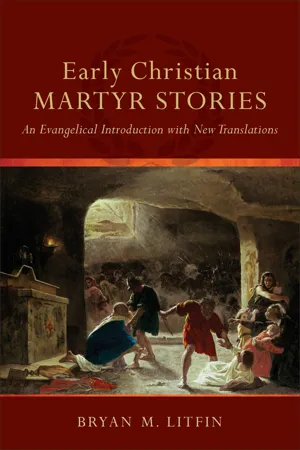
Early Christian Martyr Stories
An Evangelical Introduction with New Translations
- 188 pages
- English
- ePUB (mobile friendly)
- Available on iOS & Android
eBook - ePub
About this book
Personal narratives are powerful instruments for teaching, both for conveying information and for forming character. The martyrdom accounts preserved in the literature of early Christianity are especially intense and dramatic. However, these narratives are not readily available and are often written in intimidating prose, making them largely inaccessible for the average reader. This introductory text brings together key early Christian martyrdom stories in a single volume, offering new, easy-to-read translations and expert commentary. An introduction and explanatory notes accompany each translation. The book not only provides a vivid window into the world of early Christianity but also offers spiritual encouragement and inspiration for Christian life today.
Information
Topic
Theology & ReligionSubtopic
History of Christianity1
The Maccabean Martyrs
Witnesses for God before Christ
In the year 167 BC the Greek king Antiochus IV initiated a policy of religious uniformity that brought great suffering to the Jewish people. A century and a half earlier, the conqueror Alexander the Great had brought the Jews under his dominion. When Alexander died, his territory was split into several Greek kingdoms that often fought with one another. In one of these kingdoms, Antiochus came to power as the fourth ruler to bear the name of his forefathers within the dynasty known as the Seleucids. The Seleucid capital was Antioch, and their great rival was Egypt—which meant the territory that occupied the boundary between these two kingdoms was ancient Israel. Therefore the holy land of the Hebrews became a battleground between the world powers of the age.
While this situation was not good for the Jews, they managed to get along for a while by accommodating Greek culture to a limited degree. The Seleucid rulers wanted their subjects to “hellenize”—that is, adopt the Greek way of life. This seemed doable, so many Jews living in Greek cities assimilated Hellenistic culture into a comfortable balance with their own ancestral religion. But King Antiochus IV took things to a whole new level. Angered that some Jews had refused to hellenize, and fearful that the Mosaic law would always undermine political unity in his kingdom, he decided to eradicate the worship of Israel’s God. The final straw occurred when Antiochus profaned the altar of the Jerusalem temple, the so-called abomination of desolation mentioned in Daniel 11:31. The temple of Yahweh was now devoted to the worship of Zeus, and disgusting pagan sacrifices were being offered to a false god in the Holy of Holies.
In all the upheaval that these actions created, a revolutionary named Judas Maccabeus rallied his rebel forces against the armies of Antiochus. Eventually these “Maccabees” managed to win quasi independence from their Greek overlords. However, taking up the sword was not the only form of Jewish resistance to the evil designs of Antiochus. The ancient book of 2 Maccabees records the horrific deaths of some Jewish martyrs who gave their lives rather than submit to the commands of the king. First, a venerable scribe named Eleazar sets the martyrological pattern by refusing to violate God’s law; then seven noble brothers follow in his footsteps, assisted by the courageous exhortations of their mother.
The book that recounts this story is part of the collection of texts called “apocryphal” by Protestants and “deuterocanonical” by Roman Catholics. These terms indicate Protestants do not regard the collection as belonging to the Bible while Catholics consider them a second body of scriptural works with full divine inspiration. What distinguishes the Apocrypha from the Hebrew Scriptures? The apocryphal books were written or preserved in Greek and come primarily from the period between the Old and New Testaments. Although the Jews never recognized these writings as belonging to the authoritative canon, many early church fathers did accept them as scriptural, and this trend continued through the Middle Ages. Eventually the leaders of the Protestant Reformation in the 1500s followed Jewish tradition and rejected the books’ inspired status. The Catholics responded by formally accepting the books into the biblical canon, leading to the difference of opinion that still exists today among the various groups.
But aside from the question of the Apocrypha’s canonical status, we can certainly find great value in these books as historical witnesses to the events of ancient times. This is especially true of 2 Maccabees, because its account of the Maccabean martyrs (2 Macc. 6–7) came to be cherished by the early Christians when they began to experience their own version of martyrdom at the hands of the Romans. Ancient church fathers such as Cyprian, Origen, Gregory of Nazianzus, John Chrysostom, and Augustine all drew great inspiration from the Maccabean martyrs. It is even likely the author of Hebrews had these martyrs in mind when he wrote Hebrews 11:35–38. Although the Maccabean martyrs were Jews who lived before the time of Christ, they came to be granted the same level of respect accorded to the Christian martyrs—for they died in the name of the same God whom Christians worshiped, just without the fuller knowledge that arrived when Jesus came into the world.
Today there is skepticism among scholars that the martyrdoms unfolded exactly as described. Of course, this doesn’t mean real historical circumstances are absent from the text. The author’s description of the contemporary politics is often accurate, and he claims to be summarizing a much longer source document. Yet the narrative format—such as the martyrs being allowed to deliver heroic speeches, or the seven sons each being tortured in order of age—suggests a text whose purpose was to encourage the faithful more than record pure history. The story shows signs of being shaped and embellished by its author.
Even so, the horrible dilemma faced by the story’s characters is no fantasy. Jewish men and women in the age of Antiochus were tortured for refusing to abandon their ancestral religion. The account of the Maccabean martyrs sets forth an enduring pattern of bold words to the persecutors, confidence in eternal life, and uncompromising loyalty to the one true God. The ancient church fathers noticed these things and incorporated many aspects of this Jewish narrative into their own martyr stories. The Maccabean martyrs were embraced almost like Christian saints before Christ. Therefore this text makes a fitting introduction to a volume on early church persecution.
2 Maccabees 6–7
The Persecution of the Jews under Antiochus
A little later, Antiochus the king sent a senator from Athens to force the Jews to abandon the laws of their forefathers and no longer live by God’s commandments. Furthermore, this man was to defile the temple in Jerusalem and start calling it “The Temple of Olympian Zeus,” while the temple in Gerizim was to be called “The Temple of Zeus, Who Helps Strangers” (which fits what the people living there experienced).1 The onslaught of this evil was harsh and utterly offensive. The gentiles began to fill the Holy Place with disgusting acts and revelry, lounging around with prostitutes and having sex with women even inside the sacred temple courts! To make matters worse, they brought in forbidden sacrifices, so the altar was covered with detestable offerings prohibited by the law. No one could observe the Sabbath, nor celebrate the festivals of our ancestors, nor even admit openly to being a Jew.
Every month there was a festival for the king’s birthday. The Jews were compelled by harsh measures to partake of the sacrificial meat, and when there was a celebration for the god Dionysus they were forced to march in his parade wearing ivy wreaths.2 Then, at the instigation of Ptolemy,3 a decree was issued to the nearby Greek cities that they too should adopt the same policy toward the Jews, making them partake of the sacrifices and executing those who refrained from converting to Greek customs. So everyone understood a crisis had arrived.
For example, two women were brought in for having circumcised their children. So the authorities publicly paraded the women around the city with their babies hung around their necks and dangling at their breasts, then pushed them headfirst off the city wall. And some other folks who had secretly gathered in nearby caves to observe the Sabbath were betrayed to Philip.4 They were all burned together, because their piety kept them from defending themselves out of respect for the day of rest.
Now, I encourage those who read this book not to be saddened by all these disasters but to consider them as chastisements designed to discipline our people instead of destroying them. For it is a sign of great kindness not to tolerate the impious for a long time but to strike them immediately with punishments. In the case of the other nations, the Sovereign Lord waits patiently to punish them until they have attained the full measure of their sins. But he has determined to deal differently with us so he won’t have to execute justice upon us after our sins have reached their worst level. Thus, he never removes his mercy from us. Although he disciplines us with disasters, he does not abandon his chosen people.
So then, let this be enough of a reminder of these things. It is now time to carry on with the story.
Eleazar the Martyr
Eleazar, a high-ranking scribe, was an aged man with a distinguished appearance. The authorities forced him to open his mouth and eat pork.5 But he welcomed death with honor rather than life with defilement. He went of his own accord to the torture area and spat out the meat, which is what everyone should do who has the strength to refuse what is forbidden to taste, even if eating it is the only way to save one’s precious life.
The authorities who were ordering Eleazar to eat unlawful meat had known him for a long time, so they took him aside privately and implored him to bring meat prepared in his own way, proper for him to consume, and only pretend to eat the sacrificial meat commanded by the king. By doing this he would be freed from the death penalty and be treated well on account of his long-standing friendship with them.
But Eleazar took a well-reasoned position worthy of a man of his years—a man of advanced old age who had earned his distinguished gray hair through excellent conduct since childhood. And since he was, moreover, committed to the holy laws established by God, he quickly made his position known by saying, “Send me on to the afterlife!6 To carry out such a charade would be unworthy of my old age. Many young folks would think ninety-year-old Eleazar had finally decided to convert to foreign customs! Then, just to extend my life for a moment longer, my hypocrisy would lead them astray, and I would defile and tarnish my old age.7 Even if I were to dodge human punishment today, I would not escape the hand of the Almighty in my subsequent life or death. Therefore, by courageously giving up my life right now, I not only show myself worthy of my years but also leave for the young a shining example of how to die a good death, with eagerness and nobility, for the sake of the holy and respectable laws.”
Having said these things, Eleazar went straight to the torture area.8 The men who just a moment before were acting friendly to him now changed to hostility, because in their minds the words he had proclaimed were utterly insane. As Eleazar was about to die from all the blows, he groaned in anguish and said, “The Lord who possesses holy knowledge clearly perceives that although I could have escaped death, I chose to endure terrible agony in my body from this beating. Yet on the inside I suffer it gladly, because I fear the Lord.”
So this was how Eleazar departed this world for the next. His death left behind an example of nobility and a memorial of virtue not only for the young but indeed for the whole Jewish nation.
Seven Sons of a Jewish Mother
It also came about that seven brothers were arrested along with their mother.9 King Antiochus was torturing them with whips and the rack to compel them to eat pork against the dictates of the law.10 One of the brothers acted as a spokesman for the rest and said, “What do you hope to ask or learn from us? For we are ready and willing to die rather than transgress the laws of our forefathers.”
Infuriated by this statement, the king immediately ordered giant frying pans to be heated over fire pits. After this was done he commanded that the spokesman’s tongue be cut out, his scalp be sliced away, and his limbs be amputated while his mother and brothers looked on. Then when the man was utterly helpless though still alive, the king ordered him brought to the fire and fried. Even as the fumes from the frying pan wafted everywhere, the brothers and their mother encouraged one another to die nobly, saying, “The Lord God looks down and sees us, and he truly comforts us. This is just what Moses made clear in his song when he testified against the people to their faces, saying, ‘And he will comfort his servants’ [Deut. 32:36].”11
After the first brother died like this, they brought forward the second for their mockery. As they tore away the skin of his head along with his hair, they were asking him, “Now would you rather eat pork than have your body punished limb by limb?”
But he answered them in Hebrew, “Never!” So he took his turn being tortured like the first brother. And with his dying breath he cried out to the king, “You wretch! Though you’re sending us out of this life, the king of the universe will resurrect us to eternal life because we died for his laws!”
The third brother was the next victim of their ridicule. When they told him to stick out his tongue he immediately put it out and bravely offered his hands. “I received these from the God of heaven,” he said with great dignity, “and because of his laws I now disregard them, and from him I expect to receive them back again.” So the king himself and all his servants were utterly astonished at the young man’s courageous spirit, for he regarded his tortures as trivial.
Then they abused and tormented the fourth brother in the same way after the third died. When he was close to the end he said, “It is preferable when de...
Table of contents
- Cover
- Title Page
- Copyright Page
- Dedication
- Contents
- Introduction
- 1. The Maccabean Martyrs
- 2. Peter and Paul
- 3. Ignatius of Antioch
- 4. Polycarp of Smyrna
- 5. Justin Martyr
- 6. The Martyrs of Lyons and Vienne
- 7. The Scillitan Martyrs
- 8. Perpetua and Felicity
- 9. Tertullian
- 10. Origen of Alexandria
- 11. The Great Persecution
- 12. The Peace of Constantine
- 13. Augustine of Hippo
- Epilogue
- Index
- Notes
- Back Cover
Trusted by 375,005 students
Access to over 1.5 million titles for a fair monthly price.
Study more efficiently using our study tools.
Frequently asked questions
Yes, you can cancel anytime from the Subscription tab in your account settings on the Perlego website. Your subscription will stay active until the end of your current billing period. Learn how to cancel your subscription
No, books cannot be downloaded as external files, such as PDFs, for use outside of Perlego. However, you can download books within the Perlego app for offline reading on mobile or tablet. Learn how to download books offline
Perlego offers two plans: Essential and Complete
- Essential is ideal for learners and professionals who enjoy exploring a wide range of subjects. Access the Essential Library with 800,000+ trusted titles and best-sellers across business, personal growth, and the humanities. Includes unlimited reading time and Standard Read Aloud voice.
- Complete: Perfect for advanced learners and researchers needing full, unrestricted access. Unlock 1.5M+ books across hundreds of subjects, including academic and specialized titles. The Complete Plan also includes advanced features like Premium Read Aloud and Research Assistant.
We are an online textbook subscription service, where you can get access to an entire online library for less than the price of a single book per month. With over 1.5 million books across 990+ topics, we’ve got you covered! Learn about our mission
Look out for the read-aloud symbol on your next book to see if you can listen to it. The read-aloud tool reads text aloud for you, highlighting the text as it is being read. You can pause it, speed it up and slow it down. Learn more about Read Aloud
Yes! You can use the Perlego app on both iOS and Android devices to read anytime, anywhere — even offline. Perfect for commutes or when you’re on the go.
Please note we cannot support devices running on iOS 13 and Android 7 or earlier. Learn more about using the app
Please note we cannot support devices running on iOS 13 and Android 7 or earlier. Learn more about using the app
Yes, you can access Early Christian Martyr Stories by Bryan M. Litfin in PDF and/or ePUB format, as well as other popular books in Theology & Religion & History of Christianity. We have over 1.5 million books available in our catalogue for you to explore.