Find academic sophistication, pastoral sensitivity, and accessibility in the award-winning BECNT series
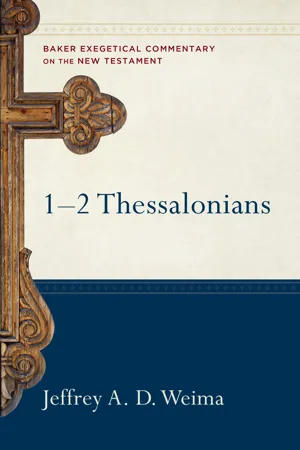
In this addition to the critically acclaimed BECNT series, respected New Testament scholar Jeffrey Weima offers pastors, students, and teachers the most up-to-date and substantive commentary available on 1-2 Thessalonians.
Weima, a Thessalonians expert, experienced teacher, and widely traveled speaker, presents well-informed evangelical scholarship at an accessible level to help readers understand the sociological, historical, and theological aspects of these letters.
As with all BECNT volumes, this informative, balanced commentary features:
● Detailed interaction with the Greek text
● Extensive research
● Chapter-by-chapter exegesis
● A blend of scholarly depth and readability
● An acclaimed, user-friendly design
The BECNT series aims for academic sophistication with pastoral sensitivity and accessibility, making it a useful tool for pastors, church leaders, students, and teachers.
eBook - ePub
1-2 Thessalonians (Baker Exegetical Commentary on the New Testament)
- 736 pages
- English
- ePUB (mobile friendly)
- Available on iOS & Android
eBook - ePub
1-2 Thessalonians (Baker Exegetical Commentary on the New Testament)
About this book
Information
Topic
Theology & ReligionSubtopic
Biblical CommentaryIntroduction to 1–2 Thessalonians
The City of Thessalonica
A Strategic Location
If the three most important factors affecting the value of real estate are “location, location, location,” then Thessalonica was destined to be a prosperous and leading city. Two geographical factors resulted in Thessalonica becoming what its first-century BC native poet Antipater called “the mother of all Macedonia” (Anth. Pal. 4.428) and what a local inscription identified as “the metropolis [“mother city”], first of Macedonia” (CIG 1.1969). That these descriptions were not merely the exaggerated claim of overly proud native citizens is confirmed by Strabo, the historian and geographer (64 BC–ca. AD 24), who similarly referred to Thessalonica as the “metropolis of Macedonia” (Geogr. 7 frg. 21).
The first of these two geographical advantages involved the city’s access to the sea: Thessalonica enjoyed a natural harbor that was perhaps the best in the entire Aegean Sea. This factor led to the creation of the city by Cassander, the king of Macedonia, in 316–315 BC. The capital city of his father-in-law, Philip II, the father of Alexander the Great, was located in nearby Pella: though situated inland, it had access to the Aegean Sea by means of the Loudias River. This river, however, suffered heavy silting, thereby forcing Cassander to establish a new port and town to serve as the center of his reign over the region of Macedonia. The king forcibly joined together the populations of twenty-six villages in the area and situated them on the existing town of Therme, naming the new city Thessalonica, after his wife1 (Strabo, Geogr. 7 frgs. 21, 24; Dionysius of Halicarnassus, Rom. Ant. 1.49.4). This location on the most innermost part of the Thermaic Gulf was chosen because of the site’s deep anchorage and excellent protection from dangerous southeast winds.2 The advantages of this favorably situated harbor were noted by ancient authors (Herodotus 7.121; Livy 44.10), and the port of Thessalonica continues to be a busy and profitable one still today. Vacalopoulos (1972: 3) reports: “Thessaloniki is the only sea-board city of contemporary Greece that has never, from its foundation (316 BC) till today, lost its commercial importance.”
The second of the geographical advantages benefiting Thessalonica involves the city’s access to major land travel routes. The city was situated on or near3 the Via Egnatia—the major east-west highway built by the Romans in the second century BC. This highway connected Thessalonica with the other major cities not only in Macedonia but also far beyond. Going west on this route some 260 miles from Thessalonica would bring one to the port of Dyrrachium on the Adriatic Sea, which could then be crossed by boat to the shore of Italy, where the Via Appia would lead directly into Rome. Going east on this route some 430 miles from Thessalonica would bring one to Byzantium, on the edge of the Black Sea, or even earlier to the Hellespont, which would allow access into Asia Minor. Thessalonica also was located on the intersection of the Via Egnatia with the major road north along the Axius River through the Balkans to the Danube region.
The benefits of Thessalonica’s location with respect to both sea and land were key factors ensuring the prosperity and numerical growth of the city. As Green (2002: 6) observes: “The great success of Thessalonica was due in grand part to the union of land and sea, road and port, which facilitated commerce between Macedonia and the entire Roman Empire. No other place in all Macedonia offered the strategic advantages of Thessalonica.” Additional geographical factors ensuring the success of the city were its favorable climate conditions, fertile plains nourished by abundant rivers, rich mineral deposits (gold, silver, iron, copper, lead), and vast forests to provide timber for building. Fearing a Macedonian revival (Livy 45.29), the Romans under General Aemilius Paullus imposed restrictions on the Thessalonians and others in Macedonia over the use of these natural resources after his victory at Pydna in 168 BC. This and the 300 million sesterces that this victory brought into the Roman treasury (Pliny the Elder [Nat. 33.17; Livy 45.40.1] gives the amount as 120 million sesterces) suggest the wealth that the region around Thessalonica could potentially produce. These geographical advantages were not lost on writers in the ancient world, as evidenced by the succinct comment of Miletius: “So long as nature does not change, Thessalonica will remain wealthy and fortunate” (cited by Lightfoot 1893: 255).
The city’s prosperity not surprisingly attracted new inhabitants: in the years just before Paul’s arrival, Thessalonica was “more populous than any of the rest” of the Macedonian cities (Strabo, Geogr. 7.7.4; see also Lucian, Ass 46.5, who, in the second century AD, refers to Thessalonica as “the largest city in Macedonia”). The exact size of the city’s population is difficult to determine with certainty. If one uses the length of the city walls to determine the total living area and factors in the typical rates of population density for ancient cities, the population of Thessalonica can be calculated to have been from 65,000 to 100,000 people (J. Hill 1990: 45–49; Riesner 1998: 314). This would rank Thessalonica among the top ten largest cities in the Roman Empire.4
A Favored Political Status
Thessalonica enjoyed a favored relationship with Rome—a relationship that it deliberately fostered in the hopes of political and financial gain. After the fall of Macedonia as an independent kingdom in the battle at Pydna in 168 BC, the victorious Romans followed the strategy of divide and conquer, splitting the region into four “districts” (μερίδες, merides; see Acts 16:12), with Thessalonica as the capital of the second district (Livy 44.32; 45.29.9; Diodorus Siculus 31.8.6–9; Strabo, Geogr. 7 frg. 47). The following years of Roman rule witnessed sporadic rebellions, finally suppressed in 146 BC, at which time the Romans expanded the boundaries of the region and reorganized Macedonia as a province, with Thessalonica alone elevated to the privileged status of capital city and as the home base of Rome’s representative, the governor.
Rome’s choice of Thessalonica as provincial capital was based not solely on the city’s size and wealth but also on its loyalty to the Roman Empire rather than to local leaders heading up the rebellions. One inscription records how the Thessalonians honor Metellus, the Roman praetor who quelled the insurrection, identifying him as the city’s “savior and benefactor” (IT 134). Several other inscriptions honor “Roman benefactors” (Ῥωμαίοι εὐεργέται, Rhōmaioi euergetai), individuals who financed local cultural institutions (e.g., the gymnasium and its activities), helped protect the city from hostile neighbors and anti-Roman invaders, promoted the interests of Thessalonica in Rome, or provided aid in other ways. These honorific inscriptions reveal that a pro-Roman attitude existed in Thessalonica and that at least some of its leading citizens were willing not merely to endure but also eagerly to embrace Roman rule in order to enjoy more fully the benefits that this relationship brought (see esp. Hendrix 1984; also Green 2002: 16–17). This positive view of Rome was enhanced by Thessalonica’s need for the empire’s help in fending off the frequent raids by the barbarian tribes in northern Macedonia (Papagiannopoulos 1982: 36). Thus Cicero, the famous Roman statesman who spent six months in Thessalonica in exile in 58 BC, referred to Macedonia as “a loyal province, friend to the Roman people” (Font. 44).
The close relationship between Thessalonica and Rome can also be seen in the key role that the city played in the empire’s civil wars, even though all too often this role involved initially backing the losing side. The city supported Pompey in his quest for power against Julius Caesar. Before his inglorious defeat at Pharsalus in 48 BC, Pompey prepared for battle by gathering in Thessalonica with the two consuls and over two hundred senators, turning the city into a kind of second Rome, where the “true” Senate was now held (Dio Cassius 41.18.4–6; 41.43.1–5). Some six years later Thessalonica was again at the center of the Roman internal wars, when the armies of Brutus and Cassius, the two leaders responsible for the assassination of Julius Caesar, faced off in battle on the plains of nearby Philippi against the armies of Marc Antony and Octavian (who later became Caesar Augustus), the two avengers of Caesar’s murder. Thessalonica initially supported Brutus and Cassius but, between the two battles on the Philippian plains, switched their allegiance to Marc Antony and Octavian, causing Brutus to promise his soldiers the right to plunder Thessalonica following their anticipated victory (Appian, Civil Wars 4.118; Plutarch, Brutus 46.1). Fortunately for Thessalonica, that victory never came: both Brutus and Cassius went down to defeat at the hands of Marc Antony and, to a lesser extent, Octavian. A triumphal arch celebrating the two victors was built at the Vardar Gate, one of the major gates of the city wall, and commemorative medals were circulated with the inscription “for the freedom of the people of Thessaloniki” (Papagiannopoulos 1982: 39). A coin series was produced, presenting on one side a veiled female head with the inscription ΟΜΟΝΙΑ (concord, harmony, like-mindedness) and on the other side a galloping free horse with the inscription ΘΕΣΣΑΛΟΝ[ΙΚΗΣ]/ΡΩΜ[ΗΣ] (Thessalonica/Rome), thereby celebrating how the victory of Antony and Octavian had restored concord between the two cities (Hendrix 1984: 162–65).
The city and the province came under the control of Marc Antony, who in 42 BC rewarded its citizens for their support by granting Thessalonica the status of a “free city” (civitas libera; Pliny the Elder, Nat. 4.17 [10]).5 This favored classification meant that the inhabitants enjoyed a measure of autonomy over local affairs, the right to mint their own coins, freedom from military occupation within the city walls, and certain tax concessions. Hendrix (1984: 251) notes that this privileged status was “granted only to people and cities which had displayed remarkable loyalty to the interests of the Roman people.” Nine years later the city found itself again backing the losing side in Rome’s internal wars as Marc Antony fell at the hands of Octavian in the battle at Actium in 31 BC. Nevertheless, the city quickly either erased the name of Antony from inscriptions honoring the defeated general (a standard way of effecting damnatio memoriae—erasing the memory of someone formally esteemed who was now dishonored) or replaced his name with Octavian (IT 6, 83, 109), thereby ensuring good relations with Rome and maintaining their favored status as a free city.
During this time period the city’s intimate relationship with Rome was fostered further with the establishment of a new cult of Roma and the Roman benefactors (Edson [1940: 133] dates its founding to 41 BC, while Hendrix [1987: 22] dates this new cult to 95 BC or earlier). Several inscriptions are addressed to “the gods and the Roman benefactors” (IT 4), “the priest of the gods . . . and of the priest of Roma and the Roman benefactors” (IT 133, 226), “of both Roma and the Roman benefactors” (IT 128), and “Roma and Romans” (IT 32). Once the cult to honor the goddess Roma and the Roman benefactors was established, it was natural to extend such honors to the most powerful and most important Roman benefactor, the emperor. A temple in honor of Caesar was built near the end of the first century BC, and a priesthood to service this temple was established: an important inscription refers to “the temple of Caesar” and to a person with the title “priest and agōnothetēs [games superintendent] of the Imperator Caesar Augustus son [of god]” as well as to the “priest of the gods . . . and priest of Roma and the Roman benefactors” (IT 31). This inscription, along with others (IT 32, 132, 133), also suggests the preeminence of officials connected with the imperial cult over other priesthoods.6
Further evidence of Thessalonica’s aggressive pursuit of fostering good relations with Rome lies in a recent rediscovery of an archaic temple that the city had moved from its original location and reassembled in the most important location in town, where all the key sanctuaries were situated, including the Serapeion. The temple was first discovered in 1936 during the erection of a two-story building in the heart of the modern city, in Antigonidon Square. However, this finding soon disappeared due to the invasion and destruction of the Nazi occupation and the subsequent postwar urban development. The temple was rediscovered in 2000 when the two-story building located on top of it was demolished as part of a redevelopment project. It then became clear that this archaic temple dates back to the late sixth century BC but had been rebuilt as an Ionic-style temple on top of a Roman base. A statue of the goddess Roma and other imperial statues were also discovered here, but nothing dating to the pre-Roman period.7 The presence of architectural marks to ensure the accurate reassembling of the temple confirmed that the temple had originally been built and located somewhere else in the late archaic period and then moved into the heart of Thessalonica during the Roman period. Its original location was likely Aineia (suburb of modern-day Michaniona), located about twelve miles south of Thessalonica, and the temple was dedicated to Aphrodite (Dionysius of Halicarnassus, Rom. Ant. 1.49.4). According to tradition, this goddess of love was the mother of Aeneas, who was the founder not only of Rome but also of the Julian line from whom Julius Caesar descended. It seems likely, then, that the Thessalonians, at great effort and expense, moved a temple that could be linked with Julius Caesar to a prime location in their city and turned it into a temple for imperial worship in order to demonstrate in a dramatic way their allegiance to Caesar’s adoptive son, Octavian (later known as Augustus), even though they had supported Octavian’s rival, Marc Antony, during Rome’s civil war.
Coinage from the city reveals that Julius Caesar and Octavian received divine honors. In one series minted about 27 BC, the laureate head of Julius Caesar appears with the inscription “God.” The reverse side of coins from this series has the image of Octavian, and though they do not have the similar inscription “God” or “son of god,” his divinity is implied by his pairing with the divine Julius and by the title Sebastos or “Augustus” often found. A statue of Augustus discovered in Thessalonica depicts the emperor in a divine posture.8 In contrast to the Prima Porta exemplar where Augustus is in full military garb, the Thessalonian statue of him omits these symbols of power and instead conveys the emperor as a man not of war but of peace.
The good relations that existed between Macedonia, including its leading city of Thessalonica, and Rome can also be seen in the so-called Augustan Settlement of 27 BC, when the emperor regulated the governance of the provinces, classifying them as either senatorial or imperial. Senatorial provinces were those considered to be peaceful and loyal to Rome and so were placed under the control of the Senate, governed by proconsuls (governors) who held office for only a one-year term. Imperial provinces were those typically located on the boundaries of the empire and whose commitment to Rome was considered weak or questionable. They were placed under the direct control of the emperor, who appointed procurators or prefects with military authority to hold office and govern these areas as long as the emperor desired. That Augustus designated Macedonia as a senatorial province (Dio Cassius 53.12.4) therefore is significant. It also suggests that the act of the subsequent emperor, Tiberius, in reclassifying Macedonia as an imperial province in AD 15 and placing this region under his direct control (Tacitus, Hist. 1.76.4), would have been viewed with alarm by those in Macedonia and Thessalonica who were concerned with maintaining good relations with Rome. Pro-Roman sensibilities in the region and capital city were encouraged, however, when Claudius i...
Table of contents
- Cover
- Series Page
- Title Page
- Copyright Page
- Dedication
- Contents
- Series Preface
- Author’s Preface
- Abbreviations
- Transliteration
- Map
- Introduction to 1-2 Thessalonians
- 1 Thessalonians
- 2 Thessalonians
- Works Cited
- Index of Subjects
- Index of Authors
- Index of Greek Words
- Index of Scripture and Other Ancient Writings
- Notes
- Back Cover
Trusted by 375,005 students
Access to over 1.5 million titles for a fair monthly price.
Study more efficiently using our study tools.
Frequently asked questions
Yes, you can cancel anytime from the Subscription tab in your account settings on the Perlego website. Your subscription will stay active until the end of your current billing period. Learn how to cancel your subscription
No, books cannot be downloaded as external files, such as PDFs, for use outside of Perlego. However, you can download books within the Perlego app for offline reading on mobile or tablet. Learn how to download books offline
Perlego offers two plans: Essential and Complete
- Essential is ideal for learners and professionals who enjoy exploring a wide range of subjects. Access the Essential Library with 800,000+ trusted titles and best-sellers across business, personal growth, and the humanities. Includes unlimited reading time and Standard Read Aloud voice.
- Complete: Perfect for advanced learners and researchers needing full, unrestricted access. Unlock 1.5M+ books across hundreds of subjects, including academic and specialized titles. The Complete Plan also includes advanced features like Premium Read Aloud and Research Assistant.
We are an online textbook subscription service, where you can get access to an entire online library for less than the price of a single book per month. With over 1.5 million books across 990+ topics, we’ve got you covered! Learn about our mission
Look out for the read-aloud symbol on your next book to see if you can listen to it. The read-aloud tool reads text aloud for you, highlighting the text as it is being read. You can pause it, speed it up and slow it down. Learn more about Read Aloud
Yes! You can use the Perlego app on both iOS and Android devices to read anytime, anywhere — even offline. Perfect for commutes or when you’re on the go.
Please note we cannot support devices running on iOS 13 and Android 7 or earlier. Learn more about using the app
Please note we cannot support devices running on iOS 13 and Android 7 or earlier. Learn more about using the app
Yes, you can access 1-2 Thessalonians (Baker Exegetical Commentary on the New Testament) by Jeffrey A. D. Weima, Yarbrough, Robert W., Stein, Robert, Robert W. Yarbrough,Robert Stein in PDF and/or ePUB format, as well as other popular books in Theology & Religion & Biblical Commentary. We have over 1.5 million books available in our catalogue for you to explore.